
How North America is Building the World's Largest Smart Wildlife Corridors
A quiet infrastructure revolution across the U.S. and Canada is reconnecting fragmented ecosystems, reducing wildlife-vehicle collisions by up to 90%, and saving billions in property damage.
By Factlen Editorial Team
- Conservation Biologists
- Focuses on habitat connectivity and preventing the genetic isolation of vulnerable species.
- Transportation & Safety Officials
- Focuses on the massive economic and human toll of wildlife-vehicle collisions.
- Taxpayer & Driver Advocates
- Focuses on the return on investment, as crossings pay for themselves by reducing property damage.
- Environmental Observers
- Focuses on the global movement, infrastructure challenges, and cross-border policy.
What's not represented
- · Urban Planners
- · Automobile Insurance Companies
Why this matters
By transforming highways from deadly barriers into permeable landscapes, wildlife crossings are simultaneously saving billions of dollars in vehicle damage, preventing hundreds of human fatalities, and rescuing isolated animal populations from local extinction.
Key points
- Motorists in the U.S. collide with large wildlife up to two million times annually, costing $10 billion.
- Over 1,000 dedicated wildlife crossings are now operational across the United States.
- The Yellowstone to Yukon Initiative has completed 204 crossings, shrinking the gap between isolated grizzly populations.
- Fenced crossing structures reduce wildlife-vehicle collisions by up to 90 percent.
- The federal Infrastructure Investment and Jobs Act allocated $350 million specifically for wildlife crossings.
For decades, the expansion of North America's highway system has created an "infrastructure tsunami," slicing through ancient migration routes and fragmenting ecosystems. The consequences are measured in both ecological decline and human tragedy. In the United States alone, motorists collide with large wildlife between one and two million times each year. These accidents result in roughly 200 human fatalities, 26,000 injuries, and an estimated $8 billion to $10 billion in property damage and medical costs annually.[1][6]
To solve this, civil engineers and wildlife biologists have pioneered a deceptively simple solution: building roads for animals. Wildlife crossings—specially engineered overpasses and underpasses—are transforming how transportation networks interact with nature. What began as a niche experiment in the late 20th century has evolved into a continent-wide infrastructure shift, with over 1,000 dedicated wildlife crossings now operational across the United States and hundreds more in Canada.[6][8]
The crown jewel of this movement is the Yellowstone to Yukon (Y2Y) Conservation Initiative, an ambitious effort to reconnect a 2,100-mile corridor stretching from Wyoming to the Canadian Arctic. Spanning five U.S. states, two Canadian provinces, and dozens of Indigenous territories, the Y2Y region is the largest intact mountain system left on Earth.[4]
Progress within the Y2Y corridor has been staggering. According to the initiative's 2025 impact report, 204 wildlife crossings have been completed across the region. These structures are actively shrinking the isolation of vulnerable species. For example, the geographic gap between isolated grizzly bear populations in the Rockies has been reduced from 150 miles (240 kilometers) down to just 30 miles (50 kilometers), allowing previously separated groups to migrate and mate.[3][4]

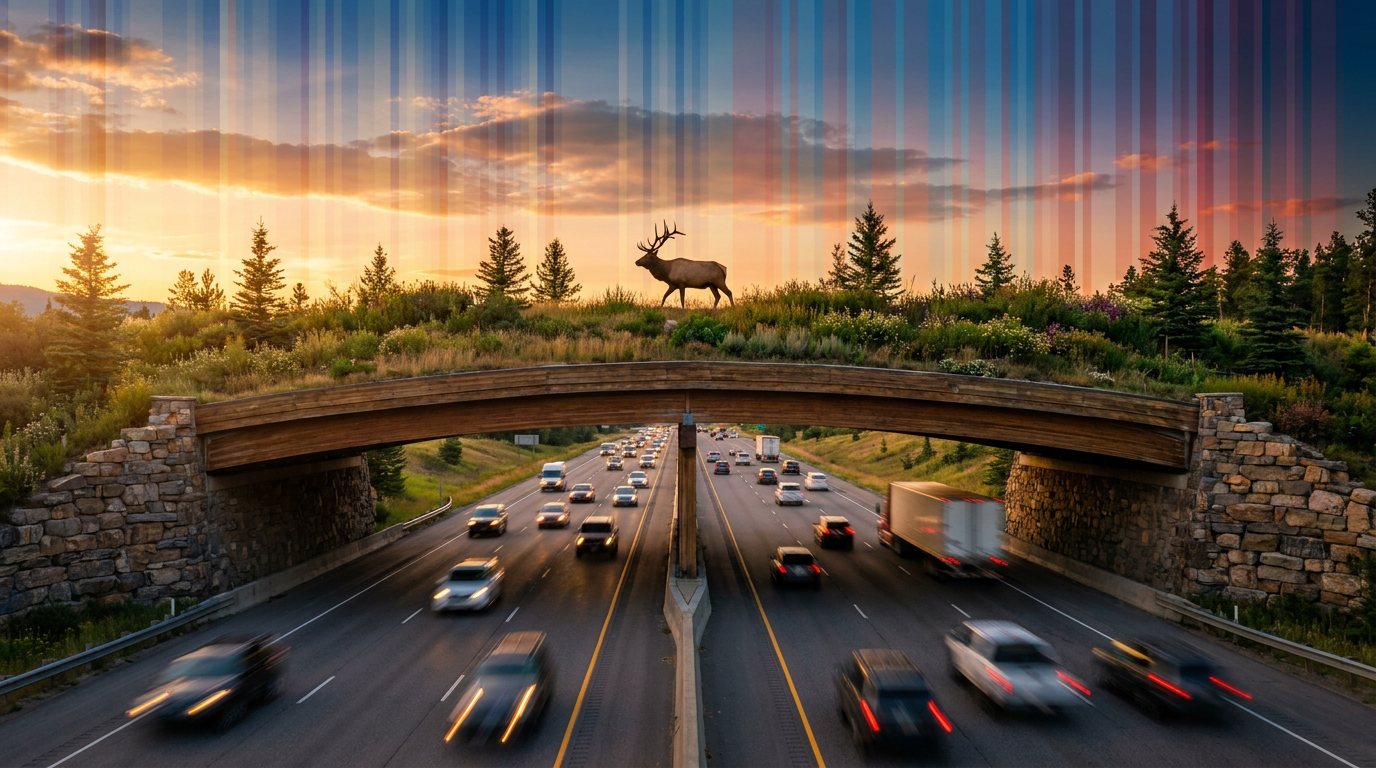
The engineering behind these crossings is highly specialized. The Federal Highway Administration categorizes crossings into 11 distinct design types, tailored to the behavioral psychology of different species. Overpasses are typically wide, open, and landscaped with native soil, grasses, and trees. This design caters to prey species like elk, moose, and grizzly bears, which require a clear line of sight to feel secure against ambush predators.[5]
Conversely, underpasses are designed to be lower and darker, providing the concealed environment preferred by ambush predators like cougars and black bears. The infrastructure even scales down to the micro-level: specialized bottomless culverts and amphibian tunnels have been installed in states like California and Massachusetts to provide safe passage for migrating toads and salamanders.[5][7]
However, the secret ingredient to a successful wildlife crossing is not the bridge itself, but the fencing. Miles of high-tensile wildlife fencing run along both sides of the highway, acting as a funnel. Without fencing to physically block access to the pavement and guide animals toward the engineered structures, the crossings are largely ignored.[1][4]
However, the secret ingredient to a successful wildlife crossing is not the bridge itself, but the fencing.
When properly implemented, the evidence of success is overwhelming. In Canada's Banff National Park, which hosts the world's longest-running wildlife crossing research program, camera traps have documented more than 250,000 safe crossings. Along an 82-kilometer stretch of the Trans-Canada Highway, the combination of fencing and 44 crossing structures has reduced wildlife-vehicle collisions by more than 80 percent overall, and by 96 percent for elk and deer.[4]

The United States is rapidly scaling up its own mega-structures. In late 2025, the Colorado Department of Transportation opened the Greenland overpass spanning Interstate 25 south of Castle Rock. Measuring 200 feet wide, it is currently the largest wildlife bridge in North America. Combined with five nearby underpasses and extensive fencing, the project has already reduced wildlife collisions in the notoriously dangerous corridor by 91 percent.[2]
An even larger project is slated to open in late 2026: the Wallis Annenberg Wildlife Crossing in Southern California. Arching over 10 lanes of the heavily trafficked 101 Freeway near Los Angeles, the massive landscaped bridge is designed to save the region's genetically isolated mountain lion population from local extinction.[1][7]

This infrastructure boom is driven by a leap in tracking technology. Wildlife biologists now use lightweight GPS collars to monitor herd migrations in real-time, overlaying animal movement data with highway collision hot-spots. This precision allows state transportation departments to place multi-million-dollar structures exactly where animals naturally want to cross, guaranteeing high utilization rates.[6]
The movement has garnered rare unanimous bipartisan support, largely due to its undeniable economic logic. While structures like Colorado's Greenland overpass cost $15 million to build, the reduction in vehicular damage, hospital bills, and emergency response costs means the bridges effectively pay for themselves within a decade. Recognizing this, the federal Infrastructure Investment and Jobs Act (IIJA) allocated $350 million specifically for wildlife crossings.[2][6]

Despite these triumphs, the push for connectivity faces significant hurdles. The "infrastructure tsunami" of new housing developments, industrial logging, and road expansions continues to outpace conservation efforts in many regions. Crossings can safely route animals over a highway, but they cannot protect the habitat on either side of the bridge from being paved over.[1]
Furthermore, cross-border conservation is vulnerable to political headwinds. More than 500 migratory species regularly cross the U.S.-Canada border, requiring synchronized policy and funding. Recent proposals for budget cuts in cross-border environmental programs have alarmed conservationists, who warn that full continental connectivity requires sustained, rigorous investment from both nations.[3]
Ultimately, the proliferation of wildlife crossings represents a profound shift in how modern societies view their relationship with the natural world. By transitioning from barriers to bridges, North America is proving that human infrastructure and ancient ecological rhythms can successfully coexist.[8]
How we got here
Late 1960s
The first rudimentary wildlife underpasses are built in the U.S. to help mule deer cross interstate highways in the West.
1993
The Yellowstone to Yukon (Y2Y) Conservation Initiative is founded with a vision to connect a 2,100-mile mountain corridor.
2021
The U.S. Infrastructure Investment and Jobs Act is passed, allocating a historic $350 million specifically for wildlife crossings.
Late 2025
Colorado opens the 200-foot-wide Greenland overpass over Interstate 25, currently the largest in North America.
Late 2026
The Wallis Annenberg Wildlife Crossing is scheduled to open over a 10-lane freeway in Los Angeles.
Viewpoints in depth
Conservation Biologists
Focuses on habitat connectivity and preventing the genetic isolation of vulnerable species.
For wildlife biologists, the primary value of these crossings is genetic. When highways slice through a landscape, they trap animal populations in artificially small territories. Over time, this isolation leads to inbreeding, disease vulnerability, and local extinction. Biologists view crossings not just as safety features, but as vital genetic lifelines that allow separated populations—like the Rocky Mountain grizzly bears—to mix, mate, and maintain healthy biodiversity.
Transportation & Safety Officials
Focuses on the massive economic and human toll of wildlife-vehicle collisions.
From the perspective of civil engineers and highway patrols, wildlife crossings are critical public safety infrastructure. With up to two million wildlife collisions occurring annually in the U.S., the resulting $10 billion in property damage, medical bills, and emergency response costs is a massive drain on the economy. Safety officials argue that while a $15 million overpass seems expensive upfront, the dramatic 90% reduction in crashes means the structures rapidly pay for themselves in saved lives and avoided damages.
Indigenous Land Guardians
Focuses on traditional stewardship and the protection of ancient migration routes.
Indigenous communities, such as the Kaska Dena in northern British Columbia, view the reconnection of these landscapes as an extension of their traditional stewardship. For millennia, these communities have relied on the natural migration patterns of caribou, moose, and elk. Indigenous land guardians advocate for wildlife corridors as a way to heal the land from industrial fragmentation, ensuring that both the wildlife and the cultural practices that depend on them can survive for future generations.
What we don't know
- Whether future federal and state funding will keep pace with the rapid expansion of new housing and highway developments.
- How shifting climate patterns will alter ancient migration routes, potentially rendering some existing crossings obsolete.
- If the U.S. and Canada can maintain synchronized funding for transboundary corridors amid shifting political priorities.
Key terms
- Wildlife Corridor
- A strip of natural habitat connecting populations of wildlife otherwise separated by human activities or structures.
- Infrastructure Tsunami
- A term used by ecologists to describe the rapid, large-scale expansion of roads, dams, and developments that fragment natural ecosystems.
- Genetic Isolation
- A scenario where a population of animals is cut off from others of its species, leading to inbreeding and a higher risk of local extinction.
- Camera Trap
- A remotely activated camera equipped with a motion sensor, used by researchers to capture images of wild animals using the crossings.
Frequently asked
Do animals actually know how to use the bridges?
Yes. Research shows animals quickly learn to use the structures. Elk often adapt immediately, while more cautious species like grizzly bears may take a few years to feel comfortable.
How much does a wildlife overpass cost?
Costs vary widely by size and location, but major highway overpasses typically cost between $10 million and $20 million. However, they often pay for themselves within a decade by preventing costly accidents.
Why do some animals get underpasses instead of overpasses?
Different species have different psychological needs. Prey animals like elk prefer wide, open overpasses with clear sightlines, while ambush predators like cougars prefer the enclosed cover of an underpass.
What keeps the animals from just walking on the highway?
Fencing. Miles of high-tensile wildlife fencing run alongside the highway, funneling the animals directly toward the safe crossing structures.
Sources
Source coverage
8 outlets
4 viewpoints surfaced








[1]MongabayEnvironmental Observers
The long and winding road to safe highways: Inside the global movement to reconnect habitat
Read on Mongabay →[2]CBS ColoradoTaxpayer & Driver Advocates
Largest wildlife overpass in North America opens in Colorado: 'It's a win-win'
Read on CBS Colorado →[3]The Globe and MailEnvironmental Observers
Cross-border wildlife conservation between the U.S. and Canada is weakening
Read on The Globe and Mail →[4]Yellowstone to Yukon Conservation InitiativeConservation Biologists
One big tent: Y2Y's 2025 impact report is here
Read on Yellowstone to Yukon Conservation Initiative →[5]Federal Highway AdministrationTransportation & Safety Officials
WILDLIFE CROSSING STRUCTURE HANDBOOK: Design and Evaluation in North America
Read on Federal Highway Administration →[6]National Conference of State LegislaturesTransportation & Safety Officials
Wildlife Migration Corridors
Read on National Conference of State Legislatures →[7]Center for Large Landscape ConservationConservation Biologists
WILDLIFE CROSSING SUCCESS STORIES IN THE WESTERN STATES
Read on Center for Large Landscape Conservation →[8]Factlen Editorial TeamEnvironmental Observers
Synthesis by Factlen editorial team
Read on Factlen Editorial Team →
Every angle. Every day.
Get world stories with full source coverage and perspective breakdowns delivered to your inbox.