
How Next-Generation Geothermal Is Unlocking 24/7 Clean Energy
By borrowing advanced drilling techniques from the oil and gas industry, Enhanced Geothermal Systems (EGS) are creating artificial underground reservoirs to provide firm, carbon-free baseload power anywhere on the planet.
By Factlen Editorial Team
- Geothermal Innovators
- Argue that applying oil and gas drilling techniques to geothermal unlocks a virtually limitless, scalable source of clean baseload power.
- Grid Operators & Utilities
- Value EGS for its reliability and ability to stabilize the grid, filling the gaps left by intermittent wind and solar without relying on fossil fuels.
- Tech Industry Offtakers
- View next-gen geothermal as the critical missing piece to achieve true 24/7 carbon-free energy for energy-intensive AI and cloud computing infrastructure.
- Subsurface Researchers
- Focus on the physics and safety of the technology, emphasizing the need for rigorous seismic monitoring and open-source data to ensure long-term reservoir viability.
What's not represented
- · Local communities hosting EGS drilling sites
- · Fossil fuel workers transitioning to the geothermal sector
Why this matters
As AI data centers and widespread electrification push the electrical grid to its limits, wind and solar are not enough because they depend on the weather. Enhanced Geothermal Systems provide firm, always-on clean power that can be deployed almost anywhere, potentially solving the grid's biggest vulnerability.
Key points
- Enhanced Geothermal Systems (EGS) create artificial underground reservoirs to generate clean power anywhere there is hot rock.
- The technology borrows horizontal drilling and hydraulic stimulation techniques from the shale oil and gas industry.
- Recent breakthroughs have slashed drilling times by up to 70%, dramatically improving the economic viability of EGS.
- Tech giants are funding early commercial EGS projects to secure 24/7 carbon-free baseload power for AI data centers.
- The U.S. Department of Energy's Utah FORGE site is providing open-source data to de-risk the technology for the entire industry.
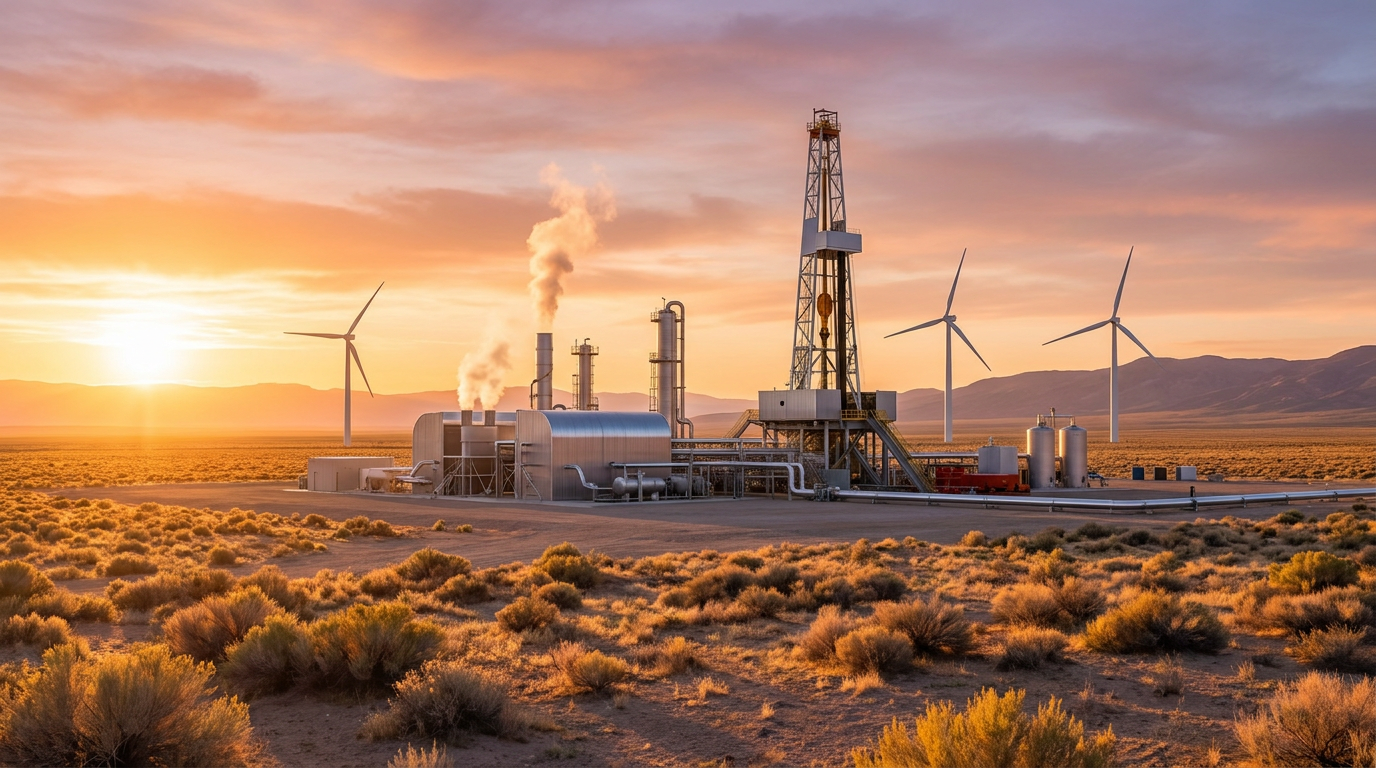
The global transition to clean energy has a massive, looming blind spot: what happens when the sun sets and the wind stops blowing. As artificial intelligence data centers, manufacturing reshoring, and widespread electrification push the electrical grid to its limits, the demand for "baseload" power—energy that flows 24 hours a day, 365 days a year—has never been higher. Historically, that constant hum of electricity was provided almost exclusively by coal, natural gas, or nuclear plants. But a quiet revolution happening deep underground is poised to change the math entirely. Next-generation geothermal energy, specifically Enhanced Geothermal Systems (EGS), is unlocking the ability to generate firm, carbon-free power almost anywhere on the planet.[4][7]
Traditional geothermal power is a proven, reliable technology, but it has always been constrained by geography. To build a conventional hydrothermal plant, developers need a rare geological trifecta: subterranean heat, naturally occurring fluid, and permeable rock that allows that fluid to flow. Because of these strict requirements, conventional geothermal has largely been limited to tectonically active regions like Iceland, Kenya, and the western United States. As a result, it currently provides less than half of one percent of the world's electricity.[3][5]
Enhanced Geothermal Systems remove the geographic lottery from the equation. Instead of hunting for naturally occurring underground reservoirs, EGS engineers build their own. By drilling deep into hot, dry, crystalline rock—often thousands of feet below the surface where temperatures exceed 300 degrees Fahrenheit—developers can create artificial permeability. They inject fluid under carefully controlled high pressure to open existing, microscopic fractures in the rock, creating a sprawling subterranean radiator.[1][7]

Once this artificial fracture network is established, the system operates in a closed, continuous loop. Cold water is pumped down an injection well, where it seeps through the newly opened cracks in the hot rock, absorbing massive amounts of thermal energy. The superheated fluid is then drawn up through a second "production" well to the surface. There, the heat is transferred to a secondary fluid that flashes to vapor, spinning a turbine to generate electricity before the cooled water is injected back into the earth to start the cycle again.[1][8]
The breakthrough making this possible relies on a profound irony: the clean energy transition is borrowing its most critical tools from the fossil fuel industry. EGS relies heavily on horizontal drilling and hydraulic stimulation—the exact same technologies that sparked the shale oil and gas boom. By turning the drill bit horizontally once it reaches the target depth, engineers can expose thousands of feet of wellbore to the hot rock, dramatically increasing the surface area for heat exchange compared to traditional vertical wells.[4][8]
The breakthrough making this possible relies on a profound irony: the clean energy transition is borrowing its most critical tools from the fossil fuel industry.
For years, EGS was viewed as a promising but commercially unproven theory. That changed with Fervo Energy, a Houston-based startup that recently moved the technology from pilot scale to commercial reality. Fervo's initial "Project Red" in Nevada successfully demonstrated that a paired horizontal well system could operate continuously and deliver power to the grid. Now, the company is scaling up massively with Cape Station, a 400-megawatt project in Beaver County, Utah, backed by a recent $421 million financing round.[2][8]
The economics of geothermal have historically been hampered by the sheer cost and time of drilling through hard granite. But the learning curve is accelerating rapidly. At the U.S. Department of Energy’s Utah FORGE (Frontier Observatory for Research in Geothermal Energy) site—a flagship research facility located near Fervo’s commercial project—engineers have demonstrated a staggering seven-fold decrease in drilling time. What used to take 440 hours to drill through 6,000 feet of hard rock has been slashed to just 60 hours using advanced polycrystalline diamond compact bits.[6]

This rapid reduction in drilling time fundamentally alters the financial viability of EGS. According to a 2025 review paper by researchers at Stanford University, faster drilling rates and optimized well designs could make enhanced geothermal systems cost-competitive with average U.S. electricity prices by 2027, hitting approximately $80 per megawatt-hour. The Stanford researchers estimate that in California alone, EGS could increase geothermal capacity tenfold by 2045, effectively replacing fossil fuels for the state's baseload power needs.[3]
The tech industry has become the crucial catalyst for this geothermal renaissance. Hyperscalers like Google and Microsoft, desperate for 24/7 carbon-free energy to power their increasingly energy-dense AI data centers, have stepped in as early buyers. Google partnered with Fervo in 2021 to fund early pilot projects, and by 2025, tech companies and utilities alike were signing massive Power Purchase Agreements (PPAs) for EGS output, providing the bankability needed for large-scale infrastructure loans.[2][8]

Despite the immense promise, engineering the subsurface is not without risks, primarily the potential for induced seismicity. Because EGS involves injecting fluid under pressure to open rock fractures, it creates microseismic events. To manage this, researchers from Lawrence Berkeley National Laboratory recently deployed custom seismometers nearly 7,000 feet underground at the Cape Station site. Monitoring the rock for seven continuous months at 338°F, the team is gathering unprecedented data to ensure that fracture creation remains safe, predictable, and far below the threshold of being felt at the surface.[5]
The U.S. Department of Energy is doubling down on the technology's potential, recently extending the Utah FORGE project through 2028 with an additional $80 million in funding. The open-access data generated at FORGE is shared across the industry, de-risking the subsurface engineering for startups and legacy energy companies alike. By proving that water can be consistently pumped through engineered pathways in hot granite to extract heat, FORGE is laying the groundwork for a standardized, repeatable EGS deployment model.[6]
As the technology matures, the geographic map of clean energy will be redrawn. While wind and solar will remain the cheapest sources of raw kilowatt-hours, they require vast amounts of land and expensive battery storage to manage their intermittency. Enhanced Geothermal Systems offer a dense, firm, and weather-independent alternative that can be deployed near existing grid infrastructure or industrial hubs, transforming the heat beneath our feet into the ultimate anchor for a decarbonized world.[4][7][9]
How we got here
2021
Google and Fervo Energy partner to fund early EGS pilot projects for data center power.
2023
Fervo's Project Red in Nevada successfully demonstrates commercial-scale EGS viability, delivering continuous power to the grid.
April 2024
The DOE's Utah FORGE project completes crucial circulation tests, proving heat extraction in engineered hot granite.
March 2026
Fervo Energy secures $421 million to scale the 400 MW Cape Station project in Utah.
June 2026
Industry data confirms EGS drilling times have dropped by 70%, dramatically improving the economic outlook for baseload geothermal.
Viewpoints in depth
Geothermal Innovators
Argue that applying oil and gas drilling techniques to geothermal unlocks a virtually limitless, scalable source of clean baseload power.
For geothermal developers, the transition from traditional hydrothermal to Enhanced Geothermal Systems represents a paradigm shift. By utilizing horizontal drilling and hydraulic stimulation—tools perfected over decades by the fossil fuel industry—innovators argue they have solved geothermal's geographic limitations. Companies like Fervo Energy point to their rapidly decreasing drilling times and successful pilot projects as proof that EGS is no longer a science experiment, but a commercially ready technology capable of providing the firm, 24/7 clean energy that intermittent renewables cannot supply.
Grid Operators & Utilities
Value EGS for its reliability and ability to stabilize the grid, filling the gaps left by intermittent wind and solar without relying on fossil fuels.
Utilities and grid managers view the rise of EGS as a critical lifeline for grid stability. As states mandate higher percentages of renewable energy, grid operators face the daunting challenge of managing the intermittency of wind and solar power. While battery storage can help smooth out daily fluctuations, it is currently too expensive for long-duration backup. Grid operators see next-generation geothermal as the ideal baseload replacement for retiring coal and natural gas plants, offering a weather-independent power source that can anchor the grid during extreme weather events or prolonged periods of low renewable generation.
Subsurface Researchers
Focus on the physics and safety of the technology, emphasizing the need for rigorous seismic monitoring and open-source data to ensure long-term reservoir viability.
Academic and government researchers, such as those at Stanford University and the Lawrence Berkeley National Laboratory, are highly optimistic about EGS but stress the importance of rigorous scientific oversight. Their primary focus is on understanding the complex thermodynamics of engineered reservoirs and mitigating the risks of induced seismicity. Researchers advocate for continuous, deep-subsurface monitoring to ensure that the hydraulic stimulation process remains safe and that the artificial fracture networks do not degrade over time. They emphasize that open-source data sharing, like the models produced at the DOE's Utah FORGE site, is essential to de-risking the technology for widespread commercial deployment.
What we don't know
- Whether the artificial fracture networks will maintain their thermal output and permeability over multi-decade lifespans.
- How quickly the regulatory and permitting processes for EGS drilling on federal lands can be streamlined to allow for rapid scale-up.
- The exact timeline for when EGS will achieve full price parity with legacy natural gas plants across all U.S. markets.
Key terms
- Enhanced Geothermal Systems (EGS)
- A next-generation technology that creates artificial underground reservoirs in hot, dry rock to generate geothermal energy in areas without natural hot springs.
- Baseload Power
- The minimum amount of electrical power needed to be supplied to the electrical grid at any given time, requiring energy sources that can run 24/7 without interruption.
- Hydraulic Stimulation
- The process of injecting fluid under high pressure into deep rock formations to open existing fractures, allowing water to circulate and absorb heat.
- Hydrothermal System
- A traditional geothermal resource that naturally possesses the three necessary elements for power generation: heat, fluid, and rock permeability.
- Polycrystalline Diamond Compact (PDC) Bit
- An advanced, highly durable drill bit used to cut through hard crystalline rock much faster than legacy drilling equipment.
Frequently asked
What is the difference between EGS and traditional geothermal?
Traditional geothermal requires naturally occurring underground hot water and permeable rock. EGS (Enhanced Geothermal Systems) engineers artificial reservoirs by drilling into hot, dry rock and injecting fluid to create permeability where none existed.
Does Enhanced Geothermal use fracking?
Yes, EGS uses hydraulic stimulation techniques borrowed from the oil and gas industry to open microscopic fractures in deep rock. However, it is used to circulate water for heat extraction, not to extract hydrocarbons.
Can EGS cause earthquakes?
The process of opening rock fractures creates microseismic events. While these are typically far too small to be felt at the surface, developers use deep underground seismometers to monitor the rock and ensure the process remains safe and controlled.
Why are tech companies investing in geothermal?
Tech companies operating massive AI data centers require 24/7 power. Because wind and solar are intermittent, tech firms are funding EGS to secure a constant, weather-independent source of carbon-free electricity.
Sources
Source coverage
9 outlets
4 viewpoints surfaced









[1]U.S. Department of EnergySubsurface Researchers
Enhanced Geothermal Systems: The Next Frontier for Geothermal Energy Deployment
Read on U.S. Department of Energy →[2]Fervo EnergyGeothermal Innovators
Project Red: Validating the Fundamental Physics of EGS Technology at Field Scale
Read on Fervo Energy →[3]Stanford UniversitySubsurface Researchers
Electricity generated using natural underground heat could become cost competitive by 2027
Read on Stanford University →[4]Center for Climate and Energy SolutionsGrid Operators & Utilities
A Closer Look: Drilling Down on Geothermal Baseload Power
Read on Center for Climate and Energy Solutions →[5]Lawrence Berkeley National LaboratorySubsurface Researchers
Scientists Develop New Technology to Continuously Monitor Geothermal Energy Operations
Read on Lawrence Berkeley National Laboratory →[6]Utah FORGESubsurface Researchers
Advancing innovative technologies to unlock Earth's limitless geothermal energy
Read on Utah FORGE →[7]World Resources InstituteGeothermal Innovators
How Do Next-Generation Geothermal Technologies Work?
Read on World Resources Institute →[8]Information Technology and Innovation FoundationGrid Operators & Utilities
EGS in Action: Commercial Scale Geothermal and the Grid
Read on Information Technology and Innovation Foundation →[9]Factlen Editorial Team
Synthesis by Factlen editorial team
Read on Factlen Editorial Team →


Every angle. Every day.
Get guides stories with full source coverage and perspective breakdowns delivered to your inbox.