
How Neuroaesthetics is Rewiring Interior Design for Brain Health
The emerging science of neuroaesthetics is moving from academic laboratories into living rooms, proving that specific interior design choices can measurably lower stress hormones and alter brain waves.
By Factlen Editorial Team
- Academic Researchers
- Focuses on gathering empirical data through fMRI scans and biometrics to prove how spatial dimensions affect neural networks.
- Design Practitioners
- Translates neuroscientific findings into actionable design choices that improve client well-being and differentiate their services.
- Wellness Advocates
- Views the built environment as a crucial, often overlooked pillar of holistic health, mental well-being, and emotional regulation.
- Editorial Synthesis
- Examines the broader societal shift of integrating biological science with everyday living spaces.
What's not represented
- · Real Estate Developers
- · Low-Income Housing Advocates
Why this matters
With humans spending roughly 90% of their time indoors, our built environments act as an invisible interface for our nervous systems. Designing spaces that actively lower cortisol and boost serotonin transforms the home from a mere shelter into a preventative health tool.
Key points
- Neuroaesthetics applies neuroscience to interior design, measuring how spatial environments affect human biology and brain waves.
- Curvilinear furniture and natural fractal patterns have been shown to increase alpha brain waves and reduce the amygdala's threat response.
- Thoughtfully designed spaces can lower the production of stress hormones like cortisol by up to 20 percent.
- Emerging smart home technologies are beginning to integrate biometric feedback to automatically adjust lighting and air quality for optimal cognitive health.
In the first three to four seconds after crossing a threshold, the human brain conducts an invisible, unconscious scan of the room. Before a person consciously registers the color of the walls, the style of the furniture, or the texture of the rug, their nervous system is already making rapid-fire calculations about safety, threat, and comfort. For decades, interior designers relied on intuition and aesthetic training to create spaces that felt welcoming, but modern neuroscience is now mapping exactly why certain environments make us exhale while others leave us on edge. This shift from subjective feeling to objective biology is fundamentally changing how we approach the spaces where we live and work.[1][6]
This intersection of biology and architecture is known as neuroaesthetics. Originally rooted in the study of how the brain processes fine art and music, the discipline has rapidly expanded into the built environment, utilizing functional magnetic resonance imaging (fMRI) and biometric sensors to measure how spatial design alters human physiology. Researchers are discovering that aesthetic choices are not merely decorative afterthoughts; they trigger measurable biological responses, including shifts in heart rate, blood pressure, and neurotransmitter production. By translating these biological markers into design principles, architects and interior designers can craft spaces that actively support cognitive function and emotional regulation.[1][3]
At the forefront of this research is the Penn Center for Neuroaesthetics, where scientists like Dr. Anjan Chatterjee are working to transform architecture from a descriptive practice into an experimental science. By analyzing how the visual brain responds to various architectural interiors, researchers have identified three core psychological dimensions that govern our aesthetic responses: coherence, fascination, and hominess. These dimensions provide a quantifiable framework for understanding why certain rooms feel inherently restorative while others induce a subtle, lingering sense of unease or mental fatigue.[2]

Coherence refers to the brain's ability to easily organize and comprehend a scene, while fascination involves the informational richness that keeps the mind engaged without overwhelming it. Hominess, a dimension uniquely related to architectural interiors, dictates our personal sense of ease and comfort. When a room successfully balances these three elements, it requires significantly less cognitive load to process. This reduction in mental effort allows the nervous system to shift away from a state of subtle alertness and into one of restorative calm, proving that good design is a biological imperative.[2][6]
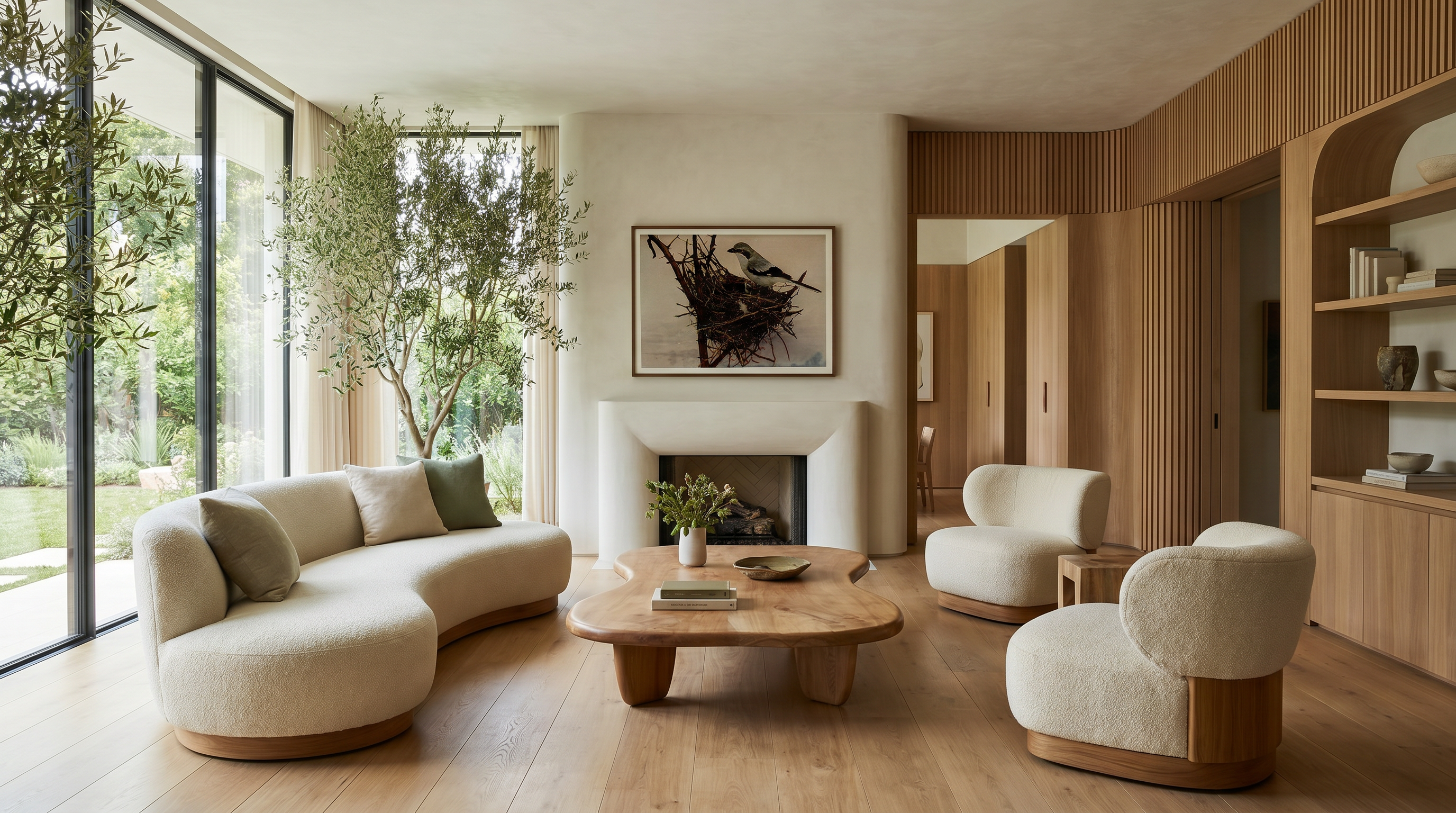
One of the most profound discoveries in neuroarchitecture relates to the geometry of our surroundings. The human brain is evolutionarily wired to constantly scan for environmental threats, and sharp, angular forms can subtly activate the anterior cingulate cortex and the amygdala—the brain regions heavily associated with threat detection and anxiety. Conversely, curvilinear forms, characterized by smooth, flowing lines and rounded edges, evoke deep-seated feelings of safety and comfort. This explains why humans naturally gravitate toward arched doorways, circular tables, and curved sofas when seeking a sanctuary.[3]
This neurological preference for organic curves is deeply tied to biophilic design, a principle that seeks to reconnect built spaces with the natural world. But true biophilia extends far beyond simply placing a potted plant in a brightly lit corner. It involves integrating nature's underlying mathematics and structural logic into the home, most notably through the use of fractals. These complex, repeating patterns bridge the gap between the chaotic outdoors and the structured indoors, providing the brain with the visual nourishment it evolved to process.[1][4]

This neurological preference for organic curves is deeply tied to biophilic design, a principle that seeks to reconnect built spaces with the natural world.
Fractals are naturally occurring, repeating patterns found in tree branches, leaf veins, coastlines, and the intricate grain of natural wood. When the human eye perceives fractal imagery, it triggers a measurable increase in alpha brain waves, which are strongly linked to states of relaxed alertness, creativity, and reduced anxiety. Incorporating these patterns into wallpapers, rugs, or natural wood finishes allows the brain to process the environment fluently, significantly reducing mental fatigue and creating a space that feels inherently restorative without demanding conscious attention.[1][3]
The biological impact of these neuroaesthetic design choices is highly quantifiable and increasingly well-documented. Studies have demonstrated that thoughtfully designed, nature-inspired environments can reduce the production of stress hormones like cortisol by 15 to 20 percent. Furthermore, exposure to spaces optimized for neuroaesthetics has been shown to elevate serotonin levels and decrease both resting heart rate and blood pressure. For individuals spending the vast majority of their lives indoors, these incremental physiological shifts compound over time, offering substantial long-term benefits to cardiovascular and mental health.[1]

Lighting plays an equally critical role in the neuroaesthetic home, acting as the primary synchronizer for the body's internal clock. Beyond basic illumination, light dictates our circadian rhythm. Harsh, artificial lighting with high blue-light content can strain the eyes and keep the nervous system in a state of low-grade stress, suppressing melatonin production. Conversely, dynamic lighting that mimics the natural progression of the sun—bright and cool in the morning, warm and dim in the evening—supports healthy cortisol cycles and ensures the brain receives the correct environmental cues for rest.[4][5]
The tactile landscape of a room also profoundly influences emotional regulation and physiological comfort. While the brain 'feels' primarily through visual input, physical touch remains one of the most powerful senses for grounding the nervous system. Engaging with natural textures like smooth stone, raw wood, or plush, heavy fabrics can actually stimulate the release of oxytocin, the hormone associated with bonding, safety, and trust. In contrast, harsh, synthetic, or overly sterile materials can jar the senses and prevent the body from fully relaxing into a space.[3]
Acoustic comfort serves as another invisible, yet vital, pillar of neuroarchitecture. Unpredictable or harsh background noise is a primary driver of emotional discomfort, elevating cortisol levels and maintaining a heightened state of auditory alertness that drains cognitive reserves. Designers are increasingly utilizing soft furnishings, specialized acoustic panels, and intentional spatial layouts to absorb sound and create dedicated quiet zones. By mitigating unwanted noise, these design choices protect the brain from auditory overstimulation and foster an environment conducive to deep focus and genuine relaxation.[1][5]
As technology advances, the principles of neuroaesthetics are seamlessly merging with home automation to create the 'neuro-centric smart home.' Rather than requiring the user to manually adjust their environment to suit their mood, these sophisticated systems use biometric sensors and artificial intelligence to adapt the space to the occupant's physiological needs in real-time. This creates a dynamic, responsive environment that actively works to maintain the inhabitant's cognitive and emotional equilibrium throughout the day. By anticipating needs before they are consciously felt, the home becomes a proactive partner in health.[6]

In these advanced residential setups, lighting gradually dims and warms in color temperature as evening approaches, preparing the brain for sleep. Simultaneously, air filtration systems automatically respond to microscopic spikes in carbon dioxide to prevent the cognitive fatigue that often accompanies poor indoor air quality. The environment modulates itself to support the user's biological rhythms, rather than forcing the user to adapt to a static, unresponsive space. This synergy between technology and biology represents the next frontier of residential design.[5][6]
Ultimately, the rise of neuroaesthetics represents a fundamental shift in how we view interior design and architecture. It moves the discipline away from fleeting visual trends and purely aesthetic considerations, repositioning it as a vital, evidence-based component of preventative healthcare. By designing for the brain we cannot see, we can transform our homes from mere physical shelters into active participants in our mental and physical well-being, proving that beauty and biology are inextricably linked. As this science becomes more accessible, the standard for a well-designed home will no longer be just how it looks in a photograph, but how it measurably improves the lives of those living inside it.[1][6]
How we got here
1990s
Brain scanning technology advances enough to measure physiological responses to beauty in real-time.
2021
The Penn Center for Neuroaesthetics publishes foundational research identifying coherence, fascination, and hominess as key architectural dimensions.
2024
Commercial spaces increasingly adopt biophilic and neuroaesthetic principles to boost employee productivity and reduce workplace stress.
2026
Neuro-centric smart home technologies begin integrating real-time biometric feedback to automatically adjust residential environments.
Viewpoints in depth
The Scientific Community's View
Focuses on quantifying the biological impact of architectural spaces.
Researchers view neuroaesthetics as the necessary evolution of architecture from a descriptive art into an experimental science. By utilizing functional magnetic resonance imaging (fMRI) and biometric sensors, scientists are mapping exactly how spatial dimensions like coherence and hominess activate specific neural networks. Their goal is to establish a rigorous, evidence-based framework that proves how the built environment directly influences cognitive load, stress hormone production, and overall neurological health.
The Design Industry's View
Focuses on translating neuroscientific data into actionable, aesthetic design choices.
For interior designers and architects, neuroaesthetics provides empirical validation for practices that were previously based on intuition. Practitioners are leveraging this science to demonstrate the tangible return on investment for their clients, proving that thoughtful design is not a luxury but a biological necessity. By intentionally incorporating biophilic elements, curvilinear furniture, and circadian lighting, designers are repositioning their services as a form of preventative healthcare that actively improves daily well-being.
The Smart Home Sector's View
Focuses on creating dynamic, responsive environments through technology.
Technologists and smart home developers see neuroaesthetics as the foundation for the next generation of residential automation. Rather than static rooms, they envision 'neuro-centric' environments where artificial intelligence and biometric sensors work in tandem to adjust lighting, temperature, and acoustics in real-time. This perspective argues that the ultimate neuroaesthetic home is one that continuously adapts to the occupant's physiological state, seamlessly mitigating stress and cognitive fatigue without requiring manual intervention.
What we don't know
- How long-term exposure to highly optimized neuroaesthetic environments affects baseline neurological health over decades.
- The exact degree to which individual neurodivergence alters the brain's response to universally prescribed neuroaesthetic principles.
Key terms
- Neuroaesthetics
- The scientific study of how the brain perceives and responds to beauty, art, and spatial environments.
- Biophilic Design
- An architectural approach that seeks to connect building occupants more closely to nature by incorporating natural lighting, ventilation, and landscape features.
- Fractals
- Complex, naturally occurring patterns that repeat at different scales, such as the branching of trees or the veins in a leaf.
- Alpha Brain Waves
- Neural oscillations associated with a state of wakeful relaxation, creativity, and reduced stress.
- Circadian Rhythm
- The natural, internal process that regulates the sleep-wake cycle and repeats roughly every 24 hours, heavily influenced by light exposure.
- Coherence
- In neuroarchitecture, the degree to which a space is easily organized and comprehended by the brain, reducing cognitive load.
Frequently asked
Do I need to buy new furniture to apply neuroaesthetics?
Not necessarily. Simple changes like maximizing natural light, decluttering to improve visual coherence, and adding natural textures or plants can significantly alter a room's neurological impact.
How do fractals work in interior design?
Fractals can be introduced through natural wood grains, stone veining, or textiles that feature repeating, organic geometric patterns, which the brain processes fluently to reduce mental fatigue.
What is the best lighting for a neuroaesthetic home?
The ideal lighting mimics the natural progression of the sun—bright, cool-toned light during the day to support focus, and warm, dimmable light in the evening to encourage melatonin production.
Can maximalist design still be neuroaesthetic?
Yes, provided it maintains 'coherence.' The brain enjoys visual fascination, so bold colors and patterns work well if they are balanced by underlying order and do not overwhelm the senses with chaotic noise.
Sources
Source coverage
6 outlets
4 viewpoints surfaced






[1]Science in DesignDesign Practitioners
What Happens in Your Body When You See Beauty
Read on Science in Design →[2]Cognitive ProcessingAcademic Researchers
The neuroaesthetics of architectural spaces
Read on Cognitive Processing →[3]Art.artWellness Advocates
Neuroaesthetics: At the Threshold of Consciousness
Read on Art.art →[4]MXD InteriorsDesign Practitioners
The Role of Neuroaesthetics in Commercial Interior Design
Read on MXD Interiors →[5]LodgerinWellness Advocates
Discover how neuroarchitecture and neurodesign influence your mental health
Read on Lodgerin →[6]Factlen Editorial TeamEditorial Synthesis
Synthesis by Factlen editorial team
Read on Factlen Editorial Team →
Every angle. Every day.
Get home stories with full source coverage and perspective breakdowns delivered to your inbox.