
How Markerless Biomechanics and AI Are Extending Elite Athletes' Careers
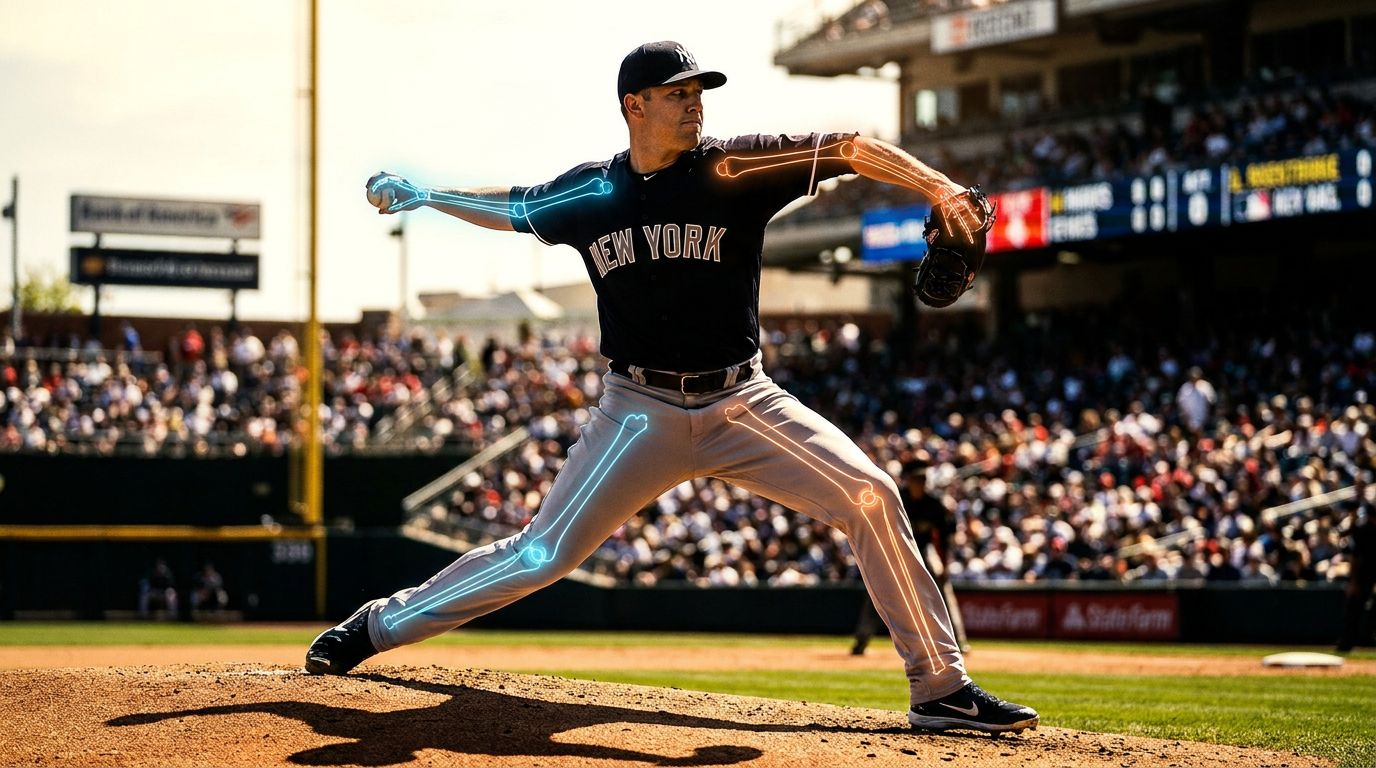
New computer vision systems can now map an athlete's skeleton in real-time during live games, allowing teams to detect microscopic changes in mechanics before a catastrophic injury occurs.
By Factlen Editorial Team
- Sports Science Researchers
- Argue that markerless tracking is a revolutionary step for in-game data, though they emphasize the need for rigorous peer-reviewed validation of AI predictions.
- Team Management & Analytics
- Value the technology as a critical tool for protecting their massive financial investments in player contracts by minimizing days lost to injury.
- Athlete Advocates
- Welcome the health benefits and extended careers but raise ethical questions about who owns predictive health data and how it affects player valuation.
What's not represented
- · Youth sports coaches who lack access to these expensive tools
- · Orthopedic surgeons who treat the injuries after they happen
Why this matters
For decades, sports injuries were treated as inevitable bad luck that cut short promising careers. By shifting from reactive medicine to predictive analytics, athletes can play longer, healthier careers, fundamentally changing how teams manage their rosters and how youth sports might eventually protect developing bodies.
Key points
- Markerless motion capture uses stadium cameras to map an athlete's skeleton in real-time.
- AI models analyze this data to detect microscopic mechanical changes that precede injuries.
- The technology shifts sports medicine from reactive treatments to proactive prevention.
- While highly effective, experts caution that individual anatomical differences make perfect prediction impossible.
- Players unions are increasingly negotiating how this predictive health data can be used in contract talks.
The sudden pop of a ligament. The abrupt end of a season. For over a century, injuries were treated as the unpredictable ghosts haunting professional sports—a matter of bad luck, fatigue, and inevitable wear-and-tear.[1]
Today, that paradigm is fundamentally shifting. The sports world is moving from reactive medicine to predictive analytics, driven by a massive leap in artificial intelligence and computer vision known as markerless motion capture.[2]
Previously, biomechanical analysis was a sterile, cumbersome process. Athletes had to wear dozens of reflective markers or sensor suits and perform their movements in a specialized laboratory, which rarely replicated the adrenaline, speed, and fatigue of a live game.[3]
The new generation of technology eliminates the lab entirely. High-speed, multi-angle camera arrays installed in stadium rafters now capture live game footage at up to 300 frames per second, watching every player on the field simultaneously.[4]

Using advanced computer vision algorithms, these systems map a three-dimensional digital skeleton over the athlete in real-time, tracking the exact position, velocity, and rotation of every major joint without a single physical sensor.[2]
This generates millions of data points per match. For a baseball pitcher, the system calculates the exact torque on the elbow during a fastball; for a basketball player, it measures the impact load on the knees during every single jump and landing.[5]
The true breakthrough, however, lies in what teams do with this spatial data. By feeding it into machine learning models trained on vast historical injury databases, analytics departments are moving from simple observation to active prediction.[1][7]
The true breakthrough, however, lies in what teams do with this spatial data.
These models are designed to spot microscopic deviations in an athlete's "kinetic chain"—the sequence of energy transfer from the legs, through the core, and into the extremities.[6]

When an athlete begins to fatigue, their mechanics subtly change before they consciously feel tired. A pitcher's arm slot might drop by a fraction of an inch, or a soccer player might unconsciously favor their right leg by two percent.[4][5]
The American Sports Medicine Institute has noted that in throwing sports, a mere two-to-three degree change in shoulder external rotation can exponentially increase the risk of a catastrophic Ulnar Collateral Ligament (UCL) tear.[6]
By flagging these minute overcompensations, AI models can warn coaches that a player is entering a high-risk injury window, allowing them to substitute the player or adjust their training load before a ligament actually snaps.[7]

However, the science is not a perfect crystal ball. Biomechanists caution that human tissue is highly variable; a mechanical "flaw" that tears one player's hamstring might be perfectly tolerated by another player's unique anatomy.[3]
Furthermore, peer-reviewed studies emphasize that while markerless tracking is highly valid for broad, explosive movements, it still struggles to capture the minute axial rotations of small joints with the exact precision of traditional lab markers.[3][7]
Despite these limitations, the integration of AI skeletal tracking represents a fundamental evolution in sports science. By making the invisible forces acting on the human body visible, analytics is doing more than optimizing performance—it is actively protecting the athletes and extending their prime years.[1][5]
How we got here
Early 2000s
Biomechanical analysis is strictly confined to indoor labs using physical reflective markers.
2015
Introduction of optical tracking in stadiums primarily for ball and player speed, not skeletal mechanics.
2021
First widespread deployment of markerless, high-framerate skeletal tracking in major professional leagues.
2024
Machine learning models begin actively predicting soft-tissue injuries based on in-game kinetic chain deviations.
2026
Predictive biomechanics becomes a standard front-office tool, sparking new debates over player data rights.
Viewpoints in depth
Sports Biomechanists
Focus on the data validity and the shift from lab to field.
Researchers in sports science view markerless motion capture as the holy grail of biomechanics, as it finally allows them to study athletes in their natural, high-stress environments. However, they remain cautious about the 'black box' nature of some commercial AI models. They stress that while the technology is excellent at tracking broad movements, it still requires rigorous peer-reviewed validation to ensure it accurately captures the minute axial rotations of smaller joints, which are often the true culprits in overuse injuries.
Front Office Executives
Focus on asset protection, ROI, and roster management.
For team management and ownership, predictive biomechanics is fundamentally an insurance policy on their most expensive assets. With hundreds of millions of dollars tied up in guaranteed player contracts, minimizing days lost to injury is a massive competitive and financial advantage. Front offices utilize this data not just to keep their current players healthy, but to evaluate the hidden injury risks of potential draft picks and free agents before signing them.
Players and Union Reps
Focus on career longevity but express concerns over data privacy and contract leverage.
Athletes generally welcome any technology that extends their prime earning years and prevents painful surgeries. However, players' unions are increasingly wary of how predictive health data is weaponized in contract negotiations. If an algorithm flags a player as having a high probability of a future hamstring tear, teams may use that invisible, unproven future injury to drive down the player's market value, prompting calls for strict collective bargaining rules around biometric data ownership.
What we don't know
- Whether predictive models can account for the sheer biological variance in how different athletes tolerate mechanical stress.
- How collective bargaining agreements will ultimately regulate the use of predictive injury data in player contracts.
- When this technology will become cheap and accessible enough for widespread use in youth sports.
Key terms
- Markerless Motion Capture
- A technology that uses standard or high-speed video cameras and computer vision to track human movement without requiring the subject to wear physical sensors or reflective dots.
- Kinetic Chain
- The concept that the human body is a linked system of joints, where energy generated in one area (like the legs) is transferred sequentially to another (like the arm).
- Load Asymmetry
- A biomechanical imbalance where an athlete unconsciously places more physical stress on one side of their body, often a precursor to injury.
- UCL (Ulnar Collateral Ligament)
- A critical ligament in the elbow, frequently torn by baseball pitchers, requiring Tommy John surgery to repair.
Frequently asked
Can AI completely eliminate sports injuries?
No. While AI can predict and prevent overuse and fatigue-related injuries by spotting mechanical flaws, it cannot prevent contact injuries or freak accidents.
How is this different from older motion capture?
Older systems required athletes to wear specialized suits with reflective markers in a laboratory. New systems use stadium cameras to capture natural movement during actual games.
Do players have access to this data?
Yes, in most major leagues, players and their medical teams have full access to their biomechanical data to help tailor their personal training and recovery programs.
Sources
Source coverage
7 outlets
3 viewpoints surfaced







[1]Factlen Editorial TeamAthlete Advocates
Synthesis by Factlen editorial team
Read on Factlen Editorial Team →[2]MIT Technology ReviewTeam Management & Analytics
How computer vision is changing sports biomechanics
Read on MIT Technology Review →[3]Journal of Sports SciencesSports Science Researchers
Validity of markerless motion capture for in-game biomechanical analysis
Read on Journal of Sports Sciences →[4]ESPNTeam Management & Analytics
Inside the stadium camera networks saving pitchers' elbows
Read on ESPN →[5]The AthleticTeam Management & Analytics
The data revolution extending athlete careers across global sports
Read on The Athletic →[6]American Sports Medicine InstituteSports Science Researchers
Data-driven approaches to UCL injury prevention in baseball
Read on American Sports Medicine Institute →[7]Nature Scientific ReportsSports Science Researchers
Machine learning in predicting lower-extremity musculoskeletal injuries
Read on Nature Scientific Reports →

More in sports
See all 13 stories →Olympic Sustainability
How the LA 2028 Olympics Will Run Entirely on Existing Stadiums
0 sources

NBA Finals
New York Knicks Win 2026 NBA Finals, Ending 53-Year Championship Drought
0 sources

NBA Finals
New York Knicks Capture First NBA Championship Since 1973
0 sources

Hockey Strategy
How the PWHL's 'Jailbreak' and 'No Escape' Rules Are Rewriting Hockey Strategy
0 sources

Every angle. Every day.
Get sports stories with full source coverage and perspective breakdowns delivered to your inbox.