
How Japan Plans to Deploy $210 Billion to Dominate Global Anime and Gaming
The Japanese government is launching a centralized agency and a massive public-private investment plan to quadruple the overseas revenue of its pop-culture industries by 2033.

Share this story
Japan has long been recognized as a global cultural superpower, but its government is now officially treating anime, manga, and video games as the ultimate engine of its future economy. In a sweeping strategic shift announced this summer, Tokyo has unveiled a staggering $210 billion (34 trillion yen) public-private investment plan designed to supercharge its content industry on the global stage.
The initiative marks a historic pivot from viewing pop culture merely as a soft-power novelty to treating it as a foundational pillar of national wealth, on par with heavy manufacturing. By mobilizing unprecedented capital, Japan is signaling to the world that its creative sectors are ready for aggressive, state-backed international expansion.[1][3]
The primary goal of this initiative is staggering in its ambition: to grow the overseas revenue of Japanese pop culture from its current $37.6 billion to roughly $130 billion by 2033. To achieve this, the government is abandoning its historically fragmented approach to arts funding.
Instead, it is establishing a centralized, state-backed command center to coordinate international expansion, streamline distribution, and fund large-scale creative projects. This new entity is designed to cut through bureaucratic red tape and provide a unified front for Japanese studios competing in an increasingly crowded global entertainment market.[1][5]
The stakes driving this reorganization are purely economic and highly quantifiable. In 2024, overseas sales of Japanese entertainment reached 6.1 trillion yen, officially surpassing the export value of the country's vaunted semiconductor industry. Lawmakers and economic planners have realized that iconic characters like Pikachu, Luffy, and Mario are no longer just cultural ambassadors; they are critical drivers of Japan's gross domestic product. With traditional manufacturing facing stiff international competition, the creative sector has emerged as a limitless, exportable resource that requires immediate structural support to maximize its profitability.[1][6]
The $210 billion investment is meticulously partitioned across four key sectors to ensure comprehensive growth. Video games will receive the lion's share of the funding, with an estimated $151 billion earmarked for development, technological infrastructure, and global marketing. Anime is slated to receive $20 billion to boost production values and studio capacities, while the music industry will see an injection of $18 billion. Finally, the manga publishing sector is allocated nearly $9.8 billion to expand its digital footprint and international reach.[3]
The catalyst for this massive financial mobilization is fierce regional competition, particularly from neighboring nations that have successfully weaponized their own pop culture. For years, Japan watched as South Korea's government-backed Korea Creative Content Agency (KOCCA) successfully engineered the global explosion of K-pop, K-dramas, and webtoons through highly coordinated state support. In 2023 alone, South Korea injected over $500 million into its content sector, while China invested nearly $850 million. Japanese officials recognized that relying solely on organic, private-sector growth was no longer sufficient to maintain market dominance.[2][5]
"Japan doesn't want anyone to catch up to their dominance in manga and anime," notes industry analysis regarding the sudden shift in policy. By drawing directly on the successful KOCCA model, the new Japanese entity will abolish the vertically segmented bureaucracy that previously divided responsibilities between the Ministry of Economy, Trade and Industry (METI) and the Cultural Affairs Agency. This consolidation will allow the government to pool resources, share market intelligence, and execute a unified global strategy without the friction of inter-departmental rivalries.[1][3]
A major priority for the new centralized agency is the eradication of piracy, which has become an existential threat to the industry's long-term profitability. As global demand for Japanese media has skyrocketed, so too has the proliferation of illicit distribution networks. In 2025 alone, losses incurred by domestic companies due to the piracy of anime, manga, and related merchandise skyrocketed to an estimated $35 billion (5.7 trillion yen). Recouping these lost revenues is considered essential to funding the next generation of high-budget creative projects.[1][6]
Pirate websites inflict severe damage not just by offering free content, but by providing unauthorized translations of works months before official localized versions are available to international audiences. To combat this systemic issue, the government's strategy heavily emphasizes the deployment of artificial intelligence-driven translation tools alongside the training of specialized localization professionals. By integrating AI into the localization pipeline, studios hope to drastically reduce the turnaround time between a product's domestic release and its international debut.[5][6]
By accelerating the translation process, Japanese publishers aim to launch manga chapters and anime episodes simultaneously across the globe, effectively undercutting the demand for illicit scanlations and pirate streaming sites. The strategy is built on the premise that most international fans are willing to pay for content if it is accessible, high-quality, and timely. Making official channels the fastest and most convenient way to consume media is viewed as the most sustainable method of dismantling the piracy black market.[5]
Beyond distribution and copyright enforcement, the initiative addresses the notoriously grueling working conditions that have long plagued Japanese animation studios. With widespread reports of animators earning poverty-level wages while enduring exhausting hours, the government recognizes that a sustainable global industry requires a healthy, fairly compensated workforce. The current "production committee" system often shields investors from risk but leaves the actual animation studios with razor-thin margins, leading to systemic burnout and a looming talent crisis.[2][5]
To ensure creators can work under appropriate contracts and earn a living wage, the administration is considering the implementation of a strict certification system for studios. By fiscal 2028, a third-party organization may be established to certify works that meet baseline labor standards, ensuring adequate working environments and fair compensation. This move is designed to retain top-tier talent within Japan and prevent the brain drain of skilled animators to better-funded overseas competitors in China and the West, who are increasingly poaching Japanese talent.[5]
Crucially, while the government is opening its checkbook, it has explicitly promised "no interference" in the creative content itself. As censorship debates intensify globally—with international platforms frequently altering or restricting games and shows to meet regional banking regulations or cultural sensitivities—Japan is positioning itself as a safe haven for unfiltered creative expression. Lawmakers understand that the unique, often boundary-pushing nature of Japanese media is exactly what makes it so appealing to international audiences, and sanitizing it would destroy its core value proposition.[4]
This hands-off approach is intended to reassure developers, directors, and artists that state funding will not come with state mandates on storytelling or character design. The message to creators is clear: build worldwide audiences while preserving the distinct style, tone, and edge that made Japanese media a global phenomenon in the first place. By protecting creative freedom, the government hopes to foster an environment where studios can take bold risks on original intellectual properties rather than relying solely on established franchises.[4]
The ripple effects of this $210 billion strategy will be felt by consumers worldwide over the next decade. Fans can expect larger production budgets for blockbuster anime, more ambitious AAA video games, and a smoother, faster pipeline for international releases. As the centralized agency begins to deploy its capital and streamline distribution networks, the historical gap between Japanese domestic audiences and international fans will likely close, resulting in a truly synchronized global pop-culture ecosystem where everyone experiences new releases simultaneously.[3][6]
Ultimately, the initiative marks the final transition of anime and gaming from niche subcultures to the undisputed center of Japan's economic identity. By treating creativity as its most valuable natural resource, Japan is betting its future on the power of its imagination. If successful, the $210 billion investment will secure the country's status as the world's premier entertainment superpower, proving that in the 21st century, cultural exports are just as vital to national prosperity as industrial manufacturing and technological hardware.[1][4]
Key points
- Japan is launching a $210 billion public-private investment plan to boost its content industry by 2033.
- The government aims to quadruple overseas sales of anime, manga, and games to $130 billion annually.
- A new centralized agency will replace fragmented ministries to coordinate global distribution and funding.
- The initiative includes aggressive measures to combat a $35 billion annual piracy problem using AI localization.
Unanswered questions
- How exactly the $210 billion in public and private funds will be distributed among major studios versus independent creators.
- Whether the new certification system for labor standards will be strictly enforced to actually raise animator wages.
- How international fans will react to AI-driven localization tools replacing traditional human translation.
How we got here
2010
Japan launches its initial 'Cool Japan' strategy to promote its cultural exports, though it faces criticism for inefficiency and lack of focus.
2023
Overseas sales of Japanese content reach $37.6 billion, officially surpassing the export value of the country's semiconductor industry.
June 2024
The Japanese government revises its strategy, setting a target of 20 trillion yen ($130 billion) in overseas content sales by 2033.
2025
Industry reports reveal that losses due to the piracy of anime, manga, and related merchandise have skyrocketed to $35 billion annually.
June 2026
The government announces preparations for a centralized, state-backed agency and a $210 billion public-private investment plan to dominate the global market.
- Economic Planners & Government Officials
- Viewing pop culture as a critical replacement for traditional manufacturing exports.
- Animation & Game Creators
- Welcoming the funding but demanding structural reforms to labor practices.
- International Licensing & Distribution
- Focusing on faster localization and building global distribution networks.
- Intellectual Property Defenders
- Prioritizing the eradication of piracy to protect domestic profits.
Perspectives this story doesn't cover
- Independent indie game developers who may struggle to access funds earmarked for massive AAA studios.
- Voice actors concerned about the rapid deployment of AI-driven translation and dubbing tools.
Sources
Source coverage
6 outlets
4 viewpoints surfaced






- [1]Yomiuri ShimbunEconomic Planners & Government Officials
Government to establish command center for content industry; aims for ¥20 trillion in overseas sales
- [2]Automaton MediaAnimation & Game Creators
Japanese government to launch a centralized organization to support the global expansion of games, anime and manga
- [3]The PopverseInternational Licensing & Distribution
The Japanese government is making a $210 billion bet to dominate the global comic, cartoon, gaming, and music industries
- [4]DexertoAnimation & Game Creators
Japan reveals $130 billion plan to spread their anime and games worldwide
- [5]The Japan TimesEconomic Planners & Government Officials
Japan to step up support for overseas expansion of content industries
- [6]Games.ggIntellectual Property Defenders
Japan plans new funding and initiatives for games and content industries, targeting $130bn in overseas sales

More in Entertainment
See all →Anime Localization
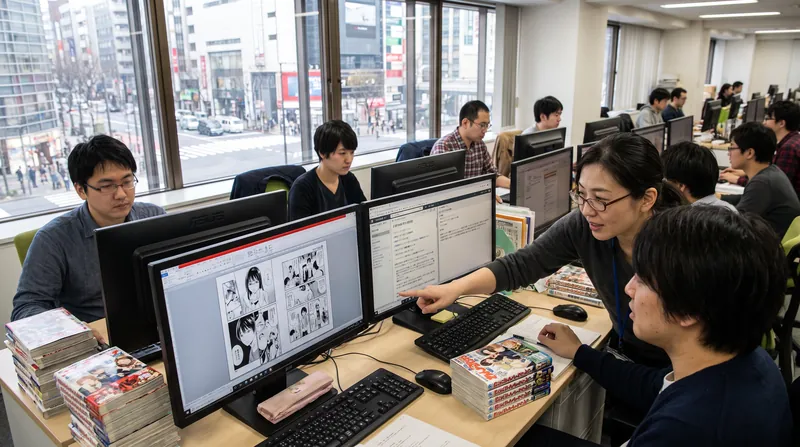
Japan Prepares $71 Million Subsidy to Accelerate Global Anime and Manga Releases Using AI
4 sources
Anime Industry
U-NEXT Acquires Studio GoHands in Landmark Deal for Japanese Domestic Streaming
2 sources

Anime Industry
Netflix Dethrones Crunchyroll as World's Most-Used Anime Streaming Platform in Major Markets
2 sources
Anime Tourism
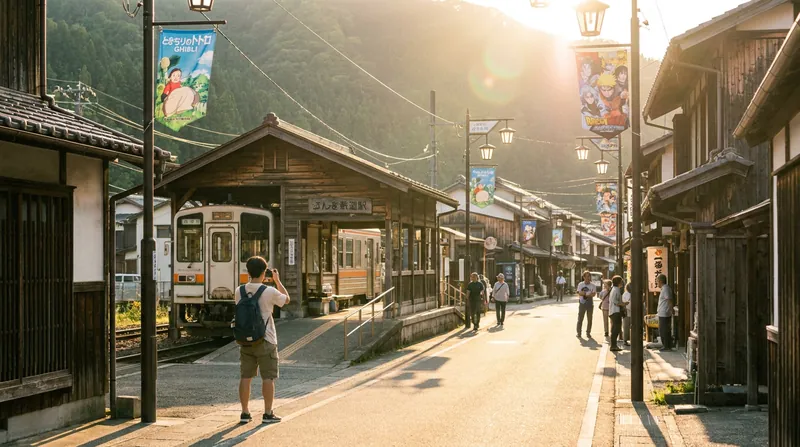
The Economics of 'Seichi Junrei': How Anime Tourism is Revitalizing Rural Japan
4 sources
Comments
Every angle. Every day.
Get Entertainment stories with full source coverage and perspective breakdowns, free every day.