
How Intergenerational Living is Solving the Loneliness and Housing Crises
Faced with soaring housing costs and an epidemic of isolation, a growing number of families and developers are turning to multigenerational homes and intentional co-housing communities. Evidence suggests these shared models not only ease financial burdens but significantly improve mental health across age groups.
By Factlen Editorial Team
- Housing Economists & Developers
- Focus on affordability, pooled resources, and the premium demand for multi-use properties.
- Public Health Researchers
- Focus on the mental health benefits, reduction in depressive symptoms, and combating loneliness.
- Community Advocates
- Emphasize mutual aid, shared caregiving burdens, and the social fabric of intentional communities.
What's not represented
- · Municipal zoning boards
- · Young adults who prefer independent living
Why this matters
The traditional model of age-segregated living is becoming financially unsustainable and socially isolating for millions. Understanding the shift toward intergenerational housing offers a practical blueprint for families looking to reduce living costs, share caregiving burdens, and build built-in support networks.
Key points
- Multigenerational living is rising as a solution to high housing costs and the loneliness epidemic.
- 14% of all homebuyers in 2025 purchased a multigenerational home, led by Generation X.
- Studies show older adults living with younger generations experience significantly lower depressive symptoms.
- Co-housing communities use shared 'common houses' and collaborative management to build social cohesion.
- Challenges include a loss of privacy, autonomy conflicts, and strict single-family zoning laws.
The modern housing landscape is colliding with a profound demographic shift. As populations age and the cost of living remains stubbornly high, two distinct crises have emerged in parallel: a severe shortage of affordable housing and what the U.S. Surgeon General has declared a public health epidemic of loneliness. For decades, the default solution in Western societies has been segregation by age—young professionals in urban apartments, nuclear families in suburban subdivisions, and older adults in age-restricted retirement communities. But a growing body of evidence suggests this model is fundamentally flawed.[3][4]
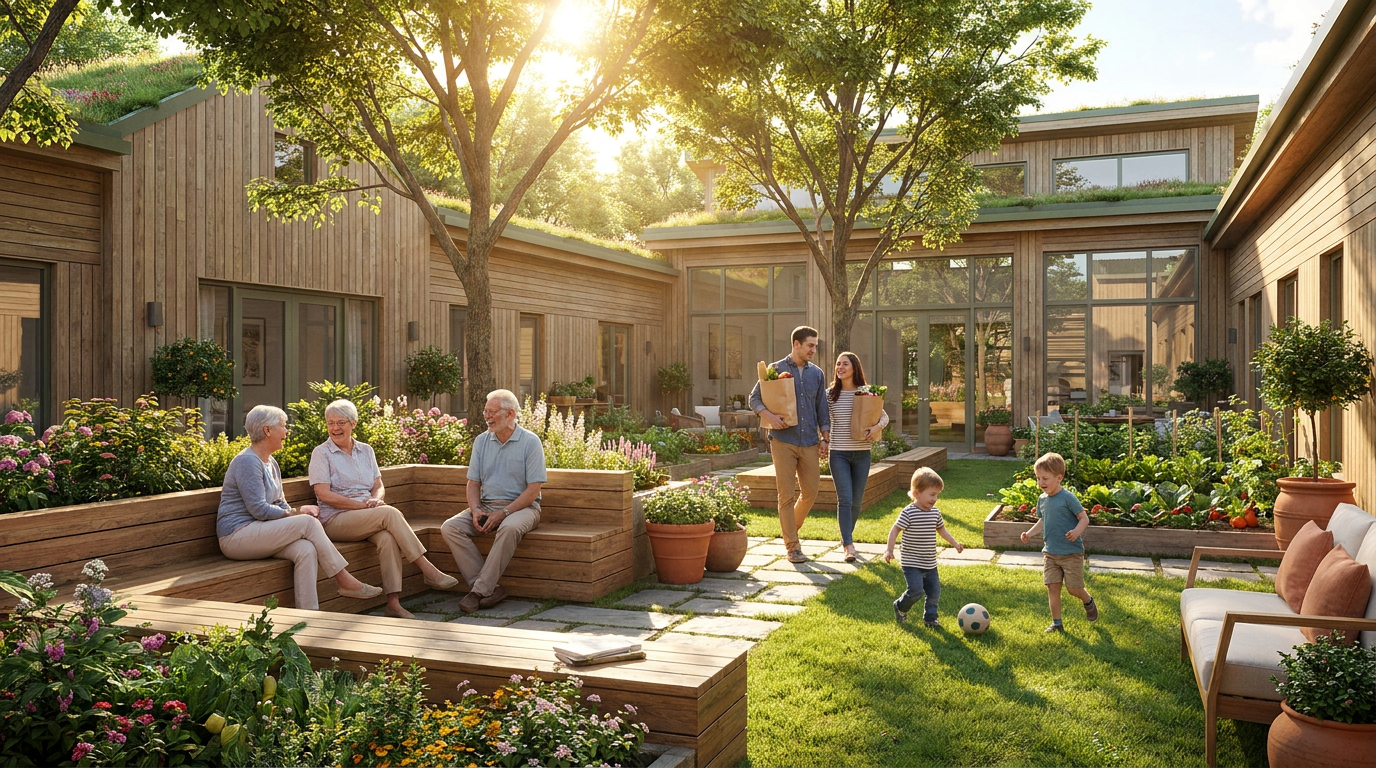
In response, a quiet revolution is reshaping how neighborhoods are built and homes are purchased. Intergenerational living—once the historical norm—is experiencing a major resurgence. This shift is taking two primary forms: the rise of multigenerational households, where extended families share a single property, and the development of intentional intergenerational co-housing communities, where diverse age groups live independently but share communal spaces and daily responsibilities.[2][8]
The appeal is deeply pragmatic. By bringing seniors, young families, and single adults under one roof or around a shared courtyard, these models tackle multiple pressure points at once. They pool financial resources, distribute the heavy burdens of childcare and eldercare, and create built-in social networks that combat the isolation inherent in modern life.[4][8]
The financial drivers behind this trend are stark. According to the National Association of Realtors' 2026 Generational Trends report, 14% of all homebuyers in the past year purchased a multigenerational home. Generation X—those currently squeezed between raising children and caring for aging parents—leads this charge, accounting for 19% of these purchases.[6]
Industry data confirms that the real estate market is rapidly adapting to this demand. Realtor.com reports that multigenerational homes—often featuring accessory dwelling units (ADUs), guest houses, or in-law suites—now make up over 6% of active listings nationally. These properties command a significant premium, listing for roughly 65% more than standard homes due to their larger footprints and specialized layouts. Yet, despite the higher upfront price tag, they remain highly sought after because they allow families to consolidate mortgages, offset utility costs, and avoid the exorbitant expenses of private childcare or assisted living facilities.[5][6]

Beyond private family homes, commercial developers are also recognizing the viability of the model. In the United Kingdom, developers like Town are spearheading purpose-built co-housing projects, such as Marmalade Lane, which intentionally mix single adults, young families, and retirees. These developments are designed around the concept of individualized collectivism, offering private residences that open into shared gardens, communal kitchens, and multifunctional halls.[3][7]
While the economic benefits are easily quantified, public health researchers argue that the psychological dividends are even more profound. Living alone in later life is strongly associated with depression, decreased mobility, and a higher risk of all-cause mortality. Conversely, robust social networks and daily interactions act as a protective buffer against cognitive decline.[2][3]
A landmark study utilizing data from the Survey of Health, Ageing and Retirement in Europe (SHARE) provided concrete evidence of this protective effect. Researchers tracking tens of thousands of older adults found that those co-residing with adult children exhibited significantly lower levels of depressive symptoms compared to those living alone. The study concluded that the daily exchanges inherent in intergenerational living directly bolster mental health, particularly during periods of economic hardship.[1]

A landmark study utilizing data from the Survey of Health, Ageing and Retirement in Europe (SHARE) provided concrete evidence of this protective effect.
In intentional co-housing communities, these benefits extend beyond biological family ties. Older residents report a renewed sense of purpose and civic engagement, often stepping in to help young neighbors with childcare or mentoring. In return, younger residents provide informal support—checking in during illnesses, assisting with heavy lifting, or simply offering the vibrant energy of a diverse neighborhood. This mutual aid creates a resilient micro-society where residents act as a safety net for one another.[4][7][8]
How exactly does intergenerational co-housing work in practice? Unlike traditional apartment buildings or subdivisions, co-housing is defined by its physical and social architecture. The physical environment is deliberately engineered to force serendipitous encounters. Parking is typically pushed to the perimeter, leaving the center of the community open for pedestrian walkways, shared gardens, and safe play areas for children.[3][7]
The cornerstone of the model is the common house—a shared facility that usually includes a large dining room, a commercial-grade kitchen, laundry facilities, and recreational spaces. Residents might cook and eat communal meals several times a week, sharing the labor of grocery shopping and food preparation.[4][8]

Crucially, this is paired with a governance structure that requires active participation. Residents manage the community themselves, making decisions by consensus and sharing maintenance tasks. This collaborative management is not just a cost-saving measure; it is the engine that builds trust and social cohesion among neighbors of different generations.[4][8]
Despite its promise, intergenerational living is not a utopian cure-all, and researchers caution that it comes with distinct challenges. The most immediate friction point is the loss of privacy. Sharing a property or a communal lifestyle requires a high degree of compromise, and the everyday negotiation of differing needs, noise levels, and habits across generations can lead to stress and interpersonal conflict.[4][8]
For older adults, there is a delicate balance between receiving support and maintaining autonomy. If a living arrangement feels overly paternalistic, or if seniors feel their independence is being compromised by well-meaning younger relatives or neighbors, it can actually contribute to anxiety and depressive symptoms rather than alleviating them.[3]
Furthermore, the model faces significant regulatory hurdles. In many North American municipalities, strict single-family zoning laws prohibit the construction of ADUs or the dense, clustered layouts required for co-housing communities. While cities are beginning to reform these codes to allow for more flexible housing, the pace of change remains slow, restricting access to these living arrangements primarily to those with the capital to navigate complex permitting processes.[4][5]

To scale these benefits, advocacy groups like Generations United have published blueprints calling for a coordinated effort between policymakers, urban planners, and healthcare providers. They argue that intergenerational living should not be a niche luxury, but a fundamental pillar of how we design future cities.[4]
This involves not only zoning reform but also the creation of financial incentives for developers to build mixed-age communities, and subsidies to ensure these spaces are accessible to low- and middle-income families. Some innovative models are already bridging the gap by matching older adults who have spare bedrooms with university students seeking affordable rent, exchanging housing for light household assistance and companionship.[4][8]
Ultimately, the shift toward intergenerational living represents a profound cultural correction. It is a recognition that the hyper-individualism of the late 20th century has left many people isolated and financially strained. By returning to a more communal, interdependent way of living, society has the opportunity to solve its housing and loneliness crises simultaneously—proving that sometimes, the most innovative solutions are simply modern adaptations of our oldest traditions.[2][3]
How we got here
Mid-20th Century
Post-war suburbanization and the rise of the nuclear family lead to highly age-segregated housing models.
Late 1960s
The modern co-housing movement originates in Denmark, emphasizing shared spaces and collaborative community management.
2020-2022
The global pandemic severely exacerbates the loneliness epidemic, prompting renewed interest in communal and multigenerational living.
2023
The U.S. Surgeon General officially declares loneliness and isolation a public health epidemic.
2025-2026
Multigenerational home purchases surge, with Gen X buyers leading the market in acquiring properties with flexible living spaces.
Viewpoints in depth
Housing Economists & Developers
Focusing on the financial efficiencies and market demand for shared living spaces.
From an economic perspective, intergenerational living is a rational market response to an affordability crisis. Economists and real estate developers point out that pooling resources allows families to afford homes they otherwise couldn't, while simultaneously offsetting the soaring costs of childcare and eldercare. Developers see a lucrative, underserved market for properties with flexible floor plans, accessory dwelling units, and purpose-built communal spaces.
Public Health Researchers
Emphasizing the mental and physical health benefits of daily social interaction.
Public health experts view intergenerational living primarily as an intervention against the loneliness epidemic. They cite extensive data showing that older adults who live with or near younger generations experience lower rates of depression, slower cognitive decline, and greater overall well-being. For this camp, the built environment is a crucial tool for preventative healthcare, fostering the daily, low-stakes interactions that keep people mentally and physically active.
Community Advocates
Highlighting the importance of mutual aid and the restoration of the social fabric.
Advocates for intentional communities argue that modern, age-segregated housing has fundamentally broken the social contract. They champion co-housing not just as a financial or medical hack, but as a necessary cultural shift back toward mutual aid. By sharing meals, chores, and caregiving responsibilities, they believe society can rebuild the resilient, interdependent neighborhoods that hyper-individualism dismantled.
What we don't know
- Whether municipal governments will reform zoning laws fast enough to meet the growing demand for co-housing.
- How the long-term mental health benefits of intentional co-housing compare to traditional multigenerational family homes.
Key terms
- Intergenerational Co-Housing
- An intentional community where people of diverse ages live in private homes but share significant communal spaces and daily responsibilities.
- Multigenerational Household
- A single property or home shared by three or more generations of a family, often to pool financial resources and caregiving duties.
- Accessory Dwelling Unit (ADU)
- A smaller, independent residential dwelling located on the same lot as a standalone single-family home, often used for aging parents.
- Common House
- The central shared facility in a co-housing community, typically featuring a large kitchen, dining area, and recreational spaces.
- Aging in Place
- The ability of older adults to live in their own homes and communities safely, independently, and comfortably, regardless of age or income.
Frequently asked
What is the difference between co-housing and a commune?
Unlike a commune where finances and property are often entirely shared, co-housing residents own or rent their private, independent homes. They only share ownership and management of specific communal spaces and facilities.
Why are multigenerational homes more expensive?
They typically feature larger square footage, specialized layouts like dual kitchens or separate entrances, and are in high demand, leading to a significant price premium over standard homes.
Does living with family always improve mental health?
Not always. While studies show it generally reduces depressive symptoms, it can cause stress and anxiety if there are conflicts over autonomy, privacy, or differing generational habits.
Are co-housing communities only for families?
No. Intentional intergenerational communities are designed to include a diverse mix of single adults, young couples, families with children, and retirees.
Sources
Source coverage
8 outlets
3 viewpoints surfaced








[1]SHARE-ERICPublic Health Researchers
Intergenerational Living Has Positive Effects on Older People's Mental Health
Read on SHARE-ERIC →[2]Institute for Family StudiesPublic Health Researchers
From Pyramid to Pillar: Multigenerational Living
Read on Institute for Family Studies →[3]National Institutes of HealthPublic Health Researchers
Intergenerational interactions and health outcomes
Read on National Institutes of Health →[4]Generations UnitedCommunity Advocates
Healthier Lives Across Generations: A Blueprint for Intergenerational Living
Read on Generations United →[5]Realtor.comHousing Economists & Developers
Multigenerational listing trends 2025
Read on Realtor.com →[6]HousingWireHousing Economists & Developers
Multigenerational housing trends 2026
Read on HousingWire →[7]MonocleHousing Economists & Developers
Co-housing developer Town builds intergenerational communities
Read on Monocle →[8]Harvard Joint Center for Housing StudiesCommunity Advocates
Building evidence for the benefits of intergenerational living
Read on Harvard Joint Center for Housing Studies →

Every angle. Every day.
Get lifestyle stories with full source coverage and perspective breakdowns delivered to your inbox.