
How Generative AI is Creating Infinite, Unscripted NPCs in Modern Video Games
Game developers are replacing static dialogue trees with large language models and real-time animation, allowing players to have unique, voice-driven conversations with digital characters.
By Factlen Editorial Team
- Technology Providers
- Focused on pushing the boundaries of real-time generation, low latency, and on-device processing capabilities.
- Narrative Designers
- Advocate for using AI as an improvisational tool bounded by strict lore guardrails, rather than a replacement for human writers.
- Hardware Analysts
- Concerned with the technical bottlenecks of AI integration, specifically API costs and the necessity of local processing power.
What's not represented
- · Voice Actors' Guilds
- · Indie Game Developers without AAA budgets
Why this matters
For decades, video game worlds have been populated by static characters repeating the same pre-written lines. The integration of generative AI means players will soon experience truly living digital ecosystems where every character remembers past interactions, adapts to the player's voice, and offers a completely unique, unscripted experience.
Key points
- Generative AI is replacing static dialogue trees with dynamic, unscripted NPC conversations.
- NPCs use vector databases to remember past interactions and adapt their behavior accordingly.
- Real-time animation tools like Audio2Face sync character lip movements to AI-generated speech.
- Narrative designers now craft psychological guardrails to keep AI characters within the game's lore.
- The industry is shifting to on-device AI processing to solve cloud latency and server costs.
For decades, the non-player character (NPC) has been the static backbone of video game world-building. Players are intimately familiar with the traditional dialogue tree: a rigid menu of pre-written responses that inevitably loop back on themselves, leading to repetitive barks and predictable interactions. No matter how beautifully rendered a digital city might be, its inhabitants have historically operated on simple scripts, breaking the illusion of a living world the moment a player tries to step outside the developer's predetermined narrative boundaries.
In 2026, that paradigm is undergoing a seismic shift. The integration of generative artificial intelligence into game engines is transforming NPCs from animatronic set dressing into dynamic, improvisational actors. Powered by large language models (LLMs) and real-time animation software, these next-generation characters can listen to a player's actual voice, understand context, and generate unique, unscripted responses on the fly. Instead of selecting from a list of prompts, players can interrogate suspects, negotiate with merchants, or strategize with squadmates using natural conversation.[1][3]
The most prominent early glimpse into this future came from Ubisoft's NEO NPC prototype, developed in collaboration with Inworld AI and Nvidia. Showcased as a proof-of-concept, the project allowed players to speak directly into their microphones to converse with characters who possessed distinct personalities, backstories, and knowledge bases. Rather than reciting lines, the NPCs improvised their dialogue while remaining faithful to the game's lore, demonstrating an unprecedented level of conversational fluidity.[1][3][4]
Understanding how these digital minds operate requires looking under the hood at a complex, multi-layered technology stack. When a player speaks, a speech-to-text analyzer instantly transcribes the audio into a text prompt. This text is fed into a character-specific LLM—essentially the NPC's "brain"—which cross-references the player's input against the character's programmed psychological profile, current emotional state, and the overarching rules of the game world.[3][7]

Crucially, these advanced NPCs are equipped with persistent memory systems, typically powered by vector databases. Unlike traditional game characters who suffer from perpetual amnesia, generative NPCs can recall past interactions, alliances, and betrayals. If a player insults a guard in one town, that guard might remember the slight and refuse to offer help hours later, creating a deeply personalized narrative ecosystem where actions have organic, unscripted consequences.[7]
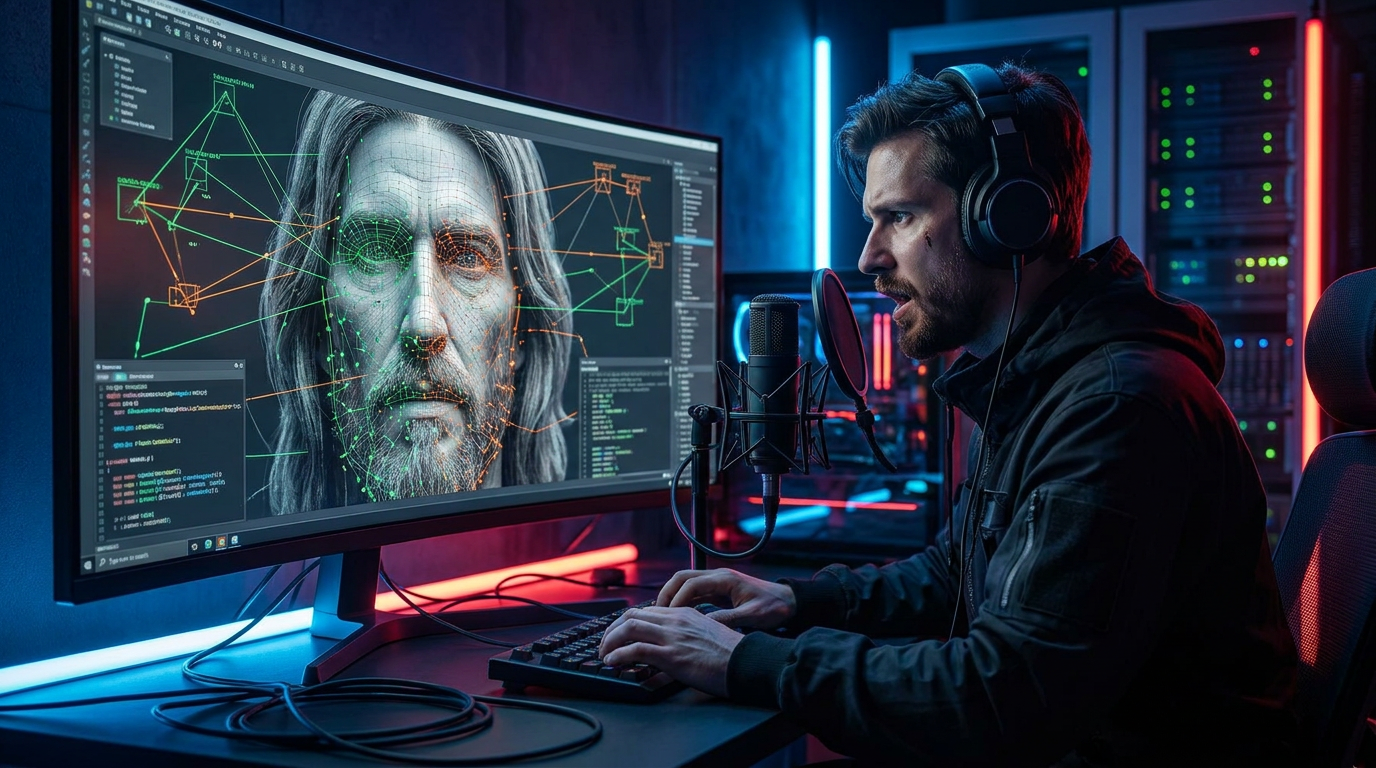
Generating the text of a response is only half the battle; delivering it believably is where real-time animation technologies step in. Systems like Nvidia's Audio2Face take the AI-generated audio response and instantly map it to the character's 3D model. The software dynamically generates accurate lip-syncing, facial micro-expressions, and body language that match the emotional tone of the dialogue, ensuring that an angry response looks genuinely furious rather than blankly robotic.[1][4][5]
Generating the text of a response is only half the battle; delivering it believably is where real-time animation technologies step in.
Despite the technological marvel, the shift toward generative AI has sparked intense debate regarding the future of game writing. A common fear is that studios might use LLMs to replace human narrative designers, resulting in sprawling but emotionally hollow games filled with verbose, generic chatter. However, developers emphasize that AI is a tool to augment, not replace, human creativity. The most successful implementations rely heavily on human writers to establish the foundational guardrails.[3][6]
In this new workflow, narrative designers transition from writing explicit scripts to crafting deep psychological profiles. They define an NPC's motivations, secrets, vocabulary quirks, and strict boundaries regarding what the character knows and will not say. The AI acts as an improvisational actor working within a meticulously designed character bible, ensuring that the generated dialogue serves the game's narrative goals rather than wandering into immersion-breaking hallucinations.[1][3][6]

Beyond narrative concerns, the practical implementation of generative NPCs faces significant technical hurdles, primarily latency and cost. Cloud-based LLMs require constant API calls to external servers, which can introduce unnatural pauses in conversation and rack up immense computing costs for games with millions of active players. For a conversation to feel natural, the entire loop—from the player speaking to the NPC replying—must occur in under 500 milliseconds.[6]
To solve this bottleneck, the industry is aggressively pivoting toward on-device inference. At CES 2026, Nvidia showcased major advancements in its Avatar Cloud Engine (ACE), demonstrating AI models optimized to run locally on a player's PC hardware rather than relying on remote servers. By leveraging the neural processing units (NPUs) and tensor cores built into modern graphics cards, games can process complex LLM interactions locally, drastically cutting latency and eliminating recurring server costs.[2][5]

This on-device capability is already moving from tech demos to active gameplay integration. Nvidia's collaborations have yielded fully AI-driven teammates in multiplayer shooters like PUBG, where players can issue complex tactical commands via voice chat. Similarly, strategy games like Total War: Pharaoh are testing context-aware AI advisors that understand the real-time state of the game board and can answer specific player questions about resource management or enemy troop movements.[2]
The democratization of these tools is also empowering independent studios to punch above their weight class. While massive AAA developers build proprietary systems, middleware platforms are offering plug-and-play AI NPC software development kits. This allows smaller teams to populate their indie RPGs or mystery games with highly reactive characters, a feat that would have previously required an impossibly large writing staff and voice acting budget.[7]
Ultimately, the goal is not to have AI generate the core emotional beats of a game's main storyline, which still benefit from the deliberate pacing and crafted prose of human authors. Instead, generative NPCs excel at filling the margins of the world. They transform the previously static background characters—the tavern keepers, the wandering merchants, the city guards—into reactive entities that make the digital environment feel genuinely alive and responsive to the player's unique journey.[6]
How we got here
June 2023
Indie game Vaudeville launches with early generative AI conversations, highlighting the potential of the technology.
March 2024
Ubisoft unveils the NEO NPC prototype at GDC, demonstrating real-time voice interactions bounded by narrative guardrails.
January 2026
Nvidia showcases on-device ACE models at CES, solving cloud latency issues by processing AI locally.
Mid-2026
Major game engines begin native integration of AI NPC SDKs, democratizing the technology for smaller studios.
Viewpoints in depth
The Technologists' View
The push for seamless, real-time digital humans running on local hardware.
For companies building the underlying architecture, the goal is to eliminate the friction that breaks immersion. They view traditional dialogue trees as an antiquated bottleneck. By combining LLMs with real-time facial animation and vector memory, they aim to create digital ecosystems where every interaction is unique. Their current primary focus is shifting this massive computational load from expensive cloud servers directly onto the player's local GPU and NPU, ensuring that conversations happen with zero lag and no recurring API subscription costs.
The Narrative Designers' View
Protecting the emotional core of the game through strict character guardrails.
Writers and narrative directors are cautiously optimistic but highly protective of their craft. They argue that an AI's ability to generate endless text does not equate to compelling storytelling. From their perspective, generative AI is best utilized as an improvisational actor that handles dynamic side-chatter, while human writers remain essential for crafting the overarching plot, emotional beats, and the psychological 'bibles' that keep the AI from hallucinating or breaking character. They view the technology as a seasoning, not the main course.
The Hardware Analysts' View
Evaluating the practical limitations of latency, hardware requirements, and cost.
Hardware and performance analysts look past the impressive tech demos to ask how this scales to millions of players. They point out that cloud-based LLMs introduce unacceptable latency—often taking over a second to reply, which ruins the illusion of a natural conversation. Furthermore, the API costs of querying a cloud LLM for every minor NPC interaction would bankrupt a studio. Therefore, they argue that the true revolution in AI NPCs will only arrive when the average consumer's PC possesses the 45-50 TOPS of neural processing power required to run these models entirely offline.
What we don't know
- Whether players will actually prefer open-ended AI conversations over tightly paced, hand-crafted dialogue.
- How regulatory bodies might handle age ratings for games where AI could theoretically generate inappropriate or unrated dialogue.
- The exact timeline for when on-device AI processing will become standard in mid-range gaming consoles.
Key terms
- Large Language Model (LLM)
- An AI system trained on vast amounts of text to understand and generate human-like language.
- Vector Database
- A specialized storage system that allows AI to efficiently search and retrieve an NPC's past memories and interactions.
- On-Device Inference
- Running AI calculations locally on the player's own computer hardware rather than sending data to a remote cloud server.
- Audio2Face
- Technology that automatically generates realistic 3D facial animations and lip-syncing directly from an audio track.
Frequently asked
Will AI NPCs replace human voice actors and writers?
No. Human writers are still required to create the character's backstory, personality, and guardrails, while AI acts as an improvisational tool to handle unscripted side chatter.
Do I need a constant internet connection to talk to AI NPCs?
While early versions relied on cloud servers, 2026 advancements in on-device inference allow these AI models to run locally on your PC's hardware, removing the need for a constant connection.
Can an AI NPC break the game's story?
Developers use strict narrative guardrails and character bibles to prevent the AI from 'hallucinating' facts or offering information that contradicts the game's lore.
Sources
Source coverage
7 outlets
3 viewpoints surfaced







[1]Game World ObserverNarrative Designers
Ubisoft unveils NEO NPC, GenAI project allowing players to have authentic conversations
Read on Game World Observer →[2]TechRadarHardware Analysts
Nvidia has finally done the one AI thing I've been dreading — and PC gaming might never be the same
Read on TechRadar →[3]Game DeveloperNarrative Designers
How do Ubisoft's AI-driven NPCs handle dynamic player interactions?
Read on Game Developer →[4]Tom's HardwareTechnology Providers
Ubisoft, Nvidia, and Inworld AI partnership to produce Neo NPC game characters
Read on Tom's Hardware →[5]NVIDIA DeveloperTechnology Providers
NVIDIA ACE for Games
Read on NVIDIA Developer →[6]FinalBossNarrative Designers
Why Ubisoft's NEO NPC Is Clever—but Won't Save Game Writing
Read on FinalBoss →[7]AivexifyTechnology Providers
How AI NPCs Work: The Technology Behind NPCs That Remember Players
Read on Aivexify →

More in gaming esports
See all 15 stories →Handheld PCs
Steam Deck OLED vs. ROG Ally X: Which Premium Handheld Fits Your Playstyle?
7 sources
Game Accessibility
How Accessibility Became the Video Game Industry's New Baseline
7 sources

Adaptive Gaming
How Adaptive Technology is Leveling the Esports Playing Field
8 sources

Gaming Accessibility
The New Standard of Play: How Hardware and Software Are Making Gaming Universally Accessible
7 sources
Every angle. Every day.
Get gaming esports stories with full source coverage and perspective breakdowns delivered to your inbox.