
How Fractional Real Estate and Tokenization Are Rewiring Property Investing
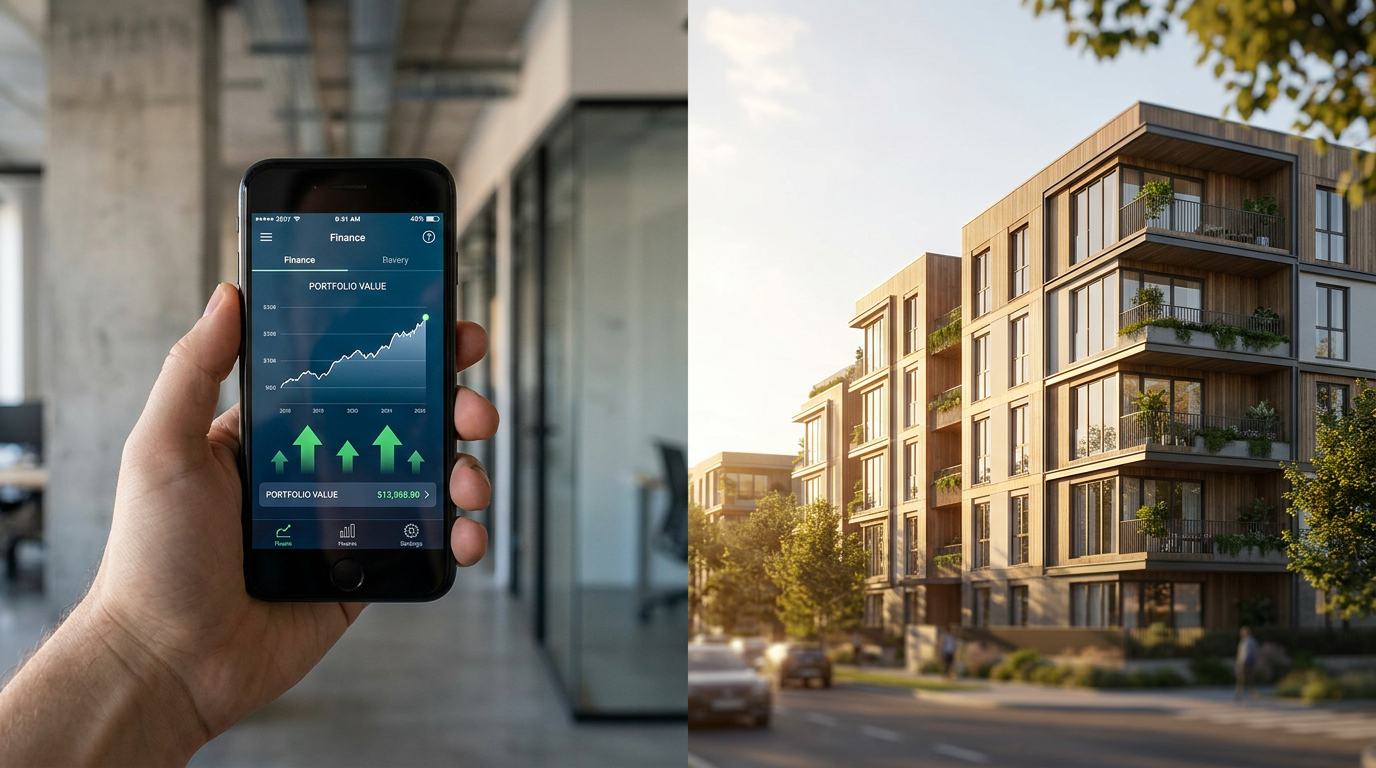
Retail investors are bypassing six-figure down payments by using blockchain-backed platforms to buy $50 shares of income-producing rental properties.
By Factlen Editorial Team
- Retail Investors
- View fractional platforms as a vital tool for wealth democratization, allowing them to earn passive income and access an asset class previously reserved for the wealthy.
- Traditional Real Estate Purists
- Remain skeptical of the model, arguing that true real estate wealth is built through direct control, tax advantages, and the use of traditional bank leverage (mortgages).
- Blockchain Infrastructure Providers
- Focus on the backend efficiency of tokenization, emphasizing how smart contracts automate compliance and eliminate costly middlemen.
What's not represented
- · Local homebuyers competing against fractional platforms for housing inventory
- · Traditional property management companies adapting to institutional platform demands
Why this matters
By lowering the barrier to entry from tens of thousands of dollars to just $50, fractional investing allows everyday people to build passive income and hedge against inflation without taking on massive mortgage debt.
Key points
- Retail investors can now buy shares of rental properties for as little as $50.
- Properties are legally held in LLCs, shielding investors from personal liability.
- Blockchain tokenization automates rent distribution and lowers transaction fees.
- Secondary markets provide liquidity, though trading volume varies by platform.
- The tokenized real estate market is projected to reach $19.4 billion by 2033.
- Clearer regulations have encouraged institutional asset managers to enter the space.
The traditional American dream of real estate investing has long been guarded by a steep financial moat. For decades, acquiring a rental property required a six-figure down payment, a pristine credit score, and a willingness to handle midnight plumbing emergencies. But in 2026, the barrier to entry has collapsed. Through fractional real estate platforms, retail investors are purchasing stakes in single-family homes, commercial logistics centers, and international vacation rentals for as little as $50.[3][7]
This shift represents a fundamental rewiring of how property ownership works. Fractional investing is not a timeshare, where buyers purchase the right to use a property for a week. Instead, it is a purely financial mechanism. Investors buy a proportional equity stake in a specific, income-producing asset, earning a share of the monthly rent and capturing any long-term appreciation when the property is eventually sold.[3]
The mechanics rely on a legal structure known as a Special Purpose Vehicle (SPV), typically a Limited Liability Company (LLC). When a platform identifies a property, they place the deed inside a dedicated LLC. Investors do not buy the physical house directly; they buy shares of the LLC. This structure shields the investor from personal liability while legally entitling them to the economic benefits of the underlying asset. Professional property managers handle the tenants, maintenance, and taxes, distributing the net income to shareholders.[2][3]

The financial appeal is grounded in tangible yields. In the United States, fractional residential properties typically target annual rental yields of 5% to 7%, while international or short-term rental markets can push those figures toward 8% to 12%. When combined with historical property appreciation of 3% to 5% annually, the total expected returns sit competitively between traditional stock market indexes and standard Real Estate Investment Trusts (REITs), but with the added psychological benefit of knowing exactly which physical building your money occupies.[3][4]
While traditional fractional platforms have grown steadily, the explosive catalyst in 2026 is blockchain tokenization. The tokenized real estate market is projected to surge from $3.5 billion in 2024 to $19.4 billion by 2033, representing a staggering 21% compound annual growth rate. Tokenization replaces traditional paper shares with digital tokens recorded on a blockchain, fundamentally altering the speed and cost of property transactions.[1][6]

Platforms utilizing blockchain infrastructure—such as Lofty on the Algorand network—use smart contracts to automate the administrative burden of real estate. Instead of waiting for a quarterly dividend check, smart contracts can distribute rental income to token holders daily, down to the fraction of a cent. This automation strips out the middleman fees that typically drag down real estate returns, allowing more of the gross yield to reach the investor.[2]
Platforms utilizing blockchain infrastructure—such as Lofty on the Algorand network—use smart contracts to automate the administrative burden of real estate.
Beyond administrative efficiency, tokenization solves one of real estate's oldest problems: illiquidity. Historically, selling a house took months of staging, negotiating, and escrow. Today, tokenized platforms operate secondary marketplaces where investors can list their digital property shares for sale 24/7. If an investor needs cash, they can sell their $500 stake in an Ohio duplex to another user on the platform in minutes, provided there is a willing buyer.[2][3]
However, this liquidity comes with critical caveats. Unlike publicly traded stocks, which have millions of daily buyers, fractional real estate shares are only as liquid as the platform's specific user base. If a platform's secondary market lacks trading volume, an investor might be forced to sell their shares at a discount or wait weeks to find a buyer. The underlying asset is still a highly illiquid physical building, and digital tokens cannot magically create demand where none exists.[3][7]
The ecosystem has also diversified beyond simple equity. Several platforms now allow retail investors to participate in real estate debt, funding short-term loans for developers and house flippers. These debt instruments often yield 8% to 12% over six to twelve months, offering a fixed-income alternative to the variable returns of rental equity. This allows users to build a blended portfolio of both property ownership and property financing from a single smartphone app.[3]

Regulatory clarity has been the unsung hero of this market expansion. A few years ago, the intersection of real estate and crypto was viewed with deep skepticism by regulators. By 2026, frameworks like the European Union's Markets in Crypto-Assets (MiCA) and clearer SEC guidelines in the U.S. have established strict rules for tokenized real-world assets (RWAs). Platforms must enforce rigorous Know Your Customer (KYC) and Anti-Money Laundering (AML) checks, ensuring that digital property shares are treated as compliant securities rather than speculative cryptocurrencies.[5][7]
This regulatory maturation has triggered a wave of institutional adoption. It is no longer just retail investors buying $50 slices of duplexes. Asset managers and pension funds are utilizing enterprise-grade tokenization platforms to digitize massive commercial real estate portfolios. By tokenizing a $40 million logistics park, developers can bypass traditional bank financing and raise capital directly from a global pool of verified investors, reducing friction and borrowing costs.[5]
Despite the momentum, fractional real estate carries inherent risks that new investors often overlook. Platform risk is paramount; if the startup managing the LLC goes bankrupt, the underlying property remains safe, but the administrative transition to a new manager can freeze distributions for months. Additionally, fractional investors have no operational control. They cannot vote to evict a bad tenant, change the property management company, or force a sale if the local market peaks.[3][7]

The macroeconomic environment of 2026 continues to fuel the model's adoption. With median U.S. home prices remaining prohibitively high for many younger demographics, fractional ownership offers a vital stepping stone. It allows Generation Z and Millennials to gain exposure to real estate appreciation and hedge against inflation without needing to save for a decade to afford a traditional down payment.[3][4]
Ultimately, the fractionalization of real estate represents the democratization of an asset class that has historically been the primary engine of generational wealth. By combining the legal bedrock of the LLC with the frictionless transferability of blockchain technology, the market has transformed physical buildings into highly accessible, programmable assets. For the everyday investor, the question is no longer whether they can afford to invest in real estate, but rather which zip code they want to buy a piece of today.[7]
How we got here
Early 2010s
Crowdfunding platforms introduce the first iterations of online real estate syndication for accredited investors.
2018-2020
Early blockchain experiments attempt to tokenize real estate, but struggle with regulatory compliance and legal structures.
2021-2023
Mainstream fractional platforms like Arrived and Fundrise popularize the $10-$100 entry point for retail investors.
2024-2025
Regulatory frameworks like Europe's MiCA provide legal clarity, triggering a surge in institutional tokenization.
2026
The tokenized real estate market accelerates, with platforms offering daily rent distributions and cross-border secondary trading.
Viewpoints in depth
Retail Investors
Focus on the democratization of wealth and the ability to generate passive income without massive debt.
For the everyday retail investor, fractional real estate is a financial equalizer. With median home prices locking millions out of traditional ownership, these platforms offer a way to participate in property appreciation and hedge against inflation. Advocates highlight that starting with $50 allows beginners to build a geographically diversified portfolio—owning a fraction of a duplex in Ohio and a vacation rental in Bali—without the concentration risk of putting a life savings into a single down payment.
Traditional Real Estate Purists
Emphasize the loss of control and the inability to use traditional mortgage leverage to amplify returns.
Traditional real estate investors argue that fractional ownership strips away the most powerful tools of property investing: leverage and control. When buying a house traditionally, an investor can use a 20% down payment to control a 100% asset, amplifying their cash-on-cash return. Fractional investors cannot take out a mortgage on their $500 share. Furthermore, purists warn that fractional owners are entirely at the mercy of the platform's management decisions, unable to force a sale or renovate the property to force appreciation.
Blockchain Infrastructure Providers
View real estate as the ultimate use case for smart contracts, focusing on backend efficiency and automated compliance.
For the technologists and infrastructure providers, the physical house is secondary to the financial rails. They view traditional real estate transactions—with their title companies, escrow agents, and manual dividend checks—as archaic and bloated. By moving the asset onto a blockchain, they argue that compliance, KYC/AML checks, and global distributions can be automated for pennies. Their ultimate goal is a fully interoperable ecosystem where a tokenized real estate share can be used as collateral in digital lending protocols.
What we don't know
- How fractional secondary markets will perform during a severe, prolonged housing market crash.
- Whether local municipalities will attempt to regulate or ban fractional ownership platforms if they are perceived to be driving up local housing costs.
- Which blockchain networks will ultimately become the standard settlement layer for global real-world assets.
Key terms
- Special Purpose Vehicle (SPV)
- A legal entity, usually an LLC, created specifically to hold the deed to a single property and shield investors from personal liability.
- Tokenization
- The process of converting ownership rights of a physical asset into digital tokens on a blockchain, allowing for easy fractionalization and trading.
- Smart Contract
- A self-executing computer program on a blockchain that automatically enforces the rules of an agreement, such as distributing daily rental income to shareholders.
- Secondary Market
- A trading platform where investors can buy and sell their existing fractional shares with other users, providing liquidity without having to sell the physical building.
- Real-World Assets (RWAs)
- Physical or traditional financial assets—like real estate, art, or bonds—that have been digitized and brought onto a blockchain.
Frequently asked
Can I live in the property I buy a fraction of?
No. Fractional investment properties are purely financial assets managed by professionals to generate rental income, unlike timeshares which are designed for personal use.
What happens if the fractional platform goes bankrupt?
The physical property is held in a separate, legally distinct LLC. While a platform bankruptcy wouldn't erase your ownership stake, it could temporarily freeze rental distributions while a new management company is appointed.
How is fractional real estate different from a REIT?
A Real Estate Investment Trust (REIT) is a large fund that buys hundreds of properties, giving you broad market exposure. Fractional investing lets you pick the exact, specific address you want to invest in.
Do I have to fix the toilet if it breaks?
No. Professional property managers handle all maintenance, tenant disputes, and repairs. These costs are simply deducted from the gross rental income before distributions are paid to investors.
Sources
Source coverage
7 outlets
3 viewpoints surfaced







[1]Custom Market InsightsBlockchain Infrastructure Providers
Real Estate Tokenization Market Size, Share, Growth Analysis
Read on Custom Market Insights →[2]LoftyBlockchain Infrastructure Providers
Fractional Real Estate vs. Traditional Ownership: Market Effects
Read on Lofty →[3]Fractional Property HubRetail Investors
What is Fractional Real Estate Investing?
Read on Fractional Property Hub →[4]DataInteloRetail Investors
Fractional Real Estate Platform Market Outlook 2025-2034
Read on DataIntelo →[5]ZoniqxBlockchain Infrastructure Providers
Top 10 Real Estate Tokenization Platforms Leading the Market
Read on Zoniqx →[6]Market InteloBlockchain Infrastructure Providers
Global Fractional Ownership Market Outlook 2025-2034
Read on Market Intelo →[7]Factlen Editorial TeamTraditional Real Estate Purists
Synthesis by Factlen editorial team
Read on Factlen Editorial Team →
Every angle. Every day.
Get real estate stories with full source coverage and perspective breakdowns delivered to your inbox.