
How Enhanced Geothermal Systems Are Unlocking 24/7 Clean Energy
Next-generation geothermal technology is breaking geographic barriers to provide continuous, carbon-free baseload power. With major projects coming online in 2026, the industry is poised to support the massive energy demands of the AI boom.
By Factlen Editorial Team
- Geothermal Developers
- Focused on rapid scaling and proving commercial viability.
- Grid & Infrastructure Analysts
- Concerned with transmission bottlenecks and capital costs.
- Scientific Researchers
- Focused on subsurface mechanics and seismic safety.
- Tech & AI Companies
- Seeking 24/7 clean energy to power data centers.
What's not represented
- · Local communities living near proposed EGS sites who may have concerns about water usage and industrialization.
- · Fossil fuel workers transitioning their drilling expertise into the geothermal sector.
Why this matters
As artificial intelligence and electrification drive a massive surge in energy demand, the grid desperately needs power that is both clean and continuous. Enhanced geothermal systems offer a scalable solution to the intermittency of wind and solar, potentially transforming global energy security.
Key points
- Fervo Energy's Cape Station in Utah will deliver 100 MW of continuous, carbon-free geothermal power to the grid by October 2026.
- Enhanced Geothermal Systems (EGS) use horizontal drilling to create artificial reservoirs, breaking the geographic limits of traditional geothermal energy.
- Scientists recently achieved a breakthrough by continuously monitoring seismic activity at 338°F nearly 7,000 feet underground for seven months.
- Tech giants like Google are heavily backing EGS to secure 24/7 clean energy for their rapidly expanding AI data centers.
- Transmission bottlenecks in the rural American West pose a challenge, prompting developers to consider building data centers directly at geothermal sites.
The global push for reliable, low-carbon energy has long faced a stubborn constraint: wind and solar are intermittent, and battery storage remains expensive at grid scale. For decades, the holy grail of the energy transition has been a clean, continuous baseload power source that can run twenty-four hours a day, regardless of the weather.[1][4]
Historically, geothermal energy offered exactly that, but it was heavily geographically restricted. Traditional geothermal plants rely on naturally occurring underground reservoirs of hot water and steam, limiting large-scale development to volcanically active regions like Iceland or California's Geysers. Because of these geographic constraints, geothermal currently supplies less than one percent of global electricity demand.[1][7]
That limitation is now being shattered by a breakthrough technology known as Enhanced Geothermal Systems (EGS). Instead of hunting for natural hot springs, EGS engineers create artificial reservoirs by drilling deep into hot, dry rock and injecting fluid to fracture the subsurface. This allows developers to harvest the Earth's immense subterranean heat almost anywhere.[2][7]

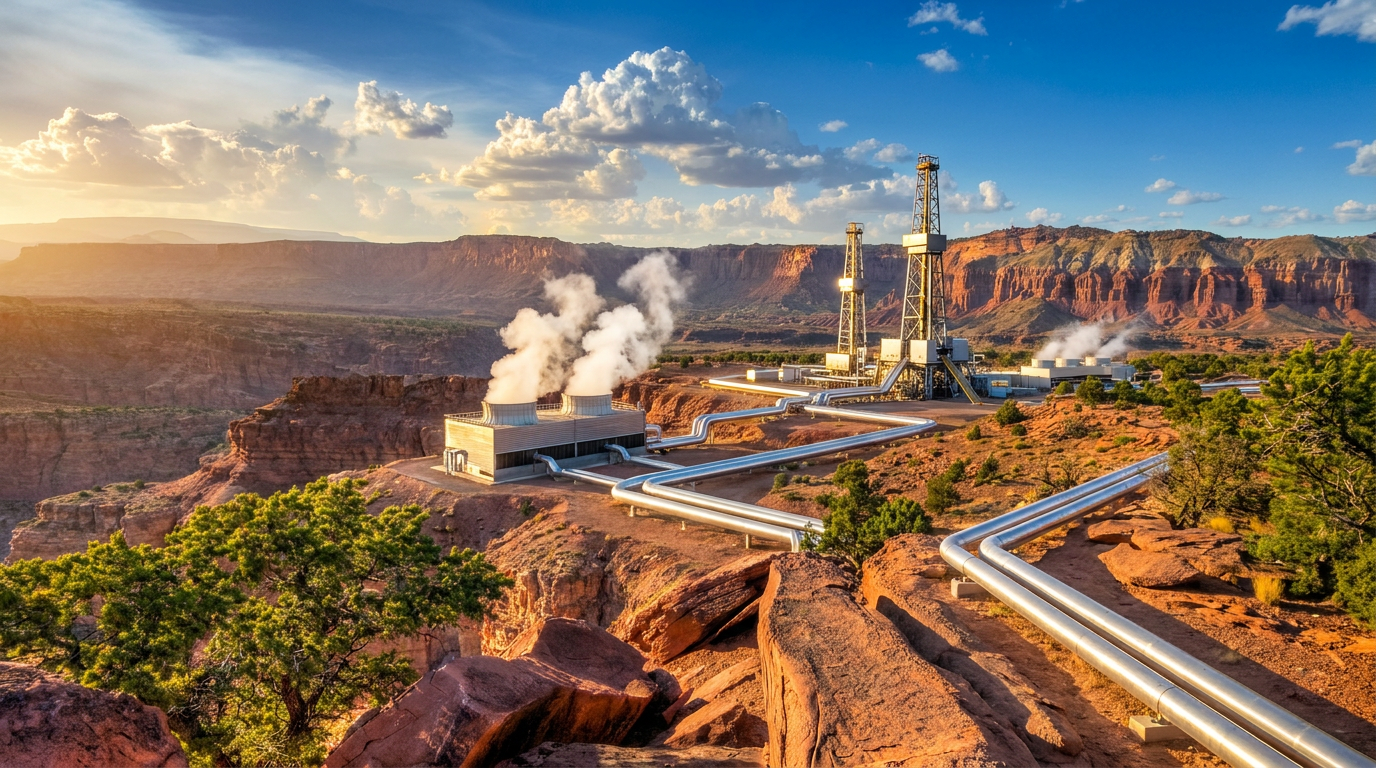
The vanguard of this movement is Fervo Energy, a Houston-based startup that is rapidly moving EGS from a theoretical concept to commercial reality. Fervo's flagship project, Cape Station, is currently under construction in the arid landscape of Beaver County, Utah, serving as a massive testbed for the industry.[1][4][8]
Cape Station is slated to deliver its first 100 megawatts (MW) of continuous, carbon-free electricity to the grid in October 2026. This milestone will make it the first commercial-scale enhanced geothermal project to achieve such an output worldwide. By 2028, the facility is expected to scale up to 500 MW, producing enough firm power for hundreds of thousands of homes.[1][4][8]
The rapid advancement of EGS relies heavily on technology transfer from the fossil fuel industry. Geothermal developers are repurposing the horizontal drilling techniques and fiber-optic sensing tools originally perfected during the shale oil and gas boom. By drilling horizontally through hot rock formations, they vastly increase the surface area available for heat exchange.[1][8]
The mechanism is elegantly simple in concept: water is pumped down an injection well, heated to extreme temperatures as it passes through the engineered fractures, and then brought back to the surface through a production well. The resulting steam drives turbines to generate electricity before the water is cooled and recirculated in a closed loop.[7]

Operating at these extreme depths and temperatures presents immense engineering challenges, particularly regarding subsurface monitoring. EGS reservoirs can create microseismic events—tiny tremors that help scientists map the fracture network but require careful management to avoid larger induced earthquakes.[4][6]
Operating at these extreme depths and temperatures presents immense engineering challenges, particularly regarding subsurface monitoring.
In a major scientific breakthrough, researchers from the Lawrence Berkeley National Laboratory recently achieved the longest continuous high-temperature seismic monitoring ever recorded. Using a custom-built seismometer deployed nearly 7,000 feet underground at Cape Station, the team continuously monitored the reservoir for seven months.[4][6]
The instrument successfully operated in extreme conditions where temperatures reached 338 degrees Fahrenheit, far exceeding previous benchmarks that peaked around 302 degrees. This continuous stream of high-fidelity data is critical for understanding how rock fractures behave, allowing operators to safely expand EGS facilities while minimizing seismic risks.[4][6]
The commercial momentum behind EGS is being supercharged by the technology sector. As artificial intelligence models grow increasingly complex, tech giants are facing a massive surge in energy demand. Because AI data centers require uninterrupted power, intermittent renewables alone cannot meet their needs.[5][8]

Recognizing this synergy, companies like Google have become major backers of next-generation geothermal. Fervo Energy recently secured over $460 million in new financing to complete Cape Station and expand its operations, with Google participating as a key investor to secure clean power for its data centers.[1][5]
However, scaling this technology is not without hurdles. Geothermal development is highly capital-intensive, requiring massive upfront investments before a single watt of power is generated. Furthermore, as developers look to expand, they are running into severe transmission bottlenecks.[2][5]
Fervo Energy has amassed a staggering development pipeline of roughly 42 gigawatts across Utah, Nevada, and Idaho. Yet, analysts warn that the limited electrical grid infrastructure in the rural American West could slow the rollout of these projects, as there simply aren't enough high-voltage power lines to transport the electricity to major cities.[2]
To circumvent these grid constraints, a new "behind-the-meter" workaround is emerging. Rather than waiting for new transmission lines to be built, developers are increasingly exploring the idea of constructing data centers directly adjacent to the geothermal plants, consuming the power on-site and bypassing the broader grid entirely.[2][8]

If these logistical and financial hurdles can be overcome, the potential scale of next-generation geothermal is staggering. The U.S. Department of Energy estimates that advanced geothermal could provide up to 120 gigawatts of firm capacity in the United States by 2050.[5]
Globally, the impact could be even more profound. Researchers at the Massachusetts Institute of Technology suggest that the heat stored beneath the Earth's crust could theoretically meet total global energy demand twice over, provided the drilling technology continues to mature.[5]
While recent years have proven that the technology works, the next decade will test the industry's ability to scale. As Cape Station prepares to send its first electrons to the grid, enhanced geothermal systems are officially stepping out of the laboratory and into the foundation of the clean energy transition.[3][4]
How we got here
2023
Fervo Energy begins producing electricity from Project Red, the world's first commercial EGS doublet.
July 2025
Berkeley Lab deploys a custom high-temperature seismometer 7,000 feet underground at Cape Station.
February 2026
Scientists complete a record-breaking seven-month continuous seismic monitoring of the EGS reservoir.
October 2026
Cape Station is scheduled to deliver its first 100 MW of commercial power to the grid.
2028
Cape Station is projected to reach its full 500 MW capacity.
Viewpoints in depth
Geothermal Developers
Focused on rapid scaling and proving commercial viability.
Companies like Fervo Energy argue that EGS is the missing piece of the clean energy transition. By repurposing oil and gas drilling technologies, they believe geothermal can scale rapidly to provide the firm, dispatchable power that wind and solar cannot. Their primary focus is on driving down the 'learning curve' costs through repeated, modular deployments, proving to utilities and corporate buyers that geothermal is a reliable, bankable asset class.
Grid & Infrastructure Analysts
Concerned with transmission bottlenecks and capital costs.
Energy market analysts caution that generating the power is only half the battle. They point out that the most promising EGS sites are located in the rural American West, far from major population centers. Without massive, slow-moving investments in high-voltage transmission lines, they warn that tens of gigawatts of clean geothermal power could be stranded. They also highlight the steep upfront capital required to drill deep wells before any revenue is generated.
Scientific Researchers
Focused on subsurface mechanics and seismic safety.
Geophysicists and national laboratory researchers view EGS as a complex subsurface engineering challenge. Their priority is understanding how rock fractures behave under extreme heat and pressure over decades. They emphasize that while the risk of induced seismicity can be managed, it requires rigorous, continuous monitoring using advanced sensors. For this camp, the long-term success of EGS depends on transparent data sharing and safe reservoir management.
Tech & AI Companies
Seeking 24/7 clean energy to power data centers.
Major technology firms view EGS as a critical enabler for their artificial intelligence ambitions. Facing immense pressure to meet net-zero climate pledges while simultaneously building power-hungry data centers, these companies are willing to pay a premium for 'clean firm' power. They are increasingly stepping in to provide the early-stage capital and long-term power purchase agreements needed to get next-generation geothermal projects off the ground.
What we don't know
- Whether the rural Western power grid will be upgraded fast enough to handle the massive 42 GW pipeline of planned geothermal projects.
- How the long-term maintenance costs of EGS wells will compare to wind and solar once the technology reaches global scale.
- If 'behind-the-meter' data centers will face regulatory hurdles from local utilities concerned about grid balancing.
Key terms
- Enhanced Geothermal Systems (EGS)
- A technology that generates geothermal electricity without the need for natural convective hydrothermal resources by engineering artificial reservoirs.
- Baseload Power
- The minimum amount of electric power needed to be supplied to the electrical grid at any given time, requiring power plants that can operate continuously.
- Horizontal Drilling
- A technique transferred from the oil and gas industry where a well is turned horizontally deep underground to expose more surface area of the rock.
- Induced Seismicity
- Minor earthquakes and tremors that are caused by human activity that alters the stresses and strains on the Earth's crust, such as fluid injection.
- Capacity Factor
- The ratio of a power plant's actual electrical energy output over a given period of time to the maximum possible electrical energy output over that period.
Frequently asked
What is an Enhanced Geothermal System (EGS)?
EGS is a technology that creates artificial underground reservoirs by drilling into hot, dry rock and injecting fluid to fracture it, allowing geothermal energy to be harvested in areas without natural hot springs.
How is EGS different from traditional geothermal energy?
Traditional geothermal relies on naturally occurring pockets of hot water and steam, limiting it to volcanically active regions. EGS engineers the reservoir itself, vastly expanding where geothermal plants can be built.
Does EGS cause earthquakes?
The fracturing process creates microseismic events, which are tiny tremors usually unfelt at the surface. Operators use advanced continuous monitoring to manage the reservoir and minimize the risk of larger induced earthquakes.
Why are tech companies investing in geothermal?
Artificial intelligence and massive data centers require continuous, 24/7 electricity. Geothermal provides clean baseload power that intermittent sources like wind and solar cannot guarantee around the clock.
Sources
Source coverage
8 outlets
4 viewpoints surfaced








[1]Canary MediaTech & AI Companies
Fervo nabs $462M to complete massive next-gen geothermal project
Read on Canary Media →[2]The Cool DownGrid & Infrastructure Analysts
Fervo's 42 GW geothermal push hits a Western grid bottleneck, but a workaround is emerging
Read on The Cool Down →[3]ThinkGeoEnergyGeothermal Developers
New technologies, steady hope, and cautious realism for geothermal in 2026
Read on ThinkGeoEnergy →[4]Highways TodayTech & AI Companies
Continuous seismic monitoring achieved for seven months at nearly 7,000 feet depth in extreme heat
Read on Highways Today →[5]BloombergNEFGrid & Infrastructure Analysts
Next-Generation Geothermal Energy Could Be a Game Changer
Read on BloombergNEF →[6]Lawrence Berkeley National LaboratoryScientific Researchers
Custom sensor monitors seismicity for months straight more than a mile below ground
Read on Lawrence Berkeley National Laboratory →[7]MIT NewsScientific Researchers
Achieving large-scale electricity generation from next-generation geothermal
Read on MIT News →[8]Fervo EnergyGeothermal Developers
A year of execution, scale, and momentum
Read on Fervo Energy →
Every angle. Every day.
Get energy stories with full source coverage and perspective breakdowns delivered to your inbox.