
How End-to-End AI Replaced 300,000 Lines of Code in Autonomous Vehicles
The self-driving industry is undergoing a massive architectural shift, abandoning hand-coded rules in favor of neural networks that learn to drive by watching humans.

The reality of self-driving in 2026 is no longer confined to closed test tracks or tightly controlled pilot programs. In cities across the United States, autonomous vehicles have become a mundane fact of the daily commute.[3]
Waymo, the Alphabet-owned pioneer of the industry, now operates fully driverless commercial robotaxis in ten major metropolitan areas, including San Francisco, Phoenix, Los Angeles, and Atlanta.
These vehicles are currently completing over 500,000 paid rides every single week, navigating complex urban environments without a human behind the wheel.[3]
But beneath the surface of this massive commercial rollout, the underlying technology powering autonomous vehicles is undergoing a radical, invisible revolution.[4]
For the past decade, the industry standard was built on what engineers now refer to as "AV 1.0."[4]
This traditional approach relied on a highly modular software stack, dividing the monumental task of driving into discrete, manageable chunks: one system for perception, another for prediction, and a third for planning the vehicle's path.[2]
AV 1.0 required explicit programming. Engineers wrote hundreds of thousands of lines of C++ code to dictate exactly how a car should behave in specific scenarios—if the camera detects a red light, stop; if a pedestrian steps into the crosswalk, apply the brakes.[2]
The fatal flaw of this modular, rule-based approach is the "long tail" of edge cases. The real world is infinitely complex, and it is mathematically impossible to hand-code a rule for every bizarre scenario a car might encounter.[2]
Whether it is a person in a chicken suit chasing a dog, or a double-parked delivery truck blocking a temporary construction lane, rule-based systems often freeze or disengage when faced with situations outside their programmed logic.[2]
Enter "AV 2.0," or end-to-end AI. Instead of breaking driving down into discrete, programmed steps, end-to-end systems use a single, massive neural network that learns to drive by watching millions of hours of human driving data.[1]
The architecture is often described by engineers as "photon-to-control." Raw sensor data—the photons hitting the car's cameras—flows directly into the neural network, and the network outputs steering, acceleration, and braking commands without any intermediate code.[2]
This shift closely mirrors the revolution in natural language processing that gave the world large language models. Just as AI learned to write by ingesting vast amounts of text rather than memorizing grammar rules, end-to-end driving models learn the implicit "grammar" of driving by observing human behavior.
Tesla became the most visible champion of this approach with the release of Full Self-Driving version 12. In a sweeping architectural overhaul, the company deleted over 300,000 lines of explicit C++ control code.[2]
According to Tesla's engineering team, the new system no longer contains a single line of code explicitly defining a "roundabout" or a "stop sign." Instead, the neural network understands these concepts implicitly through pattern recognition, resulting in smoother, more intuitive driving.
The UK-based startup Wayve has taken this concept even further, pioneering what it calls "Embodied AI." Wayve's foundation models are designed to be vehicle-agnostic and mapless, meaning they do not rely on the highly detailed, pre-mapped 3D routes that traditional robotaxis require.[1]
Because the AI understands the fundamental principles of driving rather than memorizing a specific city's layout, Wayve has been able to rapidly scale its testing to over 500 cities globally, from London to Tokyo, using the exact same underlying model.
This scalability has attracted major automotive and silicon partners. In early 2026, Qualcomm announced a collaboration with Wayve to integrate this end-to-end AI directly onto its Snapdragon Ride system-on-chips, paving the way for automakers to deploy advanced, mapless autonomy in consumer vehicles.[4]
However, the industry remains fiercely divided over whether pure end-to-end AI is safe enough for fully driverless operation. The "Great Divergence" pits the vision-only, data-driven approach against the multi-sensor, redundancy-focused philosophy of legacy players like Waymo.[2]
Waymo argues that while neural networks are incredibly powerful, they remain "black boxes." To ensure verifiable safety, Waymo's newly deployed 6th-generation "Driver" continues to utilize a multi-modal suite of 13 cameras, six radar sensors, and four LiDAR sensors to create a mathematically absolute 3D map of its surroundings.
Ultimately, the transition to end-to-end AI represents a profound maturation of the autonomous vehicle industry. Whether the future belongs to pure vision-based neural networks or hybrid systems equipped with LiDAR, cars are no longer being programmed to drive—they are being taught.[4]
Key points
- The autonomous vehicle industry is shifting from hand-coded C++ rules to end-to-end neural networks.
- End-to-end AI processes raw camera data and directly outputs steering and braking commands, mimicking human learning.
- Tesla's FSD v12 deleted over 300,000 lines of code by adopting this 'photon-to-control' architecture.
- Wayve is using foundation models to scale mapless autonomous driving to over 500 cities globally.
What we don’t know
- Whether regulators will eventually mandate LiDAR for all fully autonomous vehicles, or if vision-only systems will be deemed safe enough.
- How quickly end-to-end AI can solve the remaining 'long tail' edge cases that still cause occasional system disengagements.
How we got here
2017
Wayve is founded with a contrarian vision to use end-to-end deep learning instead of modular rules.
2020
Waymo launches the first fully driverless public robotaxi service in Phoenix, utilizing a modular AV 1.0 stack.
Late 2023
Tesla releases FSD v12, replacing 300,000 lines of explicit C++ code with a single end-to-end neural network.
Early 2026
Waymo expands to 10 US cities with its 6th-generation driver, while Wayve partners with Qualcomm to put end-to-end AI on consumer chips.
- End-to-End Vision Pioneers
- Argue that massive neural networks trained on human driving data can solve autonomy using only cameras, eliminating the need for complex rules and expensive sensors.
- Multi-Sensor Redundancy Advocates
- Maintain that true safety requires a combination of AI and redundant physical sensors like LiDAR and radar to guarantee performance in all conditions.
- Industry Analysts
- Focus on the commercial implications of the software shift, noting how end-to-end AI lowers compute costs and accelerates global deployment.
Perspectives this story doesn't cover
- Traditional human drivers
- Public transit advocates
Sources
Source coverage
4 outlets
3 viewpoints surfaced




- [1]WayveEnd-to-End Vision Pioneers
Building Embodied AI For Any Vehicle, Anywhere
Read on Wayve → - [2]SkyworkIndustry Analysts
The Great Divergence: How Tesla's FSD v12 is Reshaping the Autonomous Driving Landscape
Read on Skywork → - [3]TIMEMulti-Sensor Redundancy Advocates
Waymo's Self-Driving Future Is Here
Read on TIME → - [4]World Economic ForumIndustry Analysts
Autonomous Vehicles: Timeline and Roadmap Ahead
Read on World Economic Forum →

More in Automotive & Transportation
See all →Auto Tech Strategy
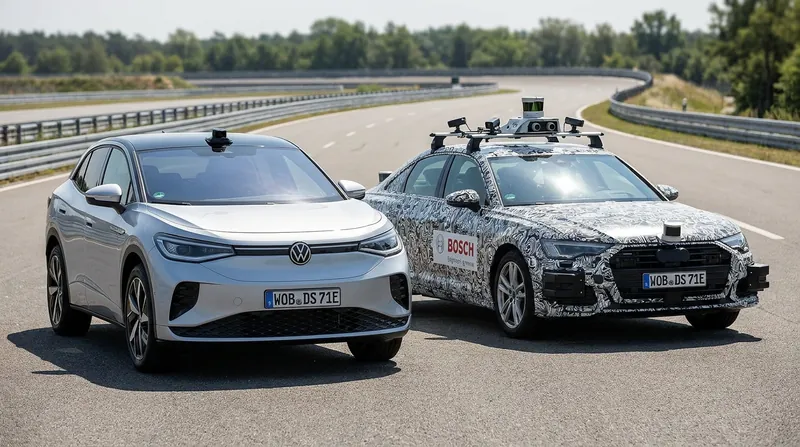
Volkswagen Scraps €1.5 Billion Autonomous Driving Alliance with Bosch Over Software Competitiveness
4 sources
Robotaxi Tech
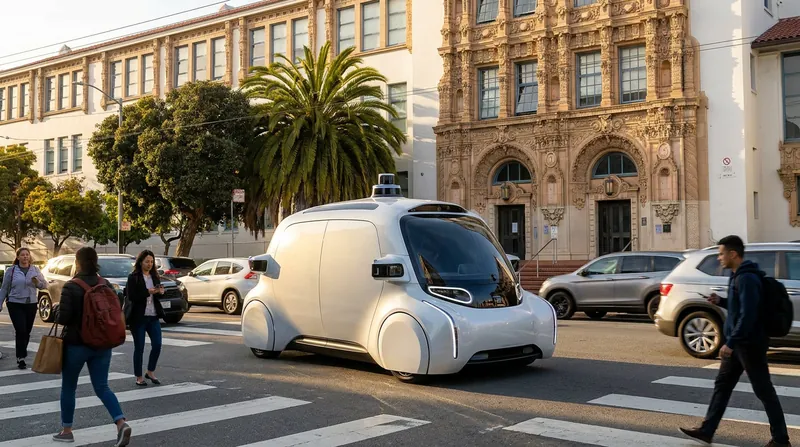
Waymo Recalls Nearly 4,000 Robotaxis After Software Failure Allows Entry Into Closed Freeway Construction Zones
4 sources
Robotaxi Regulation
NHTSA Proposes Rule Change to Eliminate Mandatory Brake Pedals in Purpose-Built Autonomous Vehicles
2 sources
Robotaxi Scale
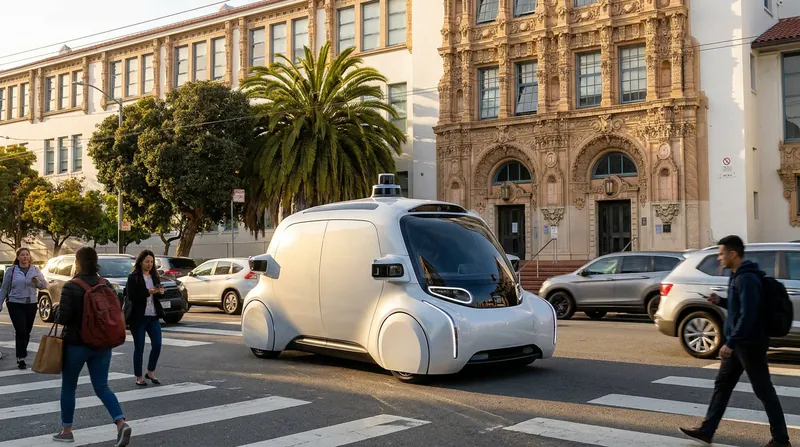
How Level 4 Autonomous Robotaxis Scaled to 11 Cities in 2026
2 sources
Comments
Every angle. Every day.
Get Automotive & Transportation stories with full source coverage and perspective breakdowns, free every day.