
How Electric Hydrofoils Are Rewriting the Rules of Boating
By combining underwater wings with aerospace software, a new generation of electric boats is overcoming water resistance to achieve unprecedented range and speed.
By Factlen Editorial Team
- Marine Engineers & Designers
- Focuses on the physics of drag reduction and the software required for stable flight.
- Environmental Advocates
- Highlights the ecological benefits of zero emissions and wake reduction.
- Boating Enthusiasts & Consumers
- Prioritizes range, ride comfort, and the practicalities of ownership.
What's not represented
- · Traditional Marina Operators
- · Commercial Fishermen
Why this matters
By solving the massive energy drain of water resistance, hydrofoil technology finally makes long-range, zero-emission boating viable. This breakthrough paves the way for silent, wake-free public transit on our waterways, fundamentally changing how coastal cities and island nations move people.
Key points
- Water resistance drastically limits the range of traditional electric boats, requiring massive batteries for minimal distance.
- Hydrofoils act as underwater wings, lifting the hull out of the water and reducing drag by up to 80 percent.
- Aerospace-grade flight controllers adjust the foils up to 100 times per second to ensure a smooth, stable ride.
- Modern electric hydrofoils can achieve ranges of 60 to 90 nautical miles at cruising speeds of 25 knots.
- The technology eliminates destructive wakes, protecting shorelines and marine ecosystems from erosion.
- High upfront costs and strict weight limits remain the primary hurdles for widespread consumer adoption.
The electrification of transportation has conquered roads, but water has remained a stubborn, unforgiving frontier. While an electric car rolls effortlessly down a highway, a boat must push its way through a medium that is nearly 800 times denser than air.[6]
Marine engineers often compare driving a traditional boat hull through water at high speeds to driving a car with a massive parachute deployed out the back. The physical resistance is immense, and overcoming it requires a staggering amount of continuous energy.[7]
For early electric boats, this immutable law of physics forced a brutal compromise. Designers either had to limit vessels to a crawling pace to conserve energy, or pack the hull with massive, heavy batteries that still only yielded a fraction of the range of a standard gas tank. Range anxiety on the water wasn't just a psychological hurdle; it was a mathematical certainty.[1][6]
The solution to this energy crisis didn't come from a breakthrough in battery chemistry, but from a radical shift in hull design. By taking the boat out of the water entirely, a new generation of electric hydrofoils is fundamentally rewriting the rules of maritime transport.[3]

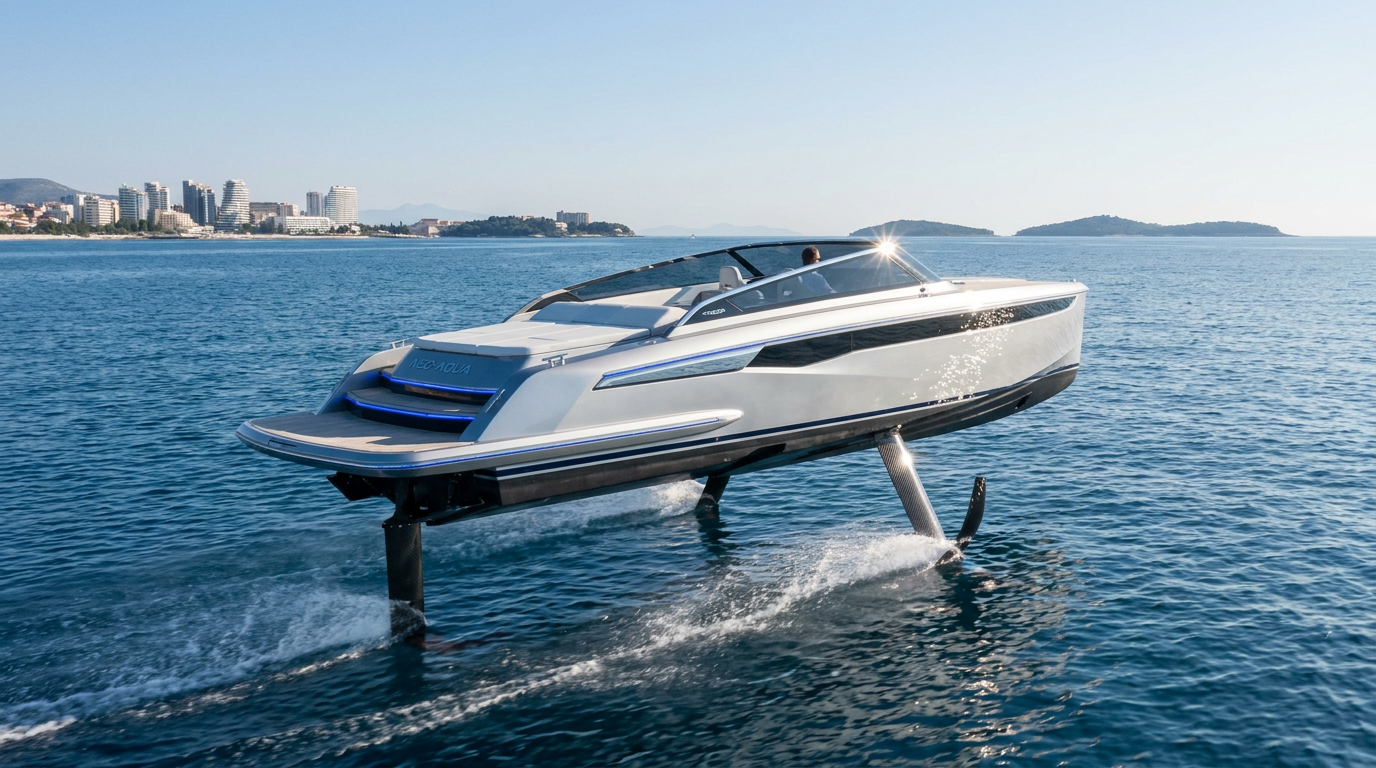
Hydrofoils are essentially underwater wings. As the vessel accelerates, water flows over these submerged carbon-fiber structures, generating upward lift in the exact same aerodynamic manner that an airplane wing generates lift in the sky.[1]
The transition is seamless. At lower speeds, the vessel operates like a normal boat. But as it accelerates past 15 to 18 miles per hour, the magic happens: the hull completely clears the surface. By flying above the waves, the boat leaves only the slender struts and torpedo-shaped electric motors submerged.[4][5]
The resulting efficiency gains are staggering. Eliminating hull friction reduces hydrodynamic drag by up to 80 percent. Suddenly, a relatively modest electric car battery—like the 69-kilowatt-hour pack used in some models—can propel a 30-foot boat for 60 to 90 nautical miles at cruising speeds of 25 knots.[1][4][5]

But raw physics is only half the story; the other half is silicon. Water is a chaotic, constantly shifting environment. Balancing a multi-ton vessel on submerged wings requires constant, microscopic corrections to prevent the boat from crashing back into the waves.[1][7]
But raw physics is only half the story; the other half is silicon.
To achieve this, modern electric hydrofoils rely on aerospace-grade flight controllers. Using a network of ultrasonic sensors, gyroscopes, and accelerometers, the onboard computer reads the water surface ahead and adjusts the angle of the foils up to 100 times per second.[1][7]
This software-driven stability creates an otherworldly passenger experience. Because the hull flies above the chop, the boat doesn't slam into waves or roll with the swells. It delivers a "magic carpet ride" that virtually eliminates seasickness, even in rougher coastal conditions.[2][8]
The environmental benefits extend far beyond zero tailpipe emissions. Traditional fast boats displace massive amounts of water, creating destructive wakes that erode shorelines, damage docks, and disturb delicate marine ecosystems.[7]

A foiling boat, by contrast, slices cleanly through the water, leaving a wake no larger than a kayak's. Combined with submerged electric motors, the vessels operate in near-total silence, allowing passengers to converse in whispers while cruising at 30 miles per hour.[4][7]
The consumer market is already seeing fierce competition. Sweden's Candela has led the charge with its C-8 daycruiser, utilizing Polestar batteries to achieve unprecedented range. Meanwhile, California-based Navier has introduced the N30, a carbon-fiber powerhouse boasting twin 90-kilowatt motors and advanced America's Cup foiling technology.[4][5]
Yet the most profound impact of this technology will likely be in commercial transit. Ferries account for a disproportionate amount of maritime pollution—in Europe, for example, they represent just 3 percent of vessels but generate 10 percent of the sector's emissions.[3]
Cities and island nations are taking notice. Stockholm has integrated foiling ferries into its public transit network, cutting commute times in half because the wake-free vessels are exempt from urban speed limits. Similarly, massive fleets of electric water taxis are being deployed in the Maldives to create zero-emission inter-island transit networks.[8][9][10]

Challenges remain, primarily regarding cost and weight. The extensive use of carbon fiber and aerospace electronics pushes the price of leisure models well past $350,000. Furthermore, foiling requires strict weight management; overload the boat with too much cargo, and it simply cannot generate the lift required to fly.[5][6]
There are also practical concerns about submerged debris. While the software can adjust for minor impacts, striking a submerged log at 30 knots remains a risk. To mitigate this, manufacturers are engineering breakaway mechanisms and retractable foils that also allow for shallow-water docking.[7][8]
Despite these hurdles, the trajectory of the industry is clear. By marrying the aerodynamics of flight with the silent efficiency of electric propulsion, hydrofoils have finally made sustainable, high-speed boating a reality, proving that the best way to travel on the water is to fly above it.[3][8]
How we got here
2014
Candela is founded in Sweden with the goal of applying aerospace technology to electric boats.
2021
Early electric hydrofoil models like the Candela C-7 prove the concept of software-stabilized foiling.
2023
The Candela C-8 and Navier N30 are introduced, bringing longer ranges and advanced carbon-fiber designs to the consumer market.
2024
Stockholm launches the world's first electric hydrofoil passenger ferry service, cutting commute times in half.
2025
An electric hydrofoil successfully crosses the Baltic Sea, proving the viability of long-distance zero-emission sea travel.
2026
Major commercial deployments begin, including a 100-vessel electric water taxi network in the Maldives.
Viewpoints in depth
Marine Engineers & Designers
Focuses on the physics of drag reduction and the software required for stable flight.
This camp emphasizes that the electrification of boating is fundamentally a physics problem, not just a battery chemistry challenge. By utilizing aerospace-grade flight controllers that adjust the foils 100 times per second, engineers have solved the massive hydrodynamic drag that previously crippled electric boat range. Their focus remains on optimizing carbon-fiber structures and sensor arrays to make foiling even more efficient.
Environmental Advocates
Highlights the ecological benefits of zero emissions and wake reduction.
For environmental groups, the appeal of electric hydrofoils extends beyond the elimination of fossil fuels. Traditional boat wakes cause severe shoreline erosion and disrupt marine habitats. Because hydrofoils leave almost no wake and operate in near-total silence, advocates view them as a critical tool for decarbonizing sensitive waterways and reducing noise pollution that harms aquatic life.
Boating Enthusiasts & Consumers
Prioritizes range, ride comfort, and the practicalities of ownership.
Consumers and boating analysts are excited by the "magic carpet ride" that eliminates seasickness and hull slamming, but they remain focused on the bottom line. While the extended range of 60 to 90 nautical miles makes electric boating viable, this camp points to the high upfront costs—often exceeding $350,000—and the strict weight limits required for foiling as hurdles that must be overcome before mass adoption can occur.
What we don't know
- How well the delicate carbon-fiber foils and sensors will hold up to decades of harsh saltwater corrosion.
- Whether economies of scale will eventually bring the $350,000+ price tag down to a level accessible to average consumers.
- How existing marinas and waterways will adapt their infrastructure to accommodate deep-draft foils and high-voltage fast charging.
Key terms
- Hydrofoil
- An underwater wing designed to generate lift and raise a vessel's hull out of the water as it accelerates.
- Hydrodynamic Drag
- The physical resistance a boat experiences as it pushes through water, which increases exponentially with speed.
- Flight Controller
- The onboard computer system that uses sensors to read the water and adjusts the foils continuously to keep the boat stable.
- Displacement Mode
- The traditional way a boat operates when its hull is resting in and pushing through the water, before it reaches the speed required to fly on its foils.
Frequently asked
Do you need a pilot's license to drive a hydrofoil boat?
No. Modern electric hydrofoils are driven like conventional boats; the onboard flight controller and software automatically handle the complex physics of balancing on the foils.
What happens if the boat hits a wave or submerged debris?
The software adjusts the foils instantly to absorb wave impacts for a smooth ride. For larger submerged debris, the foils are built from ultra-strong carbon fiber, and many models feature breakaway or retractable mechanisms to prevent catastrophic hull damage.
Can these boats operate in shallow water?
Yes. Most modern hydrofoils feature retractable struts that can be raised, allowing the boat to operate in a traditional displacement mode for shallow-water navigation and docking.
Why are they so much more efficient than regular boats?
Water is incredibly dense. By lifting the hull out of the water entirely, hydrofoils eliminate the massive friction (hydrodynamic drag) that normally drains a boat's fuel or battery power.
Sources
Source coverage
10 outlets
3 viewpoints surfaced










[1]Power Transmission WorldMarine Engineers & Designers
With hydrofoil you fly on water
Read on Power Transmission World →[2]The LogBoating Enthusiasts & Consumers
Poseidon AmphibWorks is Combining Cars, Boats and Hydrofoils
Read on The Log →[3]Curbing CarbonEnvironmental Advocates
Electric Hydrofoils: Redefining Sustainable Maritime Transport
Read on Curbing Carbon →[4]Boating MagBoating Enthusiasts & Consumers
2024 Candela C-8 Open Daycruiser Boat Test, Pricing, Specs
Read on Boating Mag →[5]Powerboat and RIBMarine Engineers & Designers
Overview: Navier N30
Read on Powerboat and RIB →[6]YachtWorldBoating Enthusiasts & Consumers
The Rise of Electric Boats: A Boater's Guide
Read on YachtWorld →[7]The Green BoaterEnvironmental Advocates
The Electric Advantage: Why Foiling Shines
Read on The Green Boater →[8]The Cool DownEnvironmental Advocates
Revolutionary all-electric hydrofoil boat just shattered major world record
Read on The Cool Down →[9]AutoEvolutionBoating Enthusiasts & Consumers
100 US-Made Electric Flying Boats Worth $100M Bring Clean Mobility to the Maldives
Read on AutoEvolution →[10]ElectriveEnvironmental Advocates
Candela builds ten electric hydrofoil boats for the Maldives
Read on Electrive →
Every angle. Every day.
Get automotive stories with full source coverage and perspective breakdowns delivered to your inbox.