
How Electric Hydrofoil Boats Are Decarbonizing the Maritime Industry
By combining aerospace engineering with marine design, a new generation of 'flying' electric boats is solving the industry's massive emissions and efficiency problems.
By Factlen Editorial Team
- Marine Technologists
- Engineers focused on solving the physics of water resistance through aerospace technology.
- Environmental Advocates
- Groups prioritizing the reduction of lifecycle carbon emissions and shoreline erosion.
- Commercial Operators
- Transit authorities and businesses focused on fuel savings and faster commute times.
What's not represented
- · Traditional boatbuilders facing disruption
- · Harbormasters managing mixed-speed traffic
Why this matters
Maritime transport is one of the hardest sectors to decarbonize due to the immense energy required to push boats through water. Hydrofoiling solves this physics problem, paving the way for zero-emission ferries that could drastically reduce global shipping pollution and cut commuter travel times.
Key points
- Electric hydrofoil boats use underwater wings to lift their hulls out of the water, reducing hydrodynamic drag by up to 90 percent.
- The massive reduction in drag allows these vessels to achieve high speeds and long ranges using standard electric vehicle batteries.
- A life-cycle analysis shows that foiling electric ferries emit 97.5 percent less carbon dioxide over 30 years compared to diesel equivalents.
- Because the hull does not displace water while cruising, the boats produce virtually no wake, protecting shorelines and enabling faster harbor commutes.
- Major commercial deployments are underway, including a 150-passenger ferry in the UK and a 20-vessel fleet in Norway.
The maritime industry has long battled a fundamental problem of physics: water is nearly 800 times denser than air. Pushing a heavy hull through this dense medium creates immense hydrodynamic drag, a force that increases exponentially as a vessel accelerates. For over a century, naval architects solved this problem with brute force, strapping increasingly massive, fuel-thirsty combustion engines to the back of boats to plow through the resistance.
As the world transitions toward sustainable energy, this brute-force approach has hit a wall. Electrifying a traditional boat is notoriously difficult because batteries are heavy and hold far less energy density than diesel. To push a standard displacement hull at high speeds, an electric boat requires a battery pack so massive that its own weight severely limits the vessel's range and payload capacity.
Enter the electric hydrofoil. By combining aerospace engineering with advanced marine design, a new generation of vessels is literally taking flight. Rather than fighting the water, these boats rise above it, offering a technological breakthrough that is poised to decarbonize both recreational boating and commercial maritime transport.
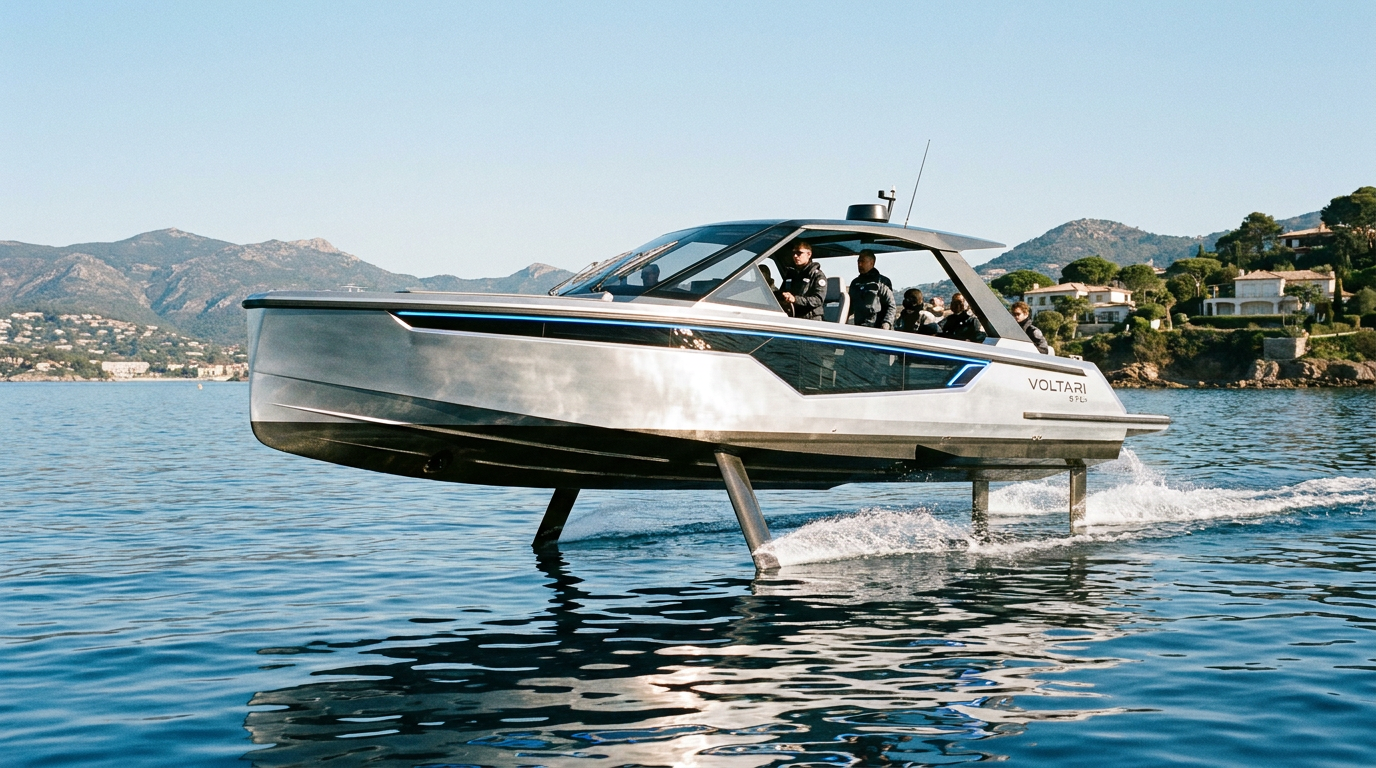
The core mechanism relies on hydrofoils—wing-like structures mounted on struts beneath the hull. Much like the wings of an airplane generate lift by manipulating air pressure, hydrofoils generate upward force as water flows over their curved surfaces.[1]
When an electric hydrofoil boat accelerates, it initially operates like a traditional vessel, pushing through the water. But as it reaches a critical speed—typically around 16 knots—the lift generated by the underwater wings exceeds the weight of the boat. The hull smoothly rises several feet into the air, leaving only the thin struts and the torpedo-shaped electric motors submerged.[1]

This delicate balancing act is managed by sophisticated, aerospace-grade flight controllers. Because a boat elevated on narrow struts is inherently unstable, onboard computers read data from gyroscopes, accelerometers, and ultrasonic height sensors. These controllers adjust the angle of the foils up to 100 times per second, compensating for pitch, roll, and oncoming waves to keep the vessel perfectly level.[1][4]
The resulting efficiency gains are staggering. By lifting the hull out of the water, hydrofoiling eliminates the surface friction and wave-making resistance that plague traditional boats. This reduces total hydrodynamic drag by 80 to 90 percent, fundamentally rewriting the math of marine propulsion.[3][6][8]
This massive reduction in drag is the magic key that unlocks electric boating. Because the vessel requires only a fraction of the energy to maintain its cruising speed, it can achieve long ranges using relatively small, lightweight battery packs. For example, a foiling boat can travel over 50 nautical miles at 25 knots on a battery similar to what is found in a standard electric car.[8]
The environmental benefits extend far beyond simply swapping diesel fuel for electricity. A comprehensive life-cycle assessment conducted by Sweden's KTH Royal Institute of Technology compared the total carbon footprint of electric hydrofoil ferries to traditional diesel vessels. The study found that over a 30-year lifespan—accounting for manufacturing, battery production, and daily operation—the foiling electric ferry emits 97.5 percent less carbon dioxide.[2]

The environmental benefits extend far beyond simply swapping diesel fuel for electricity.
Furthermore, because the hull never touches the surface while cruising, these boats produce virtually no wake. Traditional ferries displace massive amounts of water, sending destructive waves crashing into shorelines, eroding beaches, and damaging docked vessels. The wake of a foiling ferry is often measured at just a few inches, comparable to a small dinghy.[5][7]
This lack of wake has profound implications for urban transport. In Stockholm, where speed limits are strictly enforced to protect the archipelago's fragile shorelines, the Candela P-12 hydrofoil ferry was granted a historic exemption. Because it leaves no destructive wake, the electric ferry is legally permitted to fly at top speed through restricted zones, cutting commuter travel times in half.[2]
For passengers, the experience is fundamentally altered. Because the boat flies above the surface chop, it does not slam into waves. The ride is eerily silent, devoid of engine rumble, exhaust fumes, and the jarring impacts that typically cause seasickness.[3][7]

Commercial operators are moving rapidly to adopt the technology. In Norway, transport operator Boreal recently ordered 20 Candela hydrofoil vessels to serve its fjord-lined coastal routes, aiming to create the world's largest zero-emission high-speed fleet.[5]
The scale of these vessels is also expanding. In the United Kingdom, Artemis Technologies is developing the EF-24, a massive 150-passenger electric hydrofoil ferry. Scheduled to begin operations between Southampton and the Isle of Wight in 2026, the vessel is projected to save 3,700 tons of carbon dioxide emissions annually compared to the diesel ferry it replaces.[6]
The recreational market is experiencing a similar boom. Silicon Valley startup Navier has launched the N30, an all-electric hydrofoil dayboat designed by MIT engineers and America's Cup naval architects. The vessel boasts a 75-mile range and autonomous docking features, positioning itself as a pioneer in luxury sustainable boating.[3]
Other startups are entering the fray with their own specialized designs. Canada's ENVGO recently secured funding for its luxury six-passenger cruiser, while New Zealand's Vessev is testing the VS-9, a commercial tourism vessel that utilizes America's Cup foiling techniques to handle rougher ocean swells.[4][8]

Despite the immense promise, the technology faces significant hurdles. The upfront engineering and manufacturing costs are exceptionally high. To keep weight down, these boats rely heavily on expensive, vacuum-infused carbon fiber for their hulls and struts.[1]
There are also operational risks unique to flying boats. Striking a submerged log or shipping container at 30 knots while elevated on carbon-fiber struts could be catastrophic. To mitigate this, manufacturers engineer the foils with designated sheer points, allowing the wing to break away cleanly upon severe impact to protect the hull's integrity.[1]
Regulatory hurdles also remain, particularly in the United States. The century-old Jones Act mandates that vessels transporting passengers between U.S. ports must be built domestically, complicating the deployment of foreign-built hydrofoil ferries in American waters.
Nevertheless, the maritime industry has reached a clear inflection point. By solving the physics problem of water resistance, electric hydrofoils are transforming waterways from slow, polluting obstacles into high-speed, zero-emission highways.
How we got here
2019
Swedish manufacturer Candela launches the C-7, proving the concept of a production electric hydrofoil.
2022
A KTH Royal Institute of Technology study reveals foiling ferries reduce lifecycle CO2 emissions by 97.5%.
2024
The Candela C-8 becomes the first electric boat to successfully cross the Baltic Sea.
2025
Silicon Valley startup Navier debuts the N30, an all-electric hydrofoil dayboat designed by MIT engineers.
2026
The Artemis EF-24, a massive 150-passenger hydrofoil ferry, is scheduled to begin operations in the UK.
Viewpoints in depth
Marine Technologists
Focused on the physics of drag reduction and battery efficiency.
For marine engineers, the hydrofoil is the only viable mathematical solution to electrifying the water. Because water is incredibly dense, pushing a traditional hull requires exponential energy as speed increases. Technologists argue that adding larger batteries to displacement hulls is a dead end, as the added weight negates the energy gains. By utilizing aerospace flight controllers to lift the boat, they bypass the density of water entirely, making electric maritime transport physically and economically feasible.
Environmental Advocates
Focused on the elimination of emissions and the protection of fragile shorelines.
Environmental groups champion hydrofoils not just for their zero-emission electric motors, but for their physical interaction with the environment. Traditional ferries generate massive wakes that erode coastlines, destroy marine habitats, and damage docked vessels. Because a hydrofoil leaves a wake of only a few inches, advocates see it as a way to dramatically increase public transit on waterways without degrading the surrounding aquatic ecosystem.
Commercial Operators
Focused on operational costs, travel times, and regulatory exemptions.
For ferry operators and transit authorities, the appeal of hydrofoils is strictly economic and logistical. The 80 to 90 percent reduction in energy use translates directly to massive savings on fuel and maintenance. Furthermore, because the boats produce no wake, operators can secure exemptions from strict harbor speed limits. This allows them to cut commute times in half, making water transit highly competitive with cars and trains.
What we don't know
- How quickly high-voltage DC fast-charging infrastructure can be deployed at commercial marinas to support large-scale ferry fleets.
- Whether international maritime regulations will be updated swiftly enough to accommodate the unique high-speed, low-wake capabilities of these vessels.
- How the long-term maintenance costs of aerospace-grade flight controllers will compare to traditional diesel engine upkeep over a 20-year lifespan.
Key terms
- Hydrofoil
- An underwater wing that generates lift as it moves through the water, raising the boat's hull above the surface.
- Hydrodynamic Drag
- The physical resistance a boat experiences as it pushes through water, which increases exponentially with speed.
- Flight Controller
- An onboard computer system that adjusts the angle of the hydrofoils dozens of times per second to maintain stability.
- Displacement Hull
- A traditional boat design that rests in the water and pushes fluid out of the way, requiring massive energy to move at high speeds.
- Wake
- The waves created by a boat displacing water, which can erode shorelines and damage docked vessels.
Frequently asked
What happens if a hydrofoil boat hits a log?
Most modern hydrofoils are engineered with designated sheer points. If the strut strikes heavy debris at high speed, the foil breaks away cleanly to protect the hull from catastrophic damage.
Can hydrofoil boats operate in shallow water?
Yes. The underwater struts and foils can be fully retracted into the hull, allowing the vessel to navigate shallow marinas and be loaded onto standard trailers.
Do hydrofoil boats cause seasickness?
They actually prevent it. Because the hull flies above the waves rather than crashing through them, the ride is exceptionally smooth and stable, eliminating the jarring motions that cause nausea.
Why are they more efficient than regular electric boats?
Pushing a traditional hull through dense water requires massive amounts of energy. By lifting the hull into the air, hydrofoils reduce drag by up to 90%, allowing the boat to travel much further on a smaller battery.
Sources
Source coverage
8 outlets
3 viewpoints surfaced








[1]Yachting MagazineMarine Technologists
Candela's C-8 Foil Yacht Reviewed
Read on Yachting Magazine →[2]Marine LogEnvironmental Advocates
Study indicates foiling e-ferries deliver huge CO2 savings
Read on Marine Log →[3]Haute LivingCommercial Operators
Navier's Groundbreaking Boat of the Future: A Revolutionary Ride
Read on Haute Living →[4]CTV NewsMarine Technologists
Waterloo, Ont. startup aims to change boating with 'flying' electric vessel
Read on CTV News →[5]Good News NetworkEnvironmental Advocates
Fleet of 'Flying Ferries' Will Provide Zero-Emission, Silent EV Boats for Travelers Along Norway's Busy Coast
Read on Good News Network →[6]AZoCleantechCommercial Operators
Hydrofoil Technology and its Future in Zero-Emission Transport
Read on AZoCleantech →[7]The Cool DownEnvironmental Advocates
Revolutionary all-electric hydrofoil boat just shattered major world record
Read on The Cool Down →[8]ElectrekMarine Technologists
Meet Vessev and its ultra-efficient electric hydrofoil boat designed for smooth tourist rides
Read on Electrek →
Every angle. Every day.
Get automotive stories with full source coverage and perspective breakdowns delivered to your inbox.