
How Data Center REITs Are Powering the 2026 AI Infrastructure Boom
As artificial intelligence demands unprecedented computing power, specialized real estate investment trusts are transforming from niche property managers into the critical backbone of the digital economy.
By Factlen Editorial Team
- Wholesale Infrastructure Advocates
- Focus on the necessity of massive, power-dense campuses and long-term single-tenant leases to support AI scale.
- Interconnection Proponents
- Prioritize highly connected, multi-tenant hubs that route data efficiently between different networks and edge locations.
- Market Analysts
- Evaluate the sector through a financial lens, weighing the massive returns against the risks of high capex and hyperscaler self-building.
What's not represented
- · Local communities facing power grid strain from new data centers
- · Environmental groups concerned about the massive energy and water consumption of AI facilities
Why this matters
For investors and tech observers alike, understanding the physical footprint of AI reveals where billions of dollars in capital expenditure are actually going—offering a tangible way to participate in the tech boom without betting on individual software winners.
Key points
- Data center REITs own and manage the specialized physical facilities that house the servers and networking gear powering the internet and AI.
- The generative AI boom has drastically increased the power density requirements of data centers, pushing racks from 15 kilowatts to over 100 kilowatts.
- Top data center REITs have delivered returns of roughly 40% over the past year due to intense demand and limited supply.
- Power scarcity and grid constraints have created a strong economic moat for REITs that already possess locked-in power purchase agreements.
- The sector faces risks from high interest rates and the threat of major tech companies choosing to build their own proprietary data centers.
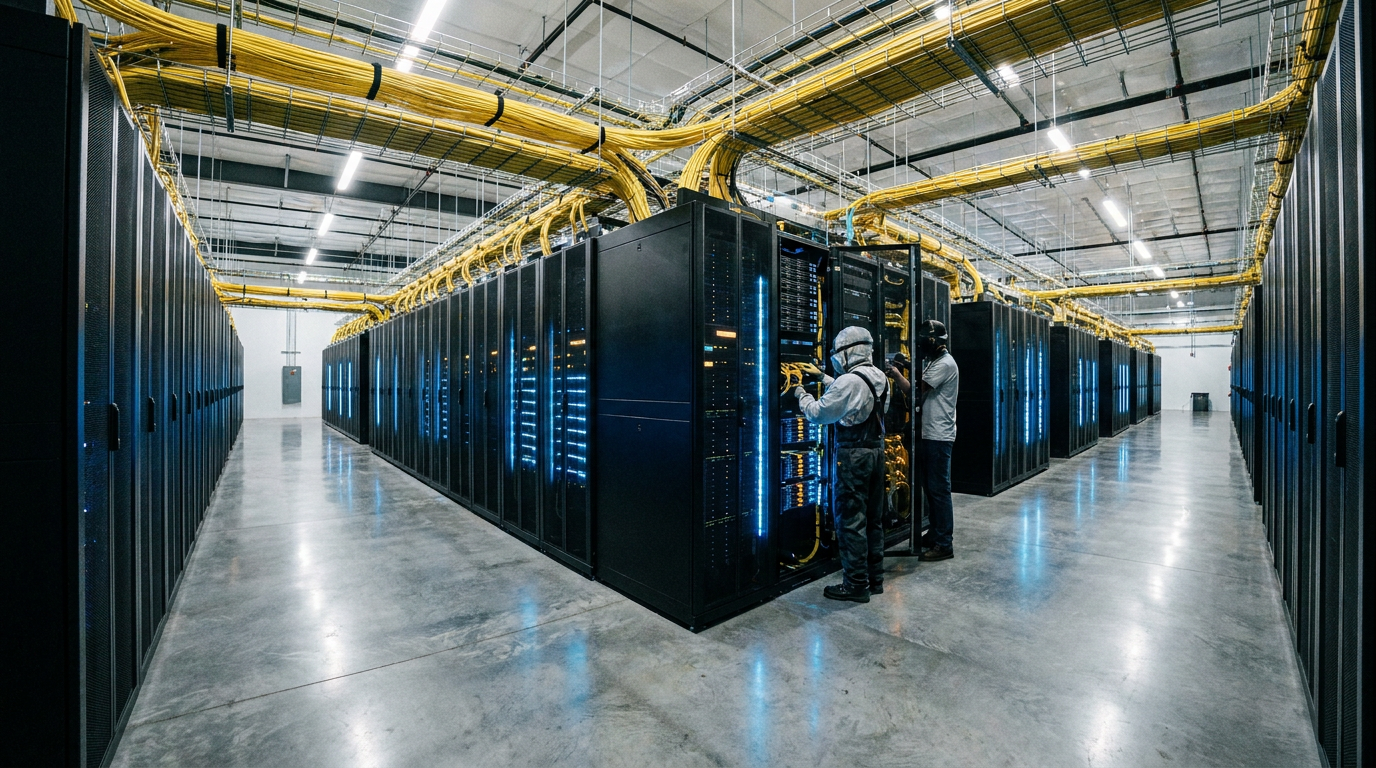
The artificial intelligence revolution is most often visualized through the lens of software—lines of code, complex neural networks, and sleek chatbots that can write essays or generate art in seconds. But in reality, the AI boom is fundamentally a massive, concrete-and-steel real estate project. Behind every generative AI prompt and enterprise machine learning model sits a physical facility housing thousands of servers, miles of high-speed networking cables, and industrial-grade cooling systems. As the digital economy expands, the physical footprint required to sustain it is growing at an unprecedented rate, transforming the landscape of commercial real estate.[1][5]
As technology giants race to build out their artificial intelligence capabilities, they are increasingly relying on specialized landlords known as Data Center Real Estate Investment Trusts (REITs). These publicly traded companies own, develop, and manage the highly specialized buildings that house the internet's most critical infrastructure. Rather than tech companies tying up billions of dollars in buying land and pouring concrete, they frequently turn to these specialized developers to provide the physical foundation for their digital empires. This dynamic has elevated data center REITs from a niche subsector of commercial real estate into one of the most vital components of the modern global economy.[3][7]
A Real Estate Investment Trust is a corporate structure originally created in the 1960s to allow everyday investors to pool their capital and buy shares in large-scale commercial property portfolios. By law, REITs are required to distribute at least 90% of their taxable income to shareholders in the form of dividends, making them a popular vehicle for income-seeking investors. While traditional REITs might focus on shopping malls, apartment buildings, or office towers, data center REITs operate at the lucrative intersection of real estate and advanced technology, offering a unique way to invest in the digital economy's growth without taking on the risk of individual software startups.[7]

The business model of a data center REIT is straightforward in concept but extraordinarily capital-intensive in execution. These companies acquire strategic parcels of land, secure massive power agreements from local utility providers, and construct the physical 'shells' of the buildings. They then lease this highly optimized space—complete with redundant power supplies, advanced cooling, and physical security—to tenants ranging from enterprise businesses to 'hyperscalers' like Amazon Web Services, Microsoft Azure, and Google Cloud. The tenants bring their own servers and networking gear, while the REIT ensures the environment remains perfectly calibrated to keep that hardware running flawlessly around the clock.[5][7]
While data centers have been growing steadily for two decades, the sector exploded in relevance after 2023, when generative AI shifted from a research curiosity to a mandatory enterprise workload. Training large language models requires massive clusters of specialized graphics processing units (GPUs), which in turn require unprecedented amounts of electricity. According to industry analysts, the sheer scale of the infrastructure buildout required to support these AI models has transformed data center capacity from a standard commercial asset into a critical piece of national infrastructure, with hyperscalers committing hundreds of billions of dollars to secure the necessary space.[6]
This shift to AI has fundamentally altered how data centers must be designed and operated. Traditional cloud computing facilities were built to handle power densities of roughly 10 to 15 kilowatts per server rack. AI workloads, however, routinely push those requirements to 50, 100, or even 150 kilowatts per rack. This extreme density generates immense heat, forcing data center REITs to retrofit existing facilities and design entirely new campuses equipped with advanced liquid cooling technologies rather than traditional forced-air conditioning. The ability to support these ultra-dense deployments has become a primary competitive differentiator among the major landlords.[5][8]

This shift to AI has fundamentally altered how data centers must be designed and operated.
Two major players dominate the publicly traded data center REIT landscape in 2026: Digital Realty and Equinix. While both companies are riding the massive tailwinds of the AI wave, they approach the market with distinct, complementary strategies. Digital Realty focuses heavily on wholesale data centers—massive, sprawling campuses designed to house the core infrastructure of the world's largest technology companies. The company has committed billions to AI-optimized facilities, including a recent €5 billion investment in French AI infrastructure, and frequently signs long-term leases that lock in revenue for five to fifteen years.[3][8]
Equinix, by contrast, specializes in 'colocation' and interconnection. Rather than just renting vast, empty halls to a single giant tenant, Equinix operates highly connected hubs where thousands of different networks, cloud providers, and enterprise IT systems physically meet and exchange data. In early 2026, Equinix reported surpassing 500,000 global interconnections, a milestone that underscores its role as the central nervous system of the hybrid cloud. As AI models become more distributed and require real-time data from multiple sources, this dense web of physical connectivity becomes increasingly vital for enterprise customers.[2][9]
The financial returns for these digital landlords have been striking, reflecting the intense demand for their specialized assets. Over the twelve months ending in April 2026, top data center REITs delivered total returns hovering between 39% and 45%, significantly outperforming both the broader real estate sector and many traditional growth indices. This surge is driven by a simple, undeniable supply-and-demand imbalance: the technology industry's appetite for AI infrastructure is currently outpacing the physical world's ability to permit, power, and build it.[4][6]

The ultimate bottleneck in this digital land grab is not access to capital or the supply of silicon chips, but the availability of electricity. Utilities across the globe simply cannot deliver new substation capacity fast enough to support modern AI training campuses, which now routinely require 100 megawatts or more of dedicated power. This power scarcity has created a formidable economic moat for existing data center REITs. Companies that secured grid access and locked in power purchase agreements years before the AI boom began are now commanding premium valuations, as they control a finite resource in an era of exponential demand.[6][7]
However, the sector is not without its significant challenges and structural risks. Data center construction is extraordinarily expensive, with new AI-ready campuses often costing between $1 billion and $2 billion to deliver. Because REITs are legally required to pay out the vast majority of their income as dividends, they cannot easily fund these mega-projects from their own retained earnings. Instead, they must constantly tap debt and equity markets to finance their expansion. This heavy reliance on borrowing makes data center REITs highly sensitive to macroeconomic shifts, particularly fluctuations in interest rates that can squeeze profit margins on new developments.[3][6]

Furthermore, the REITs face growing competition from their own biggest customers. Technology giants like Meta have recently announced plans to build out tens of gigawatts of their own AI infrastructure over the coming decade, bypassing the landlords entirely when they have the capital and land to do so. At the same time, private equity firms and massive infrastructure funds are flooding the zone, backing private data center developers that do not have to answer to the quarterly dividend demands of public market investors, intensifying the competition for prime real estate and power contracts.[1]
Despite these headwinds, the long-term outlook for data center REITs remains incredibly robust. As artificial intelligence transitions from the initial 'training' phase—where massive models are built in centralized, power-hungry hubs—to the 'inference' phase—where those models are actually deployed and used by consumers and businesses in real-time—the need for distributed, low-latency data centers will only grow. For investors and technology strategists alike, data center REITs offer a unique proposition: a way to invest in the essential picks and shovels of the AI gold rush, backed by hard physical assets and long-term lease agreements, rather than trying to guess which software startup will ultimately win the algorithm wars.[1][4][5]
How we got here
1960
The U.S. Congress creates the Real Estate Investment Trust (REIT) structure to allow public investment in large-scale commercial real estate.
Late 1990s
The first specialized data center companies emerge during the dot-com boom to house the growing internet's physical infrastructure.
2010s
The rise of cloud computing drives a massive expansion in data center construction, solidifying the dominance of major REITs like Digital Realty and Equinix.
2023
The generative AI boom begins, triggering an unprecedented surge in demand for high-density, power-intensive data center capacity.
Early 2026
Top data center REITs report 40%+ annual returns as power scarcity and AI infrastructure demands drive premium valuations.
Viewpoints in depth
Wholesale Infrastructure Developers
Focus on building massive, power-dense campuses for single hyperscale tenants.
This camp, exemplified by companies like Digital Realty, argues that the future of AI relies on sheer scale. They focus on securing massive tracts of land and hundreds of megawatts of power to build dedicated campuses for giants like Amazon and Microsoft. Their evidence points to the unprecedented capital expenditure from these hyperscalers, arguing that locking in 10-to-15-year leases provides the most stable, predictable returns in the industry, even if it requires billions in upfront construction costs.
Interconnection and Edge Advocates
Prioritize highly connected, multi-tenant hubs that route data between different networks.
Proponents of the colocation model, such as Equinix, argue that AI's true value lies in inference—applying trained models to real-world data in real-time. They believe that as AI applications become embedded in everyday enterprise software, the ability to securely and quickly route data between different cloud providers, private networks, and end-users is more valuable than raw power. They point to their hundreds of thousands of cross-connects as a defensible moat that a new competitor cannot easily replicate just by pouring concrete.
Hyperscale Self-Builders
Tech giants who prefer to build and own their own data center infrastructure.
Companies like Meta and Google increasingly argue that relying entirely on third-party REITs is too slow and expensive for their most critical AI infrastructure. They advocate for a self-build model where they control the entire stack, from the land acquisition to the custom server design. By building their own gigawatt-scale campuses, they claim they can achieve better energy efficiency, customize liquid cooling systems specifically for their proprietary silicon, and avoid paying the profit margins demanded by commercial landlords.
What we don't know
- How quickly utility companies can upgrade regional power grids to support the gigawatt-scale campuses currently in the planning stages.
- Whether the massive capital expenditures by hyperscalers will eventually lead to an oversupply of data center capacity if AI monetization slows down.
- The extent to which next-generation silicon might become dramatically more energy-efficient, potentially altering the power density requirements of future facilities.
Key terms
- REIT (Real Estate Investment Trust)
- A corporate structure that allows investors to pool capital to invest in real estate portfolios, required by law to distribute at least 90% of taxable income as dividends.
- Hyperscaler
- Massive technology companies, such as Amazon, Google, and Microsoft, that dominate the global cloud computing and AI infrastructure markets.
- Colocation
- A data center model where multiple different companies rent space, power, and cooling within the same facility, often to connect their networks directly to one another.
- Power Density
- The amount of electricity consumed (and heat generated) by a single rack of servers, which has skyrocketed from 15 kilowatts to over 100 kilowatts due to AI.
- Liquid Cooling
- Advanced thermal management systems that use liquid coolants rather than forced air to dissipate the extreme heat generated by high-density AI processors.
Frequently asked
What exactly is a Data Center REIT?
A Data Center Real Estate Investment Trust (REIT) is a company that owns, operates, and finances the physical buildings that house computer servers and networking equipment. They lease this highly optimized space to tech companies and are required by law to pay out at least 90% of their taxable income as dividends to shareholders.
Why does AI require different data centers than regular cloud computing?
AI workloads, particularly training large language models, require massive clusters of specialized GPUs that consume significantly more electricity than traditional servers. This extreme power density generates immense heat, requiring specialized liquid cooling systems and reinforced infrastructure that older data centers often cannot support.
Who are the biggest customers for these data centers?
The largest tenants are 'hyperscalers'—massive technology companies like Amazon Web Services (AWS), Microsoft Azure, Google Cloud, and Meta. However, enterprise businesses, financial institutions, and government agencies also lease space in these facilities.
What are the main risks to investing in Data Center REITs?
The primary risks include high interest rates, which increase the cost of borrowing needed to build new facilities, and the threat of hyperscalers deciding to build their own data centers instead of leasing. Additionally, power grid constraints can limit their ability to expand in key markets.
Sources
Source coverage
9 outlets
3 viewpoints surfaced









[1]ForbesMarket Analysts
The AI Data Center Gold Rush Is Leaving The Landlords Behind
Read on Forbes →[2]S&P GlobalInterconnection Proponents
Equinix to hit over 150,000 cabinets in Americas as AI fuels data center demand
Read on S&P Global →[3]The Motley FoolInterconnection Proponents
Best Data Center REITs for 2026 and How to Invest
Read on The Motley Fool →[4]Investing.comMarket Analysts
3 Ways to Play the Data Center Land Grab
Read on Investing.com →[5]MarketWiseWholesale Infrastructure Advocates
Why DLR and EQIX Are the Best Data Center REITs for the AI Boom in 2026
Read on MarketWise →[6]Angel Investors NetworkMarket Analysts
Data Center REITs: 39–45% Returns on AI Infrastructure
Read on Angel Investors Network →[7]SmartAssetWholesale Infrastructure Advocates
Data Center REITs: A Guide for Investors
Read on SmartAsset →[8]Technology AdvisorsWholesale Infrastructure Advocates
Equinix and Digital Realty: Powering the AI Infrastructure Era
Read on Technology Advisors →[9]Efficiently ConnectedInterconnection Proponents
Equinix Signals AI-Driven Infrastructure Acceleration in 2026
Read on Efficiently Connected →
Every angle. Every day.
Get real estate stories with full source coverage and perspective breakdowns delivered to your inbox.