
How Citizen Documenters and Solutions Journalism Are Rebuilding Local News
Facing record levels of news avoidance, a growing movement of community cooperatives and citizen 'Documenters' is replacing doomscrolling with rigorous, solutions-focused civic journalism.
By Factlen Editorial Team
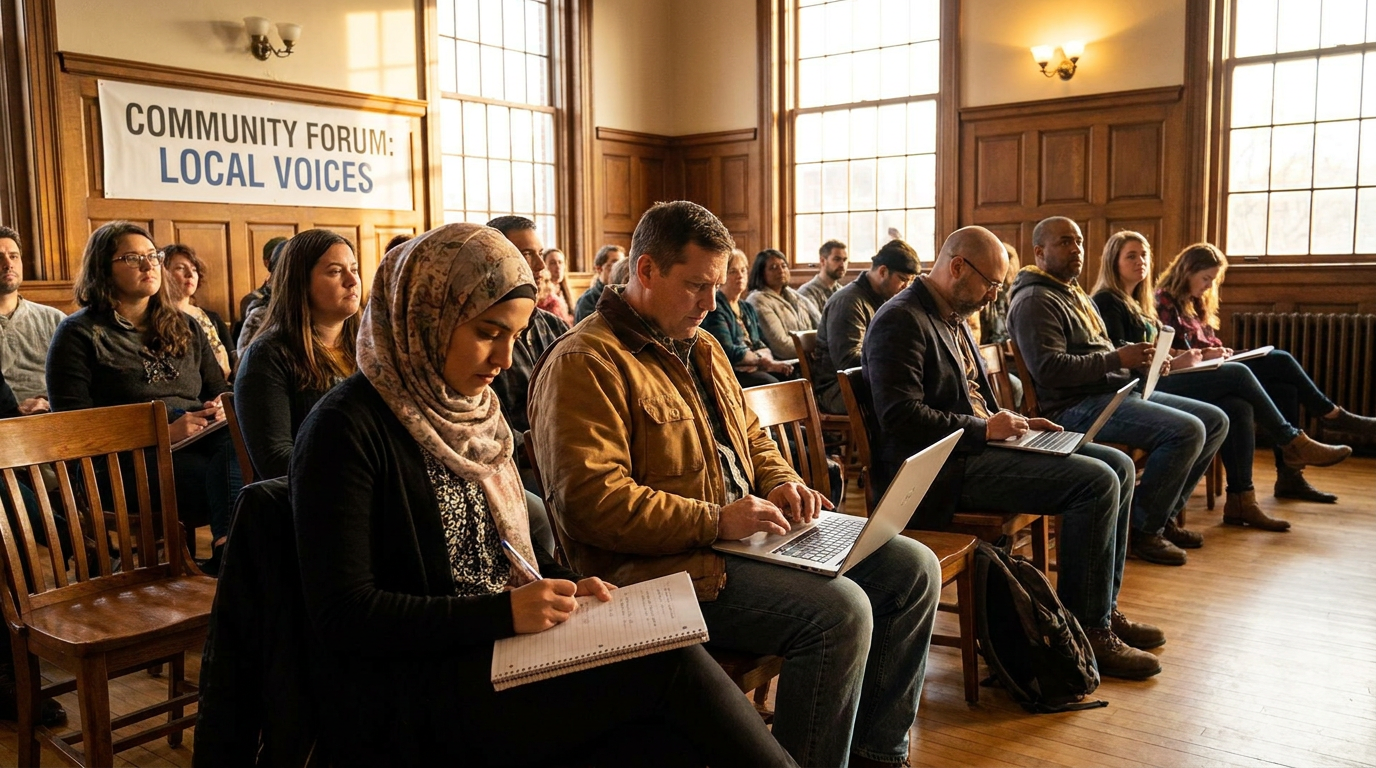
- Civic Journalism Advocates
- Argue that paying citizens to document local government democratizes information and fills critical news deserts.
- Solutions-Focused Editors
- Believe journalism must move beyond the 'disease model' to rigorously investigate responses to social problems.
- Community News Cooperatives
- Champion the reader-owned model where the audience directly funds and shapes the editorial agenda.
- Traditional Media Skeptics
- Worry about the financial sustainability of these models and the risk of 'soft' PR replacing hard accountability reporting.
What's not represented
- · Philanthropic foundations funding the initiatives
- · Local government officials being monitored by citizens
Why this matters
With 40% of people actively avoiding the news due to negativity bias, these community-driven models offer a blueprint for staying informed without sacrificing mental health. By paying residents to monitor local government, these programs empower everyday citizens to directly shape the policies and narratives that affect their neighborhoods.
Key points
- Roughly 40% of potential readers actively avoid the news due to its negative psychological impact.
- The Documenters Network pays everyday citizens to attend and record local government meetings, filling critical information gaps.
- Solutions journalism shifts the editorial focus from merely exposing problems to rigorously investigating how communities are solving them.
- Cooperative media models allow readers to own a share of the publication and directly commission investigations.
The modern media diet is heavily skewed toward the "disease model" of the world. Driven by the algorithmic reality that "if it bleeds, it leads," mainstream news feeds often prioritize conflict, crisis, and catastrophe. The psychological toll of this negativity bias is measurable: according to the Reuters Institute, roughly four out of ten potential readers now actively avoid the news, citing its detrimental impact on their mood and a lingering sense of learned helplessness. Yet, in response to this widespread fatigue, a quiet revolution is reshaping how communities interact with information.[8]
Across North America and Europe, a growing movement is dismantling the traditional, top-down broadcast model of journalism. Instead of treating readers as passive consumers of anxiety-inducing headlines, a new wave of civic media organizations is transforming them into active participants, investigators, and even owners. By centering reader voices and community dialogue, these platforms are proving that journalism can be a tool for civic empowerment rather than just a mirror reflecting societal decay.[7][8]
This shift is largely driven by two intersecting philosophies: "constructive journalism" and the deployment of citizen "Documenters." Together, they aim to fill the expanding news deserts left by the collapse of traditional local newspapers. By paying residents to monitor local government and rigorously investigating how communities are solving their own problems, these initiatives are rebuilding the public square from the ground up.[1][5]
At the vanguard of this participatory model is the Documenters Network, originally launched by the Chicago-based civic journalism lab City Bureau. The premise is radically simple: train and pay everyday citizens to attend local government meetings—city councils, zoning boards, police commissions—and take detailed, objective notes. These notes are fact-checked and published in a centralized, open-source database, creating a permanent public record where one often didn't exist.[1][2]

By 2026, the Documenters Network has expanded aggressively, growing to more than 25 sites across the United States and Canada. In Kansas City, a newly launched cohort through The Beacon recently trained over 90 residents—ranging from students and parents to retired educators and public transit riders—to monitor municipal boards across Jackson and Wyandotte counties. These citizens aren't just volunteering; they are compensated for their time, turning civic engagement into a recognized and valued labor force.[1]
The impact of this citizen-led surveillance is profound. A 2025 study analyzing the program in Grand Rapids, Michigan, revealed that a third of the public meetings covered by Documenters had no official city minutes posted. Even when official records existed, the citizen-generated notes frequently provided crucial hyperlinks and contextual background that municipal clerks omitted. By watching the watchmen, these residents are ensuring that the mundane but highly consequential machinery of local government operates in the light.[3]
This grassroots data collection directly feeds the broader journalistic ecosystem. In Southern California, San Diego Documenters—supported by the investigative outlet inewsource—covered 160 municipal meetings in a single year. Their dispatches on housing policy, water bills, and pollution regulations serve as vital leads for professional reporters, allowing newsrooms to punch above their weight class while ensuring that the lived experiences of marginalized neighborhoods dictate the editorial agenda.[2]
Parallel to the rise of citizen note-takers is the institutional embrace of "Solutions Journalism." Championed by organizations like the Solutions Journalism Network (SJN) and Germany's Bonn Institute, this approach fundamentally alters the journalistic formula. Rather than merely exposing a social problem and stopping there, solutions journalism demands rigorous, evidence-based reporting on the actual responses to those problems.[5][6]

Proponents are quick to clarify that this is not "fluff" or public relations. Constructive journalism requires the same critical rigor as investigative reporting. A true solutions story must dissect how a specific intervention works, provide qualitative or quantitative evidence of its impact, and—crucially—transparently report on its limitations and failures. It is about treating the cure with the same investigative scrutiny traditionally reserved for the disease.[5][8]
Proponents are quick to clarify that this is not "fluff" or public relations.
The adoption of this framework is accelerating globally. In 2025, the Bonn Institute partnered with Deutsche Welle to train cohorts of international broadcasters specifically in constructive reporting, acknowledging that digital usage data proves relentless negativity is no longer a sustainable audience strategy. Similarly, outlets like TriplePundit have built entire editorial models around solutions journalism, covering everything from the repurposing of abandoned mines in Australia to women-led electric rickshaw cooperatives in India.[4][6]
Academic research supports the efficacy of this pivot. Studies published in Journalism Practice indicate that solutions-focused reporting not only increases the time readers spend on a page but also significantly reduces the volume of hateful comments on social media. By presenting a problem alongside a credible, community-tested response, readers are left with a sense of agency and psychological empowerment, directly counteracting the apathy that drives news avoidance.[8]
Beyond content, the integration of reader voices is also transforming media ownership. In the United Kingdom, The Bristol Cable stands as a pioneering example of a cooperative news model. Owned by thousands of local paying members, the publication operates on a democratic mandate. Members vote on editorial campaigns, pitch investigations, and share their personal expertise through dedicated "Voices" columns.[7]
This cooperative structure inherently protects the newsroom from the clickbait incentives of ad-driven media. Because The Bristol Cable answers to its community shareholders rather than corporate advertisers, its journalists can pursue deep, months-long investigations into local housing developers or labor abuses. The readers are not just the audience; they are the commissioners of the journalism, ensuring that the reporting remains tethered to the actual needs of the city.[7]

The cooperative model also prioritizes media literacy. The Bristol Cable regularly hosts training sessions for its community contributors, teaching them media law, ethics, and investigative techniques. By demystifying the journalistic process and handing the tools of the trade directly to the public, the cooperative breaks down the traditional ivory tower of the newsroom, fostering a collaborative environment where professional reporters and citizen experts work side-by-side.[7]
Despite the undeniable momentum, the community-driven news sector faces significant structural hurdles. The most pressing is financial sustainability. While cooperative models rely on reader memberships, many civic journalism initiatives—including the rapid expansion of the Documenters Network—are heavily subsidized by philanthropic grants. Transitioning from foundation support to self-sustaining revenue models remains a critical challenge for the long-term viability of the movement.[2][3]
There is also the ongoing challenge of ensuring true demographic representation. If citizen journalism programs only attract retirees or individuals with ample free time, they risk replicating the very blind spots they were designed to eliminate. Program directors are acutely aware of this, which is why compensating Documenters is viewed not just as an ethical imperative, but as a structural necessity to ensure working-class and marginalized voices can afford to participate in the civic process.[1][3]
Furthermore, integrating solutions journalism into legacy newsrooms requires a massive cultural shift. Many veteran reporters, trained to view skepticism and problem-exposure as the pinnacle of their craft, initially resist constructive frameworks, fearing they blur the line into advocacy. Overcoming this ingrained professional reflex requires continuous training and a redefinition of what constitutes "hard news" in the 21st century.[6][8]

Yet, the trajectory is clear. As the traditional, ad-supported local news industry continues to contract, these hybrid models offer a viable, democratic alternative. By treating the public as intelligent collaborators rather than passive consumers, community-driven platforms are proving that the demand for high-quality information hasn't disappeared—it simply needs to be delivered in a format that respects the reader's agency.[1][7]
The ultimate promise of this movement is a more resilient civic infrastructure. When everyday people are equipped with the skills to document their local school board, and when newsrooms commit to highlighting the solutions being forged in their own backyards, the media ceases to be a source of despair. Instead, it becomes a shared utility, a collaborative first draft of history written by the people who are actually living it.[3][5]
How we got here
2018
City Bureau launches the Documenters program in Chicago to train citizens to cover public meetings.
2020
The Solutions Journalism Network expands globally, pushing newsrooms to adopt constructive reporting frameworks.
2024
The Bristol Cable's cooperative model gains international recognition as a sustainable path for reader-owned local news.
2025-2026
The Documenters Network expands to over 25 cities across North America, including major launches in Kansas City and Canada.
Viewpoints in depth
Civic Journalism Advocates
Argue that paying citizens to document local government democratizes information and fills critical news deserts.
This camp, which includes organizations like City Bureau and local outlets like The Beacon, views information as a public utility. They argue that the collapse of traditional local news has left municipal governments operating in the dark. By training and compensating everyday residents to attend zoning boards and city council meetings, they believe we can build a more resilient, people-powered public record that holds officials accountable while simultaneously increasing civic literacy among marginalized communities.
Solutions-Focused Editors
Believe journalism must move beyond the 'disease model' to rigorously investigate responses to social problems.
Proponents from the Solutions Journalism Network and the Bonn Institute argue that relentless negativity bias is actively harming democracy by driving news avoidance and learned helplessness. They advocate for a structural shift in editorial priorities, insisting that investigating how a community solves a problem—and transparently reporting on the limitations of that solution—is just as rigorous and newsworthy as exposing the problem in the first place.
Traditional Media Skeptics
Worry about the financial sustainability of these models and the risk of 'soft' PR replacing hard accountability reporting.
While acknowledging the crisis in local news, some traditionalists and academic observers express caution. They point out that many civic journalism initiatives are heavily reliant on philanthropic grants, which may not be sustainable long-term. Furthermore, there is a lingering concern within legacy newsrooms that an over-emphasis on 'solutions' could inadvertently blur the line between objective journalism and civic advocacy, potentially softening the adversarial watchdog role the press is meant to play.
What we don't know
- Whether philanthropic funding for these civic journalism programs can be replaced by sustainable, long-term reader revenue.
- How legacy national newsrooms will adapt their daily reporting structures to fully integrate solutions journalism at scale.
- If the presence of citizen Documenters will fundamentally change how local politicians behave during public meetings.
Key terms
- Solutions Journalism
- Rigorous, evidence-based reporting on the responses to social problems, rather than just the problems themselves.
- News Avoidance
- A documented psychological trend where individuals actively limit their exposure to news media to protect their mental health from negativity bias.
- Documenters
- Everyday citizens who are trained and paid to attend local government meetings and create a public record of the proceedings.
- Cooperative Media
- A business model where a news organization is collectively owned and democratically governed by its readers and community members.
Frequently asked
What exactly do Documenters do?
They are trained and paid to attend local government meetings, take objective notes, and publish them to a centralized database, creating a transparent public record.
Is solutions journalism just positive news?
No. It applies the same rigorous investigative standards to a community's response to a problem, requiring evidence of impact and transparent reporting on the solution's limitations.
Why are people avoiding the news?
Research shows that roughly 40% of potential readers avoid the news because the relentless focus on conflict and crisis negatively impacts their mood and creates a sense of helplessness.
How do reader-owned cooperatives work?
In models like The Bristol Cable, thousands of readers pay a monthly membership fee to own a share of the publication, giving them a democratic vote on editorial priorities and investigations.
Sources
Source coverage
8 outlets
4 viewpoints surfaced







[1]The BeaconCivic Journalism Advocates
Kansas City's first Documenters step up to build a people-powered public record
Read on The Beacon →[2]inewsourceCivic Journalism Advocates
How Documenters Are Transforming Community Reporting Around the Country
Read on inewsource →[3]Future of GoodCivic Journalism Advocates
Training citizens to watch the watchmen: Documenters Canada brings transparency to your neighbourhood public meetings
Read on Future of Good →[4]TriplePunditSolutions-Focused Editors
The Solutions Stories Our Readers Loved in 2025
Read on TriplePundit →[5]Solutions Journalism NetworkSolutions-Focused Editors
Solutions Journalism Network: Rigorous reporting on responses to social problems
Read on Solutions Journalism Network →[6]Bonn InstituteSolutions-Focused Editors
Constructive Journalism Fellowship with Deutsche Welle
Read on Bonn Institute →[7]The Bristol CableCommunity News Cooperatives
The Bristol Cable – a model for sustainable local journalism?
Read on The Bristol Cable →[8]Journalism PracticeTraditional Media Skeptics
Constructive Journalism as Practice—Storytelling in Solutions-Focused News Reporting
Read on Journalism Practice →
Every angle. Every day.
Get perspectives stories with full source coverage and perspective breakdowns delivered to your inbox.