
How Chile's Black Octagon Warning Labels Revolutionized Global Nutrition
A decade after Chile pioneered mandatory front-of-package warning labels for unhealthy foods, new data reveals massive drops in sugar consumption, sweeping industry recipe changes, and a measurable decline in childhood obesity risk.
By Factlen Editorial Team
- Public Health Advocates
- Argue that voluntary, complex nutrition labels are designed to confuse, and that mandatory, stark warnings are the only proven way to change behavior.
- Food Industry & Manufacturers
- Initially resisted the strict thresholds but ultimately adapted through massive product reformulation, proving that industry can pivot when regulated.
- Behavioral Researchers
- Emphasize that the labels work by creating visual friction, breaking the automatic habit of grabbing familiar but unhealthy snacks.
What's not represented
- · Small-scale local food producers
- · School administrators implementing the bans
Why this matters
For decades, public health officials struggled to combat rising obesity rates using confusing back-of-package nutrition panels. Chile's success proves that clear, mandatory transparency not only empowers consumers to make healthier choices but forces the food industry to create healthier products.
For generations, navigating the grocery store aisle has required a degree in mathematics. Shoppers trying to make healthy choices have been forced to decipher complex back-of-package nutrition panels, calculating serving sizes, daily value percentages, and hidden grams of added sugars. Meanwhile, front-of-package marketing often painted a different picture, using buzzwords like "all-natural" or "fortified" to create a "health halo" around highly processed foods.[4][7]
This informational asymmetry contributed to a global crisis. As diets increasingly shifted toward ultra-processed products, rates of obesity and non-communicable diseases skyrocketed worldwide. Public health advocates argued that voluntary, industry-led labeling systems were designed to obscure rather than inform, leaving consumers overwhelmed and under-informed at the point of purchase.[4][5]
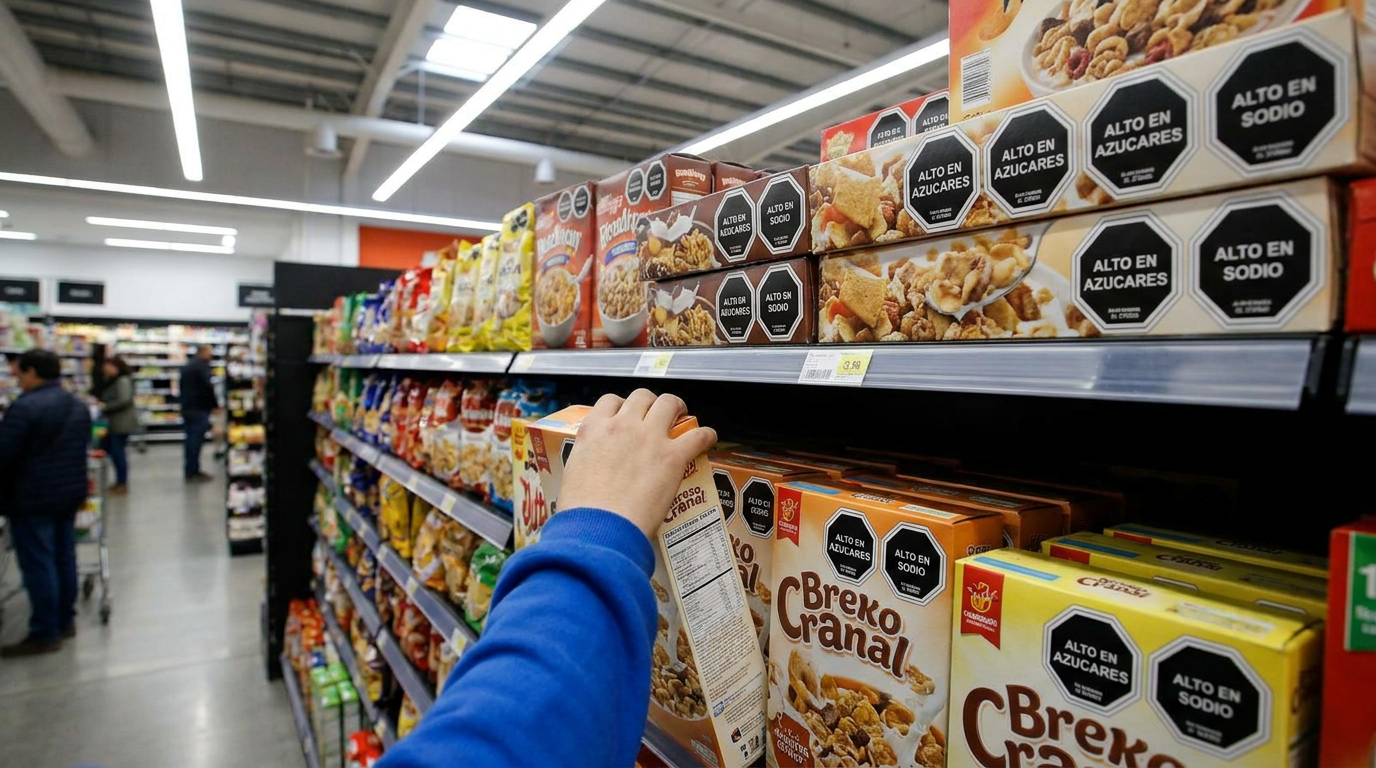
In 2016, Chile decided to rewrite the rules of engagement. Facing some of the highest childhood overweight and obesity rates in the world, the Chilean government implemented the Food Labeling and Advertising Law (FLAL). It was a radical departure from the global norm, replacing confusing numbers with an unavoidable visual cue: mandatory black octagons resembling stop signs.[3][7]
The mechanism was brilliantly simple. Any packaged food or beverage exceeding strict thresholds for sugar, sodium, saturated fat, or overall calories was required to display a stark black warning label on the front of the package. If a product was high in all four, it carried four distinct black octagons. There was no math required—just a clear, immediate signal of the product's nutritional profile.[4][5]

To give the food industry time to adapt, the policy was designed for phased adoption. The initial thresholds were implemented in June 2016, followed by a stricter second phase in 2018, and the final, most rigorous phase in 2019. This gradual tightening ensured that the market wouldn't collapse, but it kept constant pressure on manufacturers to improve their offerings.[2][7]
Crucially, the black octagons were not just informational; they were regulatory triggers. Any product bearing a warning label was legally barred from being sold or promoted in schools. Furthermore, these products faced strict marketing bans, prohibiting them from being advertised on television programs or in media targeting children under the age of 14.[3][7]
The impact on consumer behavior was immediate and profound. Recent data published in PLOS Medicine analyzing the second phase of the law revealed staggering shifts in purchasing habits. When equipped with clear, accessible information, Chilean households fundamentally changed what they put in their grocery carts.[1]
The numbers paint a picture of a population taking back control of its diet. Researchers found that households purchased 37% less sugar, 22% less sodium, 16% less saturated fat, and 23% fewer total calories from products carrying warning labels. The stark visual warnings successfully broke the automatic habit of grabbing familiar, unhealthy snacks.[1]

The numbers paint a picture of a population taking back control of its diet.
Perhaps the most significant victory of the Chilean model was its effect on the "health halo." Products that had long masqueraded as healthy—such as certain granola bars, sweetened yogurts, and fruit juices—were suddenly forced to wear the black octagon for high sugar content. Consumers who previously thought they were making nutritious choices were empowered with the truth.[4][7]
When the law was first proposed, the food and beverage industry mounted fierce resistance. Industry groups warned of catastrophic economic impacts, arguing that the strict thresholds were impossible to meet and would devastate sales. However, once the law passed, the corporate response shifted from lobbying to rapid innovation.[6][7]
A 2025 study published in BMC Medicine documented this sweeping industry reformulation. Rather than accept the stigma of the black octagons, food manufacturers went back to the drawing board. They aggressively reformulated their recipes to reduce sugar, salt, and saturated fat, aiming to slip just below the regulatory thresholds and avoid the labels entirely.[2]
The results of this reformulation were transformative for the national food supply. Before the law took effect in 2015, a staggering 71% of packaged foods and drinks in Chilean stores would have required a "high in" warning label. By the time the strictest phase went into effect in 2020, that number had plummeted to 53%.[2][5]

Despite initial friction, industry compliance ultimately proved exceptional. A comprehensive audit published in the American Journal of Public Health found that following the law's full implementation, 93.6% of products that exceeded the nutritional thresholds correctly displayed the mandatory warning labels. The system proved that strict, clear regulations are enforceable.[6]
The ultimate test of any public health policy, however, is its impact on human bodies. In 2026, landmark research published in The Lancet provided what experts describe as the first real-world evidence that a national package of food policies can plausibly reduce the risk of childhood obesity.[3]
The study, which analyzed data from over 300,000 schoolchildren, found that children exposed to the policy for 18 months showed measurable health improvements. Girls were 2.9% less likely to be overweight or live with obesity, while boys saw a 2.4% reduction in risk. These figures represent thousands of children diverted from a lifetime of metabolic disease.[3]
Chile's success has not gone unnoticed on the global stage. The country has provided a roadmap for public health researchers and policymakers worldwide. Recognizing the undeniable efficacy of the black octagons, nations across Latin America—including Mexico, Argentina, and Uruguay—have since adopted their own mandatory front-of-package warning systems.[5][7]

This mandatory, punitive approach stands in stark contrast to the voluntary systems favored in the United States and parts of Europe. Systems like the EU's Nutri-Score or voluntary industry checkmarks often highlight positive nutrients to mask negative ones. Global health advocates increasingly point to Chile as proof that only mandatory, negative warnings truly shift population-level behavior.[4][5]
Challenges remain, particularly regarding the broader category of ultra-processed foods. While the labels effectively target sugar, salt, and fat, they do not currently address the use of artificial additives, emulsifiers, or non-nutritive sweeteners that companies often use to replace sugar during reformulation. Nutrition science is still grappling with how to regulate the sheer degree of industrial processing.[7]
Nevertheless, the Chilean experiment stands as one of the most significant public health victories of the 21st century. By prioritizing clear, unavoidable truth over corporate obfuscation, Chile proved that it is possible to transform a nation's food environment, force industry accountability, and empower citizens to protect their own health.[7]
How we got here
June 2016
Phase 1 of the Food Labeling and Advertising Law goes into effect, introducing the first set of nutrient thresholds.
June 2018
Phase 2 is implemented, tightening the limits for sugar, sodium, saturated fat, and calories.
June 2019
Phase 3 takes effect, enforcing the strictest nutritional thresholds for the warning labels.
2020
Data reveals the proportion of packaged foods requiring a warning label has dropped from 71% to 53% due to industry reformulation.
June 2026
Landmark research in The Lancet links the policy to a measurable reduction in childhood obesity risk.
Viewpoints in depth
Public Health Advocates
Advocates argue that voluntary, complex nutrition labels are designed to confuse, and that mandatory warnings are essential for transparency.
For decades, global health organizations watched as the food industry successfully lobbied for voluntary, complex labeling systems like the 'Guideline Daily Amounts' or the 'Nutri-Score.' Public health advocates argue these systems are intentionally opaque, requiring consumers to perform math in the grocery aisle while being bombarded by deceptive marketing. They view the Chilean model as a triumph of public health over corporate interests, proving that when governments mandate stark, unavoidable transparency, consumers naturally gravitate toward healthier choices and population-level health improves.
Food Industry & Manufacturers
The industry initially resisted the strict thresholds but ultimately adapted through massive product reformulation.
When the law was first proposed, food and beverage conglomerates warned of economic disaster, claiming the thresholds were scientifically impossible to meet without ruining the taste and shelf-life of their products. However, the reality of the black octagons forced a rapid pivot. Rather than accept the stigma—and the accompanying bans on school sales and child-directed marketing—manufacturers invested heavily in food science. By reformulating thousands of products to reduce sugar, salt, and fat, the industry demonstrated that it possesses the technical capability to produce healthier food when regulatory pressure demands it.
Behavioral Researchers
Researchers emphasize that the labels work by creating visual friction, breaking the automatic habit of grabbing familiar snacks.
Behavioral economists and nutrition researchers point out that human beings rarely make fully rational, calculated decisions in a grocery store; they rely on habits and visual cues. The genius of the black octagon is that it acts as a cognitive stop sign. It doesn't just educate the consumer; it introduces a moment of friction into an otherwise automatic purchasing decision. This friction is particularly effective at dismantling the 'health halo' effect, where consumers are tricked into buying sugary products because the packaging features images of fresh fruit or claims of added vitamins.
What we don't know
- Whether the reduction in childhood obesity risk will compound over the next decade as the first generation raised entirely under the law reaches adulthood.
- How effectively the warning label system can combat the rise of ultra-processed foods that use artificial sweeteners and emulsifiers to avoid the sugar and fat thresholds.
Key terms
- Front-of-Package Warning Label (FOPWL)
- A clear, visual indicator placed on the front of food packaging designed to quickly alert consumers to high levels of unhealthy nutrients.
- Reformulation
- The process by which food manufacturers alter a product's recipe—such as reducing sugar or salt—to improve its nutritional profile and avoid regulatory penalties.
- Health Halo
- A psychological effect where a single positive claim (like 'all natural' or 'added vitamins') causes consumers to perceive a highly processed, unhealthy food as nutritious.
- Ultra-processed foods
- Industrial formulations made entirely or mostly from substances extracted from foods, often containing additives, artificial flavors, and high levels of sugar, fat, and salt.
Frequently asked
What exactly are the warning labels?
They are stark black octagons, resembling stop signs, printed on the front of packaging to indicate if a product is high in sugar, sodium, saturated fat, or calories.
Did the labels cause food prices to go up?
Studies evaluating the policy have found that while manufacturers changed their product formulations, there was no significant negative economic impact or widespread price gouging as a result of the law.
Why not just use the standard Nutrition Facts panel?
Traditional back-of-package panels require mathematical calculations and high nutritional literacy. The black octagons provide an instant, universal visual cue that anyone, including children, can understand.
Are other countries adopting this system?
Yes. Following Chile's success, several other countries, including Mexico, Argentina, and Uruguay, have implemented similar mandatory front-of-package warning labels.
Sources
Source coverage
7 outlets
3 viewpoints surfaced







[1]PLOS MedicineBehavioral Researchers
Changes in food purchases after Phase 2 of Chile's warning label law
Read on PLOS Medicine →[2]BMC MedicineBehavioral Researchers
Changes in Chile's packaged food supply under the mandatory front-of-package warning label law
Read on BMC Medicine →[3]The LancetPublic Health Advocates
Impact of Chile's food labelling and advertising law on childhood obesity risk
Read on The Lancet →[4]UNICEFPublic Health Advocates
Front-of-pack nutrition labelling: Evidence review
Read on UNICEF →[5]Resolve to Save LivesPublic Health Advocates
Front-of-package labels: A powerful tool to improve nutrition
Read on Resolve to Save Lives →[6]American Journal of Public HealthFood Industry & Manufacturers
Food Industry Compliance With the Display of Front-of-Package Warning Labels in Chile
Read on American Journal of Public Health →[7]Factlen Editorial Team
Synthesis by Factlen editorial team
Read on Factlen Editorial Team →

More in health
See all 121 stories →Autoimmune Research
CAR-T Cell Therapy Induces Drug-Free Remission in Severe Lupus Patients
6 sources

Medical Breakthrough
Pioneering 'Immune Reset' Therapy Puts Severe Lupus Patients Into Remission
8 sources

Longevity Science
The Emerging Science of VO2 Max and Grip Strength as Primary Predictors of Men's Longevity
7 sources

Medical Breakthrough
Revolutionary 'Immune Reset' Therapy Puts Severe Lupus into Remission in UK Trial
7 sources

Every angle. Every day.
Get health stories with full source coverage and perspective breakdowns delivered to your inbox.