
How C2PA Content Credentials Are Becoming the HTTPS of Digital Media
As synthetic media floods the internet, a massive industry coalition is rolling out cryptographic 'nutrition labels' to prove the origin of digital files. Here is how the technology works, where it falls short, and why 2026 is its breakout year.
By Factlen Editorial Team
- Provenance Architects
- The coalition building the standard believes cryptographic binding is the only scalable solution to synthetic media.
- Security Researchers
- Information security academics warn that the standard currently contains exploitable loopholes.
- Hardware Integrators
- Device manufacturers view secure silicon as the necessary root of trust for the ecosystem.
- Regulatory Bodies
- Government agencies see provenance standards as essential compliance tools for AI transparency laws.
What's not represented
- · Social media platform architects
- · Everyday consumers
Why this matters
With AI generators making it trivial to fabricate photorealistic images and video, traditional detection tools are failing. Understanding how cryptographic provenance works is essential for navigating the future of the internet, where the burden of proof will shift from detecting fakes to verifying reality.
Key points
- C2PA is an open standard that cryptographically signs media files to prove their origin and edit history.
- The system acts as a 'nutrition label' for content, detailing whether a file was captured by a camera or generated by AI.
- 2026 marks a turning point with hardware-level integration in mass-market devices like the Google Pixel 10.
- Major AI platforms, including OpenAI and Google Gemini, now automatically embed credentials in synthetic outputs.
- Security researchers warn of vulnerabilities, noting that timestamps can be forged and metadata can be stripped during social media uploads.
- The EU AI Act is accelerating adoption by mandating transparency labeling for synthetic media starting in August 2026.
The internet is facing an epistemological crisis. With synthetic media projected to account for up to 90% of online content by the end of 2026, the traditional approach to verifying reality—building AI classifiers to detect fakes—has become a losing battle. Generative models simply evolve too quickly for detection tools to keep up, creating a landscape where a single actor can fabricate high-fidelity evidence at scale.[4]

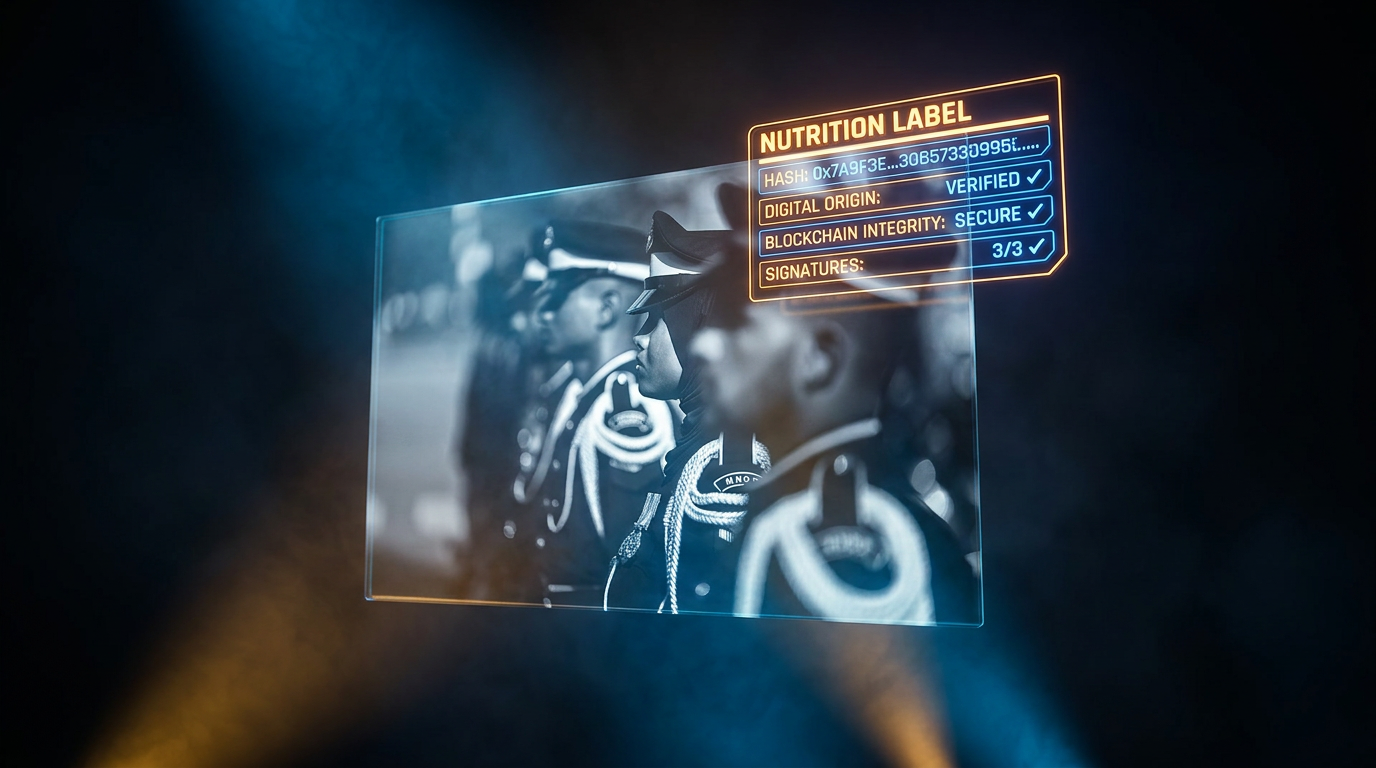
In response, the technology industry has inverted the problem. Instead of trying to detect what is fake after the fact, a massive coalition is focusing on proving what is real at the point of creation. The result is the Coalition for Content Provenance and Authenticity (C2PA), an open technical standard that acts as a secure "nutrition label" for digital media.[4][5]
C2PA does not rely on invisible watermarks or metadata tags that can be easily rewritten. Instead, it uses the same cryptographic backbone that secures global banking and web traffic: X.509 certificates. When a photo is taken or an image is generated, the creating device or software cryptographically signs the file, sealing its origin data in a tamper-evident container.[1][5]
This process, known to consumers as "Content Credentials," operates in three distinct stages. First is the signing phase, where a camera or AI platform assembles assertions about the file—such as the device used, the time, and whether AI was involved. Second is embedding, where this signed manifest is hard-bound to the pixel data. Finally, verification allows any compliant viewer to check the signature offline, confirming the file has not been altered since it was signed.[1][4]

For years, this system was largely theoretical, but 2026 has marked its transition into mass-market reality. While high-end manufacturers like Leica pioneered hardware-level signing in 2023, the ecosystem reached an inflection point with the release of the Google Pixel 10. Utilizing its Tensor G5 and Titan M2 security chips, the device signs every photograph by default, democratizing cryptographic provenance for everyday consumers.[4]

The synthetic side of the ecosystem has moved even faster. Major AI generators, including OpenAI's DALL-E, Google Gemini, and Adobe Firefly, now automatically embed C2PA credentials into their outputs. When users see a "Made with AI" label on platforms like LinkedIn or Google Search, that disclosure is increasingly powered by the underlying C2PA manifest rather than a platform's best guess.[3][5]
Major AI generators, including OpenAI's DALL-E, Google Gemini, and Adobe Firefly, now automatically embed C2PA credentials into their outputs.
However, the system is not a magic bullet for absolute truth. C2PA engineers are quick to highlight the "first-mile trust" problem. Cryptography can definitively prove that a specific camera captured a specific arrangement of light at a specific time, but it cannot prove that the scene itself wasn't staged. The credential verifies the origin of the file, not the factual accuracy of the event depicted.[4]
The standard also faces significant friction in distribution. The most common vulnerability is the "strip attack." Because many social media platforms heavily compress images upon upload to save bandwidth, they often inadvertently strip out the C2PA manifest container. An unsigned file does not mean the image is fake; it simply means it lacks verifiable provenance, leaving the ecosystem in a transitional state where credentials frequently break in transit.[4][5]
Beyond distribution friction, independent security researchers have identified structural vulnerabilities in the protocol. In April 2026, the first formal-methods analysis of C2PA was published, revealing that the standard's layered security approach allows for certain manipulations. Most notably, researchers demonstrated that timestamps can be forged or replaced without breaking the underlying cryptographic signature of the image.[2]
The same security analysis highlighted risks with the standard's "exclusion ranges." Designed as a privacy feature to allow photographers to redact sensitive GPS coordinates before publishing, these exclusion zones can theoretically be exploited to alter metadata without detection. Researchers have cautioned against relying on C2PA for high-stakes legal or financial evidence until these protocol loopholes are closed.[2]

Despite these growing pains, regulatory momentum is forcing the standard into the mainstream. The European Union's AI Act, which takes full effect in August 2026, mandates strict transparency labeling for AI-generated content. Because C2PA's architecture directly satisfies these legal requirements, compliance departments across the tech sector have accelerated its integration.[4]
In the United States, the Cybersecurity and Infrastructure Security Agency (CISA) has explicitly recommended C2PA adoption for government agencies and critical infrastructure operators. This institutional backing is shifting the standard from a voluntary industry initiative to a baseline requirement for public-sector media pipelines.[4]
The trajectory of Content Credentials closely mirrors the early days of HTTPS. In the early 2000s, encrypting web traffic was computationally expensive, inconsistently implemented, and often broken by middleboxes. Today, an unencrypted website triggers a glaring security warning in every major browser.[5][6]
Digital provenance is on the same multi-year journey. While the infrastructure is currently fragmented and imperfect, the underlying architecture is sound. As hardware support deepens and platforms update their ingestion pipelines to preserve metadata, the burden of proof will inevitably shift. In the near future, the absence of a Content Credential may become the internet's most reliable warning sign.[5][6]
How we got here
Feb 2021
C2PA is founded by Adobe, Arm, BBC, Intel, Microsoft, and Truepic.
Oct 2023
Leica launches the M11-P, the first consumer camera with hardware-level C2PA signing.
Jan 2025
The U.S. Cybersecurity and Infrastructure Security Agency (CISA) recommends C2PA adoption.
Sep 2025
Google releases the Pixel 10, bringing default hardware-backed signing to the mass smartphone market.
Apr 2026
Security researchers publish the first formal-methods analysis detailing vulnerabilities in the standard.
Aug 2026
The EU AI Act's transparency requirements for synthetic media take full effect.
Viewpoints in depth
Provenance Architects
The coalition building the standard believes cryptographic binding is the only scalable solution to synthetic media.
Organizations like Adobe and Microsoft argue that the internet must shift from a 'detect fakes' model to a 'prove reality' model. They acknowledge current friction in distribution pipelines but view C2PA as a foundational infrastructure layer—much like the early days of HTTPS—that will eventually make unsigned media inherently suspicious.
Security Researchers
Information security academics warn that the standard contains exploitable loopholes.
Researchers point to vulnerabilities like timestamp forging and exclusion-range manipulation, arguing that the standard's layered security approach is flawed. They caution that prematurely relying on C2PA for high-stakes scenarios, such as legal evidence or financial disclosures, could provide a false sense of security until the protocol is hardened.
Hardware Integrators
Device manufacturers view secure silicon as the necessary root of trust for the ecosystem.
Companies like Google and Leica emphasize that software-level signing is insufficient. They argue that true provenance must begin at the moment of capture, utilizing dedicated hardware security chips—like the Titan M2—to ensure the cryptographic keys cannot be extracted or spoofed by malicious applications.
What we don't know
- How quickly major social media platforms will update their ingestion pipelines to stop stripping C2PA metadata from user uploads.
- Whether the C2PA coalition will revise the core protocol to address the timestamp vulnerabilities identified by security researchers.
- How everyday consumers will interpret the Content Credentials icon, and whether it will be mistakenly viewed as an 'AI warning' rather than a mark of authenticity.
Key terms
- C2PA
- The Coalition for Content Provenance and Authenticity, the open standards body defining how to cryptographically sign media.
- Content Credentials
- The user-facing term and visual icon (CR) for a C2PA manifest attached to a digital file.
- X.509 Certificate
- A digital certificate standard used to verify public keys, forming the cryptographic backbone of both HTTPS and C2PA.
- Manifest
- The hidden data structure embedded inside a media file that contains its provenance history and cryptographic signatures.
- First-Mile Trust
- The inherent limitation that cryptography can prove a camera took a photo, but cannot prove the camera wasn't pointed at a staged scene.
Frequently asked
Does C2PA prove that a photo is real?
No. It proves provenance—that a specific device or software created the file at a specific time—but it cannot prove the camera wasn't pointed at a staged scene.
Why do my photos lose their Content Credentials when I post them?
Many social media platforms compress images to save bandwidth, which currently strips the hidden cryptographic container from the file.
Do I need a special camera to use this?
While new devices like the Pixel 10 have hardware support, you can also apply credentials using software like Adobe Photoshop or Lightroom.
Sources
Source coverage
6 outlets
4 viewpoints surfaced






[1]C2PA Official SpecificationProvenance Architects
C2PA Specifications for Content Credentials
Read on C2PA Official Specification →[2]arXivSecurity Researchers
Security Analysis of C2PA: Vulnerabilities in Digital Provenance
Read on arXiv →[3]EyeSiftRegulatory Bodies
C2PA Adoption Status 2026: Content Credentials, OpenAI & Google
Read on EyeSift →[4]C2PA ViewerHardware Integrators
What is C2PA: Coalition for Content Provenance and Authenticity explained
Read on C2PA Viewer →[5]Content Credentials InitiativeProvenance Architects
What are Content Credentials?
Read on Content Credentials Initiative →[6]Factlen Editorial Team
Synthesis by Factlen editorial team
Read on Factlen Editorial Team →


Every angle. Every day.
Get meta stories with full source coverage and perspective breakdowns delivered to your inbox.