
How Blended-Wing Body Aircraft Could Cut Aviation Emissions in Half
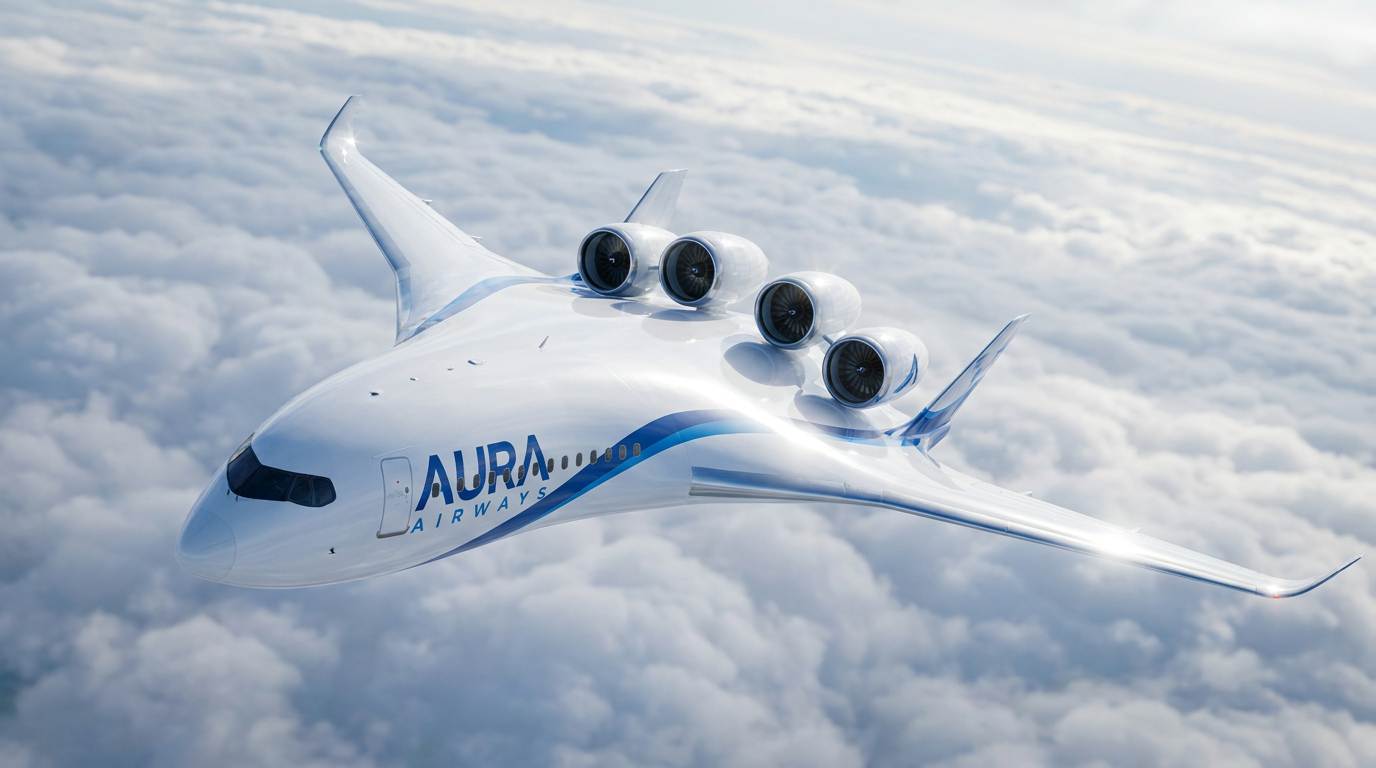
A radical redesign of commercial aircraft that merges the fuselage and wings into a single lifting surface has received FAA clearance for test flights, promising up to a 50% reduction in fuel consumption.
By Factlen Editorial Team
- Aerospace Innovators
- Startups and manufacturers pushing BWB as the necessary leap to achieve net-zero aviation.
- Regulators & Military
- Government bodies focused on validating the safety, logistics, and strategic utility of the novel airframes.
- Aerodynamic Researchers
- Scientists quantifying the exact physical efficiency gains and structural trade-offs of the blended design.
What's not represented
- · Commercial Airline Pilots
- · Airport Infrastructure Planners
Why this matters
Aviation accounts for a rapidly growing share of global carbon emissions, and traditional aircraft designs have reached their efficiency limits. The successful commercialization of blended-wing aircraft would drastically lower the climate impact of air travel while potentially reducing ticket costs through massive fuel savings.
Key points
- The Blended Wing Body (BWB) architecture merges the fuselage and wings into a single lifting surface, eliminating the aerodynamic drag of traditional tube-and-wing designs.
- JetZero's Pathfinder, a 12.5% scale BWB demonstrator, recently received FAA airworthiness certification to begin test flights in California.
- Aerodynamic studies show BWB aircraft could reduce commercial aviation fuel burn and emissions by up to 50 percent.
- The wide, cavernous fuselage of a BWB is uniquely suited to house the bulky liquid hydrogen tanks required for future zero-emission flight.
- Developers are targeting 2027 for full-scale prototype testing, with ambitions to enter commercial passenger service by 2030.
For more than seven decades, the silhouette of commercial aviation has remained fundamentally unchanged. The "tube-and-wing" architecture—a cylindrical fuselage designed to hold payload, attached to swept wings designed to generate lift—has dominated the skies since the dawn of the jet age. Over the years, aerospace engineers have relentlessly optimized this shape, introducing advanced composite materials, ultra-high-bypass turbofan engines, and drag-reducing winglets. However, these traditional airframes are now approaching their thermodynamic and aerodynamic limits. As the global aviation industry faces mounting pressure to achieve net-zero carbon emissions by 2050, the incremental efficiency gains of one or two percent per aircraft generation are no longer sufficient. A radical architectural leap is required to meet the projected demand for air travel without proportionally increasing greenhouse gas emissions.[6][8]
Enter the Blended Wing Body (BWB), an aircraft configuration that abandons the traditional cylindrical fuselage entirely. Instead, the BWB seamlessly integrates the wings and the main body into a single, continuous lifting surface. By blurring the dividing line between the cabin and the wings, the entire airframe contributes to generating lift. While the concept of a flying wing dates back to the 1920s and has been successfully utilized in military stealth bombers like the B-2 Spirit, translating the design into a viable commercial passenger jet has long eluded manufacturers. Now, advances in composite manufacturing and digital flight control systems are bringing the BWB out of the wind tunnel and onto the runway, promising to be the most significant disruption to commercial aircraft design in a century.[7][8]
The theoretical promise of the BWB is rapidly translating into physical hardware. California-based aerospace startup JetZero recently achieved a major regulatory milestone when the Federal Aviation Administration (FAA) granted an airworthiness certificate to its "Pathfinder" demonstrator. The Pathfinder is a 12.5 percent scale model of JetZero's proposed full-size airliner, featuring a 23-foot wingspan. This crucial FAA clearance allows the uncrewed, twin-engine aircraft to commence a rigorous campaign of test flights in the restricted airspace above Edwards Air Force Base in California. The initial testing phase is designed to validate the aircraft's complex flight control software and assess the aerodynamic stability of its unique articulating nose landing gear, which is engineered to increase the angle of attack during takeoff.[1][4]

JetZero's ambitious timeline—aiming for a full-scale prototype by 2027 and commercial service by 2030—is backed by formidable institutional support. The United States Air Force awarded the company a $235 million contract through the Defense Innovation Unit to accelerate the development of the BWB architecture. The military's interest is driven by the platform's potential as a highly efficient aerial refueling tanker and cargo transport, capable of operating from shorter runways with a significantly larger payload. Additionally, JetZero has received critical funding and technical support from NASA's Sustainable Flight Demonstrator program, which has spent decades researching hybrid-wing body shapes through subscale models like the X-48 to prove the viability of the aerodynamic concept.[4][8]
The core advantage of the Blended Wing Body lies in its mastery of aerodynamics, specifically the elimination of interference drag. In a conventional tube-and-wing aircraft, the sharp 90-degree junction where the wing meets the cylindrical fuselage creates turbulent airflow, generating significant drag that the engines must burn fuel to overcome. Furthermore, the traditional fuselage is essentially dead weight from an aerodynamic perspective; it houses the passengers but contributes virtually nothing to keeping the aircraft aloft. The BWB's smooth, flattened, airfoil-shaped center body eliminates these inefficient junctions. Because the entire aircraft acts as a wing, the total wetted area—the surface area exposed to the airflow—is reduced by roughly 33 percent compared to a conventional plane of the same capacity.[6]
This aerodynamic purity translates into staggering performance metrics. Recent computational fluid dynamics simulations and wind tunnel tests indicate that a BWB aircraft can operate with a lift-to-drag ratio that is 15 to 20 percent higher than current state-of-the-art narrowbody jets. When combined with the reduced weight of the airframe, this efficiency allows the aircraft to achieve a 30 to 50 percent reduction in fuel burn and emissions. For airlines operating on razor-thin margins and facing increasingly stringent environmental regulations, a halving of fuel consumption represents a paradigm shift. It not only drastically lowers operating costs but also extends the maximum range of the aircraft, opening up new direct routing possibilities that are currently economically unviable.[2][5][6]

This aerodynamic purity translates into staggering performance metrics.
Beyond aerodynamics, the BWB offers profound structural advantages. In a standard airliner, the heavy fuselage hangs from the center of the wings, creating immense bending moments at the wing roots that require heavy, reinforced structural spars to prevent the wings from snapping upward during flight. The BWB distributes the payload—passengers and cargo—across the span of the thickened center body. This spanloader effect aligns the downward force of the payload with the upward aerodynamic lift of the wings, effectively canceling out the bending forces. Consequently, the internal structure can be built significantly lighter. Mission analyses suggest that a BWB can achieve a 15 percent reduction in overall ramp weight compared to a similarly sized tube-and-wing aircraft utilizing the same advanced composite materials.[6]
The commercial race to bring this technology to market is heating up, with developers targeting specific segments of the aviation sector. JetZero is squarely aiming at the "middle of the market" with its Z4 concept, a 250-passenger airliner designed to replace aging Boeing 757s and 767s. This segment requires aircraft capable of flying transatlantic routes while still being small enough to serve secondary cities efficiently. Meanwhile, another startup, Natilus, is developing the Horizon Evo, a slightly smaller BWB concept aimed at the 200-passenger regional market, competing directly with the ubiquitous Boeing 737 and Airbus A320 families. Both companies argue that the major manufacturers lack the production capacity to meet the projected global demand of 43,000 new commercial airplanes over the next two decades, creating an opening for radical new entrants.[3]
The established aerospace giants are not ignoring the BWB's potential, though they are approaching it with characteristic caution. Airbus has been actively exploring the architecture through its ZEROe program, which aims to develop the world's first zero-emission commercial aircraft by 2035. In 2019, Airbus successfully flew a subscale BWB demonstrator named MAVERIC to validate robust flight control systems for tailless designs. While Airbus executives have publicly stated that the BWB is better suited for larger, long-haul aircraft rather than the short-haul market, the company continues to feature the blended wing prominently in its conceptual art for future fleets. Boeing, having partnered with NASA on the X-48 project in the 2000s, also holds extensive proprietary research on the configuration, though it has yet to commit to a commercial BWB program.[5][7]
Perhaps the most compelling argument for the Blended Wing Body is its unique synergy with alternative aviation fuels, particularly liquid hydrogen. Hydrogen is widely considered the holy grail of zero-emission flight because it produces only water vapor when combusted or run through a fuel cell. However, liquid hydrogen is notoriously difficult to package; it requires four times the physical volume of traditional Jet-A fuel to deliver the same amount of energy. A conventional cylindrical fuselage simply does not have the internal space to accommodate these massive cryogenic tanks without severely cutting into passenger capacity. The BWB's wide, cavernous center body provides ample internal volume to house bulky hydrogen tanks while still maintaining a full passenger payload, making it the ideal architectural vessel for the hydrogen transition.[5][7]

Despite its immense promise, the BWB faces significant engineering and operational hurdles before it can carry paying passengers. The most immediate challenge is the passenger experience. The wide, theater-like cabin means that the vast majority of passengers will be seated in the interior, far away from any natural light. To mitigate the claustrophobic effect of a windowless cabin, designers are proposing the use of high-definition digital screens that project the outside view onto the interior walls, a concept that remains untested with the general flying public. Furthermore, the wide cabin places passengers further from the aircraft's center of roll; when the plane banks into a turn, passengers seated near the outer edges of the cabin will experience more pronounced vertical movement, potentially increasing the risk of motion sickness.[2]
Airport compatibility presents another major logistical friction point. The aviation infrastructure ecosystem—from terminal gates and jet bridges to taxiways and emergency evacuation protocols—is entirely optimized for long, narrow tubes. JetZero claims its Z4 aircraft will have a wingspan of roughly 190 feet, comparable to an Airbus A330, allowing it to fit into existing widebody airport gates. However, the sheer width of the fuselage complicates boarding and deplaning procedures, potentially requiring airports to invest in dual-bridge systems to prevent excessive turnaround times. Additionally, regulators at the FAA and the European Union Aviation Safety Agency (EASA) will need to develop entirely new certification frameworks to ensure that a cabin of that width can be fully evacuated within the mandated 90-second window during an emergency.[5]

On the propulsion side, the BWB's aerodynamic profile introduces novel challenges for engine integration. To minimize parasitic drag across its massive wing area, a BWB aircraft is most efficient when cruising at extremely high altitudes, often above 41,000 feet. At these altitudes, the air is incredibly thin, which causes current-generation high-bypass turbofan engines—like those used on the 737 MAX and A320neo—to experience a significant loss of thrust. Consequently, developers may be forced to utilize older, lower-bypass engine architectures or wait for engine manufacturers to design entirely new powerplants optimized for the specific high-altitude, boundary-layer-ingestion conditions of the BWB airframe. This engine mismatch threatens to delay the ambitious timelines set by startups.[3]
As JetZero's Pathfinder continues its flight test campaign over the Mojave Desert, the aviation industry is watching closely. The data gathered from these subscale flights will be critical in proving whether the theoretical aerodynamic gains can be realized in real-world conditions. If successful, the transition from the tube-and-wing to the Blended Wing Body will represent a generational leap in human engineering. It offers a tangible, technologically viable pathway to decoupling the growth of global air travel from the growth of carbon emissions. While the logistical and regulatory mountains left to climb are steep, the sheer scale of the efficiency gains makes the BWB not just a fascinating engineering experiment, but a necessary evolution for the future of flight.[1][2]
How we got here
1920s
Aviation pioneers first explore tailless 'flying wing' concepts, laying the early theoretical groundwork for blended configurations.
2007–2012
NASA conducts over 120 test flights of the X-48, an unmanned subscale demonstrator that proves the aerodynamic viability of the blended-wing concept.
June 2019
Airbus successfully flies the MAVERIC, a subscale BWB model designed to validate flight controls for tailless passenger jets.
2023
The US Air Force awards startup JetZero a $235 million contract to accelerate the development of a full-scale BWB prototype.
March 2024
The FAA grants an airworthiness certificate to JetZero's Pathfinder demonstrator, clearing the 23-foot subscale model for test flights.
2027 (Target)
JetZero and its aerospace partners aim to begin flight testing a full-scale, 250-passenger BWB prototype.
2030 (Target)
Developers project the first blended-wing body aircraft will enter commercial passenger service.
Viewpoints in depth
Aerospace Innovators
Startups and manufacturers pushing BWB as the necessary leap to achieve net-zero aviation.
For companies like JetZero, Natilus, and Airbus, the traditional tube-and-wing aircraft has reached an evolutionary dead end. They argue that the incremental one-to-two percent efficiency gains squeezed out of each new generation of conventional jets are mathematically insufficient to meet the industry's 2050 net-zero emissions mandate. By fundamentally altering the airframe's geometry, these innovators believe they can unlock an immediate 30 to 50 percent reduction in fuel burn. Furthermore, they view the BWB's massive internal volume as the only realistic architectural pathway to eventually adopting liquid hydrogen propulsion, which requires significantly more storage space than standard Jet-A fuel.
Aviation Regulators & Military
Government bodies focused on validating the safety, logistics, and strategic utility of the novel airframes.
The FAA, EASA, and military branches like the US Air Force are approaching the BWB with a mix of strategic enthusiasm and rigorous caution. For the military, the BWB represents a highly capable future platform for aerial refueling and cargo transport, offering greater range and payload capacity from shorter runways. However, civil regulators are tasked with the monumental challenge of adapting decades-old safety frameworks to a radically new shape. Their primary concerns revolve around passenger evacuation protocols for ultra-wide cabins, the structural integrity of the pressurized non-cylindrical fuselage, and the reliability of the complex, computer-driven flight control systems required to keep a tailless aircraft stable in commercial airspace.
Aerodynamic Researchers
Scientists quantifying the exact physical efficiency gains and structural trade-offs of the blended design.
Academic and institutional researchers focus on the empirical data generated by computational fluid dynamics and wind tunnel testing. Their studies confirm that the BWB significantly reduces interference drag and wetted area, resulting in a lift-to-drag ratio that is 15 to 20 percent higher than conventional aircraft. However, researchers also highlight the physical trade-offs inherent in the design. They note that the massive wing area increases lift-induced drag at lower speeds and requires the aircraft to cruise at much higher altitudes to achieve its peak efficiency. Additionally, they point out the structural complexities of pressurizing a flattened center body, which naturally wants to expand into a cylinder under pressure, requiring novel and potentially heavier internal composite bracing.
What we don't know
- How aviation regulators will adapt 90-second emergency evacuation certifications for an ultra-wide, multi-aisle cabin.
- Whether the flying public will embrace a theater-like cabin layout where the majority of seats lack access to natural window light.
- If current high-bypass turbofan engines can efficiently power the aircraft at the extreme altitudes (above 41,000 feet) required to minimize drag on the massive wings.
Key terms
- Blended Wing Body (BWB)
- An aircraft design where the wings and fuselage are merged into a single continuous lifting surface, eliminating the traditional cylindrical cabin.
- Interference Drag
- Aerodynamic resistance created when airflow over two intersecting surfaces, like a traditional wing and fuselage, collides and becomes turbulent.
- Lift-to-Drag Ratio (L/D)
- A key metric of aerodynamic efficiency, measuring how much lift an aircraft generates compared to the drag it produces as it moves through the air.
- Wetted Area
- The total surface area of an aircraft that is exposed to the outside airflow, which directly impacts the amount of friction drag the plane experiences.
- Parasitic Drag
- Resistance caused by the aircraft's shape and skin friction as it moves through the air, separate from the drag created by generating lift.
Frequently asked
Will blended-wing aircraft have windows?
Most passengers will not have traditional windows due to the ultra-wide cabin design. Manufacturers plan to mitigate this by using high-definition screens to project outside views onto the interior walls.
Can these planes fit at normal airport gates?
Yes, designs like JetZero's Z4 are engineered with wingspans comparable to existing widebody jets like the Airbus A330, allowing them to use standard airport infrastructure.
Are blended-wing planes safe?
They are currently undergoing rigorous testing by the FAA and the military to ensure they meet or exceed the strict safety, stability, and evacuation standards of traditional commercial airliners.
Sources
Source coverage
8 outlets
3 viewpoints surfaced








[1]Aviation WeekRegulators & Military
FAA Clears JetZero BWB Subscale Demo For Flight Tests
Read on Aviation Week →[2]FLYING MagazineAerospace Innovators
Blended-Wing Body: Next Evolution in Commercial Aviation?
Read on FLYING Magazine →[3]AIN OnlineAerospace Innovators
JetZero and Natilus Pitch Blended-wing-body Alternatives
Read on AIN Online →[4]Simple FlyingRegulators & Military
JetZero's Blended Wing Body Demonstrator Cleared By FAA
Read on Simple Flying →[5]MTU AEROREPORTAerospace Innovators
Blended wing body: The future of passenger aircraft?
Read on MTU AEROREPORT →[6]The Aeronautical JournalAerodynamic Researchers
Comparison of blended wing body and tube-and-wing performance characteristics
Read on The Aeronautical Journal →[7]AirbusAerospace Innovators
Airbus reveals new zero-emission concept aircraft
Read on Airbus →[8]WikipediaAerodynamic Researchers
Blended wing body
Read on Wikipedia →
Every angle. Every day.
Get transportation stories with full source coverage and perspective breakdowns delivered to your inbox.