
How Architects Are Using Fluid Dynamics to Resurrect Ancient Cooling Tech
Faced with rising global temperatures and the massive energy costs of air conditioning, architects are reviving ancient passive cooling techniques like Persian windcatchers and Indian lattice screens. By optimizing these millennia-old designs with modern computational fluid dynamics, new buildings can dramatically lower their internal temperatures without electricity.
By Tara Reddy

The modern city is increasingly becoming a thermodynamic trap. Glass-and-steel skyscrapers act as massive greenhouses, absorbing solar radiation and relying entirely on mechanical air conditioning to remain habitable. As global temperatures shatter records, this reliance has created a vicious cycle: air conditioners consume vast amounts of electricity and vent waste heat into the streets, driving ambient urban temperatures even higher.
In response, a growing movement within contemporary architecture is looking backward to solve the climate crisis. Long before the invention of the mechanical compressor, civilizations in the Middle East, North Africa, and South Asia engineered sophisticated structures to survive scorching summers. Today, architects are resurrecting these millennia-old passive cooling techniques, proving that ancient wisdom can meet modern environmental challenges head-on.
Passive cooling relies on structural geometry, thermodynamics, and natural materials to regulate temperature without electricity. Rather than fighting the local climate with brute-force mechanical chilling, these designs harness prevailing winds, thermal mass, and the natural behavior of hot and cold air to create comfortable indoor microclimates.[4]
The most prominent of these revived technologies is the windcatcher, known historically as a badgir in Persian or malqaf in Arabic. Originating thousands of years ago, these chimney-like towers sit atop roofs, featuring directional openings that capture prevailing breezes. The captured wind is funneled down the shaft into the living spaces below, providing a continuous supply of fresh air.[4]
The physics underlying the windcatcher rely on convection and the stack effect. Because hot air is less dense, it naturally rises, while cooler, heavier air sinks. As the windcatcher forces cool breezes downward, the dense air displaces the stale, warm air inside the building, pushing it up and out through separate exhaust vents. This continuous cycle can drop indoor temperatures significantly without a single watt of power.[4]
In ancient Persian cities like Yazd, builders amplified this effect by routing the incoming air over underground water channels known as qanats. As the dry, hot air passed over the water, evaporation absorbed latent heat, chilling the air before it entered the home. This natural evaporative cooling system allowed desert residents to maintain near-freezing subterranean cisterns in the dead of summer.[4]
While ancient builders perfected these towers through generations of trial and error, modern architects are supercharging them with Computational Fluid Dynamics (CFD). Using advanced simulation software like ANSYS Fluent, engineers can model precise airflow patterns, pressure differentials, and thermal buoyancy before a single brick is laid.[2][3]
CFD analysis allows designers to optimize the geometry of a windcatcher for specific urban environments. Recent studies have shown that altering the curvature of the internal roof and the angle of the louvers can increase the airflow rate by a factor of 2.7 and boost occupied-zone air velocity by 45 percent. This mathematical precision transforms a traditional architectural feature into a highly calibrated thermodynamic engine.[2]
This synthesis of old and new is already cooling major commercial projects. The ZEF Climatic Building in Qatar utilizes computer-optimized windcatchers to maintain comfortable interiors despite the extreme Gulf climate. Similarly, the Eastgate Centre in Zimbabwe, inspired by the passive ventilation of termite mounds, uses convective principles to regulate its temperature, consuming roughly 90 percent less energy for cooling than a conventional building of its size.
Beyond the windcatcher, architects in South Asia are reviving the jaali, an intricate lattice screen prominent in Mughal and Islamic architecture. Traditionally carved from stone or wood, these geometric screens were used to block direct sunlight while allowing breezes to pass through. Today, they are recognized as highly efficient passive cooling devices.[1]
The cooling power of the jaali is driven by the Venturi effect. The lattice is designed with larger openings on the exterior that taper to smaller openings on the interior. As wind is forced through the narrowing passage, its velocity increases and its pressure drops. When the compressed air emerges into the room and expands, it cools down—functioning much like the air released from a pressurized aerosol can.
Modern adaptations of the jaali are being deployed in high-heat regions like New Delhi and Jaipur. At the Pearl Academy of Fashion in Jaipur, architects integrated expansive lattice screens alongside a modern stepwell to naturally chill the campus, a critical feature in a city where summer temperatures routinely exceed 110 degrees Fahrenheit.
Some designers are combining the jaali's geometry with the evaporative properties of terracotta. When a porous terracotta surface is soaked with water, the evaporating moisture draws out heat from the surrounding air. By constructing lattice facades out of terracotta tubes and running water over them, architects can create a massive, zero-energy evaporative cooler that drops the temperature of incoming breezes.[1]
The integration of these passive systems offers a profound layer of climate resilience. As extreme heatwaves increasingly strain electrical grids, buildings entirely dependent on mechanical air conditioning become dangerous traps during power failures. A structure designed with passive cooling will maintain a survivable baseline temperature regardless of grid stability.[4]
However, architects caution that passive cooling is not a universal panacea. Windcatchers and evaporative systems are highly dependent on local microclimates. They excel in hot, arid environments with consistent prevailing winds, but their efficiency plummets in regions with high ambient humidity, where the air cannot absorb additional moisture for evaporative cooling.[2][4]
Despite these limitations, the architectural shift toward passive cooling represents a fundamental rethinking of how humanity inhabits the planet. By treating buildings not as sealed, energy-hungry boxes, but as breathable structures that cooperate with the natural environment, designers are proving that the most advanced climate solutions may actually be thousands of years old.
Key points
- Architects are reviving ancient passive cooling techniques like windcatchers and lattice screens to reduce reliance on air conditioning.
- Modern computational fluid dynamics (CFD) software allows engineers to optimize these millennia-old designs for contemporary high-rises.
- Passive cooling systems utilize thermodynamics, such as the stack effect and Venturi effect, to lower indoor temperatures without electricity.
- Buildings equipped with passive cooling offer critical resilience during extreme heatwaves and power grid failures.
What we don’t know
- How effectively passive cooling systems can be retrofitted into existing glass-and-steel skyscrapers, rather than built into new construction.
- Whether passive cooling alone can maintain safe indoor temperatures during unprecedented 'wet-bulb' heatwaves where high humidity neutralizes evaporative cooling.
How we got here
4000 BCE
Early evidence of windcatchers (badgirs) used in ancient Persian and Egyptian architecture.
16th Century
The jaali lattice screen becomes a prominent feature in Mughal architecture across South Asia.
Late 20th Century
The rise of cheap mechanical air conditioning leads to the near-total abandonment of passive cooling in commercial architecture.
1996
The Eastgate Centre opens in Zimbabwe, proving that passive convective cooling can work at a massive commercial scale.
2024-2026
Record-breaking global heatwaves and grid failures accelerate the adoption of CFD-optimized passive cooling in modern high-rises.
- Sustainable Architects
- Argue that modern buildings must stop fighting the climate with brute-force HVAC and instead use passive design to achieve zero-carbon cooling.
- Computational Engineers
- Focus on the role of CFD software in validating and optimizing ancient designs, ensuring they meet strict modern building codes and thermal comfort standards.
- Urban Planners
- Highlight the resilience aspect, noting that passive cooling ensures buildings remain survivable during grid failures and extreme heatwaves.
Perspectives this story doesn't cover
- HVAC Manufacturers
Sources
Source coverage
4 outlets
3 viewpoints surfaced




- [1]Surfaces ReporterSustainable Architects
Terracotta Jali Facade: A Climate Responsive Design
Read on Surfaces Reporter → - [2]ResearchGateComputational Engineers
Reinventing the Windcatcher for Sustainable Saudi Homes: Transforming Urban Setbacks Into Passive Cooling Spaces
Read on ResearchGate → - [3]Horizon Research PublishingComputational Engineers
CFD Analysis of Windcatchers for Multi-Story Structures
Read on Horizon Research Publishing → - [4]WikipediaUrban Planners
Windcatcher
Read on Wikipedia →

More in Culture
See all →Architecture Laureate
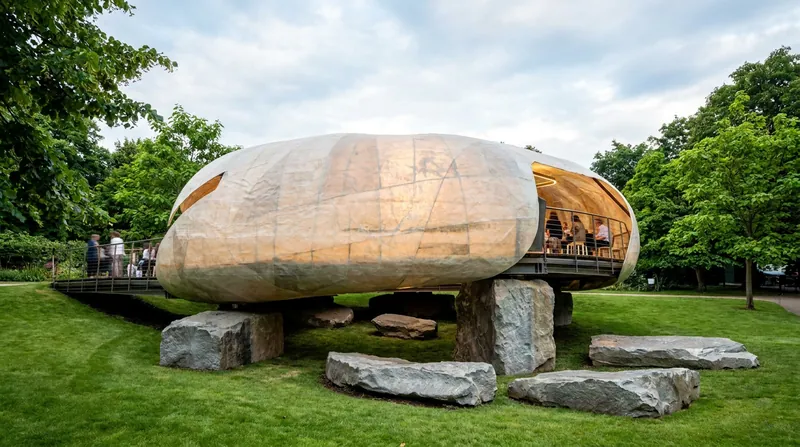
Smiljan Radić Clarke Named 2026 Laureate of the Pritzker Architecture Prize
2 sources
AI Policy
Australian Creatives Demand AI Copyright Law Over Training Data, Citing Indigenous Rights
3 sources

Calm Technology
The Rise of Calm Technology: How Design is Curing Digital Fatigue
5 sources
Sensory Architecture
Beyond the Ramp: How Architects Are Redesigning Buildings for Neurodiversity
5 sources
Comments
Every angle. Every day.
Get Culture stories with full source coverage and perspective breakdowns, free every day.