
How AI Dubbing and Lip-Sync Technology is Rewriting Hollywood's Global Playbook
Advanced AI dubbing pipelines are allowing studios and indie filmmakers to clone actors' voices and perfectly lip-sync performances in dozens of languages, democratizing global film distribution.
By Factlen Editorial Team
- Global Studio Executives
- Prioritize economic scalability, cost reduction, and the ability to execute simultaneous global releases.
- Localization Specialists
- Advocate for human-in-the-loop quality control, cultural accuracy, and fair labor compensation.
- Independent Filmmakers
- Value the democratization of global distribution and the lowering of historical financial barriers.
What's not represented
- · International Audiences
- · Traditional Sync Editors
Why this matters
Language barriers have historically dictated which films succeed globally and which remain obscure. By automating translation, voice cloning, and lip-syncing, AI dubbing democratizes distribution—allowing independent creators to reach the entire world on day one, and letting audiences experience foreign stories with the exact emotional weight of the original performance.
Key points
- AI dubbing allows studios to clone an actor's voice and perfectly lip-sync it into over 40 languages.
- The technology reduces localization costs from up to $200 per minute down to as little as $1 per minute.
- Phoneme-to-viseme mapping digitally alters an actor's mouth to match the newly translated audio track.
- Independent filmmakers can now release their projects globally on day one without prohibitive dubbing costs.
- The industry is adopting a hybrid workflow, keeping human experts involved for quality control and cultural nuance.
- Hollywood guilds have negotiated strict new guardrails to ensure actors consent to and are compensated for voice cloning.
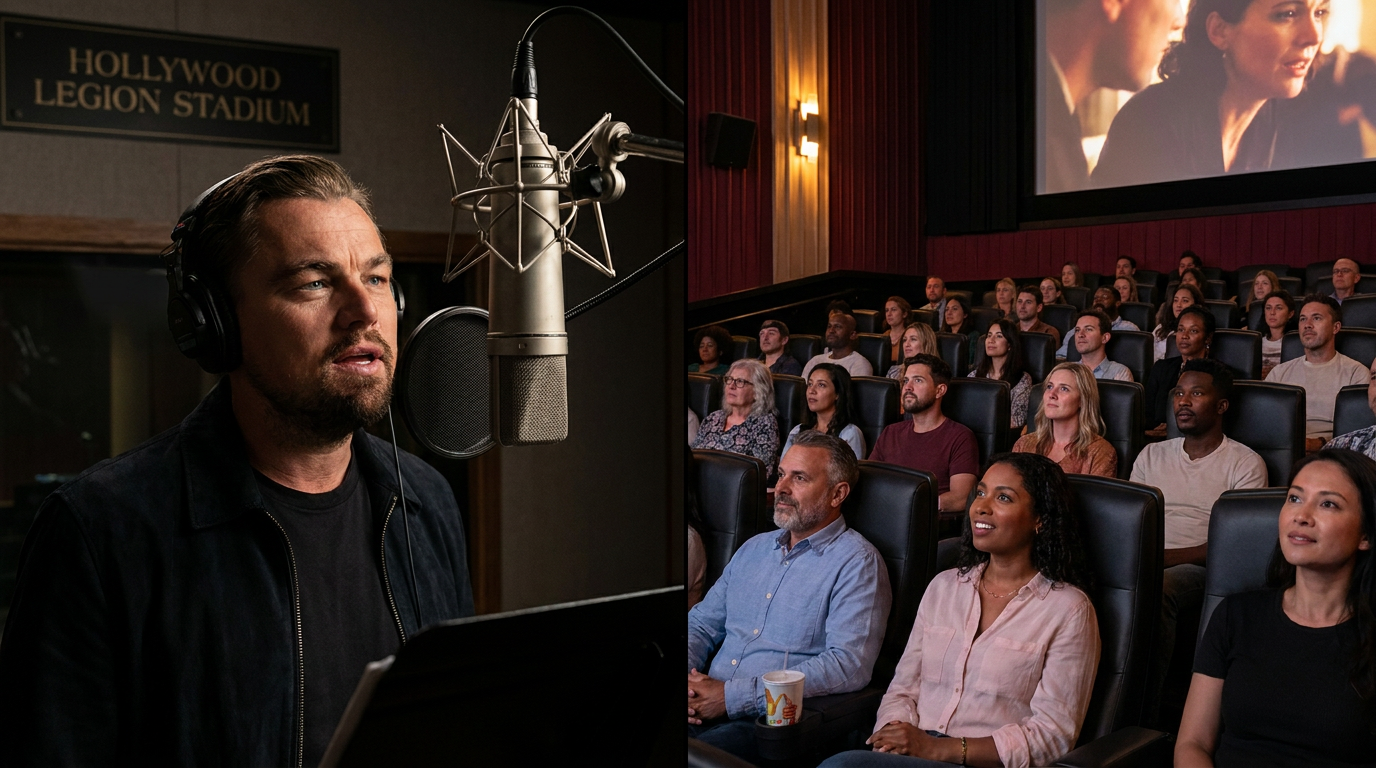
A Hollywood actor steps into a recording booth and delivers a tearful, highly nuanced monologue in English. Six weeks later, that exact voice—carrying the identical emotional texture, breath patterns, and speech rhythm—speaks fluent Spanish, Hindi, Japanese, and Portuguese in theaters worldwide. There are no separate dubbing sessions scheduled across the globe, and no local voice actors hired to mimic the performance for each international territory. The actor's original performance has simply been mathematically translated and mapped onto the final video file. This is the new reality of global film distribution, where artificial intelligence is quietly dismantling the language barriers that have segmented audiences for a century.[7]
As the entertainment industry moves through 2026, artificial intelligence has officially transitioned from a speculative research-and-development novelty into foundational production infrastructure. Among the most transformative of these new tools is AI-assisted dubbing and lip-sync technology. Major streaming platforms like Netflix and Disney, alongside massive international studios in Bollywood, have deployed the technology at scale to execute simultaneous global releases. Rather than treating AI as a fringe experiment, studio executives now view generative audio and video as a scale business that fundamentally alters the economics of international distribution. The technology has matured to the point where it operates silently in the background of major blockbusters, completely imperceptible to the average moviegoer.[6][7]
The shift represents a fundamental democratization of global storytelling. Historically, language barriers dictated which films could find an international audience and which were confined to their domestic markets. Only the largest studios could afford the exorbitant costs of localizing a film for dozens of foreign territories. By automating translation, voice synthesis, and lip-syncing, AI dubbing allows independent filmmakers and foreign-language studios to export their stories globally without those prohibitive upfront costs. A low-budget indie thriller shot in South Korea or a documentary produced in Brazil can now launch globally on day one, offering audiences a native-sounding experience that respects the original artistic vision.[5]
To understand the magnitude of this shift, one must look at the traditional localization bottleneck. For decades, dubbing a major blockbuster into 15 languages required 15 separate casting processes, studio rentals, and post-production sync teams. Voice actors had to watch the original footage and attempt to match their localized delivery to the on-screen mouth movements, a process highly dependent on the skill of both the actor and the sync editor. The workflow routinely took three to six months and cost millions of dollars, effectively pricing out smaller productions and delaying international release windows by months.[5][7]

AI dubbing replaces this manual coordination with a streamlined, software-driven pipeline that operates at unprecedented speed. The mechanism begins with Automatic Speech Recognition (ASR), which transcribes the source audio with near-perfect accuracy before translating the text into the target languages. However, translation is merely the baseline requirement; the true breakthrough lies in how the system handles the audio output and preserves the integrity of the original performance. Modern platforms can localize a ten-minute video into twenty languages in a matter of minutes, completely upending traditional post-production timelines.[3]
The next critical step in the pipeline is voice cloning, powered by deep learning models that capture the unique vocal identity of the original speaker. The system analyzes the actor's tone, cadence, and timbre, and then applies those exact characteristics to the newly generated foreign-language dialogue. This ensures that the original actor sounds like themselves, even when speaking a language they have never learned. The technology effectively clones the actor's vocal footprint, allowing their distinct sonic brand to travel across borders without being diluted by a secondary performer's interpretation.[5]
Crucially, modern systems utilize Cross-Lingual Prosody Transfer (XLPT) to maintain the soul of the performance. This technology carries the emphasis, pacing, and emotional weight of the original delivery into the synthesized track. If an actor whispers a line, lets their voice crack with grief, or delivers a punchline with a specific comedic timing, the XLPT algorithm ensures the dubbed version replicates that exact emotional nuance. This preserves the director's original intent and ensures that foreign audiences feel the exact same emotional resonance as the domestic audience.[3]
Crucially, modern systems utilize Cross-Lingual Prosody Transfer (XLPT) to maintain the soul of the performance.
The final and historically most difficult hurdle in localization is lip-syncing. An emotionally accurate voice clone is useless if the on-screen actor's mouth is clearly forming different words, creating a jarring visual disconnect that immediately pulls the audience out of the story. AI solves this persistent problem through a process known as phoneme-to-viseme mapping. This technology bridges the gap between the audio track and the visual performance, ensuring that the two elements remain perfectly unified regardless of the language being spoken.[5]

A phoneme is a distinct unit of sound in a language, while a viseme is the corresponding facial and lip shape used to produce that sound. The AI system analyzes the phonemes in the new translated audio track, identifies the necessary visemes, and seamlessly re-renders the actor's lower face in the video file to match the new dialogue. The result is a native-looking performance where the lips visibly form the target language, complete with viseme-level precision across the full facial region. This eliminates the uncanny valley effect that plagued early dubbing efforts.[3][5]
The economic implications of this automated mechanism are staggering for the entertainment industry. Traditional dubbing typically costs between $50 and $200 per finished minute, depending on the language and the prestige of the voice talent involved. AI dubbing has compressed that cost to between $1 and $20 per minute, depending on the voice tier and whether human review is included in the package. Furthermore, an eight-language localization process that once took half a year can now be completed in three to four weeks—a 10x reduction in both cost and time that fundamentally alters project budgets.[3][7]

This newfound efficiency is driving massive market growth across the media landscape. The global dubbing and voice-over market, valued at $4.2 billion in 2024, is now projected to reach $8.6 billion by 2034, fueled largely by the scalability of AI solutions. Industry leaders note that the goal is no longer just saving money on existing workflows, but creating unprecedented global experiences where every video on the internet—from corporate training to independent cinema—can eventually be localized for any viewer. The technology is expanding the total addressable market for video content.[2][8]
Despite these rapid technological leaps, the industry has largely settled on a 'human-in-the-loop' workflow rather than relying on fully autonomous generation. While AI excels at processing the bulk of the audio and rendering the visuals, human localization experts are still required to review the output, particularly for prestige film and character-driven creative works. Human oversight ensures that cultural idioms, localized slang, and highly nuanced emotional variations are accurately adapted, preventing the kind of literal translations that can ruin a film's subtext.[2][3][5]
This hybrid approach is also reshaping the labor landscape within Hollywood and beyond. Rather than eliminating localization jobs entirely, the technology is evolving them into higher-leverage positions. Workers who previously spent hours manually syncing audio tracks or recording scratch vocals are transitioning into roles focused on prompt engineering, quality control, and linguistic direction. The future belongs to professionals who understand the fundamentals of cinematic storytelling and can translate those instincts into AI-driven workflows, creating new categories of technical-creative jobs.[5][6]

However, the rapid adoption of voice cloning has necessitated strict new labor guardrails to protect performers. During the 2026 contract negotiations, the Hollywood guilds—including SAG-AFTRA—made AI consent and compensation central to their demands, building on the strike resolutions of previous years. The industry is actively hardening its production models to ensure that when an actor's voice is cloned for international markets, the usage is explicitly negotiated, governed by clear data-residency practices, and fairly priced. Compliance and consent have become just as important as the underlying technology.[3][4][6]
Ultimately, the rise of AI dubbing represents a rare technological shift that tangibly benefits both creators and consumers. For studios and independent filmmakers, it unlocks the entire globe as a potential audience on day one, removing the financial barriers that once restricted the flow of international art. For viewers, it means the ability to watch the world's best stories in their native language, without sacrificing the authenticity, timing, and emotional power of the original performance. It is a triumph of connectivity, ensuring that great cinema can transcend its linguistic origins.[3][5]
How we got here
2023
Netflix begins testing early AI-assisted dubbing primarily for documentary content in Spanish and Portuguese markets.
2024
Disney deploys AI dubbing for select Disney+ exclusives, enabling simultaneous regional releases across the Asia-Pacific market.
2025
Hollywood actors and writers ratify agreements establishing the first major guardrails for AI usage across interactive media and television.
2026
AI dubbing transitions from an experimental tool to foundational production infrastructure, heavily utilized by major Hollywood and Bollywood studios.
Viewpoints in depth
Global Studio Executives
Focused on the economic scalability and day-and-date global release capabilities.
For major studios and streaming platforms, AI dubbing is primarily an engine for scale and speed. Executives view the technology as a way to eliminate the three-to-six month localization lag, allowing tentpole films and series to premiere globally on the exact same day. By reducing localization costs by up to 90%, studios can afford to dub mid-budget and niche content that previously would have only received subtitles, vastly expanding their total addressable market and subscriber retention in emerging regions.
Localization Specialists & Voice Actors
Focused on preserving emotional nuance, human-in-the-loop quality control, and labor protections.
The localization community acknowledges the speed of AI but stresses that algorithms cannot fully grasp cultural subtext, local idioms, or complex emotional shifts. They advocate for a hybrid model where AI handles the heavy lifting of lip-sync and baseline translation, while human directors and voice actors refine the performance. Furthermore, voice actors are pushing for strict contractual guardrails to ensure they are fairly compensated when their vocal likeness is used to train proprietary studio models or generate new performances.
Independent Filmmakers
Focused on the democratization of distribution and breaking down historical barriers to entry.
For indie creators, AI dubbing is a democratizing force that levels the playing field against major studios. Previously, an independent film shot in Spanish or Korean had limited commercial viability in the English-speaking market due to the prohibitive costs of high-quality dubbing. Now, indie producers can utilize cost-effective AI platforms to generate broadcast-quality localizations, allowing their art to compete globally and find audiences that were previously locked behind a financial wall.
What we don't know
- How international audiences will react long-term to digitally altered lip movements in prestige dramas.
- Whether the cost of high-end AI dubbing will eventually drop low enough for amateur YouTube creators to use at scale.
- How international copyright law will handle disputes over unauthorized voice cloning in non-unionized markets.
Key terms
- Automatic Speech Recognition (ASR)
- Technology that automatically transcribes spoken audio into text with high accuracy, serving as the first step in the AI dubbing pipeline.
- Voice Cloning
- The use of deep learning models to capture and replicate a person's unique vocal identity, tone, and timbre.
- Cross-Lingual Prosody Transfer (XLPT)
- An algorithm that carries the emotional weight, pacing, and emphasis of an original vocal performance into a newly synthesized language.
- Phoneme-to-Viseme Mapping
- The process of matching distinct units of sound (phonemes) to the corresponding facial and lip shapes (visemes) to create realistic lip-syncing.
- Human-in-the-loop
- A workflow where artificial intelligence performs the bulk of a task, but a human expert reviews, refines, and approves the final output.
Frequently asked
Does AI dubbing completely replace human voice actors?
No. While AI automates the baseline translation and lip-syncing, the industry relies on a 'human-in-the-loop' workflow. Human experts are still needed to review translations for cultural accuracy, adjust emotional nuances, and direct the AI output.
How does the AI match the actor's lip movements?
The technology uses phoneme-to-viseme mapping. It analyzes the sounds (phonemes) of the translated language and digitally re-renders the actor's mouth shapes (visemes) on screen to perfectly match the new audio.
Is AI dubbing cheaper than traditional methods?
Significantly. Traditional dubbing costs between $50 and $200 per finished minute, while AI dubbing ranges from $1 to $20 per minute, representing a massive cost reduction for studios.
Can AI capture the emotion of the original performance?
Yes, through Cross-Lingual Prosody Transfer (XLPT). This algorithm analyzes the original actor's pacing, emphasis, and emotional tone, and applies those exact characteristics to the synthesized foreign-language voice.
Sources
Source coverage
8 outlets
3 viewpoints surfaced








[1]ForbesGlobal Studio Executives
7 Media Trends That Will Redefine Entertainment In 2026
Read on Forbes →[2]SlatorLocalization Specialists
Why 2025 Is the Breakthrough Year for AI Dubbing
Read on Slator →[3]3Play MediaLocalization Specialists
AI Dubbing vs. Traditional Dubbing: How Media Leaders Should Choose in 2026
Read on 3Play Media →[4]Screen DailyIndependent Filmmakers
Eight talking points for the US film industry in 2026
Read on Screen Daily →[5]Murf AIIndependent Filmmakers
Growing Impact of AI Dubbing on the Movie Industry
Read on Murf AI →[6]The Hollywood ReporterGlobal Studio Executives
Hollywood's 2026 AI Production Shift Moves From Tests to Deal Logic
Read on The Hollywood Reporter →[7]Mayank Digital LabsIndependent Filmmakers
AI Dubbing Hollywood Actors 2026
Read on Mayank Digital Labs →[8]Market.usGlobal Studio Executives
Global Dubbing and Voice-over Market Forecast 2024-2034
Read on Market.us →
Every angle. Every day.
Get entertainment stories with full source coverage and perspective breakdowns delivered to your inbox.