
How AI and Micro-Drones Are Rewriting the Rules of Nature Documentaries
Advancements in autonomous drones and edge AI are allowing filmmakers and conservationists to track and film wildlife with unprecedented, non-invasive precision.
By Factlen Editorial Team
- Conservation Technologists
- Scientists and rangers using drone technology to gather accurate ecological data and deter poaching.
- Cinematic Innovators
- Filmmakers pushing visual boundaries to create immersive, animal-eye perspectives.
- Ethical Ecologists
- Researchers focused on minimizing the acoustic and behavioral disturbance caused by drones.
What's not represented
- · Indigenous Communities
- · Aviation Regulators
Why this matters
This technological leap not only creates more immersive educational entertainment, but provides conservationists with the exact same tools to accurately track endangered species and combat poaching.
Key points
- AI and micro-drones are replacing helicopters and telephoto lenses in nature documentaries.
- Underwater drones can now operate at extreme depths for months, capturing unseen ecosystems.
- Edge AI allows cameras to autonomously track fast-moving animals in real-time.
- Conservationists use the same AI technology to count bird populations with up to 95% accuracy.
- Park rangers deploy autonomous drones to monitor vast landscapes and detect poaching.
- Ethical guidelines are being established to minimize the acoustic disturbance drones cause to wildlife.
For decades, the gold standard of nature documentary filmmaking involved a patient cameraperson sitting in a camouflaged blind for weeks, armed with a massive telephoto lens. If a production wanted an aerial shot, it meant renting a noisy helicopter for hundreds of dollars an hour and hoping the downdraft didn't scatter the herd. Today, the landscape of wildlife cinematography has been fundamentally rewritten.[2]
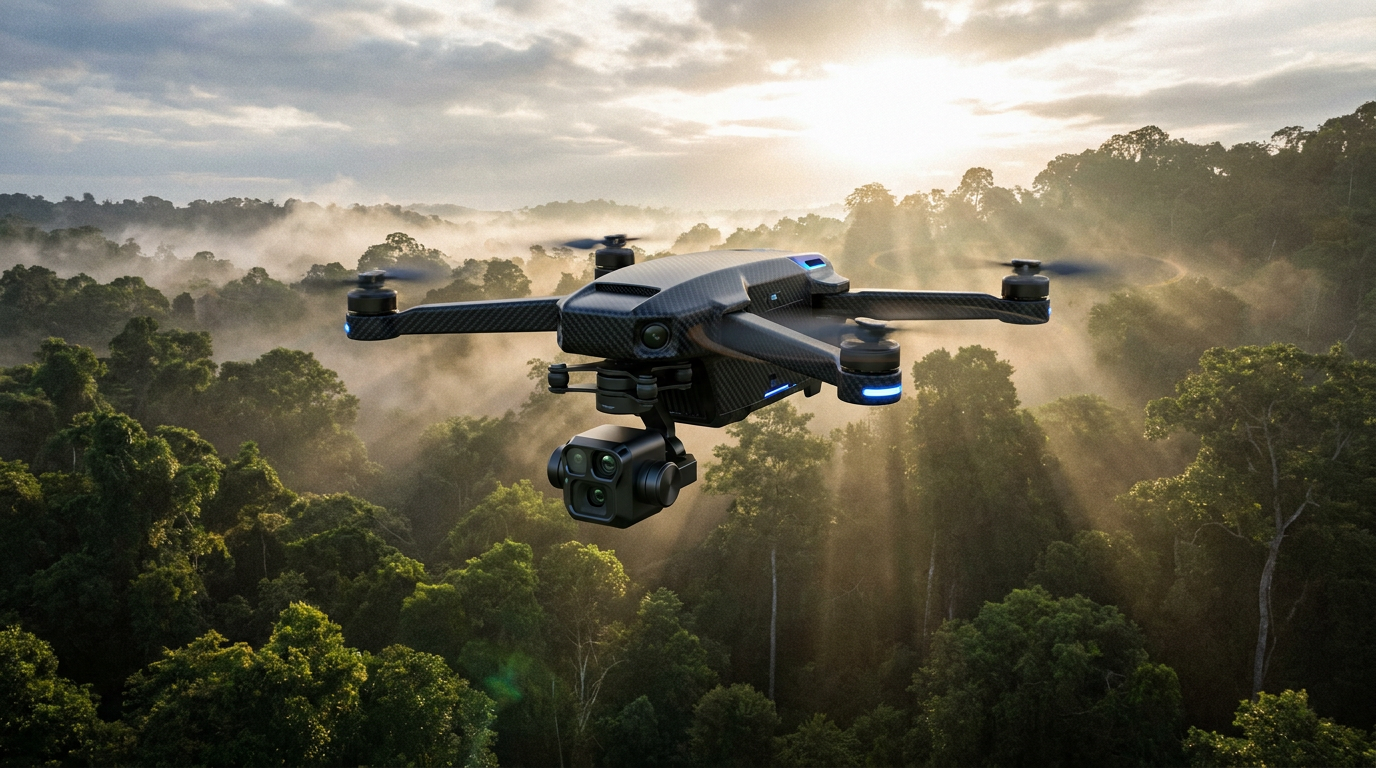
The catalyst for this shift is the convergence of two rapidly maturing technologies: artificial intelligence and micro-drone hardware. In 2026, filmmakers are no longer just observing nature from a distance; they are flying alongside it, diving beneath it, and using machine learning to track animal behavior with unprecedented precision.[7]
This technological leap is producing a new generation of documentaries that offer viewers an immersive, animal-eye perspective. But the implications extend far beyond entertainment. The very same tools developed to capture breathtaking footage for streaming platforms are now being deployed by conservationists to monitor endangered species, track migrations, and protect fragile ecosystems.[7]
The hardware revolution begins with the miniaturization of drones. First-person view drones, originally popularized in competitive drone racing, have been adapted for the canopy. These nimble, lightweight quadcopters can navigate through dense rainforest foliage, flying through gaps just inches wide without disturbing the surrounding environment.[6]

In productions exploring botanical and aerial ecosystems, these micro-drones provide a perspective that was previously impossible. Rather than looking down at the forest from above, the camera can now start above the canopy and dive seamlessly into the undergrowth, weaving between branches to put the viewer directly into the habitat. If a micro-drone bumps a leaf and crashes, its lightweight frame usually survives to fly another day.[6]
Beneath the surface, the advancements are equally striking. Underwater remotely operated vehicles have evolved from clunky, tethered machines into sleek, autonomous explorers. For example, the Boxfish Luna—a high-end underwater drone—combines integrated sensors, powerful lighting, and full-frame cinema cameras in a single enclosed frame.[1]
This specific technology was recently deployed in the Great Lakes for the documentary 'All Too Clear'. Filmmakers used the Luna to dive to depths human divers couldn't safely reach, spending over 150 days filming underwater. The drone not only captured the devastating ecological impact of invasive mussel species but also inadvertently discovered a historic shipwreck at the bottom of Lake Huron.[1]

But hardware is only half the equation. The true breakthrough of the current era is the integration of 'Edge AI'—artificial intelligence algorithms that run directly on the camera or drone itself, rather than requiring footage to be sent back to a massive server farm for processing.[7]
In the field, Edge AI allows drones to autonomously track fast-moving subjects. When filming a cheetah sprinting or a hummingbird in flight, human reflexes are often too slow to keep the subject perfectly framed. AI-driven computer vision locks onto the animal, predicting its trajectory and adjusting the drone's flight path and camera gimbal in real-time to maintain a rock-steady shot.[3][7]
In the field, Edge AI allows drones to autonomously track fast-moving subjects.
This same computer vision is revolutionizing wildlife conservation. At the University of Missouri, researchers have partnered with state conservation departments to replace traditional airplane-based bird counting with AI-equipped drones.[4]
The mechanism is highly structured: specialized software plots a drone's flight path over a wetland, optimizing altitude and image overlap. As the drone flies, the onboard AI analyzes the photos instantly. It identifies individual birds, distinguishes between species like mallards and pintails, and prevents double-counting.[4]
The accuracy of this system is staggering. On open water, the AI achieves over 95 percent accuracy in species identification and counting. Even in complex environments where birds are partially obscured by vegetation, the system maintains an 80 to 85 percent success rate, far surpassing the reliability of human observers leaning out of a loud airplane window.[4]

A similar approach is being scaled globally through initiatives like the WildDrone project. Researchers are developing autonomous fixed-wing gliders and vertical take-off and landing drones equipped with thermal imaging. These drones can fly beyond visual line of sight, monitoring vast expanses of the African savanna or European migratory flyways.[3]
The data collected by these autonomous systems is fed into real-time monitoring platforms. Park rangers in Kenya, for instance, are now using these AI-processed drone feeds to detect illegal poaching activities, monitor injured animals, and track migration patterns before human-wildlife conflicts escalate.[5]
Despite these breakthroughs, the integration of drones into wild habitats carries inherent uncertainties and ethical challenges. The primary concern among both filmmakers and conservationists is the acoustic footprint of the technology.[3][7]
Drones emit a high-frequency whine that can cause distress to sensitive species. While manufacturers are developing quieter propellers and more efficient motors, the risk of altering an animal's natural behavior remains. If a drone causes a nesting bird to abandon its eggs or induces panic in a herd, the footage captured is not only ethically compromised but scientifically invalid.[3]

To mitigate this, the industry is establishing strict non-invasive monitoring frameworks. These guidelines dictate minimum approach distances and mandate the use of telephoto lenses even when flying, ensuring the drone remains outside the animal's 'flight or fight' radius.[3][7]
Battery life also remains a persistent bottleneck. Most micro-drones can only fly for short durations before needing a recharge, limiting their utility in remote, off-grid locations. Engineers are actively testing solar-powered charging stations and hybrid fixed-wing designs to extend operational times, but power density remains a fundamental physical constraint.[3]
Ultimately, the fusion of AI and drone technology represents a paradigm shift in how humanity interacts with the natural world. We are moving from an era of passive, distant observation to one of intimate, data-rich immersion.[7]
Whether it is a documentary viewer marveling at the mechanics of a hummingbird's flight in stunning 4K, or a conservationist using thermal imaging to protect a rhino from poachers, the result is the same. Technology is no longer just a tool for capturing nature; it has become a vital instrument for understanding and preserving it.[7]
How we got here
Early 2000s
Nature documentaries rely heavily on expensive helicopter rentals and distant telephoto lenses for aerial shots.
2016
Companies like Boxfish Robotics begin developing advanced underwater drones to solve control and picture quality issues.
2022
Major productions like BBC's The Green Planet popularize the use of FPV micro-drones to fly through dense forest canopies.
2025
Researchers successfully deploy AI-equipped drones to count migratory bird populations with 95% accuracy.
2026
Edge AI becomes standard, allowing drones to autonomously track fast-moving wildlife without relying on cloud processing.
Viewpoints in depth
Documentary Filmmakers
Filmmakers emphasize the creative freedom and immersive perspectives unlocked by micro-drones.
For directors and cinematographers, the primary value of this technology is the ability to put the audience directly into the animal's habitat. Rather than observing a subject from afar with a telephoto lens, micro-drones allow the camera to move with the animal, creating a visceral, empathetic connection. They view AI tracking not just as a technical convenience, but as a storytelling tool that keeps the focus locked on fast-moving action that human operators would miss.
Conservation Biologists
Scientists focus on the data-gathering potential of autonomous systems.
Conservationists view AI and drones as essential tools for accurate population censuses, anti-poaching surveillance, and non-invasive ecological monitoring. By removing the human error inherent in manual counting from airplanes, they can generate highly accurate datasets to inform policy. For this camp, the aesthetic quality of the footage is secondary to the actionable intelligence the AI extracts from it.
Bioacoustics Researchers
Researchers express caution regarding the acoustic footprint of drones on wildlife.
This perspective argues that even 'quiet' drones emit high-frequency noise that can alter animal behavior. They stress the need for strict ethical guidelines, minimum approach distances, and rigorous testing of how different species react to UAV presence. Their concern is that if a drone causes a nesting bird to abandon its eggs or induces panic in a herd, the resulting footage is ethically compromised and scientifically invalid.
What we don't know
- The long-term behavioral impact of frequent drone presence on highly sensitive animal populations.
- How quickly battery density will improve to allow micro-drones to fly for hours rather than minutes.
Key terms
- Micro-drone
- A very small, lightweight unmanned aerial vehicle, often used for navigating tight spaces like forest canopies.
- Edge AI
- Artificial intelligence processing that occurs locally on a device, like a camera or drone, rather than in a centralized cloud server.
- BVLOS
- Beyond Visual Line of Sight; drone operations where the pilot cannot physically see the aircraft, relying entirely on instruments.
- ROV
- Remotely Operated Vehicle; a tethered or autonomous underwater robot used for deep-sea exploration and filming.
- Thermal Imaging
- Camera technology that detects heat signatures, allowing drones to spot animals at night or through dense foliage.
Frequently asked
How do drones film animals without scaring them?
Filmmakers use specialized telephoto lenses on drones to maintain a respectful distance, and manufacturers are developing quieter propellers to reduce the acoustic footprint.
What is Edge AI in wildlife filming?
Edge AI refers to artificial intelligence algorithms that process data directly on the drone or camera in real-time, rather than sending the footage to a remote server.
Can AI accurately count wild animals?
Yes. In straightforward environments like open water, AI algorithms can identify and count specific bird species with over 95% accuracy, preventing double-counts.
How deep can the new underwater documentary drones go?
Advanced underwater drones like the Boxfish Luna can safely operate at depths far beyond human diving limits, allowing for months of continuous deep-water filming.
Sources
Source coverage
7 outlets
3 viewpoints surfaced







[1]PlaybackCinematic Innovators
Producers explore new tech for nature documentary production
Read on Playback →[2]AP NewsCinematic Innovators
Drones, viral videos help 'Nature' thrive after 40 years
Read on AP News →[3]Frontiers in Conservation ScienceConservation Technologists
WildDrone: autonomous drone technology for monitoring wildlife populations
Read on Frontiers in Conservation Science →[4]University of MissouriConservation Technologists
Drones and ducks: Leading the future of wildlife conservation
Read on University of Missouri →[5]Kenya Broadcasting CorporationConservation Technologists
Take On Tech: How Drones and AI Are Transforming Wildlife Conservation in Kenya
Read on Kenya Broadcasting Corporation →[6]BBC EarthCinematic Innovators
Filming the Impossible with Drones
Read on BBC Earth →[7]Factlen Editorial TeamEthical Ecologists
Synthesis by Factlen editorial team
Read on Factlen Editorial Team →

More in entertainment
See all 61 stories →Showcase Season
Gaming's Biggest Franchises Return: June Showcases Deliver Historic Wave of Remakes and Revivals
7 sources

Disclosure Day
Steven Spielberg Returns to Sci-Fi as 'Disclosure Day' Anchors Massive June Box Office
6 sources

Pop Music
Olivia Rodrigo Releases Highly Anticipated Third Album 'You Seem Pretty Sad For A Girl So In Love'
6 sources

Music Economy
Global Music Revenues Hit Record $31.7 Billion as Vinyl Boom Meets 'Green Note' Sustainability
7 sources

Every angle. Every day.
Get entertainment stories with full source coverage and perspective breakdowns delivered to your inbox.