
How AI and Biomechanical Analytics Are Eradicating the Season-Ending Injury
Professional sports teams are deploying computer vision and machine learning to predict and prevent injuries weeks before they happen, fundamentally changing how athlete longevity is managed.
By Omar Haddad

Share this story
For the entirety of modern sports history, the catastrophic injury has been treated as a tragic lottery. A star player plants their foot, a tendon snaps, and a season—or a career—is instantly derailed. Medical staffs were largely reactive, tasked with the grueling work of surgical repair and rehabilitation after the damage was already done.
But in 2026, the paradigm has fundamentally shifted. Elite sports organizations are no longer waiting for players to break. Instead, they are deploying artificial intelligence, computer vision, and continuous biomechanical monitoring to predict and prevent injuries weeks before a player ever feels a twinge of pain.[1][2]
This transition from reactive treatment to predictive modeling represents the most significant leap in sports science since the invention of the MRI. The core mechanism relies on ingesting massive, multi-modal datasets. Today’s athletes are walking sensor arrays. Wearable technologies—including GPS trackers, inertial measurement units (IMUs), and electromyography (EMG) sensors—continuously log an athlete's acceleration, deceleration, heart rate variability, and muscle activation during every practice and match.[1]
However, raw data is useless without context. The breakthrough has come from machine learning algorithms capable of finding invisible correlations within millions of data points. Systems developed by companies like Zone7 have ingested over 200 million hours of professional soccer data to build predictive models.
These algorithms understand that injuries rarely happen in isolation. A stress fracture is not just the result of a single bad step; it is the culmination of poor sleep, a 15% spike in high-speed running volume over two weeks, and a subtle shift in ground-reaction forces favoring the left leg.[1]
By analyzing these complex, interacting variables, AI models can now predict soft-tissue injuries with up to 72% accuracy. When the system flags a player as high-risk, the intervention is immediate but often invisible to the fans.
A coach might reduce the player's sprint volume in Tuesday's practice by 20%, or the medical staff might mandate targeted mobility work for a tight hip flexor. The result is a profound drop in attrition; Spanish soccer club Getafe CF reported a 66% reduction in injuries by their second season using predictive AI, while LAFC achieved a 69% drop in non-contact injuries.[1]
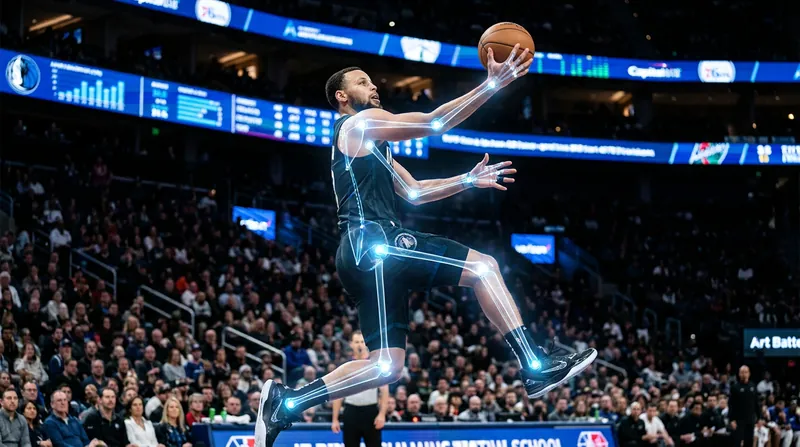
The National Basketball Association (NBA) has taken this predictive approach a step further by integrating advanced computer vision. Following a concerning spike in Achilles tendon ruptures—one of the most devastating injuries in basketball, which recently sidelined stars like Tyrese Haliburton, Jayson Tatum, and Damian Lillard—the league initiated a centralized, AI-driven monitoring system. Arena cameras now track player movements at 25 frames per second, creating real-time, three-dimensional models of every athlete on the court.
This markerless motion capture technology allows the AI to analyze biomechanics without requiring players to wear cumbersome equipment during live games. The system measures the exact angle of a player's knee when they land from a rebound or the specific force distributed through their ankle during a crossover dribble. If a player begins to subconsciously favor one leg—a classic precursor to a major compensatory injury—the AI detects the millimeter-scale asymmetry long before the human eye or the player themselves notices.[2]
The NBA's initiative, spearheaded by Commissioner Adam Silver, aggregates this video data with wearable metrics and medical records into a league-wide repository. The goal is to identify the biomechanical warning signs of Achilles and ACL tears before the tissue fails.
Silver noted that the AI's ability to ingest video of every game a player has ever played allows it to detect invisible patterns that lead to catastrophic tendon failure. This data is also being cross-referenced with external factors, such as court surface hardness and travel-induced fatigue, to create a holistic risk profile for every rostered player.
Beyond simply keeping players on the field, this technology is redefining the concept of athletic longevity. Historically, a player's physical prime was considered a fixed window that slammed shut in their early thirties. Now, longevity is treated as a measurable, engineerable output. By continuously monitoring metabolic flexibility, neuromuscular efficiency, and workload, sports scientists can tailor training regimens that preserve fast-twitch muscle fibers and joint health well into an athlete's late thirties and forties.[2]
The financial implications of this shift are staggering. In professional sports, player salaries are measured in the tens of millions, and a single season-ending injury to a star can instantly evaporate a franchise's championship hopes and revenue projections. Consequently, the sports injury prediction market has exploded, with valuations projected to reach nearly $3 billion by 2030. Teams view these AI systems not as experimental medical expenses, but as vital insurance policies on their most valuable assets.[2]
Despite the overwhelming success of these predictive models, the technology introduces new complexities, particularly regarding data privacy and player autonomy. Players' unions are acutely aware that predictive health data is a double-edged sword. While an algorithm that flags an impending hamstring tear can save a player's season, that same algorithm could theoretically be used by front offices to devalue a player during contract negotiations if they are deemed "chronically high-risk."[2]
To address these concerns, leagues and unions are actively negotiating data ownership frameworks. The consensus is that AI must function as a decision-support tool for medical staffs, not an automated GM. The human element remains critical; a physical therapist must still contextualize the AI's alerts, factoring in a player's psychological state, their communication, and their subjective feeling of fatigue.[2]
Furthermore, the models are not infallible. False positives—where the AI predicts an injury that would not have occurred—can lead to unnecessary benchings, frustrating highly competitive athletes who feel perfectly healthy. Refining the calibration layers of these neural networks to account for individual baseline variances is the current frontier of sports science research.[1][2]
Looking ahead, the benefits of this predictive revolution are already trickling down from elite arenas to consumer fitness. The same machine learning architectures used by Champions League clubs and the NFL's Digital Athlete program are being integrated into commercial smartwatches and running apps. Everyday runners and amateur athletes will soon have access to personalized, AI-driven load management, democratizing the science of injury prevention and keeping people active, healthier, and pain-free for decades.
Key points
- AI models can now predict soft-tissue injuries with up to 72% accuracy by analyzing millions of data points.
- The NBA is using markerless computer vision to track player biomechanics at 25 frames per second to prevent Achilles tears.
- Early-adopting soccer clubs have seen up to a 69% reduction in non-contact injuries.
- The technology shifts sports medicine from reactive surgical repair to proactive load management.
- Players' unions are negotiating strict data privacy rules to prevent predictive models from negatively impacting contracts.
How we got here
Early 2010s
Basic GPS trackers and heart rate monitors become standard in elite soccer and rugby for tracking total distance run.
2018–2020
Machine learning startups begin ingesting historical injury data to find correlations between training load spikes and soft-tissue injuries.
2024–2025
AI platforms like Zone7 achieve over 70% accuracy in predicting injuries, leading to widespread adoption across top European soccer leagues.
June 2025
The NBA experiences a concerning spike in Achilles ruptures, prompting Commissioner Adam Silver to announce a league-wide AI video ingestion initiative.
2026
Markerless motion capture and real-time predictive analytics become standard infrastructure in major North American and European sports arenas.
- Sports Scientists & Medical Staff
- View predictive AI as a revolutionary tool to transition from reactive care to proactive health optimization.
- Athletes & Players' Unions
- Embrace the longevity benefits but remain highly protective of data privacy and contract leverage.
- Coaching & Management
- Focus on maximizing roster availability and protecting the financial investments made in star players.
Perspectives this story doesn't cover
- Fans who may feel frustrated by star players being rested due to invisible AI risk warnings.
- Sports betting markets that must now account for algorithmic load management decisions.
Sources
Source coverage
2 outlets
3 viewpoints surfaced


- [1]MediumSports Scientists & Medical Staff
The Age of Guesswork in Sports is Over: AI's Predictive Analytics
Read on Medium → - [2]Factlen Editorial Team
Synthesis by Factlen editorial team
Read on Factlen Editorial Team →

More in Sports
See all →Sports Biomechanics
How AI and Markerless Motion Capture Are Engineering Injuries Out of Sports
3 sources
Amateur Athletics
How Smartphone AI is Democratizing Sports Analytics for Amateur Athletes
7 sources

Soccer Analytics
Beyond Expected Goals: How 'Expected Threat' is Rewiring Soccer Analytics
3 sources

Baseball Biomechanics
How Invisible AI Cameras Are Solving Baseball's Pitching Injury Epidemic
4 sources
Comments
Every angle. Every day.
Get Sports stories with full source coverage and perspective breakdowns, free every day.