
How AI and Bioacoustics Are Revolutionizing Wildlife Conservation
By combining passive acoustic monitoring with advanced artificial intelligence, scientists are decoding animal communication and detecting environmental threats in real-time, transforming how we protect global biodiversity.

In short
- Passive acoustic monitoring allows scientists to track ecosystems 24/7 without disturbing wildlife.
- AI models convert audio into visual spectrograms to identify species from thousands of hours of recordings.
- Rainforest Connection uses recycled smartphones to detect illegal logging and alert rangers in real-time.
For decades, conservationists have relied on their eyes to protect the natural world. Camera traps, satellite imagery, and aerial drones have been the standard tools for tracking endangered species and monitoring deforestation. But visual monitoring has severe limitations.
A camera trap only captures what walks directly in front of its lens, and a satellite cannot see beneath the dense canopy of a tropical rainforest or the surface of the ocean. In these complex, three-dimensional habitats, the most critical activities—from the mating calls of rare birds to the whine of an illegal chainsaw—are heard long before they are seen.
This realization has sparked a quiet revolution in ecology: a shift from looking to listening. Passive Acoustic Monitoring (PAM) involves placing autonomous recording units—microphones in forests, hydrophones in oceans—to continuously capture the "soundscape" of an ecosystem. Because these devices operate without human presence, they capture a pristine, undisturbed record of animal behavior across vast areas and extreme weather conditions.
However, this acoustic approach created a massive new problem: the data bottleneck. A network of sensors can easily generate millions of hours of audio in a single season. For human researchers, manually listening to and annotating this data is mathematically impossible. A breakthrough was needed to turn this ocean of noise into actionable ecological insights.
Enter artificial intelligence. Over the last five years, advances in machine learning have transformed bioacoustics from a niche academic pursuit into a scalable global conservation tool. Tech giants and academic labs alike have developed sophisticated models, such as Google's Perch, which can process thousands of hours of complex acoustic scenes in minutes.
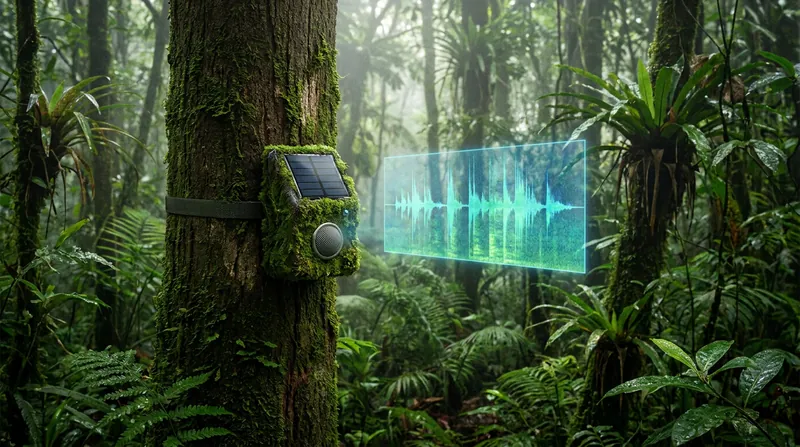
Rather than analyzing the raw audio waves directly, these AI systems typically convert the sound into spectrograms—visual heatmaps of frequency and time. Convolutional Neural Networks (CNNs), the same architecture used for facial recognition, then scan these images to identify the distinct visual signatures of specific animal calls.[4]
The impact of this technology is perhaps most visible in the fight against deforestation. According to the United Nations, up to 90 percent of logging in tropical rainforests is illegal, serving as a gateway activity to broader ecosystem collapse. Traditional satellite monitoring only detects deforestation after the trees have already been cleared—a post-mortem rather than a prevention.
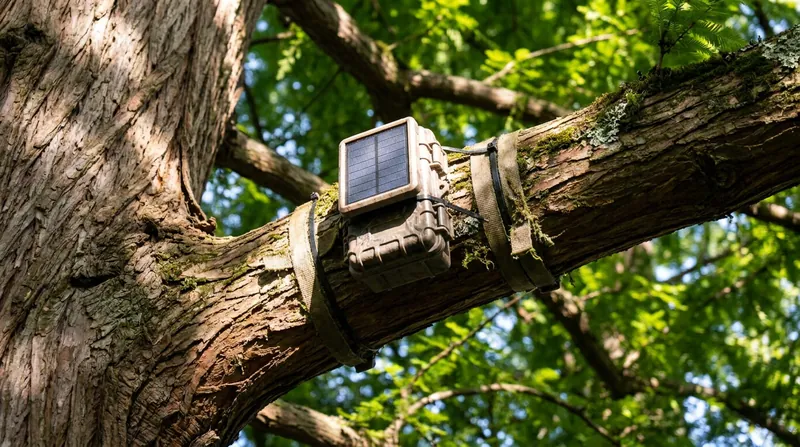
To solve this, the non-profit Rainforest Connection (RFCx) developed the "Guardian" system. These devices, originally built from recycled smartphones, are installed high in the forest canopy and powered by specialized solar panels designed to catch thin slivers of sunlight. Each Guardian continuously records all ambient sound within a three-square-kilometer radius and transmits the data to the cloud via cellular or satellite networks.
In the cloud, AI algorithms scan the live audio stream for the acoustic anomalies of human intrusion: the revving of a chainsaw, the rumble of a logging truck, or the crack of a poacher's gunshot. When a threat is detected, the system sends an instant alert to local authorities. In Brazil, this technology has been deployed to help indigenous tribes monitor their vast reserves, allowing them to intercept illegal loggers in real-time before irreversible damage occurs.
Beyond law enforcement, AI bioacoustics is fundamentally changing how we map global biodiversity. The Cornell Lab of Ornithology's BirdNET project has trained neural networks to identify more than 6,000 bird species by sound alone. By chopping audio into three-second windows and filtering out background noise, the BirdNET algorithm can isolate specific avian vocalizations with remarkable precision.[3]
This capability has democratized ecological research. Through the free BirdNET smartphone app, anyone can record a bird song in their backyard and receive an instant, AI-generated species identification. Since its launch, millions of users have contributed to this citizen-science initiative, generating a wealth of data that helps scientists track migration patterns, population shifts, and the impacts of climate change on a scale that would be impossible for professional researchers to achieve alone.[3]
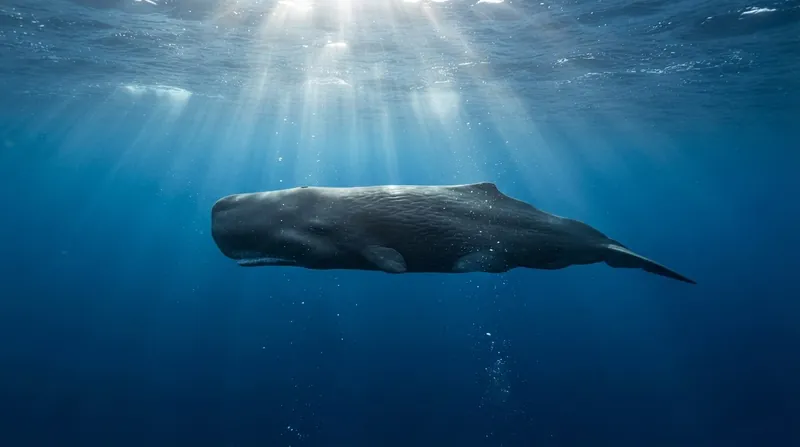
While BirdNET identifies species, other initiatives are using AI to push the boundaries of interspecies communication. Project CETI (Cetacean Translation Initiative) is an audacious interdisciplinary effort to decode the language of sperm whales. Sperm whales possess the largest brains on Earth and communicate through complex patterns of clicks known as "codas."[1]
Historically, scientists struggled to parse the structure of these codas. But by applying the same unsupervised machine translation techniques that power modern Large Language Models (LLMs), CETI researchers have made groundbreaking discoveries. The AI has identified 156 distinct codas and revealed a "sperm whale phonetic alphabet," demonstrating that their communication involves multiple interacting layers of structure that closely parallel human language.[1][2]
The data reveals a highly sophisticated, communal culture. Acoustic recordings have captured synchronized birthing events, where a dozen female whales coordinate complex movements and vocalizations to support a mother in labor. "It's another humbling moment that we're not the only species with rich, communicative, communal and cultural lives," noted David Gruber, founder of Project CETI.[2]
These scientific revelations are beginning to ripple into the realm of law and policy. At New York University, the More-Than-Human Life (MOTH) program is collaborating with Project CETI to explore how AI-assisted studies of animal communication could alter the legal landscape. If machine learning can definitively prove that cetaceans possess complex language and culture, legal advocates argue it would challenge the foundational theories that confine language—and the rights associated with it—strictly to humans.
On a more immediate level, acoustic data is already shaping land management. By providing undeniable proof of where endangered species live and breed, bioacoustic monitoring has been used to successfully adjust protected area boundaries and validate the effectiveness of specific reforestation strategies.
Despite its promise, the field faces significant hurdles. Deploying sensitive electronics in highly corrosive marine environments or humid rainforest canopies results in frequent hardware failures. Furthermore, the massive computational power required to train deep learning models carries a substantial carbon footprint, creating a paradox for conservationists trying to protect the climate.[4]
To address this, researchers are developing lighter, more efficient AI architectures. New models utilizing Hopfield neural networks require a fraction of the memory and processing power of traditional CNNs. These lightweight models can run directly on "edge devices" in the field, analyzing audio locally without needing to transmit heavy files to the cloud, thereby saving power and bandwidth.[4]
For centuries, technological advancement has largely served to distance humanity from the natural world. But in the emerging field of AI bioacoustics, the opposite is true. By giving us the tools to finally listen to the intricate, ongoing conversations of the wild, artificial intelligence is helping us understand exactly what we stand to lose—and giving us the real-time tools we need to save it.[5]
Key terms
- Passive Acoustic Monitoring (PAM)
- The use of autonomous recording devices to continuously capture the sounds of an environment without human presence.
- Bioacoustics
- The cross-disciplinary science that combines biology and acoustics to study the production and reception of animal sounds.
- Spectrogram
- A visual representation of the spectrum of frequencies of a signal as it varies with time, often used by AI to 'see' sound.
- Edge Computing
- Processing data directly on the local device (like a forest sensor) rather than sending it all to a centralized cloud server.
- Coda
- A distinct pattern of clicks used by sperm whales to communicate with one another.
Reader questions
How does AI identify an animal from a sound?
AI models convert audio recordings into visual heatmaps called spectrograms. Neural networks then analyze these images to find specific patterns that match known animal calls.
Can AI actually translate what whales are saying?
Researchers have identified a 'phonetic alphabet' in sperm whale clicks, but fully translating their language into human concepts is still an ongoing, long-term goal.
How do acoustic sensors get power in remote forests?
Devices like the Rainforest Connection 'Guardians' use specialized solar panels designed to capture the thin bands of sunlight that penetrate the dense tree canopy.
Where opinion splits
Conservation Technologists
Focus on deploying scalable hardware and real-time AI alerts to intercept poachers and map biodiversity.
For technologists and field engineers, the primary value of AI in bioacoustics is its ability to scale human effort. Organizations like Rainforest Connection view the forest as a data problem: illegal logging happens because vast areas cannot be physically patrolled. By deploying edge-computing sensors and cloud-based machine learning, they transform passive forests into active alarm systems. This camp prioritizes rugged hardware, efficient algorithms, and real-time connectivity, arguing that the best use of AI is to provide actionable intelligence to rangers on the ground before environmental damage becomes irreversible.
Behavioral Ecologists
Use machine learning to decode complex animal communication and understand non-human cultures.
Researchers studying animal behavior see AI as a translation device that unlocks the 'black box' of non-human intelligence. Projects like CETI are less focused on law enforcement and more focused on fundamental biological discovery. By applying unsupervised machine translation to sperm whale clicks, this camp seeks to prove that complex language, dialects, and generational culture are not exclusively human traits. They argue that truly understanding the intricate social lives of animals is the necessary first step toward fostering a deeper, more empathetic global conservation ethic.
Legal Advocates
Argue that scientific proof of animal language should fundamentally alter their legal standing and protections.
Legal scholars and environmental rights advocates view bioacoustic data as potential courtroom evidence. Programs like NYU's MOTH argue that current legal frameworks treat animals as property or resources because they are presumed to lack human-like consciousness and language. If AI can definitively prove that species like sperm whales possess structured phonetic alphabets and cultural traditions, this camp believes it will force a paradigm shift in environmental law, potentially granting certain species fundamental legal rights and stronger protections against industrial disruption.
- Conservation Technologists
- Focus on deploying scalable hardware and real-time AI alerts to intercept poachers and map biodiversity.
- Behavioral Ecologists
- Use machine learning to decode complex animal communication and understand non-human cultures.
- Citizen Scientists
- Leverage accessible mobile apps to contribute massive amounts of ecological data from their own backyards.
- Legal Advocates
- Argue that scientific proof of animal language should fundamentally alter their legal standing and protections.
- Editorial Synthesis
- Provides a comprehensive overview of how AI bioacoustics bridges technology and nature.
Perspectives this story doesn't cover
- Indigenous communities whose lands are monitored
- Policymakers funding conservation grants
Sources
Source coverage
5 outlets
5 viewpoints surfaced





- [1]Project CETIBehavioral Ecologists
Project CETI | The Audacious Project
Read on Project CETI → - [2]The GuardianBehavioral Ecologists
British swallowtail split from European cousins much earlier than thought, study finds
Read on The Guardian → - [3]Cornell ChronicleCitizen Scientists
AI-powered BirdNET app makes citizen science easier
Read on Cornell Chronicle → - [4]arXivConservation Technologists
First-of-its-kind AI model for bioacoustic detection using a lightweight associative memory Hopfield neural network
Read on arXiv → - [5]Factlen Editorial TeamEditorial Synthesis
Synthesis by Factlen editorial team
Read on Factlen Editorial Team →
More in Environment
See all →Nature-Based Solutions
The return of the ecosystem engineer: How beaver rewilding is reshaping flood management
2 sources

Beaver Reintroduction
How the Reintroduction of Beavers is Quietly Solving Modern Climate Crises
6 sources

Bioacoustics
How AI and Bioacoustics Are Decoding the Natural World
3 sources
Marine Biology
How Deep-Diving Whales Avoid Decompression Sickness
10 sources
Comments
Every angle. Every day.
Get Environment stories with full source coverage and perspective breakdowns, free every day.