
How AI and Advanced Imaging Are Resurrecting Lost Art Masterpieces
Museums are using artificial intelligence and medical-grade scanning to reconstruct missing canvas edges, reveal hidden underpaintings, and reverse centuries of chemical fading.
By Factlen Editorial Team
- Art Conservators & Technologists
- View AI as a revolutionary, non-invasive tool for recovering lost cultural heritage.
- Art Historians & Purists
- Warn that AI generates statistical approximations that should not be confused with historical truth.
- Museum Audiences
- Value the immersive and educational experience of seeing masterpieces in their original, vibrant forms.
What's not represented
- · Traditional physical restorers
Why this matters
This technological breakthrough allows the public to experience humanity's greatest cultural treasures exactly as the artists originally intended, preserving fragile history without risking damage to the original artifacts.
Key points
- The Rijksmuseum used neural networks to successfully reconstruct the missing edges of Rembrandt's 'The Night Watch', which were trimmed off in 1715.
- X-ray fluorescence scanning combined with AI allowed researchers to recreate a lost Van Gogh painting hidden beneath another canvas.
- Machine learning models can analyze microscopic pigment degradation to predict and digitally restore the original, unfaded colors of classical artworks.
- To preserve historical authenticity, AI reconstructions are displayed digitally or printed on separate panels rather than painted onto the original canvases.
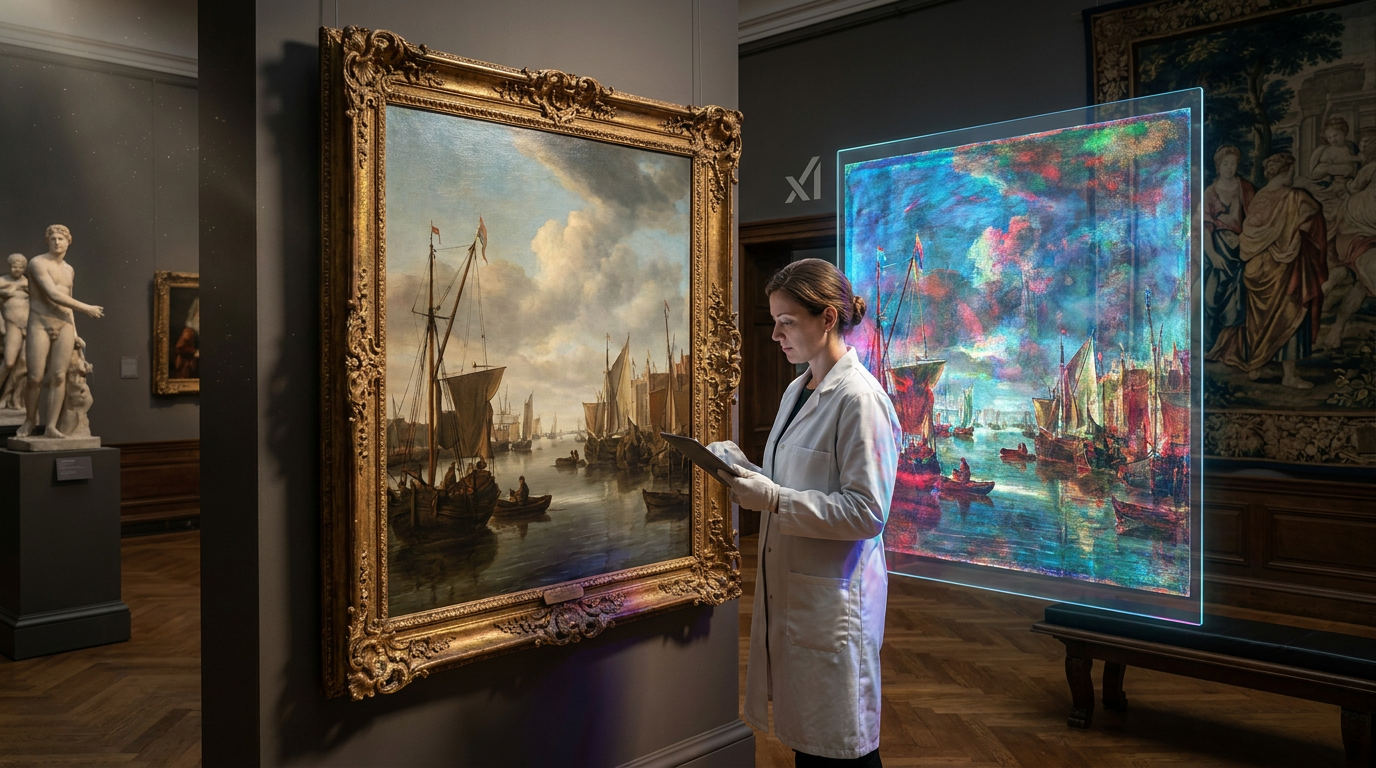
The narrative surrounding artificial intelligence and art is frequently dominated by anxiety and controversy. Headlines routinely focus on generative models scraping copyrighted material, the proliferation of deepfakes, and the existential threat posed to working illustrators and graphic designers. But inside the secure laboratories of the world's most prestigious museums, machine learning is performing a vastly different and profoundly optimistic role. Rather than replacing human creativity or generating synthetic novelties, AI is acting as a digital time machine. From Amsterdam to Oslo, conservators are deploying advanced algorithms alongside medical-grade imaging to reconstruct lost masterpieces, reveal hidden underpaintings, and reverse centuries of chemical degradation. This synthesis of code and canvas is quietly revolutionizing art history, offering a non-invasive way to preserve and understand our cultural heritage.[1][2]
The most high-profile demonstration of this technology is "Operation Night Watch" at the Rijksmuseum in Amsterdam. Rembrandt van Rijn’s 1642 masterpiece is a cornerstone of the Dutch Golden Age, celebrated for its dramatic use of light and motion. However, the version known to modern audiences is fundamentally incomplete. In 1715, the massive canvas was moved to Amsterdam’s City Hall. Because the painting was too large to fit on the wall between two doors, municipal workers unceremoniously trimmed strips from all four sides. The largest casualty was a 60-centimeter section on the left side, which completely altered the painting's focal point. The offcuts were permanently lost to history, leaving centuries of art historians to only imagine the painting's original dynamic composition.[1][5]
To restore the masterpiece to its original dimensions, Rijksmuseum scientists turned to a smaller, 17th-century copy of the uncropped painting created by the Dutch artist Gerrit Lundens. While Lundens' copy provided the structural blueprint and the missing figures, his painting style and color palette lacked Rembrandt's mastery and depth. Conservators trained three distinct neural networks to bridge this artistic gap. The algorithms were fed high-resolution scans of Rembrandt's surviving canvas to learn his specific approach to faces, color blending, and brushstrokes. The AI then translated Lundens' composition into Rembrandt's visual language, generating the missing edges pixel by pixel. These AI-generated borders were printed on canvas, varnished, and temporarily mounted around the original work, allowing the public to view "The Night Watch" exactly as Rembrandt intended for the first time in over 300 years.[1][2][5]

Beyond replacing missing edges, artificial intelligence is allowing historians to peer beneath the surface of existing works to uncover entirely new paintings. Historically, canvas was an expensive commodity, and struggling artists frequently painted over their older, unsold works to save money. Vincent van Gogh was particularly known for this practice of recycling materials. In 1886, he painted a piece titled "Two Wrestlers," which he later covered with a floral still life. Modern X-ray fluorescence (XRF) scanning can penetrate the top layer of paint to map the elemental composition of the hidden pigments, detecting the specific heavy metals like zinc and lead used in the original underlying work.[3]
However, XRF scans only yield a ghostly, grayscale topographical map of the hidden layers. To bring the wrestlers back to life, a technology startup named Oxia Palus utilized a convolutional neural network. The AI was trained extensively on Van Gogh's known catalog, learning the mathematical logic behind his signature impasto brushstrokes and vibrant color choices. By applying this learned style to the X-ray data, the algorithm generated a full-color, textured reconstruction of the lost painting. The result is a stunningly convincing approximation of a Van Gogh that hasn't been seen by human eyes in over a century, demonstrating how machine learning can resurrect art that was thought to be permanently erased.[3][4]

However, XRF scans only yield a ghostly, grayscale topographical map of the hidden layers.
Machine learning is also combating the slow, inevitable march of chemical decay that threatens all physical art. Over decades, exposure to light, humidity, and oxygen fundamentally alters the molecular structure of paint. The vibrant yellows in Van Gogh's sunflowers have notoriously browned over time, and Edvard Munch's "The Scream" has suffered significant fading due to environmental exposure. Conservators are now using multispectral and hyperspectral scanning to detect microscopic, invisible traces of the original pigments. AI models analyze these degradation patterns, cross-referencing them with historical data, contemporary photographs, and the artist's personal letters to predict the original hues with remarkable accuracy.[7]
This color reconstruction technique has even been used to reclaim art destroyed by war. During World War II, a devastating fire destroyed Gustav Klimt's "Faculty Paintings," leaving behind only black-and-white photographs as proof of their existence. Recently, researchers used machine learning to analyze those surviving photographs alongside Klimt's surviving color works. The AI successfully digitally reconstructed the vibrant gold, red, and green masterpieces, reclaiming them from the ashes of history. Despite these triumphs, the technological resurrection of art introduces profound ethical complexities. Art historians caution that an AI's output, no matter how sophisticated, remains a statistical probability rather than historical truth.[6][7]

Critics argue that algorithms predict what an artist might have done, which inherently smooths over the unpredictable, spontaneous genius of human creativity. There is a fine line between restoration and reinterpretation, and purists warn against treating machine-generated approximations as authentic historical artifacts. To navigate this ethical minefield, museums maintain strict physical boundaries. AI reconstructions are never painted onto the original canvases; they are displayed digitally or printed on separate, removable panels. Through this careful balance, technology serves not as a replacement for the artist, but as a respectful guardian of our shared cultural heritage, allowing us to see the past more clearly than ever before.[7]
The integration of artificial intelligence into museum conservation also democratizes access to art history. Traditionally, the painstaking work of chemical analysis and physical restoration was confined to back rooms, visible only to a handful of highly trained specialists. Today, projects like Operation Night Watch are conducted in custom-built glass chambers right in the middle of the gallery floor, accompanied by real-time digital updates. By open-sourcing the AI models and publishing the digital reconstructions online, institutions are inviting the global public to participate in the forensic discovery process. This transparency not only educates viewers about the fragility of physical media but also demystifies the algorithms themselves, proving that AI can be harnessed for meticulous, culturally enriching labor.[5]

Ultimately, the true value of AI in art restoration lies in its ability to embrace uncertainty without permanently altering the original artifact. In the past, aggressive physical restorations often permanently damaged masterpieces, as well-meaning conservators scrubbed away original glazes or painted over the artist's authentic strokes. Machine learning offers a sandbox for experimentation. Conservators can simulate thousands of different restoration approaches digitally, testing hypotheses about color degradation and brushwork without ever touching a cotton swab to the canvas. In this new paradigm, the masterpiece remains untouched and protected, while the algorithm provides a vibrant, reversible window into the artist's original vision.[2][7]
How we got here
1642
Rembrandt van Rijn completes his massive masterpiece, The Night Watch.
1715
The Night Watch is moved to Amsterdam's City Hall and trimmed on all four sides to fit between two doors.
1886
Vincent van Gogh paints 'Two Wrestlers', which he later covers with a floral still life.
1945
Gustav Klimt's vibrant 'Faculty Paintings' are destroyed by a fire during World War II.
2019
The Rijksmuseum launches 'Operation Night Watch', a multi-year project to research and restore Rembrandt's masterpiece.
2021
The Rijksmuseum unveils the AI-reconstructed edges of The Night Watch, temporarily restoring the painting to its original size.
Viewpoints in depth
Art Conservators & Technologists
View AI as a revolutionary, non-invasive tool for recovering lost cultural heritage.
For technologists and modern conservators, artificial intelligence represents the ultimate non-destructive sandbox. In the past, aggressive physical restorations often permanently damaged masterpieces, as well-meaning experts scrubbed away original glazes or painted over the artist's authentic strokes. Machine learning allows conservators to simulate thousands of different restoration approaches digitally, testing hypotheses about color degradation and brushwork without ever touching a cotton swab to the canvas. They argue that this technology brings us closer to the artist's original vision than ever before.
Art Historians & Purists
Warn that AI generates statistical approximations that should not be confused with historical truth.
Traditional art historians urge caution, emphasizing that an algorithm's output is fundamentally a prediction, not a historical fact. AI models rely on statistical probabilities of what an artist might have done based on their other works. This process inherently smooths over the unpredictable, spontaneous genius that defines human creativity. Purists argue that there is a fine line between restoration and reinterpretation, and they advocate for strict physical boundaries—ensuring that machine 'hallucinations' are never permanently applied to authentic historical artifacts.
What we don't know
- Whether AI models can ever truly account for an artist's spontaneous, out-of-character creative decisions that defy their established statistical patterns.
- How future generations of art historians will view the ethical boundaries of integrating machine learning so closely with irreplaceable cultural artifacts.
Key terms
- X-ray Fluorescence (XRF)
- A non-destructive analytical technique used to determine the elemental composition of materials, allowing scientists to detect heavy metals in hidden layers of paint.
- Convolutional Neural Network (CNN)
- A type of artificial intelligence specifically designed to process and analyze visual imagery, often used to learn an artist's specific style and brushstrokes.
- Impasto
- A painting technique where paint is laid on an area of the surface very thickly, leaving visible brushstrokes that AI models must learn to replicate.
- Multispectral Imaging
- A scanning technique that captures image data within specific wavelength ranges across the electromagnetic spectrum, revealing faded pigments invisible to the naked eye.
Frequently asked
Does AI actually paint on the original canvas?
No. AI reconstructions are either displayed digitally or printed on separate physical panels that are temporarily mounted near the original artwork, ensuring the historical canvas remains untouched.
How does AI know what colors to use for hidden paintings?
It analyzes X-ray fluorescence data to identify the chemical elements of hidden pigments, then uses neural networks trained on the artist's other works to predict the exact hues and brushstrokes.
Why was Rembrandt's The Night Watch cut in the first place?
In 1715, the massive painting was moved to Amsterdam's City Hall. City officials trimmed the edges simply so the canvas would fit on the wall between two doors.
Can AI perfectly recreate a lost painting?
Not perfectly. AI provides a highly educated statistical guess based on the artist's known style and surviving data, but it cannot replicate the spontaneous, unpredictable genius of the original creator.
Sources
Source coverage
7 outlets
3 viewpoints surfaced







[1]The GuardianArt Conservators & Technologists
Rembrandt's Night Watch restored to original size by AI
Read on The Guardian →[2]The New York TimesArt Historians & Purists
Rembrandt's Damaged Masterpiece Is Whole Again, With A.I.'s Help
Read on The New York Times →[3]Artnet NewsMuseum Audiences
Researchers Used A.I. to Reconstruct a Van Gogh Painting Hidden Beneath Another Canvas
Read on Artnet News →[4]ScienceAlertArt Conservators & Technologists
A Revolutionary AI Program Can Seamlessly Reconstruct Missing Sections of Images
Read on ScienceAlert →[5]RijksmuseumArt Conservators & Technologists
Operation Night Watch: The research and restoration project
Read on Rijksmuseum →[6]Smithsonian MagazineMuseum Audiences
A.I. Recreates Lost Klimt Paintings Destroyed During World War II
Read on Smithsonian Magazine →[7]MIT Technology ReviewArt Historians & Purists
The promise and peril of using AI to restore historical artworks
Read on MIT Technology Review →

Every angle. Every day.
Get culture stories with full source coverage and perspective breakdowns delivered to your inbox.