
How Agrivoltaics is Solving the Conflict Between Solar Energy and Farming
By elevating solar panels above active farmland, agrivoltaics allows for the simultaneous production of clean energy and crops. The dual-use technology is boosting agricultural yields, saving water, and transforming the economics of the renewable transition.
By Factlen Editorial Team
- Agronomists & Soil Scientists
- Focused on the ecological benefits of microclimates and water retention.
- Renewable Energy Developers
- Focused on land acquisition, grid decarbonization, and community relations.
- Agricultural Operators
- Focused on operational logistics, crop yields, and farm survival.
- Policy & Climate Strategists
- Focused on maximizing land-use efficiency to meet national climate targets.
What's not represented
- · Rural zoning boards managing local land-use disputes
- · Consumers purchasing premium shade-grown produce
Why this matters
The transition to renewable energy requires millions of acres of land, historically putting solar developers in direct conflict with agricultural communities. Agrivoltaics eliminates this zero-sum game, offering a blueprint for a future where clean energy and food security actively support one another.
Key points
- Agrivoltaics combines solar energy generation and agriculture on the same land, eliminating the competition for acreage.
- Elevated solar panels create a microclimate that reduces water evaporation and protects crops from extreme heat.
- Shade-tolerant crops like lettuce and berries can see yield increases of up to 20% under solar arrays.
- The cooling effect of plant transpiration actually helps solar panels operate more efficiently.
- Initial construction costs are 10 to 25% higher than traditional solar due to the need for elevated steel structures.
- Global capacity has surpassed 25 gigawatts, with rapid adoption across Europe, Asia, and the United States.
The global energy transition has a land problem. To meet mid-century climate targets, nations around the world will need to cover millions of acres with solar panels. Traditionally, this has meant stripping topsoil, fencing off acreage, and replacing productive farmland with seas of glass and steel. It is a zero-sum game that pits clean energy developers against rural communities, forcing a choice between decarbonizing the grid and feeding a growing population. But a rapidly maturing technology is proving that this conflict is a false dichotomy.[7]
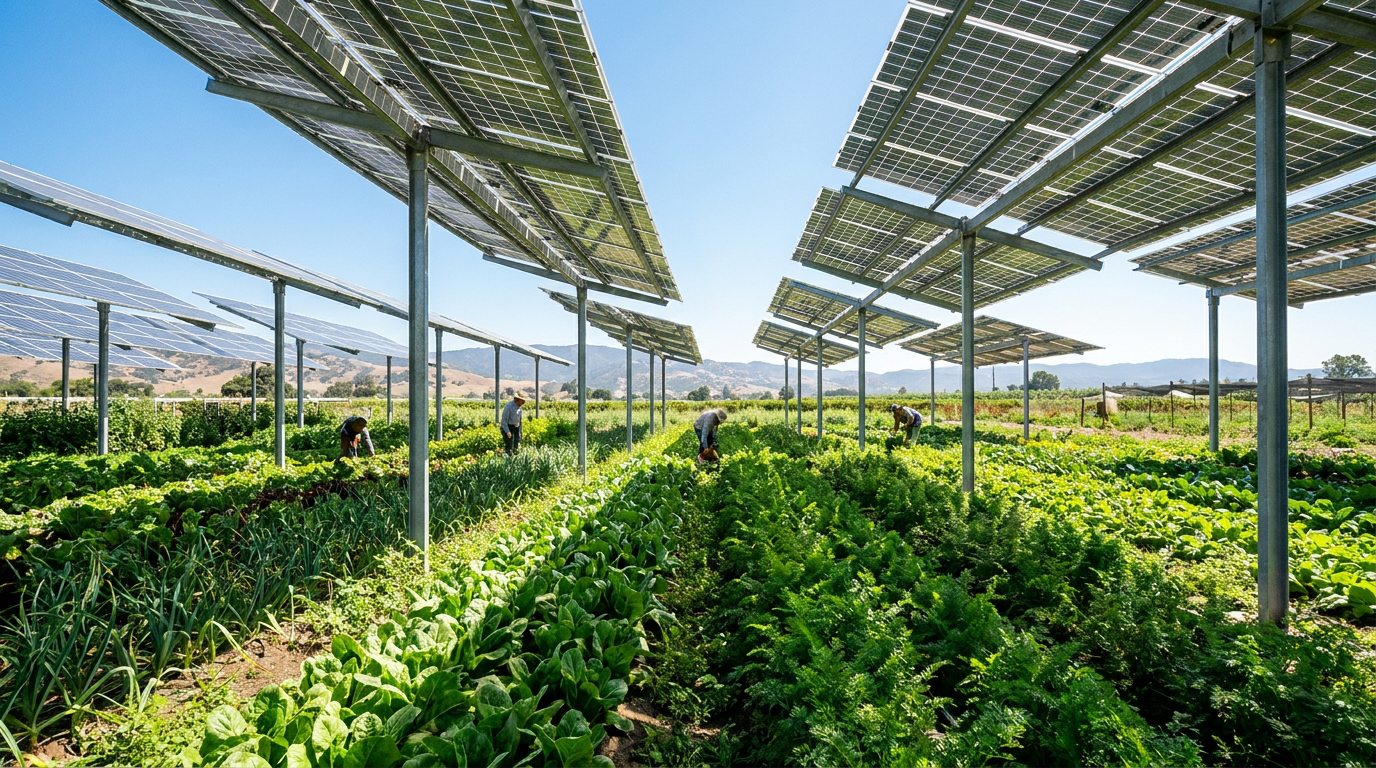
Enter agrivoltaics—the simultaneous use of land for both solar photovoltaic power generation and agricultural production. Rather than clearing land exclusively for energy, developers elevate solar arrays on specialized racking systems, allowing tractors, livestock, and crops to operate freely underneath. By treating solar panels as agricultural infrastructure rather than industrial replacements, farms can harvest the sun twice: once for electricity, and once for photosynthesis.[1][7]
The concept is not entirely new, having been first proposed in the 1980s, but it has only recently reached commercial maturity. Global agrivoltaic capacity surged past 25 gigawatts by the end of 2024, driven by aggressive deployment in Europe and Asia. In the United States, the market is expanding at a double-digit growth rate, fueled by state-level incentives and a growing recognition that dual-use solar can stabilize farm incomes in an era of volatile commodity prices.[3][5][7]
To understand why agrivoltaics is gaining such traction, one must look at the underlying mechanism: microclimate regulation. When solar panels are suspended above a field, they alter the physical environment below them. During the peak heat of a summer afternoon, the panels cast partial shade, shielding plants from extreme ultraviolet radiation and heat stress. This creates a cooler, more stable microclimate that fundamentally changes how plants and soil interact with water.[2][7]

The most immediate benefit of this microclimate is a drastic reduction in evapotranspiration—the process by which water is transferred from the land to the atmosphere by evaporation from the soil and transpiration from plants. Research from the National Renewable Energy Laboratory (NREL) and international test plots has shown that the shade from solar arrays can cut irrigation requirements by 20 to 35 percent in arid regions. In one remarkable trial in Kenya, an agrivoltaic setup reduced the water needed for irrigation by 47 percent.[1][5][7]
Counterintuitively, this partial shading does not necessarily harm crop production. For shade-tolerant and heat-sensitive crops, it actually acts as a performance enhancer. Field data from the French national research institute INRAE documented a 20 percent yield increase for lettuce grown under elevated panels, as the plants suffered less heat stress and avoided premature bolting. Similar gains of 10 to 20 percent have been recorded for strawberries, raspberries, and cherry tomatoes.[5][7]
The symbiosis works in both directions. Just as the panels protect the plants, the plants improve the performance of the panels. Solar photovoltaics lose efficiency as they heat up; their optimal operating temperature sits between 68 and 77 degrees Fahrenheit (20 to 25 degrees Celsius). As the crops below release moisture through transpiration, the rising water vapor cools the underside of the solar panels, boosting their electrical output compared to arrays built over bare dirt or gravel.[7]
Just as the panels protect the plants, the plants improve the performance of the panels.
Economists measure the efficiency of this dual-use system using a metric called the Land Equivalent Ratio (LER). If a farmer dedicates half their land to traditional solar and half to traditional farming, the LER is 1.0. But by layering the two systems, agrivoltaics routinely achieves an LER of 1.35 to 1.73. This means that 100 acres of agrivoltaics can produce the same combined amount of food and energy that would normally require 135 to 173 acres of separated land.[2][5][7]

This efficiency is driving massive institutional support. The European Commission has highlighted agrivoltaics as a powerful tool for decarbonization, noting that deploying the technology on just 1 percent of Europe's agricultural land could generate hundreds of terawatt-hours of electricity annually. Italy has launched a €1.7 billion national funding program to accelerate deployment, while Germany's Fraunhofer Institute for Solar Energy Systems has published extensive guidelines to help municipalities integrate the technology.[2][4]
In the United States, researchers are pushing the boundaries of scale. While early American projects focused on small pollinator habitats or sheep grazing, agronomists at Michigan State and Ohio State universities are now proving that agrivoltaics can work for broad-acre forage crops. By carefully designing panel spacing and alley widths, they have successfully cultivated alfalfa and grass hay between utility-scale arrays using standard agricultural machinery.[6]
Despite the overwhelming ecological and economic promise, agrivoltaics is not a universal silver bullet. The most significant hurdle is the initial capital expenditure. Elevating panels to a height of 10 to 15 feet requires substantially more steel, deeper foundations to withstand wind loads, and specialized mounting hardware. Consequently, the upfront construction costs for an agrivoltaic facility are typically 10 to 25 percent higher than a conventional ground-mounted solar farm.[3][5]
Furthermore, the agronomic reality is that not all crops are compatible with partial shade. Sun-intensive staple crops like corn, wheat, and soybeans experience significant yield reductions—often between 25 and 40 percent—when grown under solar arrays. For the vast monoculture farms of the American Midwest, traditional agrivoltaics remains a difficult proposition unless the system design is radically altered to allow maximum light penetration.[5][7]

Operational complexity also deters some traditional farmers. Navigating a combine harvester or a boom sprayer around steel pylons requires precision and slows down field operations. If a tractor accidentally strikes a mounting structure, the damage to the multi-million-dollar energy asset can be catastrophic. This necessitates a high degree of coordination between the agricultural operator and the energy developer, two parties that historically have very different priorities.[1][6][7]
To bridge this gap, the industry is rapidly innovating. The next generation of agrivoltaic systems relies on dynamic tracking panels that use software to balance the needs of the grid with the needs of the crop. During a heatwave, the panels can tilt horizontally to provide maximum shade to the plants below. During a cloudy day, they can shift vertically to let every available photon reach the soil.[2][7]
Materials science is also offering new solutions. Manufacturers are developing semi-transparent photovoltaic modules and specialized coatings that allow the specific wavelengths of light necessary for plant photosynthesis to pass through, while capturing the rest of the spectrum for electricity generation. These advancements promise to expand the list of compatible crops and make dual-use solar viable across a much wider swath of the agricultural landscape.[2][7]

Ultimately, agrivoltaics represents a profound shift in how we value land. By moving away from extractive, single-use models and embracing integrated, multi-functional landscapes, we can protect rural economies while aggressively pursuing climate targets. It is a rare example of a technology that requires compromise but delivers a genuine synergy—proving that the farms of the future can harvest both the soil and the sky.[3][7]
How we got here
1981
The concept of combining solar panels and agriculture is first proposed by researchers Armin Zastrow and Adolf Goetzberger.
2011
The term 'agrivoltaics' is officially coined as pilot projects begin testing crop yields under solar arrays.
2020
Global agrivoltaic capacity reaches roughly 5 gigawatts, primarily driven by early adopters in Japan and South Korea.
2024
Global capacity surpasses 25 gigawatts as European nations introduce dedicated funding and regulatory frameworks for dual-use solar.
2026
Advanced dynamic tracking systems and large-scale forage crop trials prove the viability of agrivoltaics for broad-acre commercial farming.
Viewpoints in depth
Agronomists & Soil Scientists
Focused on the ecological benefits of microclimates and water retention.
This camp emphasizes that agrivoltaics is primarily a tool for climate adaptation in agriculture. They point to data showing massive reductions in evapotranspiration and the protection of heat-sensitive crops from extreme weather. For these scientists, the electricity generated is almost a secondary benefit compared to the soil moisture retention and the prevention of heat stress in an increasingly warming world.
Renewable Energy Developers
Focused on land acquisition, grid decarbonization, and community relations.
Solar developers view agrivoltaics as the key to unlocking millions of acres of land that would otherwise be blocked by local opposition. By allowing farmers to keep their land in production, developers can secure long-term leases with less political friction. They acknowledge the higher upfront capital costs but argue that the smoother permitting process and dual-revenue streams make the projects highly bankable.
Traditional Farmers
Focused on operational logistics, crop yields, and farm survival.
For the agricultural operator, agrivoltaics is weighed strictly on its economic and logistical merits. While the prospect of a steady, weather-independent check from a solar lease is highly attractive, farmers remain cautious about the physical obstacles. They worry about the maneuverability of heavy machinery, the potential for soil compaction during solar construction, and the reality that staple commodities like corn and wheat do not perform well in the shade.
What we don't know
- How the long-term soil health under permanent agrivoltaic arrays will compare to open-field farming over multiple decades.
- Whether dynamic tracking panels and semi-transparent modules will become cheap enough to deploy on low-margin staple crops like wheat and corn.
Key terms
- Agrivoltaics
- The simultaneous use of land for both solar power generation and agricultural production.
- Evapotranspiration
- The process by which water is transferred from the land to the atmosphere by evaporation from the soil and transpiration from plants.
- Land Equivalent Ratio (LER)
- A metric used to measure the efficiency of growing crops and generating solar power on the same land compared to doing them separately.
- Microclimate
- The local climate of a small, specific area, which can differ significantly from the surrounding environment.
- Dynamic Tracking Panels
- Solar panels mounted on motorized axes that tilt throughout the day to follow the sun or optimize shade for crops.
Frequently asked
Do solar panels block too much sun for crops to grow?
It depends on the crop. Shade-tolerant plants like lettuce, tomatoes, and berries actually thrive and produce higher yields under partial shade. However, sun-intensive crops like corn and wheat do suffer yield reductions.
How do tractors fit under the solar panels?
Agrivoltaic systems are built with elevated racking, often 10 to 15 feet high, and spaced widely apart to allow standard agricultural machinery to pass underneath without obstruction.
Is agrivoltaics more expensive to build than regular solar?
Yes. Because the panels must be elevated higher and require stronger steel foundations to withstand wind, the initial construction costs are typically 10 to 25 percent higher than standard ground-mounted solar.
Does the farming activity damage the solar panels?
With proper planning, damage is rare. However, the dust from farming can require the panels to be cleaned more frequently, and operators must be careful when driving large machinery near the steel supports.
Sources
Source coverage
7 outlets
4 viewpoints surfaced







[1]National Renewable Energy Laboratory (NREL)Agronomists & Soil Scientists
Agrivoltaics: Co-locating Agriculture and Solar
Read on National Renewable Energy Laboratory (NREL) →[2]Fraunhofer ISEAgronomists & Soil Scientists
Agrivoltaics: Opportunities for Agriculture and the Energy Transition
Read on Fraunhofer ISE →[3]Institute for Energy Economics and Financial AnalysisRenewable Energy Developers
Agrivoltaics: A Winning Solution for Agriculture and Solar
Read on Institute for Energy Economics and Financial Analysis →[4]European CommissionPolicy & Climate Strategists
Agrivoltaics: a powerful tool for decarbonisation
Read on European Commission →[5]Energy Solutions IntelligenceRenewable Energy Developers
Agrivoltaics 2026: Farming & Solar Dual Income
Read on Energy Solutions Intelligence →[6]Michigan State University ExtensionAgricultural Operators
Forage research points to scalable agrivoltaic solutions
Read on Michigan State University Extension →[7]Factlen Editorial TeamPolicy & Climate Strategists
Synthesis by Factlen editorial team
Read on Factlen Editorial Team →
Every angle. Every day.
Get environment stories with full source coverage and perspective breakdowns delivered to your inbox.