
How Accessibility Became the Video Game Industry's New Baseline
Driven by modular hardware, comprehensive design guidelines, and a push for universal design, accessibility features are transitioning from niche additions to baseline requirements in modern video games.
By Factlen Editorial Team
- Accessibility Advocates
- Advocates emphasize that gaming is a vital social space, making accessibility a fundamental issue of equity.
- Platform Holders & Studios
- Major gaming companies view accessibility as a driver of hardware innovation and market expansion.
- Legal & Academic Observers
- Experts argue for enforceable industry standards to ensure consistent accessibility across all platforms.
What's not represented
- · Indie developers operating on micro-budgets who struggle to implement complex accessibility features.
Why this matters
With over 46 million gamers with disabilities in the US alone, standardizing accessibility not only opens the medium to a massive underserved audience but also drives hardware and software innovations that benefit all players.
Key points
- The video game industry is shifting from treating accessibility as an afterthought to embracing universal design principles from day one.
- Modular hardware like the Xbox Adaptive Controller and PlayStation Access Controller have opened gaming to players with limited mobility.
- Software innovations now include granular game speed modifiers, audio-based aiming, and native screen readers for blind players.
- Legislation like the CVAA and a market of 46 million disabled US gamers are driving the financial and legal push for inclusion.
For decades, the video game industry operated on a rigid assumption of its player base, designing experiences that required a highly specific set of motor, visual, and auditory capabilities. If a player could not hold a standard dual-stick controller, read small text, or hear audio cues, they were largely locked out of the medium. Today, that paradigm has fundamentally shifted. Driven by a combination of modular hardware, comprehensive design guidelines, and a push for universal design, accessibility features are transitioning from niche additions to baseline requirements in modern video games.[1]
The catalyst for this industry-wide transformation began at the hardware level. In 2018, Microsoft released the Xbox Adaptive Controller, a flat, rectangular hub featuring two large programmable buttons and 19 ports for external switches, mounts, and joysticks. It was a watershed moment, proving that a major platform holder could successfully mass-produce a device tailored to players with limited mobility. The success of the device demonstrated that accessibility was not just a moral imperative, but a viable, enthusiastic market.[3]
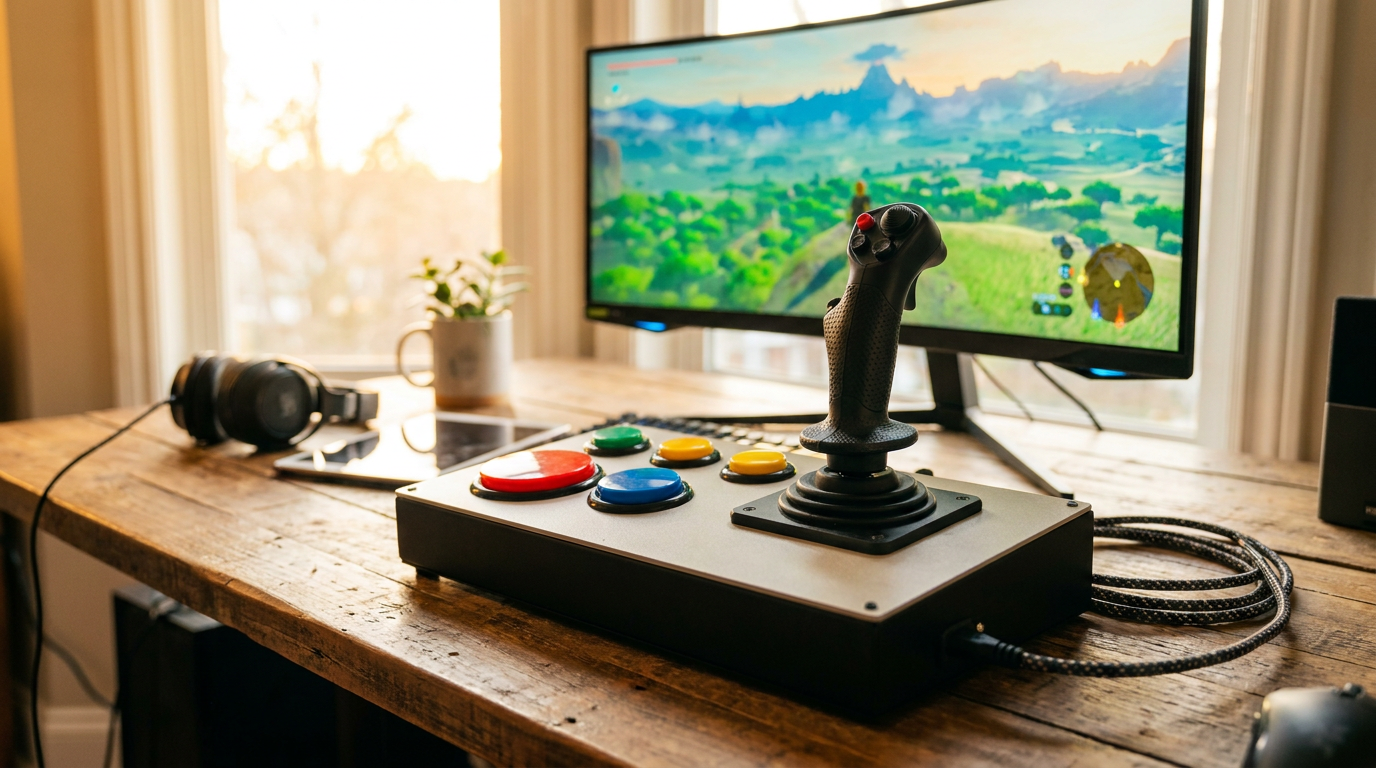
The hardware ecosystem has only expanded since that initial breakthrough. In late 2023, Sony launched the PlayStation Access Controller, a highly customizable, circular kit priced at $90 that allows players to swap out button caps and stick configurations without needing to hold a traditional gamepad. Microsoft followed up in early 2025 with the Adaptive Joystick, a low-cost companion device designed to integrate with their existing hub, complete with 3D-printable thumbstick toppers that players can customize to their specific ergonomic needs.[1][3]

But accessible hardware is only half the equation; the software must also accommodate a diverse player base. This realization has pushed developers toward the principles of universal design—the practice of building inclusivity into a game's foundation rather than patching it in as an afterthought. Instead of merely meeting minimum legal requirements, studios are increasingly consulting with disabled gamers during the early prototyping phases to identify barriers before they are hardcoded into the game's architecture.[5][7]
To formalize this approach, the industry has developed robust frameworks. The Xbox Accessibility Guidelines (XAGs) and the independent Game Accessibility Guidelines provide developers with prescriptive best practices. These frameworks categorize features by reach and impact, offering studios a blueprint for implementing everything from remappable controls and scalable text to complex audio navigation systems. They serve as a vital resource, particularly for teams that may lack dedicated accessibility consultants on staff.[2][6]
The results of these guidelines are vividly evident in the software landscape of 2025 and 2026. Take Atomfall, a recent nominee for Innovation in Accessibility at The Game Awards. The game features text scaling up to 52 pixels, high-contrast modes for gameplay, and a highly customizable audio-based aiming system for players with low vision. It also includes optional automation for traversal and reloading, proving that complex action games can be made approachable without sacrificing their core identity.[4]
The results of these guidelines are vividly evident in the software landscape of 2025 and 2026.
Similarly, Doom: The Dark Ages introduced granular game speed modifiers, allowing players to slow the chaotic, fast-paced combat down to 50% or increase it to 150%. The game also offers individual hue and opacity options for enemies, hazards, and incoming attacks, ensuring that players with cognitive processing disabilities or visual impairments can parse the overwhelming visual information on screen.[4]

Perhaps the most striking advancements have occurred in blind accessibility. Titles like Forza Motorsport and The Last of Us Part II have demonstrated that even highly visual, fast-paced games can be played entirely without sight. By utilizing complex audio cues—such as distinct sounds for track edges, approaching corners, or enemy proximity—and integrating screen readers directly into the game menus, developers have opened up AAA gaming to the blind and low-vision community.[7]
The push for accessibility is backed by compelling economics. Advocacy groups like AbleGamers estimate there are roughly 46 million gamers with disabilities in the United States alone. Furthermore, the broader disability market controls an estimated $1.9 trillion in annual disposable income. For publishers, ignoring this demographic is no longer financially viable. Expanding a game's total addressable market by including accessible design is now viewed as a standard business strategy.[3][5]
Legislation has also played a crucial role in accelerating this trend. In the United States, the 21st Century Communications and Video Accessibility Act (CVAA) mandates that digital communication services be accessible. Because modern multiplayer games feature in-game text and voice chat, studios have been legally compelled to integrate text-to-speech and speech-to-text functionalities. Similar pressures from the European Accessibility Act are ensuring that these features become standard across global releases.[6][7]
Crucially, the industry is discovering the 'curb cut effect'—the phenomenon where features designed for people with disabilities end up benefiting everyone. Subtitles, originally championed for deaf and hard-of-hearing players, are now used by a majority of the general gaming audience. Remappable controls allow casual players to find more comfortable setups, and high-contrast modes reduce eye strain during long play sessions. Accessibility, developers are finding, is simply good user experience.[7]

Despite these massive strides, significant hurdles remain. The most glaring issue is the lack of cross-platform compatibility for assistive hardware. An Xbox Adaptive Controller cannot be officially used on a PlayStation 5, and a PlayStation Access Controller does not work on an Xbox. For disabled gamers, this means that playing exclusive titles across different ecosystems requires purchasing multiple, often expensive, custom controller setups.[1][3]
Additionally, while AAA studios with massive budgets can afford dedicated accessibility teams and extensive user testing, indie developers often struggle to implement advanced features. However, this gap is slowly closing as major game engines like Unreal and Unity begin to build accessibility tools—such as native screen reader support and colorblind filters—directly into their development environments, lowering the barrier to entry for smaller teams.[6]
The trajectory of the video game industry is clear. Accessibility is no longer viewed as a charitable endeavor or a niche feature set; it is a fundamental pillar of game design. As hardware becomes more adaptable and software guidelines become more entrenched, the industry is steadily moving toward a future where the joy, challenge, and community of gaming are truly available to everyone.[1][5]
How we got here
2018
Microsoft launches the Xbox Adaptive Controller, proving the viability of mass-market accessible gaming hardware.
2020
The Last of Us Part II releases with over 60 accessibility settings, setting a new benchmark for AAA software.
Dec 2023
Sony releases the PlayStation Access Controller, providing a highly customizable first-party solution for PS5 players.
Early 2025
Microsoft expands its accessible hardware lineup with the Adaptive Joystick and 3D-printable thumbstick toppers.
Viewpoints in depth
Accessibility Advocates
Advocates emphasize that gaming is a vital social space, making accessibility a fundamental issue of equity.
For disabled gamers and advocacy groups like AbleGamers, the push for accessibility is about much more than entertainment—it is about social inclusion. Video games are a primary way people connect, communicate, and build communities. When games lack remappable controls, scalable text, or visual aids, they inadvertently isolate millions of potential players. Advocates argue that disabled gamers should not have to rely on expensive, third-party workarounds or post-launch patches to enjoy the same cultural touchstones as their peers. They push for 'inclusive design from day one,' ensuring that accessibility is woven into the fabric of a game's development rather than treated as a supplementary checklist.
Platform Holders & Studios
Major gaming companies view accessibility as a driver of hardware innovation and market expansion.
For console manufacturers and AAA studios, the accessibility movement represents both a creative challenge and a massive business opportunity. Companies like Microsoft and Sony have invested heavily in modular hardware, recognizing that a one-size-fits-all controller inherently limits their audience. On the software side, studios are utilizing comprehensive frameworks like the Xbox Accessibility Guidelines to standardize features across their portfolios. By implementing granular difficulty sliders, audio cues, and high-contrast modes, developers are not only fulfilling a moral imperative but also tapping into a demographic with an estimated $1.9 trillion in disposable income, proving that inclusive design is inherently good business.
Legal & Academic Observers
Experts argue for enforceable industry standards to ensure consistent accessibility across all platforms.
While celebrating the industry's recent innovations, legal and academic observers caution against relying entirely on voluntary corporate goodwill. Academics point out that while AAA studios have the resources to hire accessibility consultants, indie developers often lack the budget, leading to a fragmented landscape where accessibility varies wildly from game to game. Legal scholars highlight the importance of legislation like the 21st Century Communications and Video Accessibility Act (CVAA), which forced the industry to implement text-to-speech and speech-to-text features for in-game chat. These observers argue that to achieve true equity, the industry needs robust, standardized guidelines that serve as a baseline expectation for all commercial releases, rather than just a category at award shows.
What we don't know
- Whether major console manufacturers will eventually allow cross-platform compatibility for their proprietary accessibility controllers.
- How quickly smaller indie studios will be able to adopt comprehensive accessibility features without the budgets of AAA developers.
Key terms
- Universal Design
- The practice of designing products, environments, and systems to be usable by all people, to the greatest extent possible, without the need for adaptation.
- Screen Reader
- Assistive technology that renders text and image content as speech, increasingly integrated directly into game menus for blind and low-vision players.
- High-Contrast Mode
- A visual setting that simplifies color palettes and highlights key interactive elements, aiding players with low vision or color blindness.
- Remappable Controls
- A software feature that allows players to assign any in-game action to any button on their controller, crucial for players with limited mobility.
Frequently asked
Do accessibility features make games easier for everyone?
While some features like game-speed modifiers lower the difficulty, many accessibility options—such as high-contrast modes or remappable controls—simply remove physical or sensory barriers without changing the core challenge of the game.
Can I use an Xbox Adaptive Controller on a PlayStation?
Officially, no. The major console manufacturers currently restrict their proprietary accessibility controllers to their own ecosystems, meaning players often need to buy separate setups for different consoles.
Are indie games expected to have the same accessibility as AAA games?
While indie developers often lack the budget for extensive accessibility suites, industry guidelines and accessible game engines are making it easier for smaller teams to implement baseline features like remappable controls and scalable text.
What is the CVAA and how does it affect video games?
The 21st Century Communications and Video Accessibility Act is a US law that mandates accessibility for digital communication services. In gaming, it requires features like text-to-speech and speech-to-text for in-game chat.
Sources
Source coverage
7 outlets
3 viewpoints surfaced







[1]Factlen Editorial TeamLegal & Academic Observers
Synthesis by Factlen editorial team
Read on Factlen Editorial Team →[2]Microsoft Game DevPlatform Holders & Studios
Xbox Accessibility Guidelines (XAGs)
Read on Microsoft Game Dev →[3]BBC NewsAccessibility Advocates
How Xbox is making gaming accessible for all
Read on BBC News →[4]The Game AwardsPlatform Holders & Studios
Meet the 2025 Innovation in Accessibility Nominees
Read on The Game Awards →[5]AbleGamersAccessibility Advocates
How the Gaming Industry Is Adapting
Read on AbleGamers →[6]Loyola of Los Angeles Law ReviewLegal & Academic Observers
The Video Game Industry Needs a Buff: Accessibility Guidelines for Video Game Design
Read on Loyola of Los Angeles Law Review →[7]Level AccessLegal & Academic Observers
How to Make Games Inclusive
Read on Level Access →
Every angle. Every day.
Get gaming esports stories with full source coverage and perspective breakdowns delivered to your inbox.