
House Passes Landmark Bill Forcing Binding Arbitration in Union Contract Talks
The U.S. House has passed the Faster Labor Contracts Act, a major bill that would require employers and unions to reach a first contract within 90 days or face binding federal arbitration.
By Factlen Editorial Team
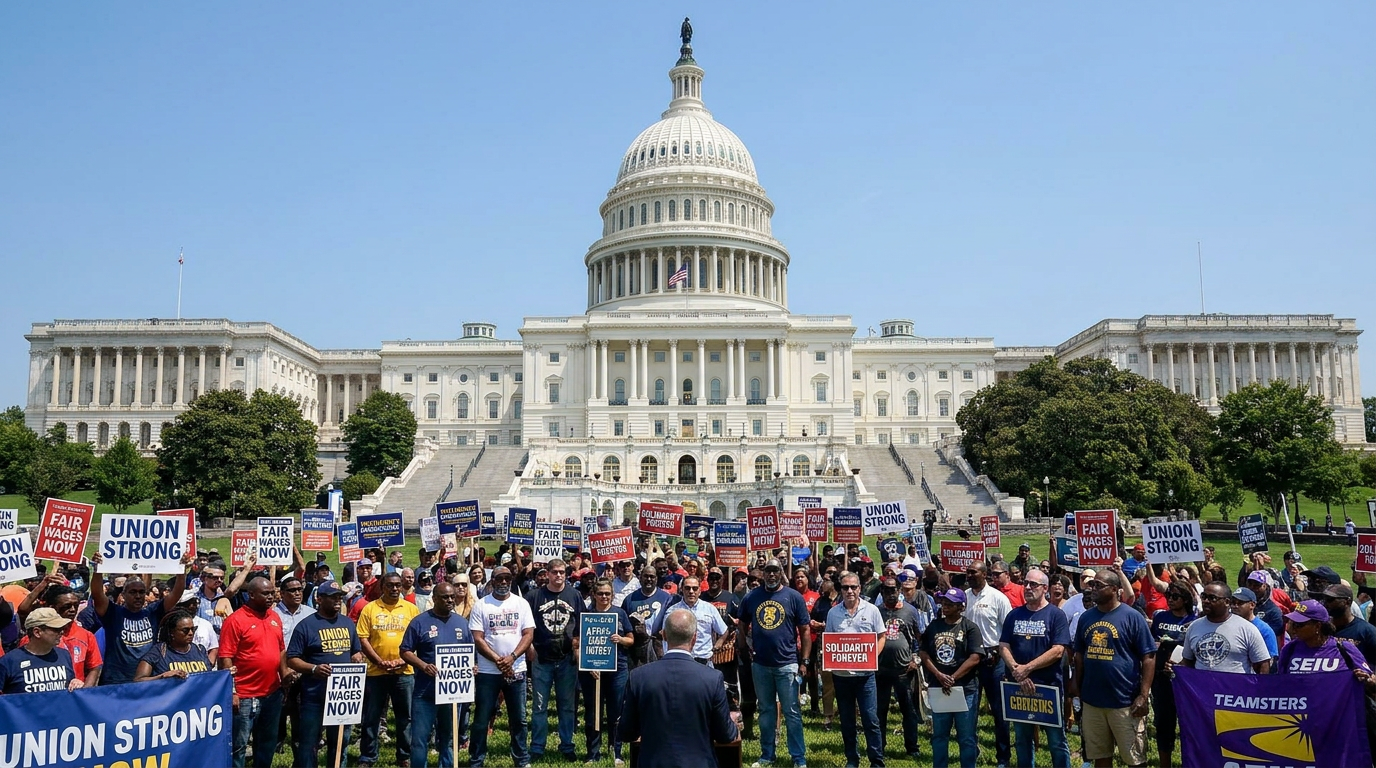
- Labor Unions & Advocates
- Argues the bill is necessary to stop corporate stalling tactics and guarantee workers a contract.
- Business & Management
- Argues the bill is draconian government overreach that strips private companies of their right to negotiate.
- Bipartisan Populists
- Supports state intervention in the free market to boost working-class wages and labor power.
What's not represented
- · Non-unionized workers
- · Small business owners
Why this matters
If enacted, this legislation would fundamentally rewrite U.S. labor law by preventing companies from stalling union negotiations indefinitely. It would virtually guarantee that newly unionized workers secure a contract, shifting the balance of power in the American workplace.
Key points
- The House passed the Faster Labor Contracts Act (FLCA) in a 230-193 vote, with 20 Republicans joining Democrats.
- The bill requires employers and newly formed unions to reach a first contract within 90 days.
- If no agreement is reached, a federal arbitration panel will impose a binding two-year contract.
- Business groups strongly oppose the bill, warning it allows the government to dictate private business terms.
- The legislation now heads to the Senate, where it faces a difficult path despite bipartisan co-sponsors.
The U.S. House of Representatives has passed a landmark piece of legislation that would fundamentally alter how labor unions and employers negotiate their initial collective bargaining agreements. In a surprise move on June 9, lawmakers approved the Faster Labor Contracts Act (FLCA) by a margin of 230 to 193. The legislation advanced after a successful discharge petition forced it out of committee and onto the House floor, bypassing traditional Republican leadership roadblocks. In a significant display of shifting political alliances, 20 Republicans crossed the aisle to join 210 Democrats in passing the measure. If enacted, the bill would represent the most dramatic restructuring of U.S. labor law in decades, shifting the balance of power at the negotiating table and virtually guaranteeing that newly formed unions secure a contract.[1][3][4]
At the heart of the FLCA is a direct challenge to a nearly 90-year-old precedent established by the 1935 National Labor Relations Act (NLRA). Under current federal law, once a union is certified, both parties are legally obligated to bargain in "good faith." However, the NLRA explicitly states that neither the employer nor the union is required to accept any specific proposal or make any particular concession. A final contract can only be reached through mutual agreement. The FLCA dismantles this framework by introducing a strict, legally enforceable timeline backed by the threat of government intervention.[7]
The new legislation imposes a rigid schedule on the bargaining process. Once a union wins an election, employers would be legally mandated to begin contract negotiations within ten days. From that point, the two sides have exactly 90 days to reach a comprehensive agreement. If the talks remain unresolved at the end of that window, either the union or the employer can request the intervention of federal mediators. If another 30 days pass without a breakthrough, the dispute is escalated to a federal arbitration panel. This panel is granted the extraordinary authority to draft and impose a binding contract that governs the workplace for the next two years.[2][5]

The prospect of binding interest arbitration in the private sector has sent shockwaves through the business community. Under the FLCA, government-appointed arbitrators would determine all terms of the collective bargaining agreement based on a set of five statutory factors. These include the employer's financial status and prospects, the size and type of the business, the local cost of living, the employees' ability to sustain their families on current compensation, and the wages offered by comparable employers. Management-side attorneys warn that this effectively allows an outside third party to dictate a private company's economic future, potentially imposing wage and benefit structures that the business cannot sustain.[7]
The prospect of binding interest arbitration in the private sector has sent shockwaves through the business community.
Labor advocates argue that the drastic measures are necessary to combat widespread corporate stalling tactics. According to data cited by Bloomberg Law, it currently takes an average of 465 days for workers and their employers to ratify a first contract following a successful union election. In many high-profile organizing drives over the past few years—including efforts at massive corporations like Amazon and Starbucks—negotiations have dragged on for years without a resolution. Unions contend that under the current system, companies have a financial incentive to delay talks indefinitely, hoping to drain the union's resources, frustrate workers, and eventually trigger an effort to decertify the union entirely.[2][5]

For organized labor, the House vote represents a monumental victory. The Teamsters General President praised the legislation, calling it "one of the most consequential labor bills to come before Congress in generations." Proponents argue that the right to unionize is meaningless if workers cannot secure a contract that actually improves their wages and working conditions. By guaranteeing a resolution within roughly four months of an election, the FLCA ensures that companies can no longer use endless litigation and bad-faith bargaining as a strategy to bust newly formed bargaining units.[4][5]
The corporate backlash to the bill has been swift and fierce. Business advocacy groups and industry lobbyists have condemned the legislation as a massive government overreach. The Chief Human Resource Officer Association labeled the bill "draconian," arguing that it strips employers of their fundamental right to manage their own operations. Critics also point out that the bill raises serious questions about the lawfulness of strikes and lockouts during first-contract negotiations. Typically, binding arbitration is premised on a mutual commitment to labor peace, but the FLCA does not explicitly prohibit unions from striking while the arbitration process is pending.[3][7]

Beyond the immediate labor implications, the passage of the FLCA highlights a profound realignment within American politics. The fact that 20 House Republicans defied their party's traditional pro-business orthodoxy to support a union-backed bill underscores the growing influence of the GOP's populist wing. This faction is increasingly willing to wield state power to intervene in the free market, particularly when it benefits working-class voters. The bill now heads to the Senate, where it faces a difficult path through the Health, Education, Labor, and Pensions (HELP) Committee. However, a companion bill has already been introduced by a bipartisan coalition that includes Senators Cory Booker (D-NJ) and Josh Hawley (R-MO), ensuring that the debate over the future of American labor law is far from over.[1][4][6]
How we got here
1935
The National Labor Relations Act is passed, establishing that neither party is forced to accept specific contract terms.
2023–2025
High-profile unionization efforts at major corporations stall during prolonged first-contract negotiations.
June 9, 2026
The House passes the Faster Labor Contracts Act in a 230-193 vote.
Late 2026
The Senate HELP Committee is expected to consider the companion bill co-sponsored by Sens. Josh Hawley and Cory Booker.
Viewpoints in depth
Labor Unions & Advocates
Argues the bill is necessary to stop corporate stalling tactics and guarantee workers a contract.
Labor organizers argue that the current system is fundamentally broken, heavily favoring employers who can afford to wait out a newly formed union. By dragging negotiations on for years, companies drain union resources and demoralize workers, often leading to decertification efforts before a contract is ever signed. Advocates view the threat of binding arbitration as the only effective mechanism to force companies to bargain in good faith and deliver the wage increases and benefits that workers voted for.
Business & Management
Argues the bill is draconian government overreach that strips private companies of their right to negotiate.
Corporate lobbying groups and management-side attorneys view the FLCA as an existential threat to free enterprise. They argue that allowing a government-appointed arbitrator to dictate wages, benefits, and working conditions strips businesses of their ability to manage their own economic viability. Critics warn that arbitrators, who may lack industry-specific expertise, could impose unsustainable financial burdens on companies, ultimately leading to layoffs or bankruptcies.
Bipartisan Populists
Supports state intervention in the free market to boost working-class wages and labor power.
A growing faction of lawmakers across both major parties is increasingly willing to use federal power to intervene in the labor market. For populist Republicans, supporting the FLCA is a rejection of traditional corporate conservatism in favor of policies that directly benefit the working class. This coalition argues that when massive corporations use their leverage to suppress wages and stall negotiations, the state has a duty to step in and level the playing field.
What we don't know
- Whether the Senate HELP Committee will advance the companion bill to a floor vote.
- How federal arbitrators would weigh the five statutory factors when imposing a contract on a private business.
- Whether the bill would survive inevitable legal challenges from corporate groups arguing it violates the National Labor Relations Act.
Key terms
- Binding Arbitration
- A process where an impartial third party makes a final, legally enforceable decision to resolve a dispute.
- First Contract
- The initial collective bargaining agreement negotiated between an employer and a newly formed union.
- National Labor Relations Act (NLRA)
- The foundational 1935 U.S. labor law that guarantees workers the right to unionize and collectively bargain.
- Discharge Petition
- A parliamentary procedure used to bring a bill out of committee and directly to the House floor for a vote.
Frequently asked
What does the Faster Labor Contracts Act do?
It imposes a strict timeline on first-contract negotiations, requiring employers to reach a deal within 90 days or face federal mediation and eventual binding arbitration.
Why did Republicans vote for a union-backed bill?
A growing populist wing of the GOP has increasingly supported pro-labor legislation to appeal to working-class voters, breaking with traditional corporate allies.
Will the bill pass the Senate?
Its future is uncertain. While it has bipartisan co-sponsors, it faces steep opposition from business groups and traditional conservatives in the Senate.
Sources
Source coverage
7 outlets
3 viewpoints surfaced







[1]ReutersBipartisan Populists
U.S. House passes landmark labor bill to force binding arbitration in union contract talks
Read on Reuters →[2]Bloomberg LawBipartisan Populists
House Passes Strict Timeline Bill for First Union Contracts
Read on Bloomberg Law →[3]Fox BusinessBusiness & Management
Business groups slam 'draconian' labor bill passed by House
Read on Fox Business →[4]The HillLabor Unions & Advocates
House passes major union-backed labor bill with surprising GOP support
Read on The Hill →[5]OnLaborLabor Unions & Advocates
House passes strict timeline bill for first union contracts
Read on OnLabor →[6]Littler MendelsonBusiness & Management
House Passes Union-Backed Faster Labor Contracts Act
Read on Littler Mendelson →[7]Labor Relations UpdateBusiness & Management
House Passes Faster Labor Contracts Act, Seeking Dramatic Restructuring of NLRA
Read on Labor Relations Update →
More in news politics
See all 9 stories →US-Iran Deal
U.S. and Iran Sign Agreement to End War; Vance Lashes Out at Israeli Critics
7 sources
U.S.-Iran Deal
U.S. and Iran Sign 14-Point Agreement to End War, Sparking Fierce Backlash from Israel
6 sources

U.S.-Iran Relations
Vance Rebukes Israeli Critics of U.S.-Iran Peace Agreement, Warning Against Alienating 'Only Powerful Ally'
8 sources
Cognitive Defense
The Science of 'Prebunking': How Psychological Inoculation is Defeating Misinformation
6 sources

Every angle. Every day.
Get news politics stories with full source coverage and perspective breakdowns delivered to your inbox.