
Harvesting Sun and Soil: How Agrivoltaics is Solving the Solar Land-Use Conflict
By co-locating solar panels and agriculture on the same land, dual-use farms are boosting crop yields, conserving water, and generating clean energy simultaneously.
By Factlen Editorial Team
- Agricultural Producers
- View agrivoltaics as a vital tool for diversifying farm income and protecting crops from extreme weather, though they remain cautious about high upfront costs and operational changes.
- Renewable Energy Developers
- See dual-use solar as a strategic way to ease land-use conflicts, secure permits faster, and reduce public opposition to utility-scale projects.
- Environmental Researchers
- Focus on the ecological synergies of the food-energy-water nexus, emphasizing water conservation and the microclimate benefits of co-location.
- Rural Policymakers
- Balance the need for clean energy expansion with the protection of agricultural heritage, focusing on zoning laws and preventing developers from exploiting agricultural tax breaks.
What's not represented
- · Agricultural equipment manufacturers
- · Utility grid operators
Why this matters
As the world races to build renewable energy infrastructure, the competition for flat, arable land has threatened rural economies and food security. Agrivoltaics offers a rare win-win solution that allows communities to decarbonize the grid without sacrificing their agricultural heritage or local food production.
Key points
- Agrivoltaics involves co-locating solar panels and agricultural production on the same land to maximize efficiency.
- The shade from solar panels reduces soil evaporation and protects crops from extreme heat and drought.
- Plant transpiration naturally cools the solar panels above them, increasing the efficiency of electricity generation.
- The dual-use approach can increase overall land-use efficiency by up to 200 percent compared to separate farming and solar sites.
- Initial installation costs are 5 to 40 percent higher due to the need for elevated or specialized mounting structures.
- The systems work best in arid and semi-arid climates, while highly humid regions may see reduced crop yields.
The global transition to renewable energy has created an escalating turf war over a finite resource: arable land. As utility-scale solar farms expand to meet decarbonization targets, developers frequently target the same flat, sun-drenched acreage that farmers rely on to grow food. This dynamic has historically forced rural communities into a zero-sum choice between harvesting crops and harvesting kilowatts, sparking local opposition to solar projects.[1][4]
But a rapidly maturing approach known as "agrivoltaics" is proving that agriculture and solar power do not have to be competitors. By co-locating solar photovoltaic panels and agricultural production on the exact same plot of land, agrivoltaic systems—also called dual-use solar—allow farmers to generate clean electricity while continuing to cultivate crops, raise livestock, or support pollinator habitats.[4][5]
The concept has moved swiftly from experimental pilot projects to commercial viability. According to a 2026 report by the International Finance Corporation, global installed agrivoltaic capacity reached an estimated 14 to 22.8 gigawatts by 2024—roughly equivalent to 26 million solar panels. Adoption is accelerating across both high- and low-income nations, from the United States and Germany to Japan, Mali, and Madagascar.[1]
The core advantage of agrivoltaics lies in the unique microclimate created beneath the solar arrays. In traditional open-field farming, crops are fully exposed to the sun, which can lead to severe heat stress and rapid water evaporation during peak summer months. When solar panels are introduced, they provide partial shade that fundamentally alters the local environment, protecting plants from extreme midday temperatures and reducing their atmospheric demand for water.[5][6]

This shading effect delivers profound benefits for water conservation, particularly in arid and semi-arid regions. Research indicates that the physical presence of the panels decreases soil evaporation, conserving soil moisture by 14 to 29 percent. In hot climates, this can improve overall water-use efficiency by up to 150 to 300 percent, significantly reducing the volume of irrigation required to keep crops healthy.[1][2]
The relationship is entirely reciprocal. While the panels protect the plants, the plants actively cool the panels. Solar photovoltaics are inherently sensitive to heat; as their temperature rises, their efficiency in converting sunlight to electricity drops. However, crops growing beneath the arrays continuously release moisture through a natural process called transpiration. This acts like an evaporative cooling system, lowering the temperature of the panels above and boosting their electrical output.[5][6]
Agricultural yields under these systems have frequently defied the assumption that shade inherently harms production. While shade-intolerant crops may struggle, shade-sensitive plants like leafy greens, tomatoes, peppers, and berries often thrive. In some dryland studies, the reduction in drought stress has led to equal or greater daily carbon assimilation and higher overall food production compared to traditional open-sky setups.[1][6]
Agricultural yields under these systems have frequently defied the assumption that shade inherently harms production.
The benefits extend beyond traditional row crops. Agrivoltaics has proven highly effective for livestock management, particularly sheep grazing. The panels provide essential shelter for the animals, reducing heat stress during the summer and offering protection from harsh winds and heavy rainfall. In return, the grazing animals manage the vegetation beneath the panels, saving developers the cost of mechanical mowing or herbicide application.[1][2]
Pollinator habitats represent another highly successful application. By planting native, non-invasive wildflowers under and around the solar arrays, developers can support local ecosystems while boosting nearby agricultural productivity. A recent study at the Alliant Energy Solar Farm at Iowa State University found that integrating pollinator habitats into a solar array led to a staggering 412 percent increase in honey production for local honeybee colonies, without interfering with energy generation.[3]

From a land-use perspective, the efficiency gains are massive. Rather than dedicating 100 acres to solar and 100 acres to farming, combining them can yield land-use efficiencies of 153 to 200 percent. This means a single acre of agrivoltaic land produces significantly more combined value than an acre dedicated solely to either food or energy.[1][2]
For farmers, this dual-use model offers a critical economic lifeline. The agricultural sector has faced soaring input costs, unpredictable market fluctuations, and increasingly severe weather events. Leasing land for solar development or owning the arrays directly provides a stable, diversified revenue stream. This secondary income can insulate farms against the financial devastation of a bad harvest, while the panels themselves offer physical protection against damaging hail and frost.[1][5]

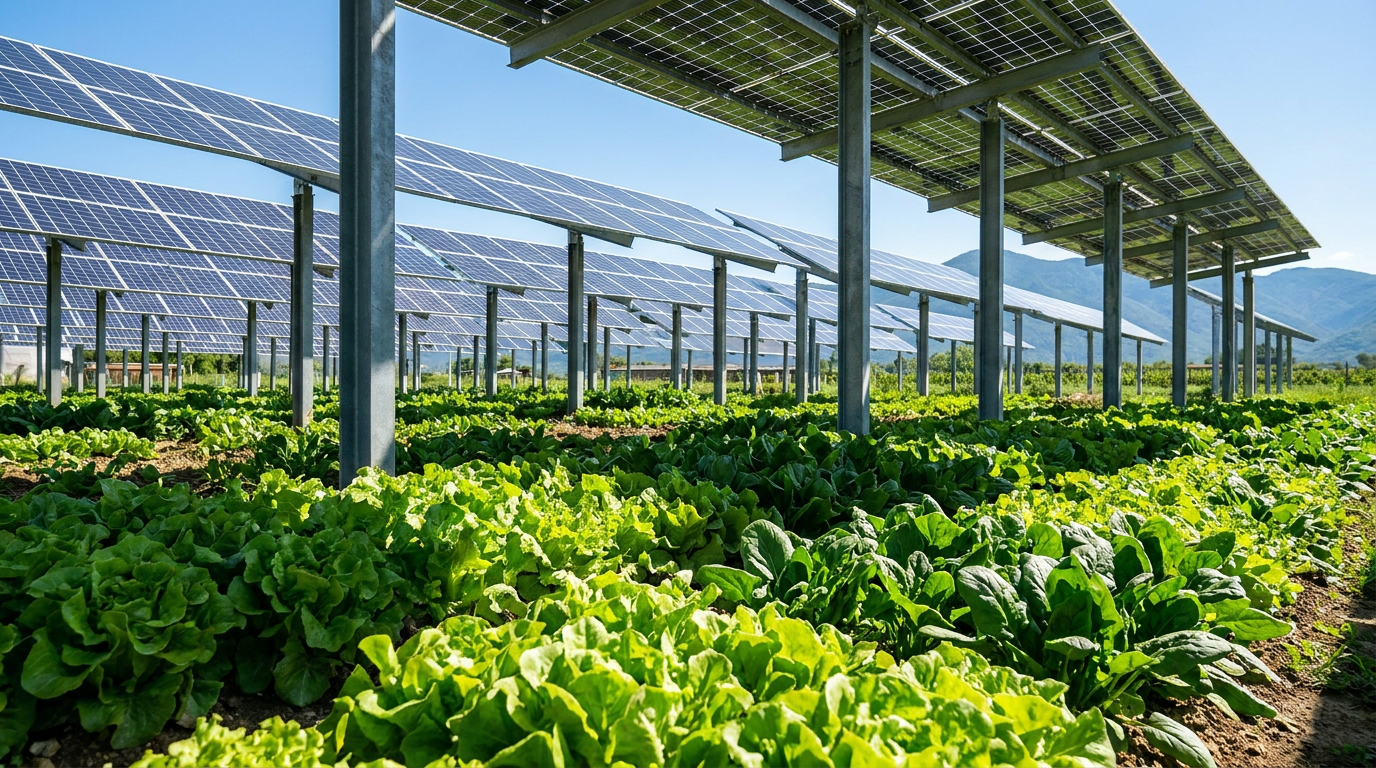
To accommodate agricultural activities, agrivoltaic systems generally utilize two primary designs. The overhead design elevates the solar panels significantly higher than traditional arrays—often eight to ten feet off the ground—allowing tractors and farm machinery to pass underneath. Alternatively, the interspaced design uses vertically mounted panels placed between rows of crops, leaving wide alleys for standard agricultural equipment to operate without obstruction.[1][5]
Despite the compelling advantages, widespread adoption faces substantial hurdles, chief among them being cost. Elevating panels on reinforced steel structures to withstand wind loads, or spacing them further apart, requires more materials and specialized engineering. Consequently, the initial capital expenditure for an agrivoltaic system can be 5 to 40 percent higher than a conventional ground-mounted solar installation.[2][5]
Geographic and climatic variables also dictate success. A 2026 study published in the Proceedings of the National Academy of Sciences demonstrated that agrivoltaics is not a universal silver bullet. While the systems dramatically improved crop growth and reduced water stress in the semi-arid western United States, they actually reduced crop yields and farm profits in the more humid, eastern regions of the Midwest, where water retention is less of a concern and sunlight is the primary limiting factor.[2]

Finally, developers and farmers must navigate complex bureaucratic and regulatory landscapes. In many jurisdictions, zoning laws strictly separate agricultural and industrial land uses, making permitting a challenge. Agricultural authorities also frequently express concern over "pseudo-agriculture"—situations where developers install solar panels under the guise of agrivoltaics to secure agricultural tax breaks, but make only token efforts to cultivate the land beneath them.[5]
To address these challenges, institutions like the U.S. Department of Energy and the National Renewable Energy Laboratory are funding extensive research to optimize system designs, lower barriers to entry, and quantify the long-term impacts on soil health and rural economies. As the technology matures and costs decline, agrivoltaics is poised to transition from a niche experiment into a foundational pillar of both global food security and the clean energy transition.[4][7]
How we got here
2019
Early foundational research published in Nature Sustainability demonstrates the mutual benefits of the food-energy-water nexus in drylands.
2024
Global installed agrivoltaic capacity reaches an estimated 14 to 22.8 gigawatts, signaling a shift from pilot projects to commercial scale.
2025
Systematic reviews confirm that dual-use systems can increase land-use efficiency by up to 200 percent and significantly improve water conservation.
2026
The International Finance Corporation publishes a comprehensive framework for scaling agrivoltaics across both high- and low-income nations.
Viewpoints in depth
Agricultural Producers
Farmers view agrivoltaics as a vital tool for diversifying income and protecting crops, though they remain cautious about operational changes.
For the agricultural community, the primary appeal of agrivoltaics is economic resilience. Facing volatile commodity prices and increasingly unpredictable weather patterns, farmers see dual-use solar as a way to secure a guaranteed secondary income stream while keeping their land in production. The physical protection the panels offer against hail, frost, and extreme heat is a significant bonus. However, the community remains highly focused on the practical challenges: maneuvering large tractors around steel pylons requires careful planning, and the high initial capital costs remain a barrier for smaller family farms without access to specialized financing.
Renewable Energy Developers
Developers see dual-use solar as a strategic way to ease land-use conflicts and secure permits faster.
Utility-scale solar developers are increasingly embracing agrivoltaics not just for its environmental benefits, but as a critical strategy for community relations. In many rural areas, traditional solar farms face fierce opposition from residents who fear the loss of agricultural heritage and productive farmland. By integrating farming into the project design, developers can often navigate zoning boards and permitting processes much more smoothly. Furthermore, incorporating livestock grazing into the site plan actively reduces the developer's long-term operations and maintenance costs by eliminating the need for mechanical mowing.
Environmental Researchers
Scientists focus on the ecological synergies of the food-energy-water nexus and the microclimate benefits of co-location.
The academic and research community views agrivoltaics as a masterclass in systemic efficiency. Rather than viewing land, water, and energy as competing resources, researchers emphasize how dual-use systems create a symbiotic microclimate. They point to data showing that panel shading dramatically reduces soil evaporation, while plant transpiration actively cools the photovoltaic cells, boosting their electrical output. For researchers, the focus is now on optimizing these systems—studying exactly which crop varieties thrive under specific panel densities and tracking the long-term impacts on soil microbiomes.
Rural Policymakers
Local governments aim to balance clean energy expansion with the protection of agricultural land and zoning integrity.
For rural policymakers and zoning boards, agrivoltaics presents a complex regulatory challenge. While they recognize the need for renewable energy and the economic benefits to local farmers, they are deeply concerned about "pseudo-agriculture." This occurs when developers install solar arrays and claim agricultural tax exemptions by placing a few sheep or token crops on the land, without making a genuine effort to maintain agricultural productivity. Policymakers are currently working to draft stricter definitions and performance standards to ensure that dual-use sites remain legitimate, productive farms.
What we don't know
- How long-term shading from solar panels will affect the soil microbiome and nutrient cycling over a 25-year project lifespan.
- Which specific crop varieties can be genetically optimized to thrive specifically in the dappled light environments of agrivoltaic systems.
- How insurance markets and agricultural lenders will standardize risk assessments and liability coverage for dual-use farms.
Key terms
- Agrivoltaics
- The simultaneous use of areas of land for both solar photovoltaic power generation and agriculture.
- Transpiration
- The process by which moisture is carried through plants from roots to small pores on the underside of leaves, where it changes to vapor and is released to the atmosphere.
- Microclimate
- The distinct, localized climate conditions within a small area, such as the shaded, cooler, and more humid environment directly beneath a solar panel.
- Land-use efficiency
- A metric used to compare the combined agricultural and energy output of a dual-use farm against the output of separate, single-use plots of land.
Frequently asked
Can any crop be grown under solar panels?
No. While shade-sensitive crops like leafy greens, tomatoes, and berries thrive, crops that require full, uninterrupted sunlight may experience reduced yields under solar arrays.
How do tractors fit under the solar panels?
Agrivoltaic systems are typically designed in one of two ways: either the panels are elevated 8 to 10 feet off the ground to allow machinery to pass underneath, or they are mounted vertically with wide alleys between rows.
Does agrivoltaics work in every climate?
The benefits are most pronounced in arid and semi-arid regions where water conservation and heat protection are critical. In highly humid areas with less sunlight, the shading can sometimes hinder crop growth.
Is it more expensive to build an agrivoltaic farm?
Yes. Because the panels must be elevated on stronger steel structures or spaced further apart, the initial capital costs are typically 5 to 40 percent higher than a standard solar installation.
Sources
Source coverage
7 outlets
4 viewpoints surfaced







[1]Economics PerspectiveAgricultural Producers
Dual-Income Farms: How Agrivoltaics Turns One Acre Into Food Profits and Electricity Revenue
Read on Economics Perspective →[2]Earth Day NetworkRural Policymakers
Harvesting Crops and Kilowatts
Read on Earth Day Network →[3]ASCERenewable Energy Developers
Agrivoltaics: How combining solar panels and farming delivers big benefits
Read on ASCE →[4]Department of EnergyEnvironmental Researchers
Agrivoltaics Research
Read on Department of Energy →[5]AZoCleantechAgricultural Producers
The Benefits and Challenges of Agrivoltaics
Read on AZoCleantech →[6]Nature SustainabilityEnvironmental Researchers
Agrivoltaics provide mutual benefits across the food–energy–water nexus in drylands
Read on Nature Sustainability →[7]Factlen Editorial TeamEnvironmental Researchers
Synthesis by Factlen editorial team
Read on Factlen Editorial Team →
Every angle. Every day.
Get environment stories with full source coverage and perspective breakdowns delivered to your inbox.