
Global Tea Prices Projected to Fall for Second Year as Oversupply and Geopolitical Conflict Hit African Exporters
A structural oversupply of tea and fractured global shipping routes have created a massive bottleneck at East African export hubs, forcing the industry to rethink how it trades the world's most popular beverage.

The world is currently growing more tea than it can drink, and the logistics of getting a morning brew from a sun-drenched hillside in Kenya to a teacup in London or Tehran have rarely been more complicated. For the second consecutive year, global wholesale tea prices are projected to fall, driven by a relentless structural oversupply and a web of geopolitical conflicts that have severed traditional trade routes.
For consumers browsing the supermarket aisle, the turbulence is largely invisible, masked by stable retail prices. But for the millions of smallholder farmers across East Africa who rely on the crop for their livelihood, the current market dynamics represent a profound shift. The industry is being forced to rethink how the world’s most popular beverage is valued, traded, and shipped.[1][6]
To understand the bottleneck, you have to step inside the Mombasa Tea Auction in Kenya. Ordinarily, this weekly gathering is a bustling hub of sensory evaluation, where buyers slurp and spit hundreds of amber infusions, bidding on lots from across East Africa. It serves as the pricing benchmark for the region. But recently, the auction rooms have been quieter, and the surrounding warehouses are overflowing with unsold burlap sacks.
The root cause is a massive structural oversupply. Global production, driven by bumper harvests in China and India, has simply outpaced the steady but slow growth in global tea drinking. When the world has a surplus of black tea leaves, international buyers can afford to be highly selective, driving down the baseline price per kilogram across the board.[3][6]
This oversupply creates a distinct vulnerability for African exporters. Kenya, Rwanda, Burundi, and Uganda produce some of the world’s finest black teas, but their export models rely heavily on the Mombasa auction clearing their inventory week after week. In early 2025, when Kenya removed a protective reserve price floor designed to shield farmers, the regional market experienced a sharp correction.
Prices crashed as the sheer volume of available tea overwhelmed buyer demand. Without the price floor, high-quality Rwandan and Burundian teas were suddenly competing in a saturated buyer's market, leading to millions of kilograms of tea sitting unsold in coastal warehouses, slowly losing the vibrant freshness that commands top dollar.[3]
Compounding the sheer volume of tea is a fractured geopolitical map that has effectively blockaded key export routes. The journey from East Africa to Europe traditionally flows north through the Red Sea and the Suez Canal. However, ongoing Houthi attacks on commercial shipping have forced major freight carriers to reroute their vessels around the Cape of Good Hope at the southern tip of Africa.
This massive detour adds weeks of transit time to every shipment and significantly spikes freight and insurance costs. Industry experts note that this weaponization of trade has introduced severe logistical friction, making it harder and more expensive to move African tea to Western markets just when producers desperately need to clear their backlogs.[4]
The logistical nightmare extends deeply into the Middle East, a region that traditionally serves as a massive consumer base for premium African and Indian orthodox teas. Escalating military tensions involving the United States, Israel, and Iran have effectively frozen demand from Tehran and neighboring Gulf states.
Trade analysts report that buyers in these regions are increasingly hesitant to confirm orders or settle payments due to skyrocketing risk premiums and failing financial linkages. With air and sea routes through Gulf hubs disrupted, shipments bound for the Middle East have stalled at export ports, further swelling the inventory backlogs in Mombasa and Kolkata and removing a crucial pillar of demand from the auction floors.[2]
Regional politics within Africa have also dealt unexpected blows to the tea trade. In a stark example of how localized disputes ripple through agricultural markets, Sudan—historically one of the largest buyers of Kenyan tea—implemented a sudden ban on imports. The embargo stemmed from a geopolitical disagreement over Kenya allegedly hosting activities related to Sudan's Rapid Support Forces.
Overnight, a market worth tens of millions of dollars vanished. For Kenyan farmers, the sudden loss of the Sudanese market meant that a massive volume of tea specifically cultivated and blended for North African palates was suddenly left stranded, exacerbating the regional oversupply and pushing prices down even further.[1]
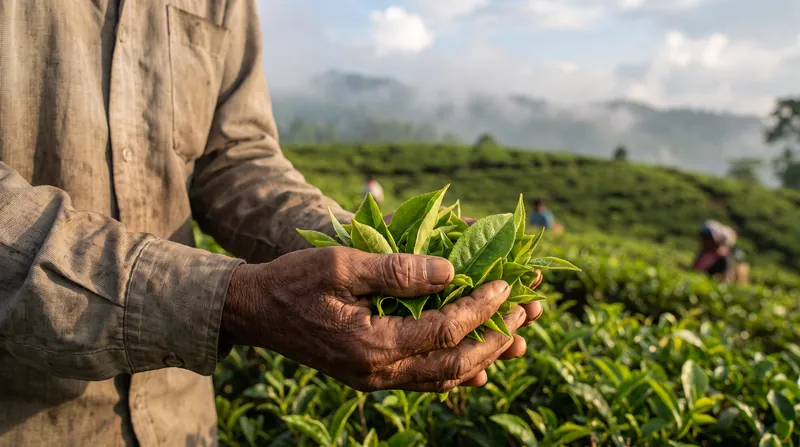
The financial toll of these compounding crises falls heaviest on the smallholder farmers who hand-pluck the leaves. In the lush, high-altitude regions of Mt. Kenya and the Great Rift Valley, tea is not just a crop; it is the economic engine that pays school fees and funds community infrastructure.
Factory directors in these regions note that the depressed auction prices translate directly into smaller annual bonus payouts for farmers. While the factories have invested heavily in modern processing technologies to maintain world-class quality, they cannot entirely insulate their growers from the macroeconomic reality of a weak global market and unfavorable currency exchange rates.[5]
In response to the crisis, local governments are attempting to stabilize the sector through policy interventions, though the results have been mixed. Kenya recently introduced new levies on tea buyers to fund agricultural research, price stabilization efforts, and rural infrastructure. However, the move has sparked intense debate within the industry.
Some factory directors and lawmakers argue that adding taxes in a depressed market only drives international buyers toward untaxed teas from neighboring countries, leaving Kenyan leaves to be used merely as cheap filler for global blends. The tension highlights the delicate balancing act of trying to protect farmer incomes without pricing the country's primary export out of a highly competitive global market.[5]
To escape the commodity trap, many East African cooperatives are executing a strategic pivot toward quality and differentiation. Instead of churning out bulk crush, tear, curl (CTC) black tea destined for anonymous supermarket tea bags, progressive factories are investing in specialty grades.
They are producing orthodox whole-leaf teas, delicate green teas, and even white teas that command significant premiums from boutique international buyers. By diversifying their output, these producers are intentionally stepping out of the saturated bulk market and catering to a growing global demographic of tea enthusiasts who are willing to pay a premium for unique flavor profiles and artisanal processing.[3][6]
Beyond changing what they grow, African producers are changing how they sell it. Historically, the vast majority of African tea was exported as a raw, bulk commodity, only to be blended, packaged, and branded in Europe or the Middle East. The real profit margins were captured thousands of miles away from the farms where the leaves were grown.
Now, there is a concerted push for value addition at the source. By investing in local packaging facilities and building homegrown brands, African cooperatives are aiming to sell finished, retail-ready products directly to international markets, retaining a much larger share of the final purchase price within the local economy.[3]
At the farm level, the focus is shifting toward long-term climate resilience and sustainable agriculture. Recognizing that volatile prices are only one part of the equation, farmers are adopting practices to protect their yields against increasingly erratic weather patterns.
Cooperatives are distributing drought-resistant tea clones and encouraging farmers to intercrop their tea bushes with nitrogen-fixing legumes. These regenerative practices improve soil health, reduce the need for expensive chemical fertilizers, and provide farmers with secondary food crops, ensuring that rural communities remain economically resilient even when global tea prices hit the floor.[3][4]
Technology is also providing a new pathway to bypass the traditional auction bottlenecks. Buyers in Europe and North America increasingly demand total transparency, wanting to know the exact hillside their tea comes from and the labor conditions under which it was harvested. In response, East African producers are implementing digital traceability platforms and blockchain ledgers.
These tools allow cooperatives to prove the provenance and sustainability of their harvests, enabling them to secure direct, long-term contracts with premium international buyers. By leveraging data, farmers are slowly decoupling their livelihoods from the unpredictable swings of the global commodity market, ensuring that the perfect cup of tea remains a sustainable business for the people who grow it.[3]
Key points
- Global tea prices are projected to fall for a second consecutive year due to a structural oversupply driven by large harvests in Asia.
- Houthi attacks in the Red Sea have forced shipping detours, significantly increasing the time and cost of transporting African tea to Europe.
- Escalating conflicts in the Middle East have frozen demand from major buyers in Iran and the Gulf states, leading to massive unsold stockpiles.
- In response to the crisis, East African cooperatives are shifting away from bulk commodity sales toward premium specialty teas and local packaging.
What we don’t know
- It remains unclear when shipping routes through the Red Sea and Suez Canal will normalize enough to reduce freight costs.
- The long-term impact of Kenya's new agricultural levies on the competitiveness of its tea exports is still heavily debated.
- Whether the global pivot toward premium and specialty teas can absorb the massive volume of displaced bulk black tea remains to be seen.
How we got here
Early 2024
Global tea production surges, particularly in Asia, pushing the market into a state of structural oversupply.
Late 2024
Houthi attacks in the Red Sea begin disrupting the primary shipping route for East African tea bound for European markets.
Early 2025
Kenya removes its reserve price floor at the Mombasa auction, leading to a sharp regional drop in wholesale tea prices.
March 2025
Sudan bans the import of Kenyan tea amid geopolitical disputes, wiping out a major export destination.
Mid 2026
Global tea prices are projected to fall for a second consecutive year as unsold stocks accumulate in export warehouses.
- East African Producers
- Advocates for local value addition, fair auction pricing, and relief from levies to protect smallholder farmers.
- Global Trade Analysts
- Focuses on the macroeconomic reality of structural oversupply driven by Asian mega-harvests outstripping steady global demand.
- Supply Chain Experts
- Highlights the logistical friction of the Red Sea and Middle East conflicts, emphasizing that the tea exists but cannot efficiently reach buyers.
Perspectives this story doesn't cover
- European Retail Consumers
- Asian Mega-Producers
Sources
Source coverage
6 outlets
3 viewpoints surfaced






- [1]Africa Sustainability MattersGlobal Trade Analysts
Global tea markets are entering a second consecutive year of declining prices
Read on Africa Sustainability Matters → - [2]Expana MarketsSupply Chain Experts
Middle East conflict entangles global tea markets in trade disruptions
Read on Expana Markets → - [3]TraceXEast African Producers
Why are Rwandan and Burundian teas struggling?
Read on TraceX → - [4]FoodNavigatorSupply Chain Experts
How geopolitical instability and climate change are affecting tea prices
Read on FoodNavigator → - [5]The StarEast African Producers
Mt Kenya tea directors defend bonuses amid global price drop
Read on The Star → - [6]The Biz LookGlobal Trade Analysts
The Global Tea Supply: More Oversupply Than Scarcity
Read on The Biz Look →

More in Food & Drink
See all →Tea Chemistry
The Chemistry of Tea: How Catechins, L-Theanine, and Volatile Compounds Create Flavor and Health Effects
11 sources

Beverage Science
The Science of Tisanes: Comparing the Botanical, Chemical, and Legal Differences Between Herbal Infusions and True Tea
7 sources

Tea Chemistry
The Science of Tea Processing: How Oxidation and Fixing Create the Six Main Types of Tea
6 sources

Food Safety
Tata and Unilever Enforce Strict Pesticide Limits, Halting Procurement From 50,000 Indian Tea Farmers
6 sources
Comments
Every angle. Every day.
Get Food & Drink stories with full source coverage and perspective breakdowns, free every day.