
How China's Zero-Tariff Policy on African Tea is Rewiring the Global Market
A sweeping new trade policy has eliminated Chinese import tariffs for 53 African nations, opening a massive new market for the continent's tea growers and reshaping global supply chains.

Share this story
On May 1, 2026, a sweeping new trade policy quietly rewired the global agricultural landscape. China officially eliminated import tariffs on all products originating from 53 African nations with which it maintains diplomatic relations, a move designed to deepen economic ties across the Global South. While the sweeping policy covers everything from fresh fruit to industrial components, its most profound and immediate impact is rippling through the global tea market.
For centuries, China has been the undisputed heavyweight of global tea exports, supplying premium green and specialty teas to the world. However, a historic shift in domestic consumption has recently transformed the nation into a net importer of black tea. By dropping tariffs to absolute zero for African nations, Beijing has effectively opened the floodgates for the world's most prolific black tea producers to access its massive, thirsty consumer base without the financial friction that previously hindered trade.[3]
The policy marks a deliberate and highly strategic pivot in Sino-African economic relations. Historically, Africa's exports to China have been overwhelmingly dominated by raw minerals—with crude oil, copper, and cobalt accounting for the vast majority of trade volume. By removing market-access barriers specifically for agricultural goods, Chinese economic planners are actively encouraging African economies to diversify their exports into higher-value, sustainable sectors.
The mechanics of this zero-tariff initiative are rooted in the Forum on China-Africa Cooperation (FOCAC). Building on a "Green Channel" established in previous years to fast-track agricultural imports, the new May 1 policy removes the final financial hurdles. Tariffs that previously squeezed the margins of African farmers and made their goods less competitive against Southeast Asian imports have been entirely erased, fundamentally altering the unit economics of cross-border agricultural trade.
The immediate results of the policy are already visible at major entry points along the Chinese coast. According to Shanghai Customs, the value of imports from the 53 benefiting African countries exceeded $176 million in just the first few weeks of the policy's implementation, saving importers millions in duties. For agricultural produce specifically, the elimination of tariffs has cut the per-container import cost by roughly 17 percent, a margin that dramatically boosts the competitiveness of African goods on Chinese supermarket shelves.
To handle the expected influx of perishable and time-sensitive agricultural products, Chinese ports have completely overhauled their logistics. Shanghai Customs has implemented a 24/7 green channel with tailored clearance plans, ensuring that shipments of fresh goods, cut flowers, and agricultural staples like tea can bypass traditional bottlenecks and enter the market rapidly without losing quality.[2]
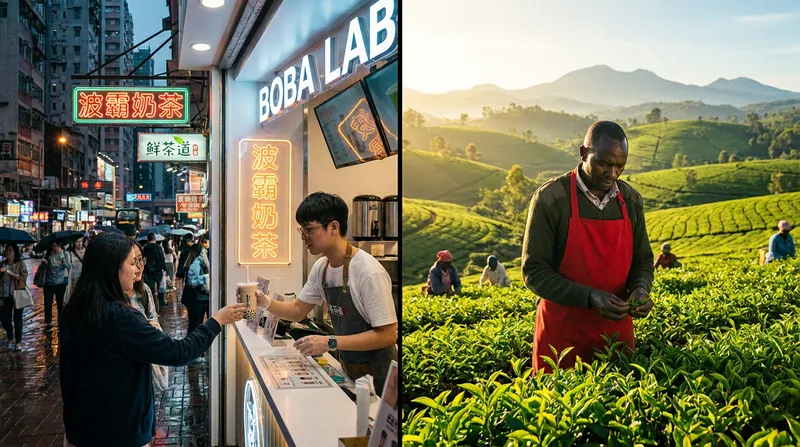
For African tea growers, the policy arrives at a critical moment of vulnerability in the global market. Nations like Kenya—which stands as the world's largest exporter of black tea—have long relied on a narrow portfolio of traditional buyers, primarily Pakistan, Egypt, and the United Kingdom. This heavy concentration has left millions of rural smallholder farmers exposed to currency crises, inflation, and shifting consumer demand in those specific regions.
The zero-tariff access to China offers a stabilizing economic lifeline. Farmers in regions ranging from the Kenyan highlands to Zanzibar are suddenly looking at a high-demand, high-volume market that is actively courting their product. Agricultural economists note that this diversification reduces systemic risk for African cooperatives, ensuring more predictable income streams and protecting rural livelihoods regardless of geopolitical shocks or economic downturns in the Middle East or Europe.[1][3][4]
The demand from the East is far from theoretical. Rwandan and Malawian tea estates are already reporting a significant surge in forward contracts from Chinese buyers looking to lock in supply for the remainder of the 2026 harvest. The removal of the tariff barrier means that African tea can now compete directly on price with domestic Chinese lower-tier teas and imports from neighboring Asian countries.
The paradox of China—the historical birthplace of tea—importing vast quantities of the leaf is explained by the explosive growth of its domestic beverage industry. The modern Chinese consumer is driving an unprecedented boom in milk tea, boba, and ready-to-drink fruit teas, creating a multi-billion-dollar retail sector. These wildly popular beverages require massive volumes of robust, highly astringent black tea to serve as a base that can stand up to heavy milk, sugar, and ice without losing its flavor profile.[1][3][4]
African tea, particularly the Crush, Tear, Curl (CTC) variety produced in massive quantities across East Africa, is perfectly suited for this specific commercial application. It brews quickly, yields a dark, strong liquor, and is highly cost-effective to produce at scale. By importing this base ingredient tariff-free, Chinese beverage chains can protect their profit margins in a fiercely competitive domestic retail market where price wars are common.
Simultaneously, this import strategy allows Chinese domestic tea farmers to pivot their agricultural efforts toward more lucrative harvests. Rather than competing on volume for the low-margin beverage base market, local growers in regions like Yunnan and Zhejiang are increasingly focusing their acreage on premium, high-margin specialty teas like Longjing and aged Pu'er. It is a macroeconomic division of labor that optimizes agricultural output for both nations.[3][4]
Beyond the immediate trade of raw tea leaves, the zero-tariff policy is designed to catalyze long-term industrial development and structural transformation in Africa. Trade analysts point out that the policy makes it highly attractive for foreign direct investment (FDI) to flow directly into African processing facilities.
Chinese beverage conglomerates, seeking to optimize their supply chains and reduce costs, are now heavily incentivized to build processing, blending, and packaging plants directly in Kenya, Rwanda, or Tanzania. By processing the tea locally and exporting the finished, value-added product back to China tariff-free, these companies can bypass higher manufacturing and labor costs at home while securing their supply lines.[4]
For African nations, this shift represents the holy grail of agricultural economics: moving up the global value chain. Instead of merely exporting raw commodities to be blended and packaged in Europe or Asia, local economies can capture the higher margins associated with processing and branding.
This localized industrialization creates skilled jobs, facilitates technology transfer, and builds infrastructure that can be utilized by other agricultural sectors. Economists view this as a necessary step for the continent to break free from the historical cycle of resource extraction, turning agriculture into a true engine for middle-class growth.[4]
Despite the overwhelming optimism surrounding the new trade corridor, the transition is not without operational friction. African exporters must carefully navigate China's stringent phytosanitary standards and complex customs documentation, which differ significantly from those of their traditional Western buyers. While the financial tariffs have vanished, the regulatory bar for food safety and pesticide residue remains incredibly high. This reality requires African cooperatives to invest heavily in better testing facilities and quality control infrastructure to ensure their shipments are not rejected upon arrival at Shanghai or Guangzhou.[2][3]
Ultimately, the zero-tariff policy represents a landmark evolution in South-South trade that redefines how emerging economies interact. By leveraging its massive consumer market to support African agricultural development, China is securing a stable, low-cost supply of raw materials for its modern beverage boom. For millions of African farmers, the policy provides the economic stability and market access they have sought for decades, transforming a historic tea exporter into a vital lifeline for the continent's agricultural future.[1][3]
Key points
- China has eliminated import tariffs on goods from 53 African nations, fundamentally rewiring the global agricultural trade.
- The policy provides African tea growers with a massive, stable new market, reducing their reliance on traditional buyers.
- Chinese beverage chains benefit from a cheaper, tariff-free supply of robust black tea needed for the booming milk tea industry.
- The elimination of duties has cut the per-container import cost of African agricultural goods by an estimated 17 percent.
What we don’t know
- It remains unclear how traditional buyers of African tea, such as Pakistan and the UK, will respond to tighter supplies and increased competition from China.
- We do not yet know how quickly African cooperatives can upgrade their quality control infrastructure to consistently meet China's strict phytosanitary standards.
- The long-term impact on domestic Chinese black tea producers, who now face direct price competition from tariff-free African imports, is still unfolding.
How we got here
November 2021
China announces the creation of a 'Green Channel' to facilitate faster customs clearance for African agricultural products.
2024
China eliminates tariffs for Least Developed Countries (LDCs) in Africa, testing the waters for broader agricultural trade.
May 1, 2026
The zero-tariff policy is officially expanded to all 53 African nations with diplomatic ties to China.
July 2026
Shanghai Customs reports over $176 million in tariff-free imports in the first weeks, confirming the policy's immediate impact.
- African Agricultural Exporters
- Focused on market diversification and escaping the price volatility of traditional buyers.
- Chinese Economic Planners
- Focused on securing low-cost raw materials and expanding South-South agricultural trade.
- Global Trade Observers
- Focused on the macroeconomic shift from resource extraction to agricultural value-add.
Perspectives this story doesn't cover
- Traditional Tea Importers (UK/Pakistan)
- Domestic Chinese Black Tea Farmers
Sources
Source coverage
4 outlets
3 viewpoints surfaced




- [1]CGTN AfricaAfrican Agricultural Exporters
Zero-tariff policy offers Zanzibari and mainland farmers a stable market
Read on CGTN Africa → - [2]China DailyChinese Economic Planners
Zero-tariff policy for African goods sees fruitful returns at Shanghai Customs
Read on China Daily → - [3]ReutersGlobal Trade Observers
African tea growers pivot to China as zero-tariff policy reshapes global market
Read on Reuters → - [4]African BusinessAfrican Agricultural Exporters
How China's beverage boom is fueling a new era for Kenyan and Rwandan tea
Read on African Business →
More in Food & Drink
See all →Tea Chemistry
L-Theanine Counterbalances Caffeine in Tea to Elevate Alpha Brain Waves
2 sources

Nutritional Science
Why L-Theanine and Caffeine in Tea Provide Sustained Alertness Without Jitters
3 sources

Extraction Kinetics
How Rapid Catechin Depletion Makes the Second Steep of Oolong and Pu-erh Taste Sweeter
7 sources

Food Chemistry
How Heat Inactivates the Enzyme That Turns Green Tea Leaves Black
4 sources

Comments
Every angle. Every day.
Get Food & Drink stories with full source coverage and perspective breakdowns, free every day.