
How Flour Choice and Wheat Enzymes Dictate the Microbiome and Digestibility of Sourdough
Recent microbiological sequencing reveals that a baker's choice of flour fundamentally alters the bacterial ecosystem of a sourdough starter, while the resulting acidity activates dormant wheat enzymes that break down complex dietary fibers.
By Lan Xu

Share this story
In short
- A baker's choice of flour strictly dictates which lactic acid bacteria survive in a sourdough starter, altering the final flavor profile.
- The acidic environment created by these bacteria activates dormant wheat enzymes that break down complex dietary fibers.
- This enzymatic breakdown pre-digests arabinoxylans, making the resulting bread significantly easier for the human gut to process.
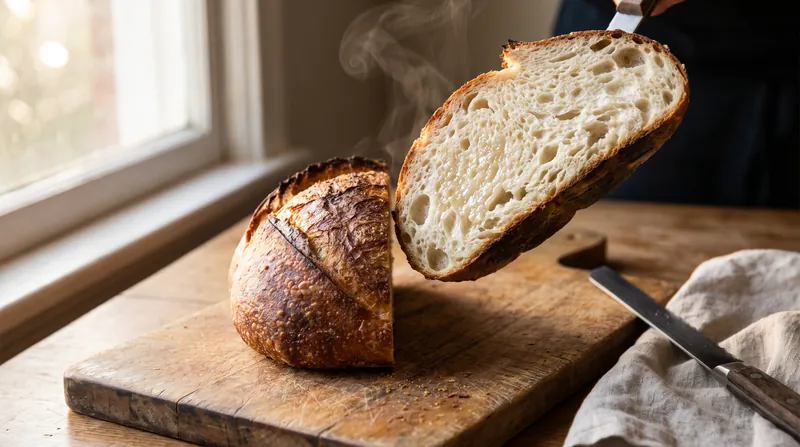
A baker mixing flour and water initiates a microscopic competition that dictates the final structure and flavor of a loaf. The choice of grain, the hydration level, and the daily feeding schedule determine exactly which bacteria survive the highly acidic environment of a sourdough starter. When the baker finally folds the dough and commits it to the heat of the oven, they are locking in a chemical architecture built entirely by those surviving microbes and the dormant wheat enzymes they activate.[7]
The familiar chewy texture and tangy flavor of a natural loaf come from a complex ecosystem that researchers are only now beginning to fully map. Historically, scientists have identified more than 60 types of bacteria and over 80 kinds of yeast in starters collected from kitchens around the world. But a January 2026 study published in the journal Microbiology Spectrum by researchers at North Carolina State University revealed that these microbes do not assemble by chance. They are strictly governed by the specific resources the baker provides.[1][4]
"We can use sourdough as an experimental evolution framework, to see what happens over time," said evolutionary biologist Caiti Heil, the study's senior author. Her team tracked starters fed with all-purpose, bread, and whole wheat flours over the course of one month.
They found that a hardy yeast genus known as Kazachstania rapidly multiplied to become the dominant yeast in every starter, regardless of the feeding schedule or the flour type used. The yeast provides the carbon dioxide necessary for the dough to rise, but the bacteria tell a far more nuanced story.[3][4]
The bacterial communities diverged sharply based on the baker's choice of flour. Mature starters fed with whole wheat flour fostered high concentrations of Companilactobacillus, while those sustained on refined bread flour were dominated by Levilactobacillus. Because these distinct lactic acid bacteria produce different metabolic byproducts, the initial flour selection fundamentally alters the starter's flavor profile. "And because the microbial composition affects different traits, by altering the flour you could potentially alter how your bread tastes," Heil noted.[1][4]
Yet the microbes are only half of the fermentation equation. A March 2026 doctoral study by Víctor González Alonso at the Vrije Universiteit Brussel demonstrated that the rising acidity of the dough activates dormant enzymes already present within the wheat itself. As the lactic acid bacteria lower the pH of the dough, these native wheat enzymes wake up and begin breaking down complex dietary fibers known as arabinoxylans.[1][2]
This enzymatic breakdown transforms the physical properties of the dough beneath the baker's hands. As the large arabinoxylan molecules are cleaved into smaller fragments, the dough's viscosity shifts and its ability to retain gas changes. "Sourdough remains a fascinating interplay of biology and craftsmanship," González Alonso said, noting that the fermentation process influences wheat fibers to a much greater extent than cereal chemists previously understood.[2]
The specific bacterial strains present during this breakdown also dictate the aromatic compounds that fill a kitchen during baking. The Brussels researchers linked Lactococcus lactis to the production of rich, buttery aromatic notes, while Limosilactobacillus fermentum generated sugar alcohols that impart a mild sweetness to the crumb. By adjusting the fermentation time and temperature, a baker can effectively steer the microbial population toward these specific flavor outcomes.[1][2]
Beyond flavor, this structural transformation has profound implications for how the human body digests the final loaf. A May 2026 review in Frontiers in Nutrition highlighted that the acidification driven by sourdough fermentation enhances polysaccharide swelling and delays the staling process. As the complex carbohydrates are pre-digested by the enzymatic activity, the resulting bread becomes significantly easier for the human gut to process, particularly for individuals sensitive to dense, unfermented wheat matrices.[6]
Food scientists are now leveraging these mechanical insights to fortify baked goods without ruining their texture. A May 2026 study published in MDPI explored how adding soluble dietary fibers like resistant dextrin interacts with the gluten network. Researchers found that incorporating exactly 6 percent resistant dextrin into wheat starch provided the optimal balance, reducing the bread's 14-day retrogradation—the chemical process that causes staling—from 57.2 percent down to 48.6 percent.[5]
Pushing the fiber content higher, however, requires careful hydration management. The MDPI study revealed that while resistant dextrin increases the dough's water-holding capacity, it physically interposes itself between gluten chains, weakening the overall protein network.
A baker attempting to maximize fiber must therefore adjust their mixing times and water ratios to ensure the glutenin and gliadin proteins can still form the elastic bonds necessary to trap the carbon dioxide produced by the Kazachstania yeast. The structural integrity of the final loaf depends entirely on how well the baker balances this chemical interference against the dough's development.[5]
Key terms
- Arabinoxylans
- Complex dietary fibers found in wheat that help determine the structure, water retention, and digestibility of bread.
- Kazachstania
- A hardy genus of yeast that rapidly multiplies to become the dominant carbon-dioxide-producing organism in most sourdough starters.
- Lactic Acid Bacteria
- Microbes that ferment sugars into lactic acid, lowering the dough's pH and creating the signature tangy flavor of sourdough.
- Retrogradation
- The chemical process where starch molecules realign and crystallize after baking, causing bread to become stale and hard over time.
- Resistant Dextrin
- A soluble dietary fiber used to fortify baked goods, known to increase water-holding capacity and delay staling.
Reader questions
Does the type of flour change the yeast in a sourdough starter?
No. Recent studies show that the hardy yeast genus Kazachstania rapidly dominates starters regardless of whether they are fed whole wheat, bread, or all-purpose flour.
Why does sourdough bread taste different depending on the flour?
While the yeast remains consistent, the bacterial communities change. Whole wheat flour fosters different lactic acid bacteria than refined bread flour, which produce distinct flavor compounds like buttery notes or mild sweetness.
How does sourdough fermentation improve bread digestibility?
The acidic environment created by lactic acid bacteria activates dormant wheat enzymes. These enzymes break down complex dietary fibers called arabinoxylans, essentially pre-digesting the carbohydrates before baking.
Can adding extra fiber ruin the texture of sourdough bread?
Yes, if not managed correctly. While adding soluble fibers like resistant dextrin reduces staling, it can also interpose between gluten chains and weaken the dough's elastic network, requiring bakers to adjust hydration and mixing times.
Where opinion splits
Microbial Ecologists
Focuses on how environmental inputs like flour type and feeding schedules dictate the survival and dominance of specific microbes.
For evolutionary biologists and microbial ecologists, a sourdough starter is a fast-paced arena of natural selection. They view the fermentation process not as a culinary art, but as a predictable biological response to environmental constraints. By sequencing the DNA of starters fed with different flours, these researchers have demonstrated that the microbial community is not random. The environment strictly dictates the outcome: Kazachstania yeast inevitably wins the competition for carbon dioxide production, while the specific lactic acid bacteria that survive depend entirely on the nutritional profile of the flour provided.
Cereal Chemists
Focuses on the mechanical and enzymatic transformations that occur within the dough matrix during fermentation.
Cereal chemists look past the microbes to study the structural architecture of the dough itself. From their perspective, the bacteria are merely the trigger that lowers the pH, which in turn activates the wheat's native enzymes. These chemists measure how the enzymatic breakdown of arabinoxylans alters the dough's viscosity and gas retention. They also quantify how fortifying dough with soluble fibers like resistant dextrin physically interferes with the glutenin and gliadin proteins, forcing a trade-off between nutritional enhancement and the mechanical strength of the gluten network.
Commercial Bakers
Focuses on translating these microbiological and chemical insights into consistent flavor, texture, and product formulation.
For commercial bakers and product developers, this scientific mapping offers a new level of control over the final loaf. Rather than relying entirely on intuition, they can now manipulate the fermentation variables to achieve specific outcomes. Knowing that Limosilactobacillus fermentum produces sweet sugar alcohols, or that specific enzymatic breakdowns delay retrogradation, allows bakeries to formulate highly digestible, fiber-rich breads that stay softer for longer. Their primary challenge is balancing these health and flavor benefits against the mechanical realities of large-scale dough mixing and baking.
- Microbial Ecologists
- Focuses on how environmental inputs like flour type and feeding schedules dictate the survival and dominance of specific microbes.
- Cereal Chemists
- Focuses on the mechanical and enzymatic transformations that occur within the dough matrix during fermentation.
- Commercial Bakers
- Focuses on translating these microbiological and chemical insights into consistent flavor, texture, and product formulation.
Perspectives this story doesn't cover
- Home bakers
- Gastroenterologists
Sources
Source coverage
7 outlets
3 viewpoints surfaced







- [1]ScienceDailyCommercial Bakers
What Happens During Sourdough Fermentation
Read on ScienceDaily → - [2]BakeryAndSnacksCommercial Bakers
Sourdough is rewriting fibre functionality
Read on BakeryAndSnacks → - [3]The MicrobiologistMicrobial Ecologists
Flour choice shapes sourdough microbial communities
Read on The Microbiologist → - [4]Microbiology SpectrumMicrobial Ecologists
The role of flour type and feeding schedule on the sourdough microbiome
Read on Microbiology Spectrum → - [5]MDPICereal Chemists
Refined wheat staple foods are widely criticized for low dietary fiber and high postprandial glycemic response
Read on MDPI → - [6]Frontiers in NutritionCereal Chemists
Fermentation in breadmaking: enhancing digestibility and nutritional value for gastrointestinal health
Read on Frontiers in Nutrition → - [7]Factlen Editorial Team
Synthesis by Factlen editorial team
Read on Factlen Editorial Team →
More in Food & Drink
See all →Flour Milling
The 0.45% Ash Content: How European Flour Type Numbers Define Global Baking Grades
5 sources
Fat Crystallization
The β' Crystal Structure: How the Polymorphism of Solid Fat Dictates Aeration and Flakiness in Baked Goods
6 sources
Sourdough Science
How Predictable Sourdough Microbes and Enzymes Resist Mold and Build Flavor
7 sources
Baking Science
The 60°C to 85°C Window: How Starch Gelatinization Sets the Crumb Structure and Defines a Baked Good's Final Texture
5 sources
Comments
Every angle. Every day.
Get Food & Drink stories with full source coverage and perspective breakdowns, free every day.