
The Science of Tea Processing: How Oxidation and Fixing Create the Six Main Types of Tea
Every true tea originates from the exact same plant, Camellia sinensis. The vast differences in flavor, color, and aroma between green, black, and oolong teas come entirely from how the leaves are bruised, heated, and oxidized after harvest.

In short
- All six true tea types—white, green, yellow, oolong, black, and pu-erh—come from the Camellia sinensis plant.
- Oxidation is the chemical reaction where enzymes in the leaf interact with oxygen, turning the leaf brown and altering its flavor.
- Fixing, or 'kill-green', is the process of applying heat to deactivate these enzymes and permanently halt oxidation.
Walk down the tea aisle of any grocery store, and the vibrant boxes of green, black, and white teas look like entirely different agricultural products. It is the most common misconception in the beverage world: the belief that green tea comes from a green tea plant, and black tea comes from a black tea plant. In reality, every single cup of true tea you have ever consumed—whether a delicate, silvery white tea or a robust, malty black tea—begins its life on the exact same evergreen shrub: Camellia sinensis.[4][5]
The magic that transforms this single botanical canvas into six distinct categories of tea is not found in the soil or the seed, but in the processing. It is a story of chemistry, heat, and time. How a tea maker handles the freshly plucked leaf dictates whether it will brew into a grassy, spring-like infusion or a dark, comforting cup.
To understand tea processing, you must first understand the leaf's internal chemistry. When a tea leaf is plucked, it is plump, rigid, and packed with water, enzymes, and polyphenols. The most crucial of these enzymes is polyphenol oxidase. As long as the leaf is intact, these compounds remain separated within the cellular structure.[1][3]
The journey begins with withering. Freshly harvested leaves are spread out on bamboo trays or fabric troughs, exposed to gentle airflow. Over several hours, the leaves lose up to a third of their moisture. They transform from crisp, easily broken leaves into limp, pliable ones. This physical softening is essential; it prepares the leaf to be rolled and shaped without shattering into dust.[1]
Once withered, the true divergence of the six tea types begins, driven by a process called oxidation. If you have ever bitten into an apple and watched the exposed flesh turn brown, you have witnessed oxidation. In tea, rolling or bruising the withered leaves breaks down their cell walls, exposing the internal enzymes to oxygen in the air.[2]
This exposure triggers a cascade of chemical reactions. The polyphenol oxidase begins converting the leaf's natural catechins—the compounds responsible for the brisk, astringent taste of green tea—into complex new molecules called theaflavins and thearubigins. These new compounds are what give oxidized teas their reddish-brown colors and deep, malty, or fruity flavors.[2][3]
The tea maker's primary tool for controlling this chemical transformation is heat. Applying high heat to the leaves denatures the enzymes, permanently halting the oxidation process. In the tea industry, this crucial step is known as 'fixing' or 'kill-green' (shaqing). The exact moment the tea maker decides to apply this heat determines which of the six categories the tea will fall into.[1][2]
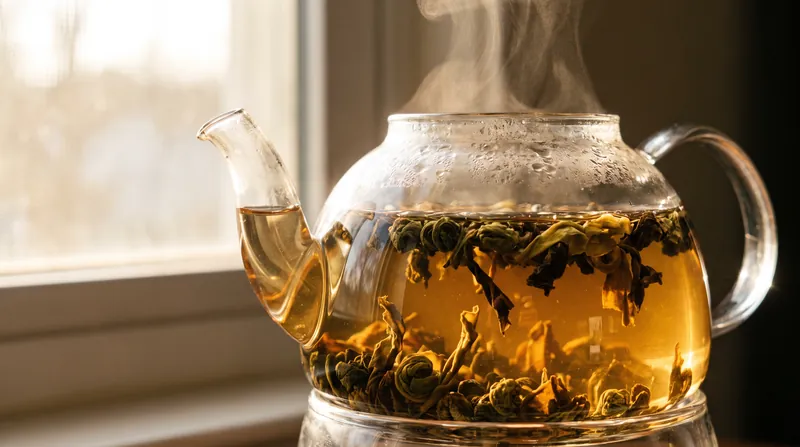
Green tea is the purest expression of the unoxidized leaf. To preserve the vibrant green color and the fresh, vegetal flavors, green tea is fixed almost immediately after a brief withering period. In Japan, this is traditionally done by steaming the leaves, which yields a deep, savory, and oceanic flavor profile. In China, the leaves are typically pan-fired in large woks at temperatures reaching 250°C (482°F), resulting in a sweeter, more toasted, and nutty character.[1][4]
Because green tea undergoes zero oxidation, its chemical makeup remains very close to that of the fresh leaf. It retains exceptionally high levels of catechins. This is why green tea requires cooler brewing water; boiling water extracts these intact catechins too aggressively, creating a harsh, bitter cup that masks the tea's natural sweetness.[3]
At the opposite end of the spectrum sits black tea, known in China as 'red tea' for the color of its liquor. To create black tea, the withered leaves are heavily rolled and bruised, then left in a humid, temperature-controlled environment to oxidize completely. The leaves turn from green to a deep coppery brown, and the grassy aromas are replaced by scents of honey, malt, and dark fruit.[2][5]
Only after the leaves have reached 100% oxidation are they finally fired to dry them and lock in the flavor. This complete chemical conversion makes black tea incredibly robust. The complex thearubigins formed during this long oxidation process are less prone to bitterness, which is why black tea can withstand the rolling boil of a kettle and pairs so beautifully with milk and sugar.[2][3]
Between the unoxidized green and the fully oxidized black lies the vast, complex world of oolong tea. Oolongs are partially oxidized, ranging anywhere from 10% to 85%. Crafting oolong requires immense skill; the tea maker must repeatedly bruise the edges of the leaves, let them oxidize slightly, and then halt the process at the exact right moment.[4]
A lightly oxidized oolong, often rolled into tight little spheres, will brew into a fragrant, floral cup reminiscent of lilac and butter. A heavily oxidized oolong, characterized by long, dark, twisted leaves, will offer deep notes of roasted stone fruit, wood, and spice. The fixing process for oolong is often followed by extensive roasting, adding yet another layer of sensory complexity.[4][5]
White tea is the least processed of all six types, yet it is not entirely unoxidized. The freshly plucked buds and young leaves are simply withered in the sun or a controlled indoor environment for an extended period, sometimes up to three days. During this long, slow withering, a very slight, natural ambient oxidation occurs, usually around 5 to 10 percent.[4][5]
White tea is never subjected to the high-heat 'kill-green' step, nor is it rolled or bruised. It is simply dried. This minimalist approach preserves the delicate, silvery hairs on the tea buds and results in a brew that is incredibly subtle, offering notes of melon, hay, and sweet cream. Its simplicity in processing belies the difficulty of executing it perfectly, as the maker relies entirely on ambient climate control.[4]
Yellow tea is the rarest of the six categories and shares much of its DNA with green tea. It begins with the same immediate fixing process to halt oxidation. However, while still warm and damp, the leaves are wrapped in paper or cloth and allowed to gently steam in their own heat—a process called 'sweltering' or 'menhuang.'[1][4]
This sweltering step induces a non-enzymatic browning, similar to caramelization, which removes the grassy astringency typical of green tea. The resulting yellow tea offers a mellow, sweet, and remarkably smooth profile, bridging the gap between the freshness of green tea and the comforting sweetness of a light oolong.[1][5]
Finally, there is pu-erh, or dark tea (hei cha). While other teas are defined by oxidation, pu-erh is defined by fermentation. The leaves are processed similarly to green tea, but they are left with a slightly higher moisture content. Over months or years, naturally occurring microbes and yeast ferment the leaves, fundamentally altering their chemistry.[4][5]
This microbial fermentation allows pu-erh to age and improve over decades, much like a fine wine. The flavors evolve from earthy and mushroom-like in young raw pu-erh to deep, rich, and profoundly smooth in aged or artificially ripened (shou) pu-erh. It is a living tea, continuing to change long after it has left the tea maker's hands.[4]
Understanding this spectrum—from the immediate heat of green tea to the slow microbial aging of pu-erh—transforms the act of drinking tea. It is no longer just a hot beverage, but a botanical snapshot of a specific moment in time, captured by the precise application of heat and the careful management of oxygen.
How we did this
- Method
- Comparison of oxidation percentages and enzymatic deactivation temperatures across the six main tea categories to map the precise thermal thresholds that define each type.
- What we found
- The defining characteristic separating the six teas is not just the presence of oxidation, but the exact timing of the 'kill-green' (fixing) thermal shock, which dictates the final ratio of catechins to theaflavins.
- What we worked from
- Green tea oxidation level (0%) and fixing temperature (approx. 250°C): 0% / 250°C — PMC
- Black tea oxidation level (100%): 100% — Tea Epicure
- Oolong tea oxidation range (10-85%): 10-85% — Mei Leaf
- Limits of this analysis
- Oxidation ranges for oolong and white teas vary significantly by regional tradition and specific cultivar, meaning these thermal thresholds are guidelines rather than universal laws.
Jargon, explained
- Camellia sinensis
- The single species of evergreen shrub whose leaves produce all six categories of true tea.
- Oxidation
- An enzymatic browning process where polyphenol oxidase reacts with oxygen to create complex flavor compounds and darken the leaf.
- Fixing (Kill-Green)
- The application of heat, via steaming or pan-firing, to denature enzymes and permanently stop the oxidation process.
- Catechins
- Antioxidant compounds abundant in unoxidized teas like green and white, responsible for their brisk, astringent taste.
- Theaflavins
- Complex molecules formed during oxidation that give black tea its robust flavor and reddish-brown color.
- Withering
- The initial step after plucking where leaves are laid out to lose moisture and become physically pliable for rolling.
Common questions
Is herbal tea processed the same way?
No. Herbal teas, or tisanes, are made from dried flowers, herbs, or fruits (like chamomile or peppermint) and do not contain Camellia sinensis leaves, meaning they do not undergo the same enzymatic oxidation.
Why does green tea taste bitter sometimes?
Green tea retains high levels of catechins because it is unoxidized. Brewing it with boiling water extracts these tannins too rapidly, resulting in a bitter cup; it requires cooler water (around 175°F).
Does oxidation affect caffeine levels?
Oxidation itself does not significantly increase caffeine. Caffeine content is more dependent on the specific cultivar, the age of the leaf plucked, and the brewing parameters.
Competing readings
Traditional Tea Masters
For generations, the manipulation of Camellia sinensis has been an art form guided by the senses.
Traditional producers argue that the exact moment to halt oxidation cannot be dictated by a thermometer or a timer. Instead, they rely on the changing aroma of the withering leaves—waiting for the precise shift from grassy to floral—and the tactile pliability of the leaf to know when to apply the 'kill-green' heat. This intuitive approach allows them to adapt to daily variations in humidity, ambient temperature, and leaf moisture, treating each harvest as a unique living ingredient.
Food Scientists & Chemists
From a biochemical perspective, tea processing is a controlled manipulation of enzymes.
Researchers view the creation of the six tea types as a strict timeline of enzymatic reactions, specifically the activity of polyphenol oxidase. By mapping the exact temperatures at which these enzymes denature, scientists aim to optimize the production of beneficial compounds like catechins in green tea or theaflavins in black tea. This analytical approach seeks to ensure consistency and maximize the health benefits of the final cup, standardizing a process that sensory methods sometimes leave to chance.
- Traditional Tea Masters
- Value the sensory, intuitive approach to processing, relying on touch, smell, and visual cues to determine the perfect oxidation and fixing moments.
- Food Scientists & Chemists
- Focus on the molecular transformation of polyphenols into thearubigins and theaflavins, seeking to standardize quality through precise temperature and humidity controls.
- Specialty Tea Consumers
- Prioritize transparency in processing methods and origin, seeking specific oxidation profiles for complex flavor experiences.
Perspectives this story doesn't cover
- Commercial mass-market tea producers
- Agricultural laborers harvesting the leaves
Sources
Source coverage
6 outlets
3 viewpoints surfaced






- [1]PMCFood Scientists & Chemists
Tea Harvesting and Processing Techniques and Its Effect on Phytochemical Profile and Final Quality of Black Tea: A Review
Read on PMC → - [2]Tea EpicureSpecialty Tea Consumers
Tea Processing Step: Oxidation
Read on Tea Epicure → - [3]teaspecFood Scientists & Chemists
Chemistry Behind Every Cup Of Tea
Read on teaspec → - [4]Mei LeafSpecialty Tea Consumers
The Six Types of Tea
Read on Mei Leaf → - [5]Tea RepertoireSpecialty Tea Consumers
Six Different Types of Tea
Read on Tea Repertoire → - [6]Factlen Editorial Team
Synthesis by Factlen editorial team
Read on Factlen Editorial Team →
More in Food & Drink
See all →Tea Chemistry
The Science of L-Theanine: How Tea Delivers Calm Focus Without the Caffeine Crash
4 sources
Tea Chemistry
The Science of Tea: How L-Theanine and Oxidation Shape Your Brain and Body
2 sources
Tea Culture
The Orange Pekoe Standard: How International Tea Grades Classify Leaf Size and Quality
4 sources
EGCG Metabolism
The 0.1 to 0.3 Percent Oral Bioavailability: Why Green Tea's Primary Antioxidant Fails to Reach the Bloodstream
10 sources
Comments
Every angle. Every day.
Get Food & Drink stories with full source coverage and perspective breakdowns, free every day.