
Global Carbon Budget for 1.5°C Will Be Exhausted in Three Years, Major Climate Report Warns
A comprehensive update from over 70 international scientists reveals that human-induced global warming reached 1.37°C in 2025, leaving a remaining carbon budget that will be depleted by 2029. The findings arrive as delegates at the UN Bonn Climate Conference clash over a $1.3 trillion finance roadmap ahead of COP31.
By Factlen Editorial Team
- Climate Scientists
- Emphasize the physical limits of the Earth's climate system and demand immediate, drastic emission cuts.
- Rainforest Nations
- Argue that the global north must pay for forest conservation if it expects developing nations to halt deforestation.
- Developed Economies
- Focus on market integrity, transparency, and strict accounting rules for climate finance and carbon credits.
- Climate Justice Advocates
- Demand that the transition away from fossil fuels centers human rights and protects vulnerable communities.
What's not represented
- · Fossil fuel industry representatives arguing for a slower transition to protect energy security.
- · Indigenous communities living within the tropical forests being debated.
Why this matters
The 1.5°C threshold is the cornerstone of the Paris Agreement, designed to prevent the most catastrophic impacts of climate change. With the carbon budget set to expire by 2029, global policymakers face an immediate, non-negotiable deadline to drastically cut emissions or prepare for a fundamentally altered global climate.
Key points
- The remaining carbon budget to limit global warming to 1.5°C is 130 billion tonnes, which will be exhausted in three years.
- Human-induced global warming reached 1.37°C above pre-industrial levels in 2025, making it the third-hottest year on record.
- Global greenhouse gas emissions hit an all-time high of 56.8 billion tonnes of CO2 equivalent in 2024.
- UN climate chief Simon Stiell is pushing for a $1.3 trillion annual climate finance roadmap at the Bonn Climate Conference.
- Rainforest nations and developed countries are clashing over how to fund the global transition and halt deforestation by 2030.
The window to limit global warming to the internationally agreed 1.5°C threshold will close within three years unless global emissions plummet immediately. According to the latest Indicators of Global Climate Change (IGCC) report, published Monday by a coalition of more than 70 scientists, the Earth's remaining carbon budget has dwindled to just 130 billion tonnes of carbon dioxide. At current emission rates, this budget will be entirely exhausted by 2029. The stark findings arrive at a critical juncture for international climate diplomacy, as delegates from around the world gather at the United Nations Climate Change Conference in Bonn, Germany. The scientific consensus presented in the report underscores that the physical limits of the Earth's climate system are rapidly being breached, transforming long-term climate targets into immediate, non-negotiable deadlines for the global economy.[1][2][3]
The comprehensive assessment, coordinated with the Copernicus Climate Change Service and published in the peer-reviewed journal Earth System Science Data, reveals that human-induced global warming reached 1.37°C above pre-industrial levels in 2025. This makes it the third-hottest year on record, driven by an unprecedented accumulation of heat in the Earth's systems. The researchers noted that human-induced warming is currently increasing at a rate of 0.27°C per decade. This high rate of warming is caused by a combination of greenhouse gas emissions remaining at all-time highs and recent reductions in the strength of aerosol cooling, which previously masked some of the warming effect. The data provides a crucial integrative measure of the overall heating of the planet, demonstrating that the Earth's energy imbalance has more than doubled in recent decades.[1][2][3]
"These emissions are no longer rapidly increasing, leading to a steady rise in the atmospheric concentrations of the major greenhouse gases," the authors of the IGCC report stated, but the sheer volume of annual pollution remains staggering. Global greenhouse gas emissions reached an all-time high of 56.8 billion tonnes of carbon dioxide equivalent in 2024, primarily fueled by fossil fuel combustion, deforestation, and industrial agriculture. The concentration of carbon dioxide in the atmosphere has increased by 3.8 percent since 2019, while methane and nitrous oxide have also seen significant jumps. While the stabilization of emission growth rates offers a glimmer of hope that peak emissions may be near, the absolute volume of greenhouse gases being pumped into the atmosphere guarantees continued, rapid heating until net-zero is achieved.[2][3]

The physical consequences of this massive energy imbalance are accelerating across the globe, severely stressing both terrestrial and marine ecosystems. The report highlights a particularly alarming trend in the world's oceans: the number of marine heatwave days has more than tripled globally between 1991 and 2025. In 2025 alone, the oceans experienced 65 days of marine heatwaves, which can trigger devastating coral bleaching events and mass mortality of marine life. Meanwhile, global sea levels reached a new record, rising 23 centimeters since 1901. The rate of this sea-level rise is speeding up rapidly due to accelerated ice melt from the polar sheets and the thermal expansion of warming ocean waters, posing an existential threat to low-lying coastal communities and island nations.[1][2]
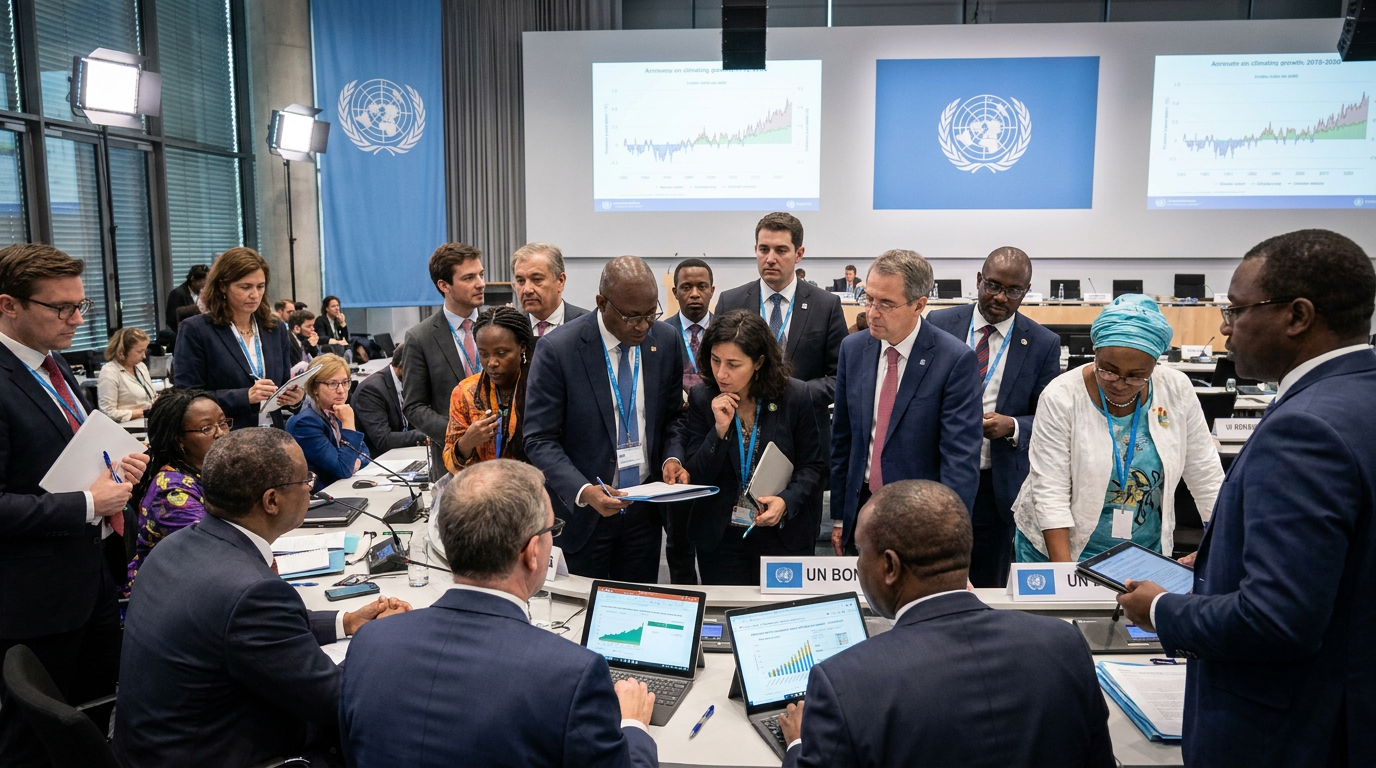
This stark scientific reality serves as the immediate and sobering backdrop for the ongoing United Nations Climate Change Conference in Bonn, Germany, known as SB64. Negotiators, diplomats, and civil society representatives from around the world are currently gathered at the World Conference Center to lay the technical and political groundwork for the COP31 summit, scheduled for November 2026 in Antalya, Türkiye. The Bonn conference is widely viewed as a critical bridge between the commitments made at previous summits and the urgent need for concrete implementation. With the 1.5°C carbon budget evaporating, the pressure on these mid-year negotiations has never been higher, as countries are forced to confront the massive gap between their stated climate ambitions and their actual emission trajectories.[3][5]
This stark scientific reality serves as the immediate and sobering backdrop for the ongoing United Nations Climate Change Conference in Bonn, Germany, known as SB64.
At the absolute center of the Bonn negotiations is a desperate push to finalize a comprehensive global climate finance roadmap. UN Climate Change Executive Secretary Simon Stiell has urgently called for unprecedented political support to mobilize $1.3 trillion annually by 2035. Addressing delegates at a joint presidency event, Stiell warned that finance remains the critical bottleneck in turning national climate commitments into tangible action. "This is an era of implementation in climate action. And finance will drive it forward," Stiell declared. The proposed $1.3 trillion target is intended to help developing nations transition to renewable energy, adapt to inevitable climate impacts, and cover the mounting costs of loss and damage caused by extreme weather events.[6]

However, the negotiations in Bonn are already exposing deep geopolitical rifts over how this massive financial transition will be structured and governed. A major flashpoint has emerged over a proposed roadmap to halt and reverse deforestation and forest degradation by 2030. Rainforest nations, including heavily forested countries like Guyana and Suriname, are demanding predictable, sovereign-level payments for keeping their forests standing. They argue that the current global economy perversely rewards agricultural expansion and resource extraction, while countries that have historically protected their ecosystems receive comparatively little capital. During a dedicated session on the deforestation roadmap, these nations insisted that the international community must fundamentally restructure its financial mechanisms to directly compensate conservation efforts.[4]
Developed nations, conversely, are pushing back against unconditional sovereign payments, advocating instead for stricter regulations, market integrity, and rigorous transparency in carbon accounting. Representatives from wealthier economies have raised significant concerns about the risk of double-counting emission reductions and the lack of universally accepted definitions for what constitutes forest degradation. They argue that any massive transfer of wealth—whether through bilateral agreements or international carbon markets—must be accompanied by verifiable metrics to ensure that the funds actually result in permanent, additional carbon sequestration. This standoff highlights the enduring tension between the urgent need for climate finance in the Global South and the demand for strict accountability from donor nations in the Global North.[4][5]
Beyond the intricate financial and technical disputes, international civil society organizations are heavily pressuring negotiators to ensure that human rights remain at the center of the global energy transition. Amnesty International released a comprehensive briefing ahead of the Bonn meetings, demanding that wealthy nations lead a "fair, fast and funded phase-out of fossil fuels." The organization specifically called out countries like Australia, urging them to stand with their Pacific neighbors and increase support for a human rights-centered transition. Advocates argue that the rush to secure critical minerals for renewable energy and the implementation of large-scale climate mitigation projects must not come at the expense of indigenous rights, local communities, or environmental justice.[7]

As the Bonn conference continues through mid-June, the dire findings of the IGCC report loom over every technical dialogue and plenary session. The revelation that the 1.5°C carbon budget will be exhausted within three years strips away the illusion that the world has decades to slowly pivot away from fossil fuels. The diplomatic maneuvering currently taking place in Germany will largely determine whether the international community can orchestrate the massive, coordinated decarbonization required to avert the most catastrophic climate scenarios. Ultimately, the success of these negotiations will be measured not by the elegance of the final texts, but by the speed and scale at which capital is deployed to reshape the global energy system before the end of the decade.[1][5][6]
How we got here
2015
The Paris Agreement is adopted, establishing the goal of limiting global warming to 1.5°C above pre-industrial levels.
2023-2025
The Indicators of Global Climate Change (IGCC) initiative begins publishing annual updates to track human influence on the climate.
November 2025
COP30 in Belém, Brazil, concludes with a roadmap to halt deforestation but leaves key financial mechanisms unresolved.
June 11, 2026
The 2025 IGCC report is published, revealing the 1.5°C carbon budget will be exhausted by 2029.
June 8-18, 2026
Negotiators meet at the UN Bonn Climate Conference (SB64) to draft the $1.3 trillion finance roadmap ahead of COP31.
Viewpoints in depth
Climate Scientists & Researchers
Emphasize that the physical limits of the Earth's climate system are being breached and demand immediate, drastic emission cuts.
The authors of the IGCC report argue that the data is unequivocal: the Earth's energy imbalance has more than doubled in recent decades, and the remaining carbon budget for 1.5°C is effectively gone. They stress that while the rate of emission growth has slowed compared to the 2000s, the absolute volume of greenhouse gases being pumped into the atmosphere guarantees continued, rapid heating. For this camp, the focus must shift from long-term target setting to immediate, year-over-year absolute reductions in fossil fuel combustion.
Rainforest Nations
Argue that the global north must pay for forest conservation if it expects developing nations to halt deforestation.
Countries with vast, intact tropical forests contend that the current international financial architecture is fundamentally flawed. They point out that capital flows readily to nations that clear forests for agriculture, while those that preserve their ecosystems receive little to no compensation. At the Bonn negotiations, these nations are demanding sovereign-level, predictable payments for conservation, arguing that they cannot be expected to sacrifice economic development to maintain the world's carbon sinks for free.
Developed Economies
Focus on market integrity, transparency, and strict accounting rules for climate finance and carbon credits.
While acknowledging the need for climate finance, developed nations are prioritizing the structural integrity of carbon markets and funding mechanisms. They express deep concerns over the potential for double-counting emission reductions and the lack of standardized definitions for forest degradation. This camp insists that any massive transfer of wealth—such as the proposed $1.3 trillion annual roadmap—must be accompanied by rigorous, verifiable metrics to ensure that the funds actually result in permanent carbon sequestration.
What we don't know
- Whether the international community will successfully agree on the $1.3 trillion annual climate finance target before COP31.
- How the UNFCCC will resolve the standoff over sovereign payments for forest conservation versus market-based carbon credits.
- Exactly how global ecosystems will respond once the 1.5°C threshold is consistently breached in the late 2020s.
Key terms
- Carbon Budget
- The maximum amount of cumulative net global anthropogenic carbon dioxide emissions that would result in limiting global warming to a given level with a specific probability.
- Earth's Energy Imbalance (EEI)
- The difference between the amount of energy from the sun arriving at the Earth and the amount returning to space, serving as a fundamental metric for the rate of global warming.
- Marine Heatwave
- A period of unusually high ocean temperatures, which can have devastating impacts on marine ecosystems, including coral bleaching and mass mortality of marine life.
- Subsidiary Bodies (SB64)
- The technical and implementation committees of the UN climate convention that meet midway between the annual COP summits to negotiate policy details.
Frequently asked
What happens when the carbon budget is exhausted?
Once the carbon budget is depleted, any additional carbon dioxide emitted into the atmosphere will push global temperatures past the 1.5°C threshold, significantly increasing the risk of severe climate impacts.
Are global emissions still rising?
Yes. While the rate of growth has slowed compared to the 2000s, global greenhouse gas emissions reached an all-time high of 56.8 billion tonnes in 2024.
What is the goal of the Bonn Climate Conference?
The Bonn conference serves as a critical preparatory meeting for the upcoming COP31 summit, with negotiators focusing on finalizing a $1.3 trillion annual climate finance roadmap and rules for halting deforestation.
Sources
Source coverage
7 outlets
4 viewpoints surfaced







[1]Copernicus Climate Change ServiceClimate Scientists
Indicators of Global Climate Change 2025: annual update of key indicators
Read on Copernicus Climate Change Service →[2]Earth System Science DataClimate Scientists
Indicators of Global Climate Change 2025: annual update of key indicators of the state of the climate system and human influence
Read on Earth System Science Data →[3]Agence EuropeDeveloped Economies
Global warming reached 1.37°C in 2025 and could hit 1.5°C by 2030, according to Indicators of Global Climate Change
Read on Agence Europe →[4]Down To EarthRainforest Nations
Bonn Climate Conference 2026: Global Rift Widens Over Paying to Halt Deforestation by 2030
Read on Down To Earth →[5]IISDDeveloped Economies
Inside Bonn Climate Change Conference 2026
Read on IISD →[6]PINAClimate Justice Advocates
UN climate chief pushes $1.3 trillion finance plan, Calls for Political Support
Read on PINA →[7]Amnesty InternationalClimate Justice Advocates
Government must use Bonn Climate Conference to advance climate commitments and protect human rights
Read on Amnesty International →
More in news politics
See all 9 stories →US-Iran Deal
U.S. and Iran Sign Agreement to End War; Vance Lashes Out at Israeli Critics
7 sources
U.S.-Iran Deal
U.S. and Iran Sign 14-Point Agreement to End War, Sparking Fierce Backlash from Israel
6 sources

U.S.-Iran Relations
Vance Rebukes Israeli Critics of U.S.-Iran Peace Agreement, Warning Against Alienating 'Only Powerful Ally'
8 sources

Cognitive Defense
The Science of 'Prebunking': How Psychological Inoculation is Defeating Misinformation
6 sources

Every angle. Every day.
Get news politics stories with full source coverage and perspective breakdowns delivered to your inbox.