
First Working Nuclear Clock Heralds a New Era in Ultra-Precise Timekeeping
Physicists have successfully demonstrated the world's first nuclear clock, a breakthrough that measures time using the nucleus of a thorium atom rather than its electrons. The technology promises unprecedented resilience to environmental noise, paving the way for GPS-independent navigation and new tests of fundamental physics.
By Factlen Editorial Team
- Quantum Metrologists
- Physicists focused on using the clock's extreme precision to test the fundamental laws of the universe.
- Aerospace & Defense Engineers
- Engineers prioritizing the clock's resilience for autonomous navigation in GPS-denied environments.
- Materials Scientists
- Researchers focused on the physical challenges of scaling the technology and sourcing materials.
What's not represented
- · Global Supply Chain Managers
- · Commercial Telecom Operators
Why this matters
Atomic clocks currently synchronize the global internet, financial markets, and GPS networks, but they are highly sensitive to environmental interference. A portable, ultra-stable nuclear clock could secure critical infrastructure against jamming and enable autonomous deep-space and submarine navigation.
Key points
- Physicists have successfully demonstrated the world's first working nuclear clock, measuring time via the nucleus rather than electrons.
- The clock relies on the rare isotope thorium-229, which can be triggered by ultraviolet lasers instead of gamma rays.
- Because the nucleus is shielded by electrons, the clock is immune to the environmental noise that disrupts traditional atomic clocks.
- Recent breakthroughs in electroplating and deep-ultraviolet crystals have proven the technology can be miniaturized for portable use.
- The extreme scarcity of thorium-229, with only about 40 grams available globally, remains the primary hurdle to mass production.
For decades, atomic clocks have served as the undisputed gold standard of precision timekeeping, quietly synchronizing the invisible infrastructure of the modern world, from global financial market transactions to the intricate network of GPS satellites orbiting Earth. Now, an international coalition of physicists has successfully demonstrated the world's first working "nuclear clock," fundamentally shifting the mechanism of time measurement from the fragile outer electron shell of an atom to the dense, tightly bound nucleus itself [1], [6]. This breakthrough represents one of the most significant leaps in quantum metrology in half a century, promising to redefine how humanity measures the passage of time and interacts with the fundamental forces of the universe.[1][6]
The core distinction between these two advanced technologies lies entirely in where the microscopic "ticking" occurs. Traditional atomic clocks measure time by tuning highly specific lasers to the exact frequencies required to make electrons jump between distinct energy levels [6]. By meticulously counting the electromagnetic oscillations of that laser light as it interacts with the electrons, scientists can divide a single second into billions of hyper-accurate fractions. This method has allowed humanity to achieve unprecedented technological synchronization, but it relies on manipulating particles that sit on the very outer edge of the atomic structure, leaving them exposed to the surrounding environment.[6]
Because electrons orbit on the extreme exterior of an atom, they are inherently exposed to the chaotic universe around them. This fundamental architectural flaw makes atomic clocks highly sensitive to stray magnetic fields, subtle temperature fluctuations, and ambient electromagnetic interference [4], [7]. To maintain their peak accuracy and prevent the electrons from being disturbed by outside forces, the world's best atomic clocks require massive, heavily shielded laboratory equipment, complex vacuum chambers, and extreme cryogenic cooling systems, making them entirely impractical for deployment outside of highly controlled scientific facilities.[4][7]
The nuclear clock concept bypasses this environmental vulnerability entirely by looking deeper into the atom. By measuring the precise energy jumps of protons and neutrons packed tightly inside the atomic nucleus, the clock's timekeeping mechanism is naturally shielded by the surrounding, dense cloud of electrons [1]. This internal isolation renders the nucleus virtually immune to the environmental noise and electromagnetic interference that routinely disrupts traditional atomic systems, offering a clear pathway to building ultra-precise clocks that can maintain perfect time while operating in rugged, unpredictable real-world conditions [7].[1][7]

For over fifty years, this elegant concept remained purely theoretical because exciting a typical atomic nucleus requires massive amounts of energy, usually delivered in the form of highly destructive gamma rays [4]. The recent breakthrough relies entirely on a singular, miraculous anomaly found in the periodic table: the isotope thorium-229. This specific isotope possesses a nuclear "isomer" state with an exceptionally low energy threshold, making it the only known nucleus in existence that can be gently triggered by a specialized, controllable ultraviolet laser rather than a violent gamma-ray burst [2], [6].[2][4][6]
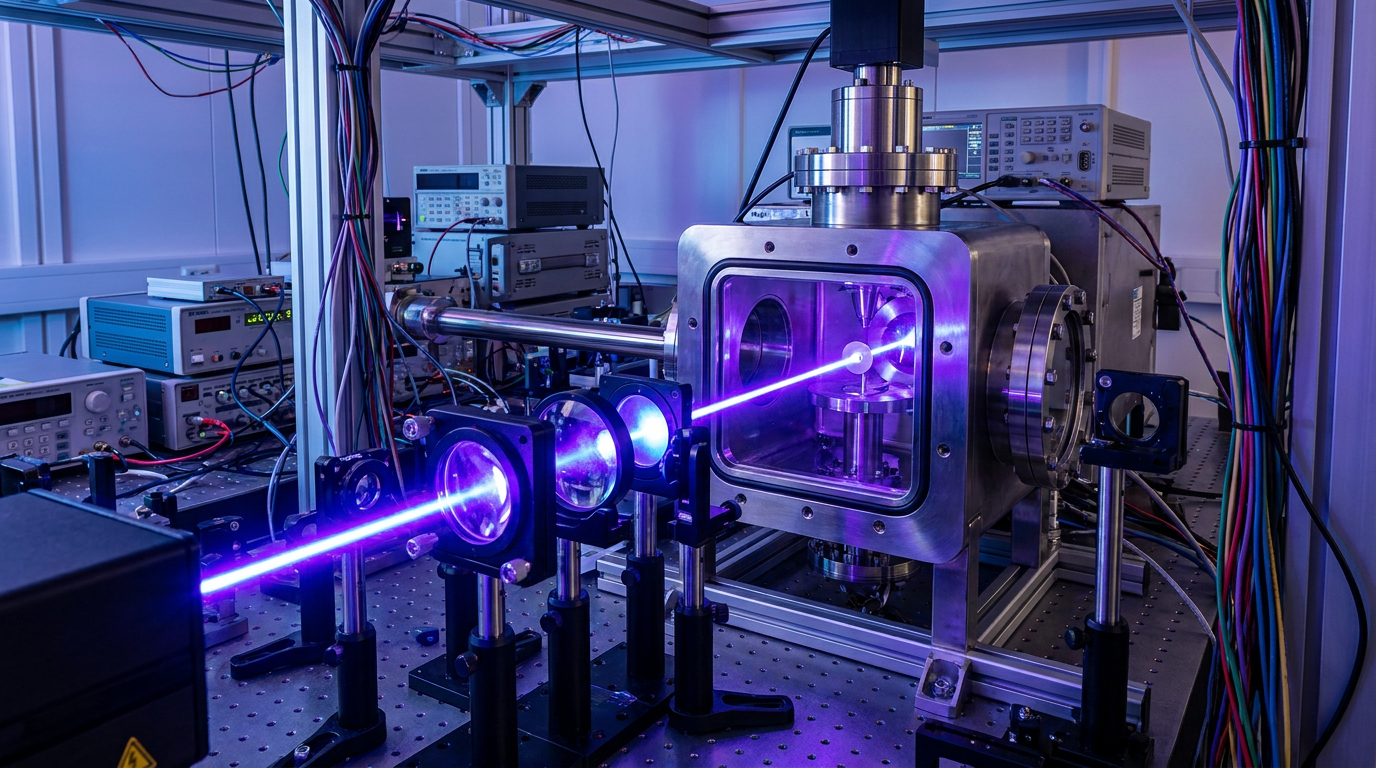
The primary claim driving the field—that a nuclear clock could be successfully built, controlled, and read—was definitively proven in late 2024. Researchers at JILA, the National Institute of Standards and Technology (NIST), and TU Wien successfully fired a custom-built vacuum-ultraviolet laser into a specialized thorium-doped crystal [6]. They precisely measured the nuclear ticks and utilized an optical frequency comb to establish a direct, million-fold improvement in precision, successfully linking the microscopic behavior of the thorium nucleus to the established rhythm of a traditional strontium atomic clock [1], [2].[1][2][6]
Following this historic proof of concept, the global engineering challenge immediately shifted toward a second major claim: that these nuclear clocks can be effectively miniaturized and manufactured at scale for actual field deployment. The initial laboratory prototypes relied on growing complex, highly transparent fluoride crystals to hold the thorium atoms, a manufacturing process that was exceptionally fragile, prohibitively expensive, and required significant amounts of highly radioactive material to function properly [3], [7].[3][7]
Evidence supporting the viability of rapid miniaturization emerged much faster than the scientific community anticipated. By late 2025 and early 2026, a team of researchers at the University of California, Los Angeles (UCLA) demonstrated a radically simpler and more elegant approach [3]. Instead of spending months growing specialized, transparent crystals, the team utilized a standard jeweler's technique to electroplate a microscopic, ultra-thin film of thorium oxide directly onto a basic stainless-steel disc, fundamentally altering the physical architecture of the clock [7].[3][7]
Evidence supporting the viability of rapid miniaturization emerged much faster than the scientific community anticipated.
This electroplating breakthrough conclusively proved that the thorium nucleus could still be reliably excited by an ultraviolet laser and its microscopic energy transitions measured directly via an electric current [3]. By completely eliminating the need for delicate, transparent crystals, the UCLA method drastically reduced the mechanical complexity of the device and cut the amount of rare thorium required to a tiny fraction of previous designs, paving the way for rugged clocks small enough to eventually fit inside portable electronics or standard server racks [7].[3][7]

Further robust evidence for the technology's scalability comes from parallel, rapid advances in the highly specialized lasers required to drive the system. Chinese researchers recently developed a new fluorinated borate crystal capable of efficiently converting standard laser light into the precise 145.2-nanometer deep-ultraviolet wavelength required to trigger the thorium nucleus [5]. This specific optical breakthrough significantly shrinks the physical footprint of the laser apparatus, removing one of the final, most stubborn bottlenecks to building compact, ultra-stable timekeeping systems for commercial use [5].[5]
The successful miniaturization of these nuclear clocks underpins a third major claim: that this technology will fundamentally revolutionize global navigation, particularly in hostile environments where traditional GPS signals simply cannot reach. Because they do not need constant recalibration to account for environmental interference or temperature shifts, portable nuclear clocks are uniquely suited for extreme isolation, allowing vehicles to maintain perfect internal synchronization without relying on external satellite pings [4], [7].[4][7]
Aerospace and defense engineers project that a military submarine equipped with a compact thorium clock could navigate deep underwater for months at a time without ever needing to surface to receive a vulnerable satellite fix [5]. Similarly, next-generation deep-space probes could utilize onboard nuclear timekeepers to autonomously calculate their complex trajectories across the solar system, entirely eliminating the need to wait for delayed, speed-of-light signal corrections from Earth-based mission control centers [7].[5][7]
Beyond its immediate, highly lucrative navigational utility, the realization of the working nuclear clock provides theoretical physicists with an unprecedented, ultra-sensitive tool to test the fundamental laws of nature. The strong nuclear force that binds protons and neutrons together inside the nucleus operates on entirely different quantum principles than the electromagnetic force that governs the behavior of electrons in traditional atomic clocks [1], [4].[1][4]
Because the nuclear clock is deeply anchored to this strong nuclear force, it is exponentially more sensitive to theoretical, microscopic shifts in the universe's fundamental constants [4]. Researchers are already preparing to use the thorium-229 transition to actively search for ultralight dark matter—a hypothetical, invisible substance that could explain vast cosmic mysteries—by carefully observing whether the clock's ticking rate subtly changes as the Earth moves through different, invisible regions of space [4], [6].[4][6]

Despite these rapid, paradigm-shifting advancements, significant uncertainties remain regarding the global scalability and commercialization of the technology. The primary constraint threatening widespread adoption is the extreme, almost unprecedented scarcity of the core material itself. Thorium-229 does not occur naturally anywhere on Earth; it is exclusively harvested as a slow decay byproduct of uranium-233, a highly regulated, weapons-grade nuclear material [7].[7]
Current scientific estimates suggest that only about 40 grams of usable thorium-229 exist in the entire world, tightly controlled by a handful of government agencies [7]. While the new electroplating techniques drastically reduce the volume of material needed for a single device, scaling the technology from laboratory prototypes to ubiquitous global infrastructure will require the international scientific community to establish entirely new, highly secure, and incredibly expensive supply chains for this exceptionally rare isotope [3], [7].[3][7]
How we got here
2003
Theoretical physicists first propose the concept of a nuclear clock based on the unique properties of the Thorium-229 isotope.
September 2024
Researchers at JILA and TU Wien successfully demonstrate the first nuclear clock prototype by firing a UV laser into a thorium-doped crystal.
December 2025
UCLA scientists dramatically simplify the design by electroplating thorium onto steel, proving the clock can be miniaturized without fragile crystals.
Early 2026
Chinese researchers develop a new deep-ultraviolet crystal capable of generating the exact laser wavelength needed, removing a major bottleneck for portable devices.
Viewpoints in depth
Quantum Metrologists
Physicists focused on using the clock's extreme precision to test the fundamental laws of the universe.
For theoretical physicists and quantum metrologists, the nuclear clock is less about keeping time and more about building an ultra-sensitive probe for new physics. Because the clock relies on the strong nuclear force rather than electromagnetism, it offers a completely new lens through which to observe the universe. Researchers argue that by comparing a nuclear clock's ticking rate against a traditional atomic clock over time, they can detect microscopic variations in the fundamental constants of nature, potentially proving the existence of ultralight dark matter or revealing flaws in the Standard Model of particle physics.
Aerospace & Defense Engineers
Engineers prioritizing the clock's resilience for autonomous navigation in GPS-denied environments.
The aerospace and defense sectors view the nuclear clock as the ultimate solution to the fragility of global GPS networks. Current atomic clocks are too sensitive to environmental noise to be deployed in rugged vehicles without massive shielding. Engineers emphasize that a compact, environmentally immune thorium clock would allow submarines to remain submerged indefinitely without losing their exact coordinates, and enable deep-space probes to navigate the solar system autonomously. For this camp, the priority is ruggedization, miniaturization, and securing a reliable supply chain for the rare thorium isotope.
Materials Scientists
Researchers focused on the physical challenges of scaling the technology and sourcing materials.
Materials scientists are primarily concerned with the immense physical and logistical hurdles standing between laboratory prototypes and mass production. While the physics of the clock are proven, this camp highlights that the global supply of thorium-229 is limited to roughly 40 grams, all derived from weapons-grade uranium. Furthermore, they emphasize the ongoing difficulty of engineering the specialized deep-ultraviolet lasers and optical crystals required to trigger the nucleus. For these researchers, the true breakthrough will not be in the physics, but in developing scalable manufacturing techniques like electroplating that reduce the reliance on scarce materials.
What we don't know
- Whether the nuclear clock will practically surpass the 10^-18 stability of the best optical lattice atomic clocks in real-world conditions.
- How the global scientific community will establish a reliable supply chain for Thorium-229, given its extreme scarcity.
- Whether the clock's unprecedented precision will actually detect variations in the universe's fundamental constants or dark matter.
Key terms
- Nuclear Isomer
- A state of an atomic nucleus where its protons and neutrons are arranged in a way that stores extra energy, which can be released or measured.
- Vacuum Ultraviolet (VUV)
- A specific, highly energetic band of ultraviolet light that is strongly absorbed by air, requiring experiments to be conducted in a vacuum chamber.
- Optical Frequency Comb
- A specialized laser tool that acts like a highly precise ruler for light, allowing scientists to count the exact number of electromagnetic wave cycles to measure time.
- Electroplating
- A process that uses an electric current to coat a conductive surface with a microscopic layer of another material, used here to deposit thorium onto steel.
Frequently asked
What is the difference between an atomic clock and a nuclear clock?
Atomic clocks measure time by tracking electrons jumping between energy levels on the outside of an atom. Nuclear clocks measure energy jumps inside the atom's nucleus, which is naturally shielded from environmental interference.
Why is Thorium-229 the only element used for this?
Exciting a typical atomic nucleus requires massive amounts of energy, usually gamma rays. Thorium-229 is the only known isotope with an energy state low enough to be triggered by a controllable ultraviolet laser.
Will this replace the atomic clocks used for GPS?
Eventually, yes. Because nuclear clocks are immune to magnetic fields and temperature changes, they can be miniaturized for portable use in submarines, spacecraft, and secure communications networks where GPS is unavailable.
Why is Thorium-229 so difficult to obtain?
It does not occur naturally. It is a byproduct of the radioactive decay of uranium-233, a weapons-grade material, meaning the global supply is strictly limited to roughly 40 grams.
Sources
Source coverage
7 outlets
3 viewpoints surfaced







[1]New ScientistQuantum Metrologists
First working nuclear clock heralds a new era in timekeeping
Read on New Scientist →[2]NatureQuantum Metrologists
Frequency ratio of the 229mTh nuclear isomeric transition and the 87Sr atomic clock
Read on Nature →[3]ScienceDailyMaterials Scientists
An old jeweler's trick could change nuclear timekeeping
Read on ScienceDaily →[4]GizmodoQuantum Metrologists
The Clock of Physicists' Wildest Dreams May Finally Help Advance Science
Read on Gizmodo →[5]TechRadarAerospace & Defense Engineers
New Chinese crystal breakthrough could make the world's GPS obsolete overnight
Read on TechRadar →[6]NISTQuantum Metrologists
Major Leap for Nuclear Clock Paves Way for Ultraprecise Timekeeping
Read on NIST →[7]UCLAMaterials Scientists
Thorium-based nuclear clocks could unlock satellite-free navigation
Read on UCLA →

Every angle. Every day.
Get science stories with full source coverage and perspective breakdowns delivered to your inbox.