
First Working Nuclear Clock Heralds a New Era in Ultra-Precise Timekeeping
Physicists have successfully demonstrated the first working nuclear clock, utilizing the nucleus of thorium-229 atoms to achieve unprecedented timekeeping stability. The breakthrough paves the way for GPS-free navigation, portable quantum sensors, and new tests of fundamental physics.
By Factlen Editorial Team
- Quantum Metrologists
- Focused on achieving unprecedented fractional frequency uncertainty to test fundamental physics and redefine the second.
- Aerospace & Defense Engineers
- Value the clock's immunity to electromagnetic interference and its potential for autonomous, GPS-free navigation.
- Materials Scientists
- Prioritize the scalable manufacturing, crystal doping, and thin-film deposition techniques required to commercialize the technology.
What's not represented
- · Consumer Electronics Manufacturers
- · Regulatory Bodies for Radioactive Materials
Why this matters
Timekeeping is the invisible infrastructure of the modern world, underpinning everything from GPS navigation to internet synchronization and financial transactions. A portable clock that is immune to environmental interference could allow deep-space probes to self-navigate and submarines to operate for months without surfacing for satellite signals.
Key points
- Researchers have demonstrated the first working nuclear clock, using the nucleus of thorium-229 atoms.
- Nuclear clocks are vastly more stable than atomic clocks because the nucleus is shielded from environmental interference.
- The breakthrough was enabled by embedding thorium in calcium fluoride crystals and developing specialized vacuum ultraviolet lasers.
- New thin-film manufacturing techniques have reduced the required radioactive material by a factor of 1,000.
- The technology paves the way for autonomous deep-space navigation and new tests of fundamental physics.
For more than half a century, the world's most accurate timekeepers have relied on the predictable dance of electrons. But a new era in precision metrology has officially begun. Researchers have demonstrated the first working nuclear clock, a device that measures time using the energy transitions within the core of an atom rather than its outer shell. This milestone realizes a long-held ambition in physics, promising a timekeeping platform that is vastly more robust and potentially more accurate than today's best atomic clocks.[1][5]
To understand the magnitude of this shift, one must look at how modern timekeeping works. Traditional atomic clocks, like the strontium optical lattice clocks that currently define global time standards, operate by tuning lasers to the exact frequency required to make an electron jump between energy levels. The precise number of laser wave cycles required to trigger this jump serves as the clock's highly predictable "tick."[7]
However, electrons are exposed on the outer edge of an atom. This makes them highly sensitive to their environment. Stray electromagnetic fields, slight temperature fluctuations, and even the lasers used to measure them can cause "Stark shifts" that alter the electron's energy state. To achieve extreme precision, atomic clocks must isolate their atoms in elaborate, room-sized vacuum chambers and complex optical lattices, making them fragile and entirely stationary.[5][6]
A nuclear clock bypasses this vulnerability entirely. Instead of exciting an electron, it excites the protons and neutrons packed tightly inside the atomic nucleus. Because the nucleus is buried deep within the atom and heavily shielded by the surrounding electron cloud, it is almost completely immune to external electromagnetic interference. In plain terms, swapping an atomic clock for a nuclear clock is like swapping a delicate violin string for a rigid steel beam—it is vastly harder to shake out of tune.[5][6][7]

The challenge, historically, has been accessing the nucleus. For almost all known elements, the energy required to force a nuclear transition is immense, requiring highly destructive X-rays or gamma rays that cannot be precisely tuned by modern lasers. The sole known exception in the universe is an isotope called thorium-229. Its nucleus features an unusually small energy gap, allowing it to be excited by lower-energy ultraviolet light.[7]
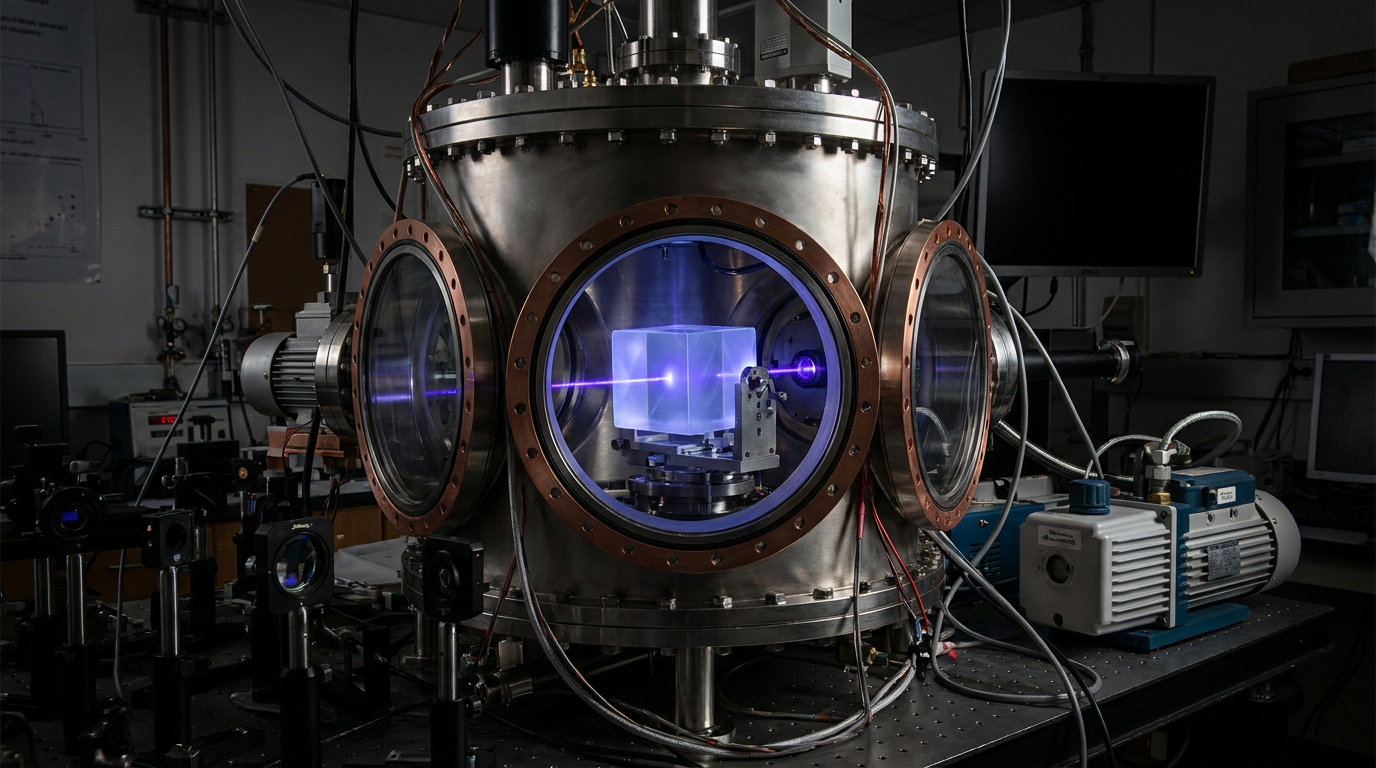
Capitalizing on this anomaly, researchers at JILA, the National Institute of Standards and Technology (NIST), and TU Wien pioneered a solid-state approach. Rather than trapping individual atoms in a vacuum, they embedded trillions of thorium-229 atoms into a transparent calcium fluoride crystal. Because the nuclear transition is so robust, the crystal environment does not disrupt the clock's ticking, allowing for a massive density of emitters in a highly compact form factor.[5][6]
The viability of this crystal clock was cemented in a landmark paper published in Nature. The research team systematically measured the frequency reproducibility of the solid-state thorium clock over seven months, proving that the crystal could maintain its extreme precision over time. They established that the clock's fractional frequency uncertainty could be suppressed to below 10^-18, matching the performance of elite room-sized atomic clocks but in a solid, portable state.[2][5]

The viability of this crystal clock was cemented in a landmark paper published in Nature.
The researchers also identified a critical thermal "sweet spot" for the device. By operating the calcium fluoride crystal at exactly 196 Kelvin (roughly -77 degrees Celsius), the first-order thermal sensitivity of the thorium nucleus vanishes completely. This discovery means that future field-deployable nuclear clocks will only require simple, standard thermal control mechanisms rather than the extreme cryogenic cooling demanded by some quantum sensors.[2]
But building the crystal was only half the battle; scientists also needed a way to reliably "tick" the clock. Thorium-229 requires a very specific wavelength of vacuum ultraviolet (VUV) light to trigger its nuclear transition. For years, the lack of a continuous-wave laser capable of operating at this exact frequency bottlenecked global research and prevented the clock from running continuously.[3]
That barrier was recently cleared by a team at Tsinghua University and the Beijing Academy of Quantum Information Sciences. Using a technique called four-wave mixing in cadmium vapor, the Chinese researchers developed a continuous-wave VUV laser operating at precisely 148.4 nanometers. This ultra-narrow linewidth laser provides the exact output power needed to support coherent nuclear interactions, overcoming what metrologists described as the final technical hurdle for a fully functional nuclear clock.[3]

As the core technology matured, engineers faced a practical hurdle: thorium-229 is both exceedingly rare and radioactive. Relying on heavily doped bulk crystals posed safety and manufacturing challenges that could limit the clock's widespread adoption outside of specialized government laboratories.[4]
To solve this, a collaboration between UCLA and JILA developed a method to replace the bulk crystals with thin films. Using physical vapor deposition, the team coated surfaces with a microscopic layer of thorium tetrafluoride. This technique achieved the same nuclear excitation while using a thousand times less radioactive material. The thin-film approach is highly compatible with existing semiconductor manufacturing, suggesting that nuclear clocks could eventually be mass-produced as microchips.[4]
The implications of a portable, ultra-stable clock extend far beyond keeping the time of day. In aerospace, spacecraft currently rely on Earth-based atomic clocks for navigation, resulting in communication delays that prevent real-time self-navigation. A compact nuclear clock would allow deep-space probes to carry their own primary time standard, maintaining their trajectories autonomously without waiting for a signal ping from Earth.[3]

Closer to home, the technology promises to revolutionize navigation in GPS-denied environments. Because nuclear clocks are immune to electromagnetic jamming and do not require satellite signals to maintain their accuracy, they could allow submarines to navigate underwater for months without surfacing, or keep critical power grids synchronized during catastrophic satellite outages.[3][4]
Finally, the sheer precision of the nuclear clock opens a new frontier in fundamental physics. By comparing the ticking of a nuclear clock to an electron-based atomic clock over time, physicists can test whether the fundamental constants of the universe—such as the strong nuclear force or the fine-structure constant—are actually changing. What began as a quest to build a better timepiece may ultimately rewrite our understanding of the laws of space and time.[2][4]
How we got here
1970s-2000s
Physicists theorize that Thorium-229 has a uniquely low nuclear energy state, but struggle to measure it precisely.
Sep 2024
Researchers at JILA and NIST measure the exact frequency of the thorium nuclear transition for the first time.
Dec 2024
UCLA and JILA scientists develop a thin-film coating method, drastically reducing the radioactive material needed.
Feb 2026
Tsinghua University researchers unveil a continuous-wave 148.4 nm laser, overcoming the final hurdle to reliably 'tick' the clock.
Jun 2026
The first fully functional solid-state nuclear clock prototypes are demonstrated, proving long-term frequency reproducibility.
Viewpoints in depth
Quantum Metrologists' View
Pushing the boundaries of measurement to test the laws of the universe.
For physicists focused on fundamental metrology, the nuclear clock is less about practical navigation and more about probing the fabric of reality. By comparing the 'ticks' of a thorium-229 nuclear clock with a traditional strontium atomic clock, researchers can isolate the behavior of the strong nuclear force from electromagnetic forces. If the ratio between these two clocks drifts even slightly over years of observation, it would provide the first concrete evidence that the fundamental constants of the universe are not actually constant, potentially opening the door to new physics beyond the Standard Model.
Aerospace & Defense Engineers' View
Seeking robust, field-deployable timekeeping for extreme environments.
Engineers tasked with securing critical infrastructure and navigating deep space view the nuclear clock as a solution to the fragility of GPS. Current atomic clocks are too delicate and bulky to deploy in high-vibration, high-radiation environments. Because the thorium nucleus is shielded by its electron cloud, a solid-state nuclear clock could survive the launch forces of a rocket or the electromagnetic noise of a submarine engine room without losing its tick. This camp is heavily focused on miniaturizing the required vacuum ultraviolet lasers to fit the entire clock assembly into a portable, ruggedized chassis.
Materials Scientists' View
Solving the supply chain and safety bottlenecks of radioactive isotopes.
While physicists celebrate the theoretical precision, materials scientists are focused on the practical reality of building these devices at scale. Thorium-229 is a rare, radioactive isotope, and growing the heavily doped calcium fluoride crystals required for the first prototypes is a slow, expensive process. This camp champions the recent shift toward physical vapor deposition and thin-film coatings, arguing that reducing the radioactive payload by a factor of 1,000 is the only viable path to commercializing nuclear clocks and integrating them into standard semiconductor manufacturing pipelines.
What we don't know
- How quickly the specialized vacuum ultraviolet lasers can be miniaturized for field deployment outside of laboratory environments.
- Whether thin-film thorium coatings will exhibit the same decades-long stability as bulk calcium fluoride crystals.
- If the unprecedented precision will reveal actual fluctuations in the universe's fundamental constants, as some theoretical physicists suspect.
Key terms
- Nuclear Clock
- A timekeeping device that measures the 'ticks' of energy transitions within an atom's nucleus, rather than its electron shell.
- Thorium-229
- A rare radioactive isotope with an unusually low nuclear energy jump, making it the only known element suitable for a laser-driven nuclear clock.
- Vacuum Ultraviolet (VUV) Laser
- A specialized laser operating at extremely short wavelengths, required to trigger the specific nuclear transition in thorium.
- Fractional Uncertainty
- A measure of a clock's precision, indicating the fraction of a second it might gain or lose over a specific period.
Frequently asked
Why is a nuclear clock better than an atomic clock?
Atomic clocks rely on electrons, which are easily disturbed by electromagnetic fields and temperature changes. A nuclear clock uses the atom's core, which is heavily shielded and much more stable in extreme environments.
Will nuclear clocks replace the clock in my phone?
Not directly. They will likely be used in GPS satellites, power grids, and deep-space probes, which in turn keep consumer devices synchronized.
Is the radioactive thorium dangerous?
Recent breakthroughs using thin films have reduced the required amount of thorium by a factor of 1,000, making the devices significantly safer and easier to manufacture than early crystal prototypes.
Sources
Source coverage
7 outlets
3 viewpoints surfaced







[1]New ScientistQuantum Metrologists
First working nuclear clock heralds a new era in timekeeping
Read on New Scientist →[2]NatureQuantum Metrologists
Frequency reproducibility of solid-state thorium-229 nuclear clocks
Read on Nature →[3]CGTNAerospace & Defense Engineers
China achieves 148 nm laser breakthrough, clearing key hurdle for nuclear clock
Read on CGTN →[4]ScienceDailyMaterials Scientists
An old jeweler's trick could change nuclear timekeeping
Read on ScienceDaily →[5]Menlo SystemsQuantum Metrologists
Advancing Solid-State Thorium-229 Nuclear Clocks: Frequency Reproducibility in 229Th:CaF2
Read on Menlo Systems →[6]Tech ExploristMaterials Scientists
A big step toward ultra-precise nuclear clocks
Read on Tech Explorist →[7]The DebriefAerospace & Defense Engineers
Scientists Demonstrate Key Technologies Behind Holy Grail of Timekeeping: The World's First Nuclear Clock
Read on The Debrief →

Every angle. Every day.
Get science stories with full source coverage and perspective breakdowns delivered to your inbox.