
Federal Loan Overhaul Takes Effect: Graduate PLUS Loans Eliminated, Imposing Hard Borrowing Caps
A sweeping federal overhaul has officially eliminated the Grad PLUS loan program for new borrowers, replacing unlimited borrowing with strict annual and lifetime caps for graduate and professional students.
By Nabil Faris


- Higher Education Administrators
- Focused on compliance, managing the grandfathering transition, and helping incoming students bridge sudden funding gaps.
- Professional Students & Advocates
- Deeply concerned that hard caps and reliance on private loans will lock low-income students out of medical and legal careers.
- Financial Analysts & Lenders
- Focus on the mechanics of the new repayment plans and the shift toward private credit markets.
Why this matters
For decades, graduate students and parents could borrow up to the full cost of college directly from the federal government. The sudden imposition of hard borrowing caps means millions of future students must now rely on private loans, institutional grants, or out-of-pocket cash to fund their education, fundamentally altering who can afford advanced degrees.
Key points
- The Grad PLUS loan program has been eliminated for all new borrowers effective July 1, 2026.
- Graduate students are now capped at $20,500 annually, while professional students can borrow up to $50,000.
- A new absolute lifetime federal borrowing limit of $257,500 has been established across all Title IV loans.
- Existing borrowers are grandfathered under legacy rules for up to three academic years.
- The new Repayment Assistance Plan (RAP) replaces older income-driven options, stretching forgiveness to 30 years.
On July 1, 2026, the federal student loan system underwent its most significant transformation in a generation. Following the passage of sweeping federal legislation last year, the Department of Education has officially implemented a massive overhaul of how higher education is financed in the United States.[1][2]
The cornerstone of the new policy is the outright elimination of the Graduate PLUS loan program for new borrowers. For years, Grad PLUS loans served as a financial safety valve, allowing graduate and professional students to borrow up to the full cost of attendance—including living expenses—minus any other financial aid received.[2][5]
In its place, the federal government has instituted strict, hard borrowing caps. Graduate students pursuing degrees such as an MBA, Master of Social Work, or Master of Public Health are now limited to $20,500 per year in Direct Unsubsidized Loans, with a lifetime aggregate cap of $100,000.[2]
Students enrolled in designated "professional" programs—specifically doctorate-level tracks requiring licensure, such as medicine (M.D./D.O.), dentistry, and law (J.D.)—are placed in a higher tier. These professional students can borrow up to $50,000 annually, capped at a $200,000 aggregate limit. However, programs like physician assistant (PA) studies and nursing (MSN/DNP) are currently excluded from this professional tier, restricting them to the lower $20,500 limit.[2][4]
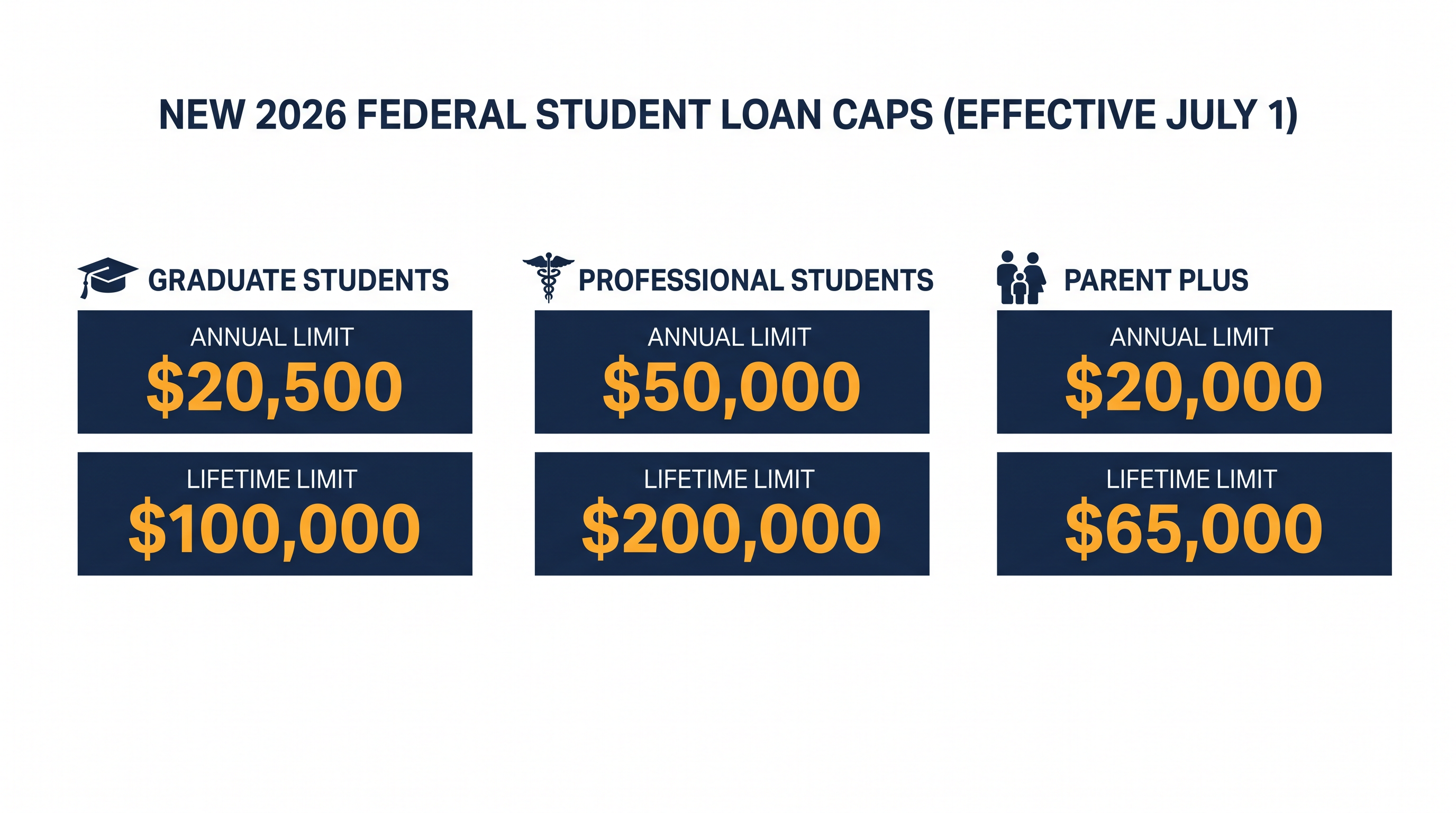
The legislation also imposes a new absolute ceiling on federal borrowing. Across all Title IV federal student loans, borrowers now face a strict $257,500 lifetime maximum. Because this cap includes undergraduate debt, students who relied heavily on federal loans for their bachelor's degrees will find their graduate borrowing capacity significantly reduced.[2]
Parents of undergraduate students are also facing a new reality. The Parent PLUS loan program, which previously allowed unlimited borrowing up to the cost of attendance, is now capped at $20,000 annually and $65,000 in total lifetime borrowing per child.
For students already in the educational pipeline, the Department of Education has implemented a "grandfathering" clause. Anyone who received a Grad PLUS or Parent PLUS loan disbursement prior to July 1, 2026, is protected under the legacy rules.[4]
For students already in the educational pipeline, the Department of Education has implemented a "grandfathering" clause.
This legacy protection allows existing borrowers to continue accessing funds up to the full cost of attendance for a maximum of three academic years, or until they complete their degree, whichever comes first. However, students lose this protection immediately if they transfer to a different institution, change their program of study, or withdraw.
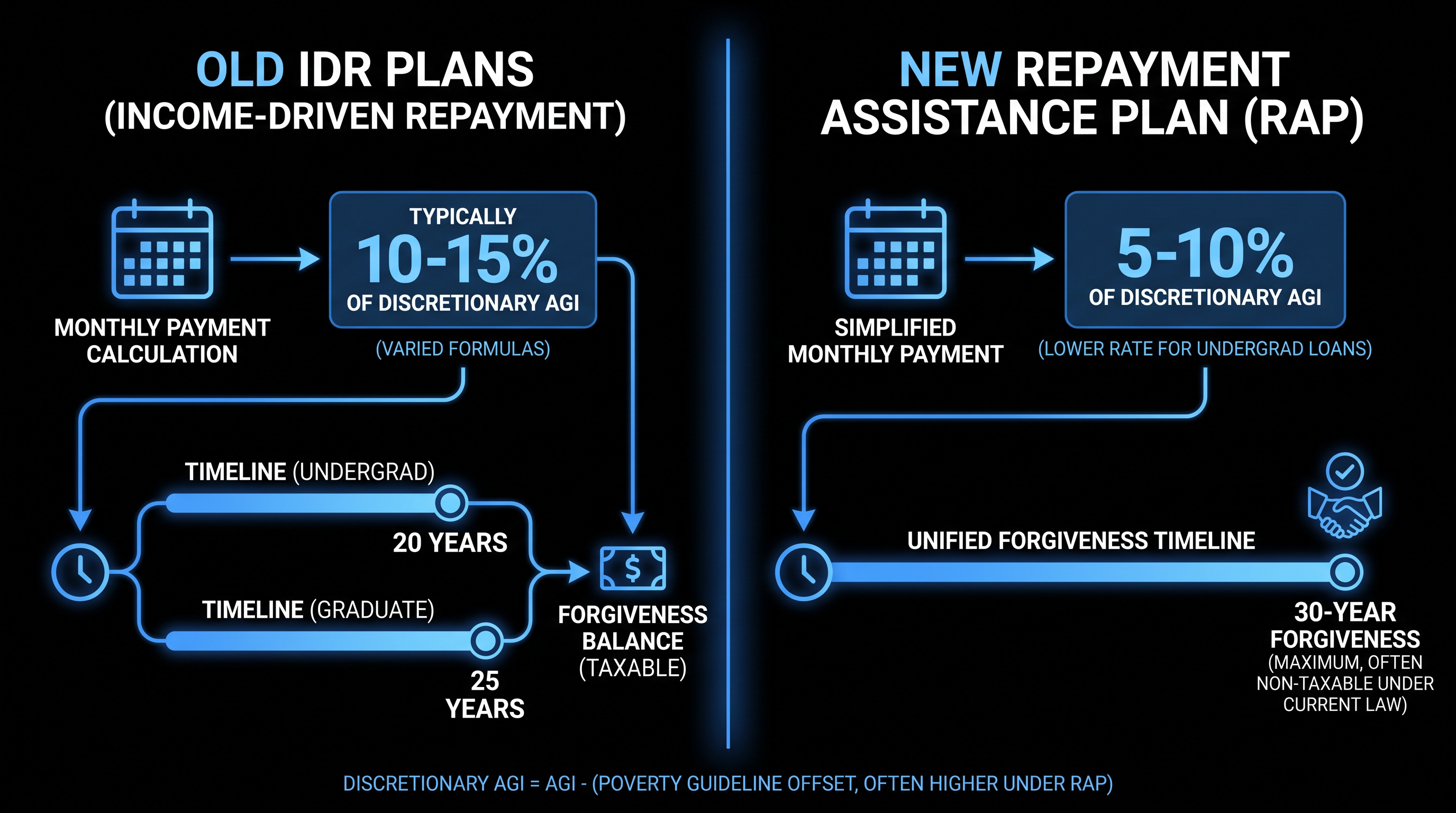
Beyond borrowing limits, the overhaul fundamentally rewrites how students pay back their debt. The complex menu of existing income-driven repayment (IDR) options—including PAYE and ICR—is being phased out for new borrowers.[1]
In their place, the government has introduced the Repayment Assistance Plan (RAP). Under RAP, monthly payments are capped between 1% and 10% of a borrower's adjusted gross income, but the timeline for loan forgiveness has been stretched to 30 years.[1][4]
Furthermore, the financial math of forgiveness has changed. As of January 1, 2026, the temporary tax exemption for forgiven student loans established by the American Rescue Plan Act expired. This means that any balance forgiven at the end of the 30-year RAP timeline will once again be treated as taxable income by the IRS.[1]
The rationale behind the sweeping legislation rests on cost containment. Proponents argue that the previous system of unlimited federal lending gave universities a blank check, allowing them to artificially inflate tuition year after year without consequence. By capping federal dollars, lawmakers aim to force institutions to lower prices and compete on value.
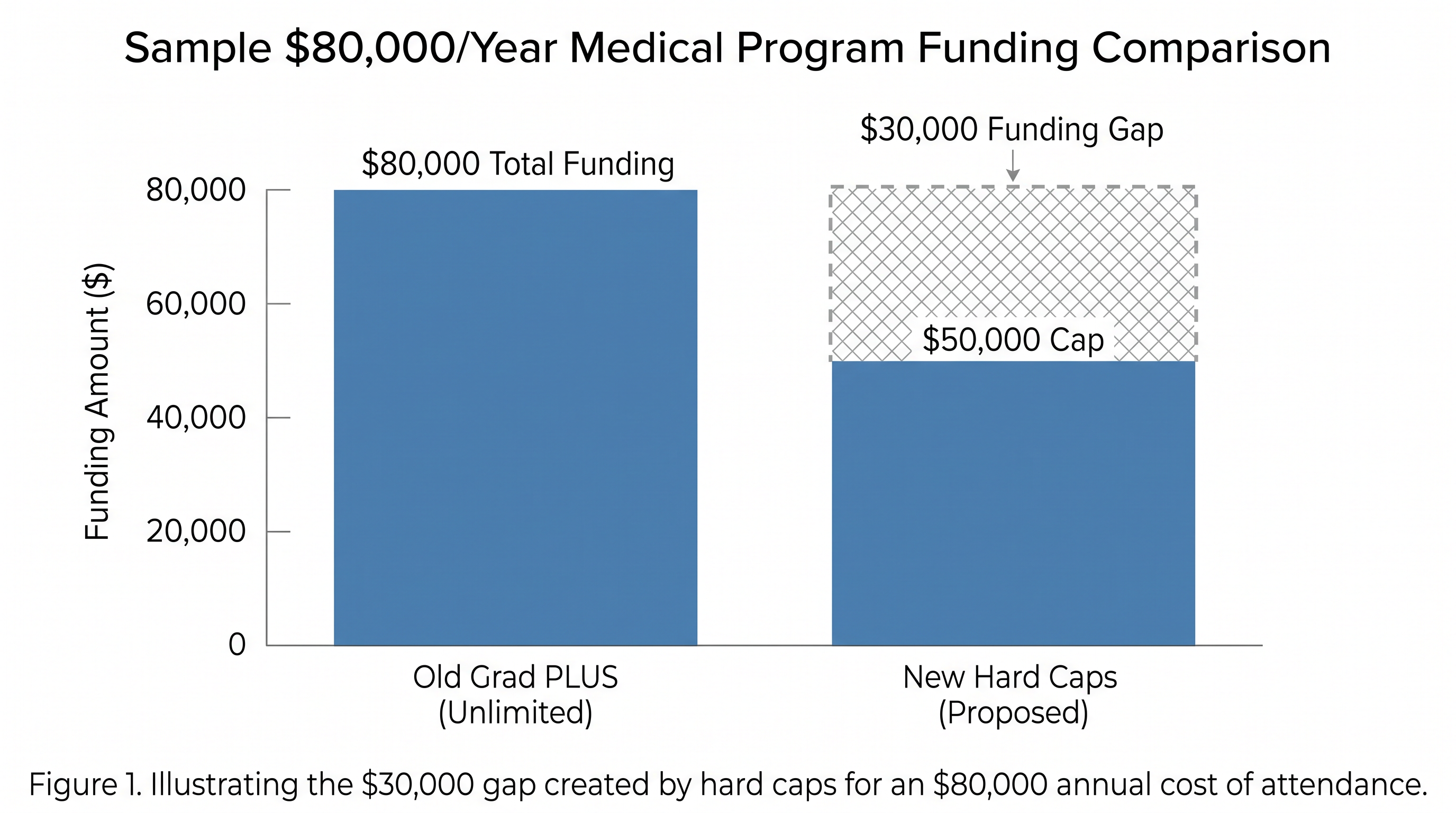
In the immediate term, however, the caps have created a frantic scramble. A medical student facing $80,000 in annual tuition and living expenses now has a $30,000 funding gap after maxing out their $50,000 federal limit.[3]
To bridge these gaps, financial aid offices are directing students toward the private loan market. Unlike federal loans, private educational loans typically require a credit check, a low debt-to-income ratio, and often a creditworthy co-signer.[3]
This shift has sparked intense concern among equity advocates and medical associations. Organizations like the Latino Medical Student Association warn that relying on private credit markets will disproportionately lock low-income and first-generation students out of advanced degrees, as they are less likely to have family members who can co-sign massive private loans.[3]
Universities are now under immense pressure to adapt. To maintain enrollment in expensive graduate programs, institutions will likely need to significantly increase their internal grant aid, freeze tuition, or restructure their programs to lower the overall cost of attendance.
As the first cohort of students enrolls under the 2026 rules, the higher education sector faces a profound stress test. The coming years will reveal whether the hard caps successfully force tuition prices down, or simply shift the debt burden from the federal government to private banks and students' families.
How we got here
July 2025
Congress passes sweeping higher education reform legislation, setting the stage for the loan overhaul.
December 2025
The Department of Education finalizes the rules and updates its systems to prepare for the transition.
January 2026
The temporary tax exemption for forgiven student loans expires, making future loan forgiveness taxable income.
July 1, 2026
The new borrowing caps take effect, and the Grad PLUS loan program is officially eliminated for new borrowers.
Viewpoints in depth
Professional Students & Equity Advocates
Warn that the caps will disproportionately harm low-income students who cannot access private credit.
Medical and legal student advocacy groups point out that $50,000 a year does not cover the cost of most professional programs. They argue that pushing the remaining balance into the private loan market creates a massive barrier to entry. Because private lenders require strong credit histories and low debt-to-income ratios, low-income and first-generation students will be forced to find wealthy co-signers or abandon their career aspirations entirely, potentially reversing decades of diversity initiatives in medicine and law.
Higher Education Administrators
Focused on the immediate logistical crisis of bridging the funding gap for incoming cohorts.
Financial aid offices are caught in the middle of the transition. Their immediate priority is managing the complex 'grandfathering' rules for existing students while completely overhauling financial aid packages for the incoming class of 2026. Administrators warn that unless universities can rapidly scale up institutional grants and scholarships, enrollment in expensive master's programs could plummet as students balk at the prospect of high-interest private loans.
Financial Analysts & Lenders
Focus on the mechanics of the new repayment plans and the shift toward private credit markets.
Market analysts and credit unions are closely tracking the massive influx of students who will now need private financing to cover their educational gaps. Financial institutions emphasize that while the federal government is stepping back, private lenders are prepared to meet the demand—provided borrowers have strong credit profiles. Analysts also highlight the long-term financial implications of the new Repayment Assistance Plan (RAP), noting that the 30-year forgiveness timeline and the return of the 'tax bomb' will significantly alter lifetime wealth accumulation for heavy borrowers.
What we don't know
- How universities will adjust their tuition pricing in response to the new federal borrowing caps.
- Whether the private loan market will loosen credit requirements to accommodate the influx of graduate students.
- The exact criteria the Department of Education will use to classify borderline degree programs into the 'professional' tier.
Key terms
- Grad PLUS Loan
- A discontinued federal loan program that previously allowed graduate and professional students to borrow up to the full cost of attendance minus other financial aid.
- Professional Student
- Under the new rules, a student enrolled in a doctorate-level program requiring six or more years of postsecondary coursework and professional licensure, such as an M.D. or J.D.
- Repayment Assistance Plan (RAP)
- The new federal income-driven repayment plan that replaces older models, capping payments at 1% to 10% of adjusted gross income with a 30-year forgiveness timeline.
- Grandfathering Clause
- A legacy protection allowing students who borrowed under the old rules before July 1, 2026, to maintain their previous borrowing limits for up to three years.
Frequently asked
Can I still get a Grad PLUS loan if I start school in Fall 2026?
No. The Grad PLUS program was eliminated for all new borrowers effective July 1, 2026. You will be subject to the new hard caps.
I took out a Grad PLUS loan in 2025. Am I affected?
Existing borrowers are grandfathered in. You can continue borrowing under the old limits for up to three academic years, provided you stay continuously enrolled in the same program.
Does my undergraduate debt count toward the new graduate limits?
Yes. The new rules establish a strict $257,500 lifetime borrowing cap across all Title IV federal student loans, meaning heavy undergraduate borrowing reduces your graduate capacity.
What happens if my tuition exceeds the new federal loan caps?
Students must cover the remaining balance through institutional grants, scholarships, out-of-pocket payments, or private student loans, which typically require a credit check or co-signer.
Sources
Source coverage
5 outlets
3 viewpoints surfaced




[1]TheStreetFinancial Analysts & Lenders
The student loan landscape is about to look completely different
Read on TheStreet →[2]Boston UniversityHigher Education Administrators
Federal Financial Aid Changes Effective July 1, 2026
Read on Boston University →[3]Latino Medical Student AssociationProfessional Students & Advocates
The Unspoken Crisis: How Policy Changes Are Quietly Reshaping Support for Med Students
Read on Latino Medical Student Association →[4]MedicalAid.orgProfessional Students & Advocates
PA School Loans and the 2026 Federal Loan Overhaul
Read on MedicalAid.org →[5]MBA MoolaProfessional Students & Advocates
What Is the 2026 Grad PLUS Loan Cap?
Read on MBA Moola →
Every angle. Every day.
Get education stories with full source coverage and perspective breakdowns delivered to your inbox.