
Evidence Pack: The Architecture of U.S. Cyber Strategy and the Shift to Persistent Engagement
A comparative analysis of the doctrinal frameworks—Defend Forward, Persistent Engagement, and Deterrence by Detection—that govern modern military operations below the threshold of armed conflict.
By Aarav Khanna

Share this story
In short
- U.S. cyber strategy shifted in 2018 from reactive defense to continuous, proactive engagement.
- Defend Forward mandates operating in adversary networks to halt threats before they reach domestic infrastructure.
- Persistent Engagement relies on imposing daily tactical friction to disrupt adversary operations.
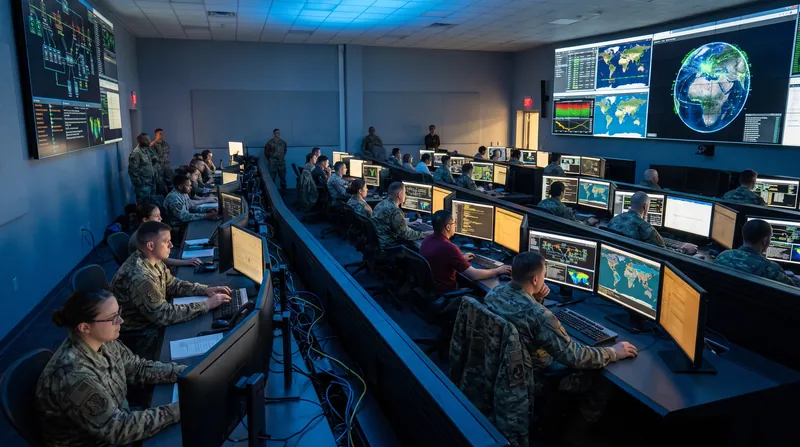
In 2018, the United States Department of Defense fundamentally altered its cyber posture, publishing a vision document that replaced a historically reactive stance with a mandate to operate continuously against adversaries. This pivot acknowledged a structural reality of the digital domain: it is not a dormant battlefield awaiting a conventional war, but an environment of constant, daily contact where state actors maneuver for strategic advantage.[1]
This shift codified two distinct but interlocking concepts that now define U.S. military cyber operations: Defend Forward and Persistent Engagement. While often used interchangeably in public discourse, they represent different nodes in the operational architecture. One dictates where forces operate, while the other dictates the tempo of those operations.[1][3]
Defend Forward is the geographic and network-topological mandate. It dictates that U.S. forces must operate outside their own networks—specifically within adversary or neutral networks—to halt malicious activity before it reaches domestic infrastructure. The evidence supporting this approach rests on the premise that waiting for an attack to hit domestic firewalls cedes the initiative entirely to the attacker.[1][2]
Persistent Engagement, conversely, is the operational tempo. It argues that because adversaries are constantly probing, mapping, and exploiting vulnerabilities below the threshold of armed conflict, the only effective defense is continuous, reciprocal friction. By imposing tactical costs on a daily basis, defenders aim to disrupt the adversary's operational rhythm.[3][6]
The mechanics of this friction are highly specific. They include exposing adversary malware to public cybersecurity vendors, disrupting command-and-control servers, or publicly attributing attacks to specific state intelligence units. The goal is to force attackers to expend their resources rebuilding infrastructure and developing new tools rather than executing their primary strategic missions.[1][6]
The evidence supporting the efficacy of Persistent Engagement is largely drawn from the absence of catastrophic cyber events since its implementation, though academic literature notes the inherent difficulty of proving a negative. Analysts point out that while low-level intrusions continue, the continuous friction model has arguably prevented these intrusions from coalescing into larger, systemic attacks.[3][6]
A third, parallel framework—Deterrence by Detection—operates on a similar logic of continuous presence but relies on pervasive Intelligence, Surveillance, and Reconnaissance (ISR) rather than active network disruption. This concept extends beyond the cyber domain, encompassing space-based sensors, maritime patrols, and signals intelligence.[4]
Deterrence by Detection posits that if an adversary knows they are being continuously observed by a network of sensors, they are less likely to initiate an aggressive act because the element of surprise is eliminated. The theoretical foundation is that transparency itself acts as a deterrent mechanism, denying the adversary the benefit of anonymity.[4][5]
However, the evidence for Deterrence by Detection is highly contested within the strategic community. Critics argue that visibility does not equal deterrence; an adversary may simply accept that they are being watched if they believe the observing party lacks the political will or the rapid-response capability to intervene effectively.[5]
The Center for Strategic and International Studies (CSIS) analysis highlights this limitation explicitly, noting that perfect attribution and detection do not automatically translate to behavioral change. Highly motivated state actors, particularly those operating in their own geographic spheres of influence, may proceed with operations regardless of whether they are detected.[5]
When analyzed as a unified system, these three frameworks reveal a fundamental shift in how military power is applied in the 21st century. They move away from the Cold War model of "deterrence by punishment"—which relies on the threat of massive retaliation—toward "deterrence by denial" and "deterrence by friction."[2][3][7]
The integration of Defend Forward and Deterrence by Detection creates a theoretical operational loop: pervasive ISR identifies the adversary's preparations, and forward-deployed cyber elements disrupt those preparations before they mature. This requires a seamless flow of intelligence from collection platforms to tactical cyber units.[1][4][7]
Yet, the empirical evidence regarding escalation risks remains thin and heavily debated. A primary concern among scholars is that operating continuously in adversary networks (Defend Forward) could be misinterpreted as preparation for a kinetic strike, inadvertently triggering the very conflict the strategy aims to prevent.[3][6]
The Taylor & Francis study on permanent engagement underscores this uncertainty, questioning whether continuous tactical friction actually alters long-term strategic behavior or merely accelerates the cycle of cyber capability development on both sides. If the latter is true, the strategy may inadvertently drive a rapid arms race in stealth and counter-detection technologies.[6]
Ultimately, the architecture of modern military cyber operations relies on the assumption that continuous, low-level engagement is safer and more effective than episodic, high-intensity retaliation. While the operational data from the past several years supports this hypothesis, the long-term stability of a perpetually contested domain remains an open question.[3][6][7]
How we did this
- Method
- Comparative doctrinal synthesis mapping the operational dependencies between proactive cyber disruption and pervasive surveillance.
- What we found
- While Defend Forward and Deterrence by Detection are doctrinally distinct, they function as a necessary unified loop: pervasive surveillance (detection) is required to provide the targeting data that makes continuous friction (persistent engagement) possible without escalating to conventional war.
- What we worked from
- Defend Forward operational mandate: Operating outside domestic networks to halt malicious activity — U.S. Cyber Command
- Deterrence by Detection critique: Visibility alone does not alter highly motivated state behavior — CSIS
- Persistent Engagement tempo: Continuous friction below the threshold of armed conflict — Taylor & Francis Online
- Limits of this analysis
- This synthesis relies on unclassified doctrinal statements and academic critiques; actual operational integration at the classified level may differ, and empirical data on the success rate of these combined operations is not publicly available.
Terms to know
- Defend Forward
- The strategy of operating outside domestic networks to disrupt threats before they reach their targets.
- Persistent Engagement
- The operational tempo of maintaining continuous, low-level friction with adversaries in cyberspace.
- Deterrence by Detection
- The concept of preventing adversary action by maintaining pervasive surveillance that eliminates the element of surprise.
- Below the threshold of armed conflict
- Hostile actions that are disruptive or damaging but do not legally constitute an act of war.
Different angles
Doctrinal Proponents
Argues that continuous friction is the only viable way to defend a domain where adversaries are perpetually active.
Proponents of the 2018 doctrinal shift argue that the cyber domain structurally favors the attacker, making passive defense a losing strategy. By operating continuously in adversary networks, defenders can identify malware development early, disrupt command-and-control infrastructure, and force adversaries to spend time and money rebuilding their own systems rather than attacking others. In this view, friction is not an escalation; it is the baseline requirement for stability in a contested environment.
Escalation Skeptics
Warns that operating inside adversary networks risks miscalculation and unintended escalation into conventional war.
Skeptics of Defend Forward point to the inherent ambiguity of cyber operations. When a state actor penetrates an adversary's critical infrastructure network, the adversary cannot immediately know if the intrusion is for espionage, tactical disruption, or preparation for a catastrophic kinetic strike. This ambiguity, scholars argue, creates a dangerous environment where a routine Persistent Engagement operation could be misinterpreted as an act of war, triggering a rapid and unintended escalation.
Deterrence Realists
Questions whether detection and friction actually change adversary strategic goals or merely force them to alter their tactics.
Analysts critical of Deterrence by Detection argue that the framework fundamentally misunderstands state motivation. While pervasive surveillance might eliminate the element of surprise, highly motivated actors—such as states seeking regional hegemony or regime survival—may simply accept the cost of being detected. Furthermore, these analysts suggest that continuous cyber friction does not deter long-term strategic campaigns; it merely forces adversaries to develop more sophisticated, stealthy tools, accelerating a digital arms race.
- Doctrinal Proponents
- Argues that continuous friction is the only viable way to defend a domain where adversaries are perpetually active.
- Escalation Skeptics
- Warns that operating inside adversary networks risks miscalculation and unintended escalation into conventional war.
- Deterrence Realists
- Questions whether detection and friction actually change adversary strategic goals or merely force them to alter their tactics.
Perspectives this story doesn't cover
- Allied nations whose networks may be utilized as neutral ground during Defend Forward operations
- Private sector infrastructure operators who bear the collateral impact of state-level cyber friction
Sources
Source coverage
7 outlets
3 viewpoints surfaced






- [1]U.S. Cyber CommandDoctrinal Proponents
CYBER 101 - Defend Forward and Persistent Engagement
Read on U.S. Cyber Command → - [2]Model DiplomatDoctrinal Proponents
Defend Forward: U.S. Cyber Strategy Explained
Read on Model Diplomat → - [3]CSS ETH ZürichEscalation Skeptics
US Cyber Strategy of Persistent Engagement and Defend Forward
Read on CSS ETH Zürich → - [4]Model DiplomatDoctrinal Proponents
deterrence by detection — Definition & Meaning
Read on Model Diplomat → - [5]CSISDeterrence Realists
Bad Idea: Deterrence by Detection
Read on CSIS → - [6]Taylor & Francis OnlineEscalation Skeptics
The implications of persistent (and permanent) engagement in cyberspace
Read on Taylor & Francis Online → - [7]Factlen Editorial TeamDeterrence Realists
Synthesis by Factlen editorial team
Read on Factlen Editorial Team →

More in Defense & Security
See all →International Humanitarian Law
Applying Military Necessity, Distinction, and Proportionality to Targeting Decisions
9 sources

Cyber Law
The Legal Architecture of Cyber Warfare: Applying Jus ad Bellum and Jus in Bello to State-Sponsored Operations
7 sources
Escalation Assessment
Evidence Pack: Assessing Reports of Russian Escalation and Tactical Nuclear Discussions
6 sources

Drone Supply Chain
Evidence Pack: The Architecture of Western Drone Reliance on Chinese Components
6 sources

Comments
Every angle. Every day.
Get Defense & Security stories with full source coverage and perspective breakdowns, free every day.