
Evidence Pack: Does Ranked-Choice Voting Actually Reduce Political Polarization?
As ranked-choice voting expands across U.S. municipalities and states, political scientists are gathering concrete data on its effects. This evidence pack examines the claims surrounding campaign civility, voter turnout, and ballot exhaustion.
By Factlen Editorial Team
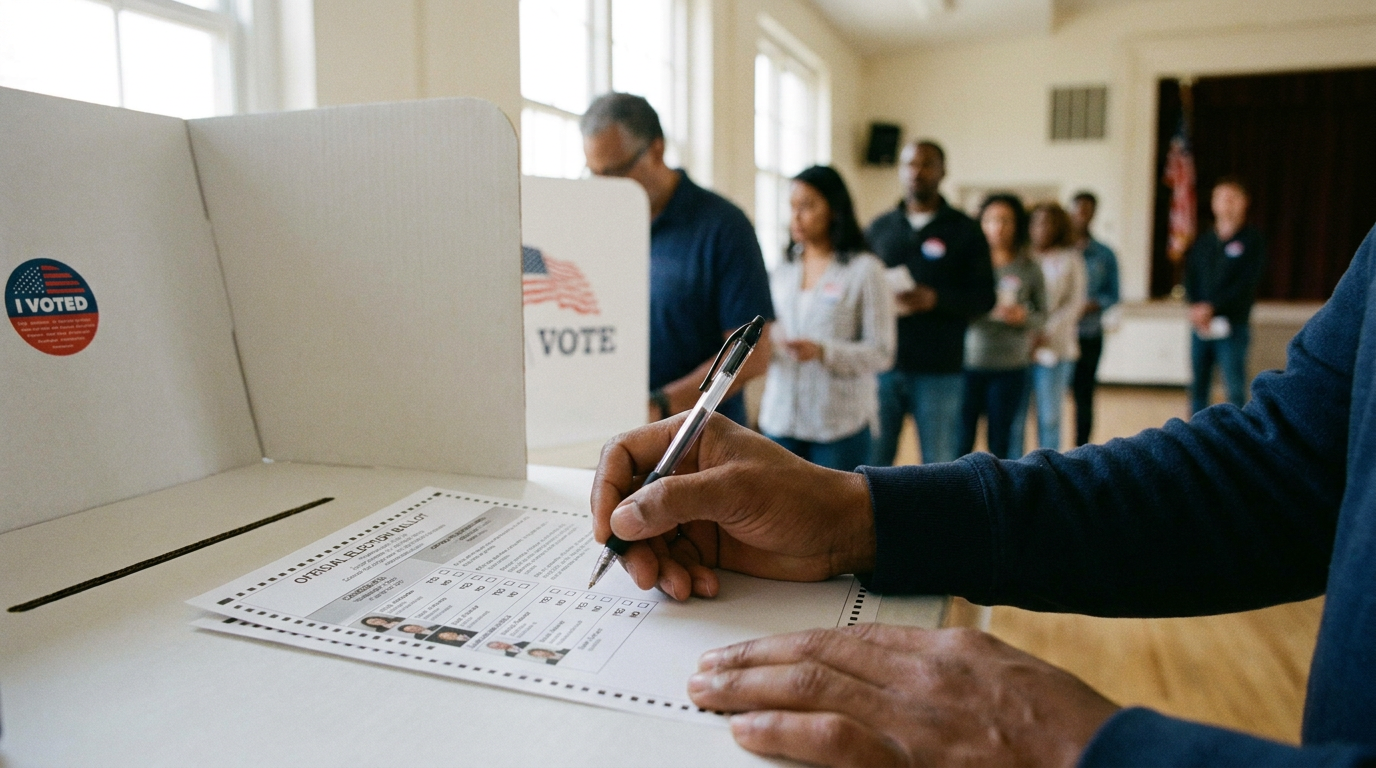
- Electoral Reform Advocates
- Argue that plurality voting forces a 'lesser of two evils' choice and point to data showing RCV eliminates the spoiler effect.
- Political Scientists & Researchers
- Focus on empirical data, noting that while RCV improves local campaign civility, it does not drastically alter voter turnout.
- Election Administrators
- Highlight the logistical hurdles of implementation, emphasizing the need for extensive voter education and upgraded tabulation software.
What's not represented
- · Voters whose ballots were exhausted in past elections
- · Third-party candidates who ran under both systems
Why this matters
As more cities and states consider adopting ranked-choice voting, understanding the hard data behind its successes and limitations helps voters separate proven benefits from political rhetoric. This structural reform is fundamentally changing how campaigns are run and how majorities are built.
Key points
- RCV reliably reduces negative campaigning in local elections, though the effect is weaker in federal races.
- Claims that RCV dramatically increases voter turnout are not strongly supported by current economic and political data.
- Voter confusion and 'exhausted ballots' are real issues in first-time implementations but drop sharply in subsequent elections.
- The system successfully eliminates the 'spoiler effect,' allowing voters to support third-party candidates without wasting their vote.
Over the past decade, ranked-choice voting (RCV) has transitioned from a niche academic proposal to a functional reality in American elections. More than 50 jurisdictions across the United States, including entire states like Maine and Alaska, now utilize the system for municipal, state, or federal races.[1]
The mechanics of the system represent a significant departure from traditional plurality voting. Instead of selecting a single candidate, voters rank their preferences—first, second, third, and so on. If no candidate secures an outright majority of first-choice votes, the candidate with the fewest votes is eliminated. The ballots of voters who chose the eliminated candidate are then redistributed to their second choices, a process that repeats until one candidate crosses the 50 percent threshold.[1]
Proponents have long argued that this mathematical shift fundamentally alters the incentives of political campaigning, promising a reduction in toxic partisanship and an increase in voter engagement. Opponents counter that the system is overly complex, leading to voter confusion and discarded ballots. With several election cycles now complete, political scientists finally have the empirical data to test these claims.[7]

Claim 1: Ranked-choice voting reduces negative campaigning and political polarization. The evidence for this claim is strong, particularly in local and municipal elections.[7]
Under traditional plurality rules, candidates are incentivized to attack their opponents to suppress their turnout. Under RCV, candidates must actively court the second- and third-choice votes of their opponents' supporters. Alienating a rival's base through vicious attack ads can mathematically doom a campaign in the later rounds of tabulation.[3][4]
Data published in the American Political Science Review demonstrates a measurable decrease in negative messaging in mayoral races utilizing RCV compared to similar cities using plurality systems. Candidates in RCV cities were significantly more likely to use positive, coalition-building language in their campaign materials and public debates.[4]
However, researchers note that this effect is weaker in high-stakes federal elections. In races for the U.S. Senate or House, national partisan polarization and the influence of outside spending groups often override the local structural incentives of the ballot, meaning attack ads still flow freely.[4][7]
Claim 2: Ranked-choice voting dramatically increases voter turnout. The evidence supporting this claim is currently weak to inconclusive.[7]
Claim 2: Ranked-choice voting dramatically increases voter turnout.
Early advocacy models suggested that by eliminating the "spoiler effect" and giving voters a wider array of viable choices, citizens who felt alienated by the two-party system would flock to the polls.[3]
Yet, comprehensive analysis by the National Bureau of Economic Research indicates that the implementation of RCV itself does not act as a primary driver of voter turnout. Turnout remains overwhelmingly dictated by the competitiveness of the race, the amount of campaign spending, and the broader political climate. While RCV does not depress turnout, it is not the silver bullet for civic disengagement that some advocates hoped for.[2]
Claim 3: The system confuses voters and leads to "exhausted ballots." The evidence here is moderate, but highly dependent on the electorate's experience level with the system.[7]
An exhausted ballot occurs when a voter only ranks one or two candidates, and those candidates are eliminated in early rounds. Because the voter provided no further preferences, their ballot cannot be transferred and does not factor into the final, deciding round of the election.[6]
Studies from the Stanford Center on Democracy found that in first-time RCV elections, ballot exhaustion rates can hover between 5 and 8 percent. In tight races, this margin is more than enough to swing an outcome, raising concerns about whether the final winner truly represents a majority of all voters who cast a ballot.[6]

However, this confusion appears to be a temporary growing pain. The Bipartisan Policy Center notes that by the second or third election cycle in a given jurisdiction, voter error and ballot exhaustion drop significantly. As public education campaigns take effect and voters adapt to the new format, the vast majority successfully utilize their multiple rankings.[5]
Claim 4: Ranked-choice voting breaks the two-party duopoly and helps third-party candidates win. The evidence for this is mixed, showing strong gains in vote share but weak results in actual victories.[7]
The system undeniably succeeds in eliminating the "spoiler effect." Voters can safely rank a third-party or independent candidate first, knowing that if that candidate fails to gain traction, their vote will seamlessly transfer to a more mainstream second choice. Consequently, third-party candidates consistently receive a higher share of first-choice votes under RCV.[1][7]
Despite this increased initial support, third-party candidates rarely survive the final tabulation in heavily partisan districts. Because the system is designed to ensure majority support for the ultimate winner, the final rounds almost always default back to a major-party candidate who possesses broader, more moderate appeal across the electorate.[1][2]

Ultimately, the accumulated data suggests that ranked-choice voting is not a cure-all for democratic dysfunction. However, it reliably achieves its primary mathematical goal: ensuring the winning candidate is acceptable to a broad majority of voters, while modestly improving the civility of local campaigns.[7]
How we got here
2004
San Francisco becomes the first major U.S. city to implement modern ranked-choice voting.
2018
Maine becomes the first state to use RCV for federal elections.
2022
Alaska implements a top-four open primary followed by an RCV general election.
2026
Over 50 jurisdictions across the United States now utilize some form of ranked-choice voting.
Viewpoints in depth
Electoral Reform Advocates
Argue that the current system is broken and that RCV is the most viable structural fix.
Reform advocates point to the mathematical realities of plurality voting, arguing it forces citizens into a 'lesser of two evils' mindset. By eliminating the spoiler effect, they argue RCV frees voters to express their true preferences without fear of inadvertently electing their least favorite candidate. They frequently cite data from municipal elections showing that candidates who build broad coalitions and avoid toxic attack ads are rewarded under the ranked-choice system.
Election Administrators
Focus on the practical realities and logistical hurdles of changing how votes are counted.
For those tasked with running elections, RCV presents significant operational challenges. Administrators emphasize that transitioning to the system requires entirely new tabulation software, redesigned ballot layouts, and massive public education campaigns. They warn that if these logistical elements are underfunded, the resulting voter confusion and delayed results can severely damage public trust in the electoral process, regardless of the system's theoretical benefits.
Traditional Party Strategists
Express skepticism about the system's ability to deliver clear mandates.
Many strategists within established political parties argue that RCV unnecessarily complicates the ballot and can obscure the true mandate of a primary base. They suggest that the system often leads to the election of a compromise candidate who is everyone's second choice but lacks passionate, driving support from any specific constituency. Furthermore, they argue that in highly polarized environments, the promised reduction in negative campaigning rarely materializes.
What we don't know
- How ranked-choice voting will perform at scale if implemented in a highly polarized presidential general election.
- Whether the reduction in negative campaigning holds true as Super PACs and outside spending groups adapt their strategies to ranked-choice systems.
Key terms
- Exhausted Ballot
- A ballot that cannot be counted in the final rounds of a ranked-choice election because all the candidates the voter ranked have been eliminated.
- Spoiler Effect
- A phenomenon where a third-party candidate draws votes away from a major candidate with similar views, inadvertently helping their mutual opponent win.
- Plurality Voting
- The traditional electoral system where the candidate with the most votes wins, even if they do not secure a majority (over 50%).
Frequently asked
Does ranked-choice voting favor one political party over another?
Research indicates RCV does not inherently favor Democrats or Republicans; rather, it favors candidates with broad appeal who can secure second-choice votes from various factions.
What happens if I only vote for one candidate?
Your vote will count for that candidate in the first round. If they are eliminated and you haven't ranked anyone else, your ballot becomes 'exhausted' and does not factor into subsequent rounds.
Does RCV delay election results?
It can. Because all ballots must be collected before the lowest-performing candidates can be mathematically eliminated, final results often take longer to tabulate than traditional elections.
Sources
Source coverage
7 outlets
3 viewpoints surfaced







[1]MIT Election Data and Science LabPolitical Scientists & Researchers
Ranked-Choice Voting: Research and Data
Read on MIT Election Data and Science Lab →[2]National Bureau of Economic ResearchPolitical Scientists & Researchers
The Effects of Ranked Choice Voting on Election Outcomes and Voter Turnout
Read on National Bureau of Economic Research →[3]FairVoteElectoral Reform Advocates
Ranked Choice Voting and Campaign Civility
Read on FairVote →[4]American Political Science ReviewPolitical Scientists & Researchers
Does Alternative Voting Reduce Polarization? Evidence from U.S. Local Elections
Read on American Political Science Review →[5]Bipartisan Policy CenterElection Administrators
Administering Ranked-Choice Voting: Challenges and Best Practices
Read on Bipartisan Policy Center →[6]Stanford Center on DemocracyPolitical Scientists & Researchers
Voter Comprehension and Ballot Exhaustion in Alternative Electoral Systems
Read on Stanford Center on Democracy →[7]Factlen Editorial Team
Synthesis by Factlen editorial team
Read on Factlen Editorial Team →
More in news politics
See all 157 stories →Cartel War
US Military Strike in Venezuela Kills Tren de Aragua Leader 'Niño Guerrero'
8 sources

Transnational Crime
U.S. Military Strike Kills Tren de Aragua Gang Leader in Venezuela
6 sources

Transnational Crime
U.S. Military Strike in Venezuela Kills Tren de Aragua Gang Leader
7 sources

Media Consolidation
DOJ Approves $111 Billion Paramount-Warner Bros. Merger, Reshaping Media Landscape
9 sources

Every angle. Every day.
Get news politics stories with full source coverage and perspective breakdowns delivered to your inbox.