
EV vs. PHEV in 2026: Which Electric Powertrain Actually Fits Your Life?
As battery ranges expand and charging networks grow, the choice between a pure electric vehicle and a plug-in hybrid comes down to daily charging access and road-trip frequency.
By Factlen Editorial Team
- Pure EV Advocates
- Believe that zero-emission vehicles are the only logical choice and view hybrids as an outdated half-measure.
- Pragmatic Hybrid Buyers
- Value the daily electric commute but demand the limitless range of a gas engine for road trips.
- Reliability Analysts
- Focus on the mechanical complexity and early-adopter growing pains of both powertrains.
What's not represented
- · Apartment dwellers who physically cannot install home chargers
- · Rural drivers living in areas completely devoid of public charging infrastructure
Why this matters
Choosing the wrong powertrain can saddle you with thousands in unnecessary fuel and maintenance costs, or leave you stranded without a charge. Understanding how your daily driving habits align with either an EV or a PHEV ensures you buy a vehicle that actually saves you money and fits your lifestyle.
Key points
- EVs run entirely on electricity, offering the lowest operating costs and zero tailpipe emissions.
- PHEVs offer 40–50 miles of electric range before a gas engine takes over for longer trips.
- EVs require significantly less maintenance due to having only a fraction of the moving parts of a gas car.
- PHEVs eliminate range anxiety but require daily plugging in to realize their fuel-saving benefits.
- Consumer data shows both EVs and PHEVs currently face more early-adoption reliability issues than traditional gas cars.
- Home charging access is the most critical factor when deciding between an EV and a PHEV.
In 2026, the automotive market has officially moved past the question of whether to go electric, arriving at a more nuanced debate: which kind of electric vehicle actually fits your life? For buyers ready to step away from traditional internal combustion engines, the decision almost always narrows down to two distinct paths: the Battery Electric Vehicle (EV) and the Plug-in Hybrid Electric Vehicle (PHEV). Both promise lower tailpipe emissions and reduced fuel costs, but they achieve these goals through fundamentally different mechanical philosophies.[4][6]
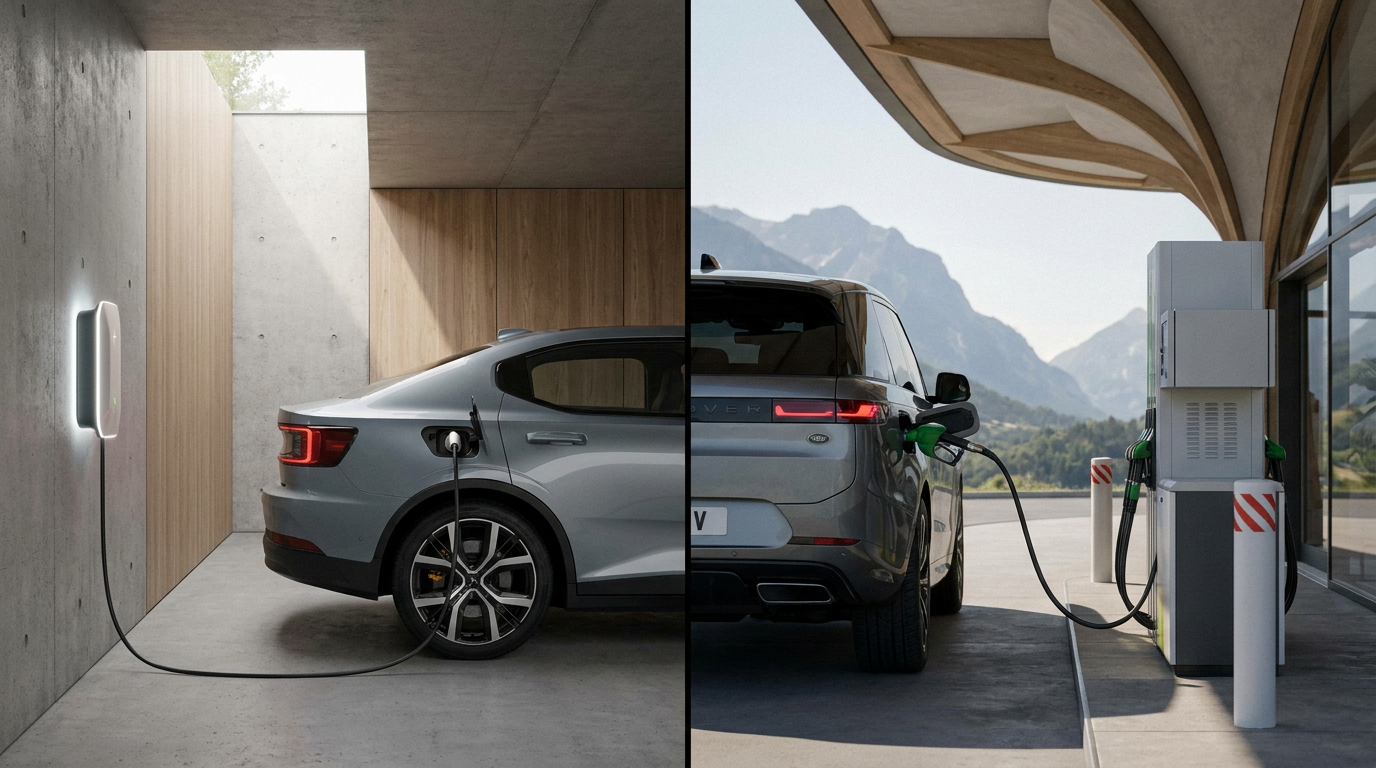
The core mechanism of a pure EV is elegant in its simplicity. An EV is powered entirely by a large battery pack and electric motors, meaning it has no gas tank, no exhaust system, and no internal combustion engine. In contrast, a PHEV is essentially two vehicles merged into one. It features a smaller battery and electric motor for short-distance driving, alongside a traditional gasoline engine that takes over when the battery is depleted. This dual-powertrain setup allows the vehicle to be plugged into a wall to charge, but also fueled at a standard gas station.[1][4]

The primary argument for choosing a pure EV in 2026 centers on absolute efficiency and minimal maintenance. Because an EV drivetrain contains roughly 20 moving parts, owners never have to pay for oil changes, spark plug replacements, or transmission fluid flushes. Electricity is also significantly cheaper than gasoline globally; charging an EV at home overnight can cost a fraction of what it takes to fill a gas tank. Furthermore, modern EVs have largely conquered range anxiety. In recent Edmunds testing, the 2026 Tesla Model 3 Rear-Wheel Drive achieved an impressive 393 miles on a single charge, proving that daily commuting and even moderate road trips are easily handled by battery alone.[1][4][6]
However, the case against the pure EV remains tied to infrastructure and lifestyle constraints. While 350kW ultra-fast chargers can now add an 80% charge in about 15 to 20 minutes, public charging networks can still be patchy in rural corridors. For drivers who live in apartment buildings without dedicated overnight charging, relying solely on public infrastructure can turn vehicle ownership into a logistical chore. The upfront purchase price of a long-range EV also tends to be higher than its hybrid counterparts, requiring buyers to calculate how many years of fuel savings it will take to break even.[4][5]
However, the case against the pure EV remains tied to infrastructure and lifestyle constraints.
This is where the PHEV makes its strongest case, operating on what industry experts call the '80/20 rule.' For most drivers, 80% of their time behind the wheel consists of local commutes, grocery runs, and school drop-offs—trips that easily fall within the 40 to 50 miles of pure electric range offered by modern 2026 PHEVs. If plugged in every night, a PHEV owner might go months without visiting a gas station. Yet, for the 20% of driving that involves long weekend road trips or cross-country travel, the gasoline engine seamlessly engages, completely eliminating range anxiety and the need to map out charging stops.[2][4]
The argument against the PHEV lies in its sheer mechanical complexity and the discipline it requires from the owner. A PHEV carries the weight and maintenance schedule of a gasoline engine, plus the high-voltage battery of an EV. If an owner fails to plug the vehicle in daily, they are essentially driving a heavy, less fuel-efficient gas car, entirely defeating the purpose of the premium purchase price. Furthermore, Consumer Reports data from late 2025 indicates that both EVs and PHEVs are currently experiencing 'growing pains,' with these newer powertrains reporting about 80% more reliability issues than traditional, century-old gas engine designs.[3][4]

When evaluating the financial evidence, the trade-offs become clear. A pure EV offers the lowest possible cost per mile, with some European studies showing savings of over €1,500 annually compared to gasoline equivalents. PHEVs, while cheaper to insure in some markets, combine the costs of electricity and occasional gasoline, resulting in a higher long-term energy bill if the gas engine is frequently used. Resale values in 2026 also show a divergence: pure EVs with newer solid-state or long-life batteries are holding their value remarkably well, while PHEVs are sometimes viewed by the secondary market as transitional technology.[4][6][7]
Ultimately, a pure EV fits perfectly when you have reliable access to Level 2 charging at home or work, your daily commute is predictable, and you want to completely eliminate gasoline and routine engine maintenance from your life. It is the definitive choice for maximizing long-term savings and achieving zero tailpipe emissions. It does not fit well if you regularly drive hundreds of miles through rural areas lacking fast-charging infrastructure, or if you cannot install a charger at your residence.[1][5]

Conversely, a PHEV fits exceptionally well for the 'one-car household' that wants the silent, emission-free benefits of an EV for daily city driving, but requires the limitless range of a gas tank for frequent weekend adventures. It serves as a brilliant safety net for those hesitant about the electric transition. However, a PHEV does not fit well if you lack the discipline to plug it in every single night, or if your goal is to completely walk away from oil changes, mechanical complexity, and the gas pump.[2][4][5]
How we got here
Early 2010s
The first mass-market EVs and PHEVs, like the Nissan Leaf and Chevy Volt, introduce consumers to plug-in technology.
2020
EV ranges begin to consistently cross the 250-mile threshold, making them viable for more households.
2023
PHEVs see a massive surge in popularity as a 'bridge' technology for buyers hesitant about public charging infrastructure.
Late 2025
Consumer Reports releases data showing EVs and PHEVs experience more initial reliability issues than legacy gas vehicles.
2026
Mainstream EVs routinely hit 350+ miles of real-world range, while PHEVs standardize around 40-50 miles of pure electric driving.
Viewpoints in depth
Pure EV Advocates
Focus on zero emissions, minimal maintenance, and future-proofing the garage.
This camp argues that plug-in hybrids are merely a transitional half-measure that delays the inevitable shift to full electrification. By holding onto a gasoline engine, they argue, PHEV owners are still tethered to oil changes, spark plugs, and fossil fuel infrastructure. EV advocates point to the rapidly expanding 350kW fast-charging networks and real-world ranges approaching 400 miles as evidence that range anxiety is an outdated fear. For them, the simplicity of an electric motor—with its fraction of moving parts—makes the pure EV the only logical long-term investment.
Pragmatic Hybrid Buyers
Value the flexibility of electric daily driving without sacrificing road-trip freedom.
Pragmatists view the PHEV as the ultimate 'best of both worlds' solution for the current decade. They acknowledge that while public charging is improving, it is still not as ubiquitous or reliable as the century-old network of gas stations. By utilizing the 40-50 miles of electric range for daily chores, they achieve the environmental and financial benefits of an EV for the vast majority of their driving. When it's time for a cross-country trip or an emergency evacuation, the gas engine provides immediate, stress-free range, making the PHEV the perfect compromise for single-car households.
Reliability Analysts
Highlight the mechanical complexity and early-adopter risks of dual powertrains.
Consumer watchdogs and automotive data analysts look strictly at the numbers, warning that adding new technology often introduces new points of failure. They note that PHEVs are the most complex vehicles on the road today, requiring the vehicle's computer to seamlessly manage hand-offs between a high-voltage battery system and a combustion engine. Because both EVs and PHEVs are relatively new to mass-market production, analysts point to data showing higher rates of initial quality issues compared to legacy gas vehicles, advising cautious buyers to weigh long-term warranty coverage heavily.
What we don't know
- How quickly solid-state batteries will reach the mass market, potentially rendering current EV and PHEV ranges obsolete.
- Whether future government regulations will eventually ban PHEVs from city centers in favor of pure zero-emission vehicles.
- How the long-term resale value of complex PHEVs will hold up once their battery warranties expire.
Key terms
- BEV (Battery Electric Vehicle)
- A vehicle powered entirely by electricity stored in a large battery pack, with no internal combustion engine.
- PHEV (Plug-in Hybrid Electric Vehicle)
- A vehicle with both an electric motor and a gas engine, featuring a battery large enough to be plugged in for short electric-only trips.
- Level 2 Charging
- A 240-volt charging station, typically installed at home or work, that can fully replenish an EV battery overnight.
- Range Anxiety
- The fear that an electric vehicle will run out of battery power before reaching a suitable charging station.
- Regenerative Braking
- A system that captures the kinetic energy normally lost during braking and uses it to recharge the vehicle's battery.
Frequently asked
What happens if I never plug in a PHEV?
If you don't plug it in, the vehicle operates entirely on its gas engine. Because PHEVs are heavier due to the battery pack, you will actually get worse fuel economy than a standard gas car, defeating the purpose of the vehicle.
Are EVs really cheaper to maintain?
Yes. Because EVs lack an internal combustion engine, they do not require oil changes, spark plug replacements, or transmission fluid flushes, drastically reducing long-term maintenance costs.
How long does it take to charge an EV on a road trip?
Using modern 350kW ultra-fast public chargers, many 2026 EVs can replenish their battery from 10% to 80% in about 15 to 20 minutes.
Do PHEVs qualify for the same tax credits as EVs?
It depends on the specific model and battery size, but many governments are beginning to phase out incentives for PHEVs in order to prioritize funding for pure zero-emission vehicles.
Sources
Source coverage
7 outlets
3 viewpoints surfaced




[1]EdmundsReliability Analysts
Hybrids vs. Plug-in Hybrids: What's the Difference?
Read on Edmunds →[2]Consumer ReportsReliability Analysts
Is a Plug-In Hybrid Vehicle Right for You?
Read on Consumer Reports →[3]Tech BrewReliability Analysts
Consumer Reports finds reliability issues with EVs, PHEVs
Read on Tech Brew →[4]Mobile Studio 24hPragmatic Hybrid Buyers
PHEV vs. EV in 2026: Which Technology is Actually Better?
Read on Mobile Studio 24h →[5]Culver City MazdaPragmatic Hybrid Buyers
EV vs. PHEV vs. Gasoline: What's Best for Southern California Drivers?
Read on Culver City Mazda →[6]ElectraPure EV Advocates
Electric Car or Plug-in Hybrid: How to Choose?
Read on Electra →[7]HDFC Ergo
Electric Vehicle vs Plug-in Hybrid: Which is Right for You?
Read on HDFC Ergo →

More in shopping
See all 5 stories →


Every angle. Every day.
Get shopping stories with full source coverage and perspective breakdowns delivered to your inbox.