
DOL Proposes New Independent Contractor Rule, Reverting to Business-Friendly Two-Factor Test
The U.S. Department of Labor has introduced a proposed rule to replace the 2024 worker classification framework with a streamlined "economic reality" test. By elevating two core factors—control over work and opportunity for profit—the shift aims to provide greater clarity for businesses and freelancers.


- Employer Defense & Compliance
- Focuses on the reduced legal risk and clearer compliance guidelines the new rule offers to businesses.
- Industry & Trade Groups
- Emphasizes the operational flexibility the rule restores for sectors relying heavily on subcontractors.
- Payroll & Operations
- Focuses on the practical mechanics of auditing worker classifications and updating internal HR systems.
- Small Business Advocates
- Highlights the massive cost savings and reduced administrative burden for smaller enterprises.
Summary
- The Department of Labor has proposed replacing the 2024 worker classification rule with a streamlined two-factor test.
- The new framework prioritizes a worker's control over their work and their opportunity for profit or loss.
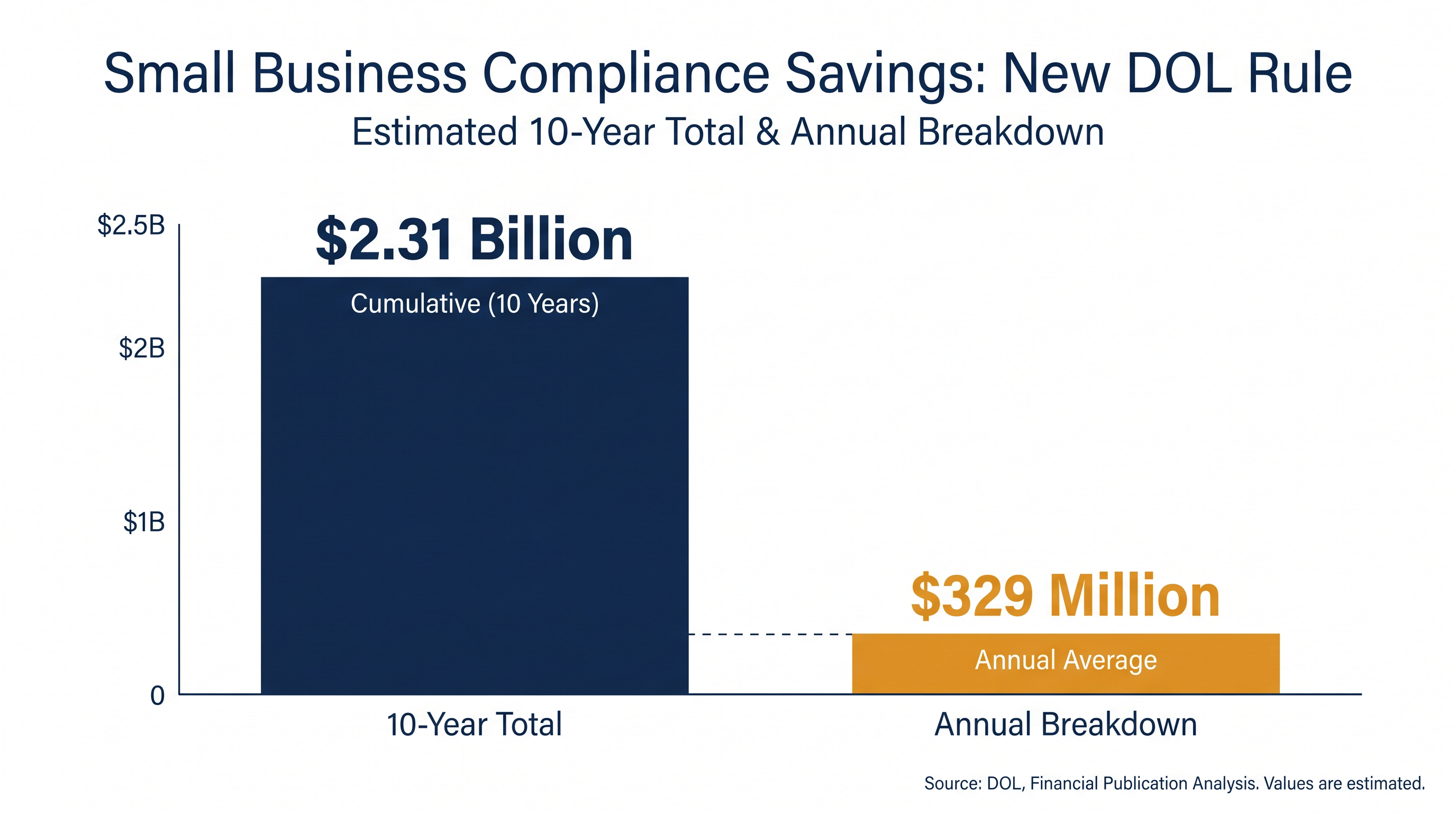
- The Small Business Administration estimates the regulatory shift will save small entities $2.31 billion in compliance costs over a decade.
- Secondary factors, such as the skill required and the permanence of the relationship, will only serve as tiebreakers.
- The federal rule does not preempt stricter state-level classification laws, meaning employers must still navigate local regulations.
- The DOL has already instructed its investigators to stop enforcing the 2024 standard while the new rule is finalized.
An estimated $2.31 billion in compliance savings over the next decade is the driving force behind a sweeping regulatory reversal in Washington. In February 2026, the U.S. Department of Labor announced a proposed rule that fundamentally rewrites how the federal government determines whether a worker is a traditional employee or an independent contractor. The shift aims to dismantle the complex regulatory framework established in 2024, replacing it with a streamlined standard that is widely viewed as more favorable to businesses and self-employed professionals. For companies that rely on freelance talent, consultants, and gig workers, the proposal signals a return to a more predictable legal environment.[1][2]
At the heart of the proposed regulation is a return to an "economic reality" test anchored by two core factors. The new framework discards the "totality of the circumstances" approach implemented in 2024, which required employers and auditors to weigh six different variables equally. Under the 2026 proposal, the Department of Labor establishes a clear hierarchy for determining a worker's status under the Fair Labor Standards Act (FLSA). By elevating two primary indicators above all others, the agency intends to cut through the ambiguity that previously left human resources departments guessing how an investigator might interpret their contractor relationships.[3][4]
The first core factor evaluates the nature and degree of control over the work being performed. This pillar examines whether the worker or the hiring company dictates daily schedules, specific work methods, and the ability to serve a broader client base. Crucially, the proposed rule clarifies that requirements imposed solely to ensure legal compliance, health and safety standards, or baseline quality control do not constitute the type of employer control that would trigger an employment relationship. This carve-out is particularly significant for heavily regulated industries like construction and real estate.[4][8]
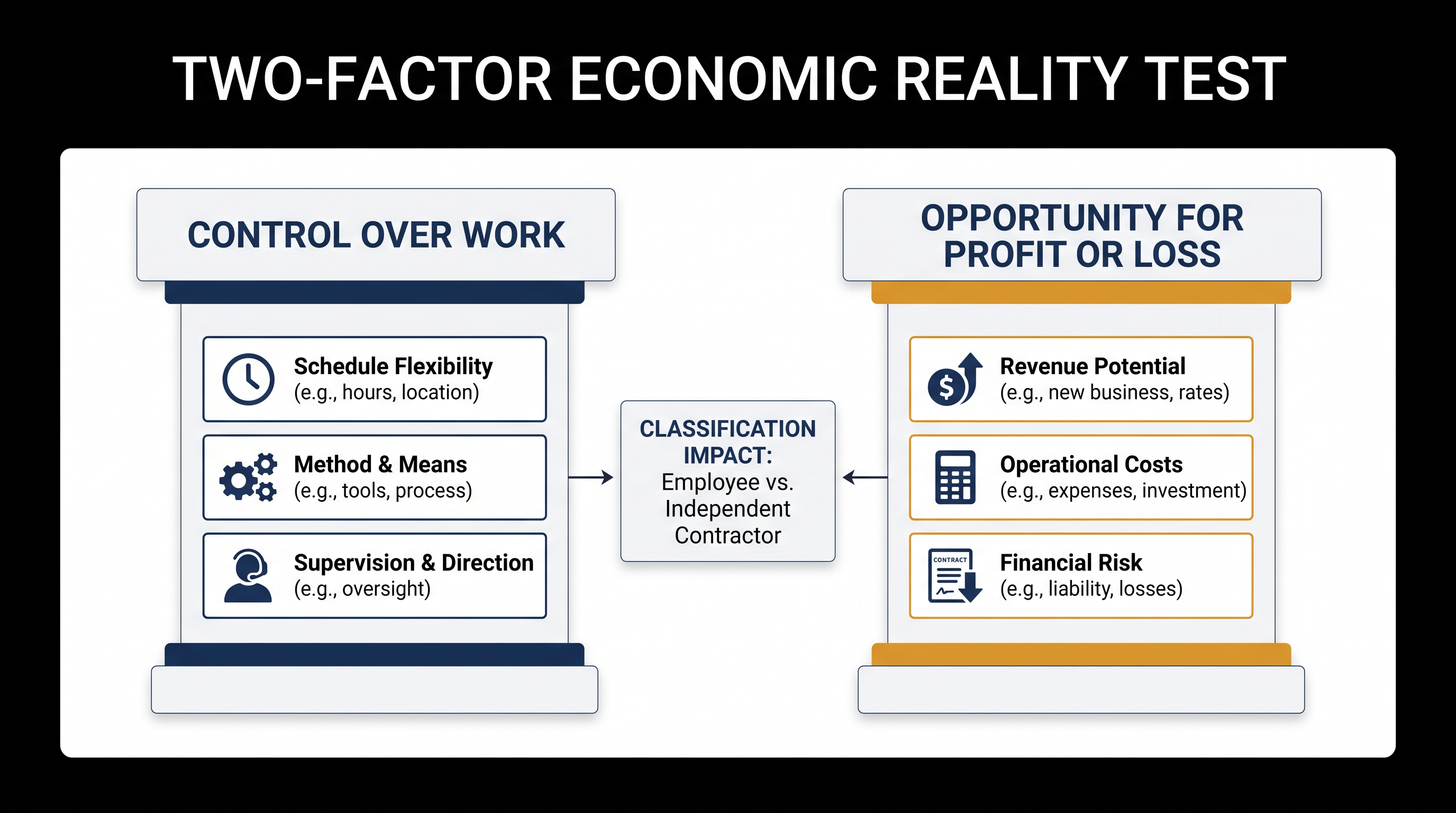
The second core factor assesses the worker's opportunity for profit or loss based on their own initiative, business acumen, or capital investment. If a freelancer can actively increase their earnings by taking on more clients, investing in specialized equipment, or streamlining their operations, they are demonstrating the economic independence characteristic of a true contractor. Conversely, a worker whose income is entirely dependent on an hourly wage set by a single employer, with no ability to scale their own profitability, leans heavily toward employee status.[5][6]
When both of these core factors point in the same direction, the classification is generally considered settled. If a worker controls their own schedule and has a genuine opportunity for profit, they are an independent contractor; if the company controls the work and the pay rate, they are an employee. Three secondary factors—the specialized skill required for the work, the permanence of the working relationship, and whether the work is part of an integrated production unit—are retained in the rule but explicitly relegated to a supporting role. These secondary elements serve primarily as tiebreakers in edge cases where the two core factors yield conflicting results.[3][7]
When both of these core factors point in the same direction, the classification is generally considered settled.
This structural hierarchy represents a direct return to the regulatory philosophy first introduced in 2021. The 2024 rule, by contrast, treated all six factors as equal pieces of a puzzle, a standard that corporate advocates argued created a blurred line leaning heavily toward classifying independent workers as employees. The ambiguity of the 2024 standard forced many risk-averse companies to either limit their use of freelance talent entirely or spend heavily on external legal audits to justify their 1099 payrolls.[2][3]
The financial stakes surrounding worker classification are intensely practical. Misclassifying an employee as an independent contractor can trigger severe federal penalties, including retroactive back pay for minimum wage and overtime, unpaid payroll taxes, and liquidated damages. By simplifying the test, the Small Business Administration estimates the 2026 rule will save small entities roughly $329 million annually in administrative and legal compliance costs. For small businesses operating on thin margins, the reduction in audit risk provides the confidence needed to scale operations using specialized external talent.[1][8]
For career freelancers and independent professionals, the proposed rule offers a clearer mandate to operate as autonomous business entities. Independent consultants, creative professionals, and tradespeople often rely on contractor status to maintain flexible, multi-client operations. Under the broader definitions of the previous rule, some independent professionals reported losing lucrative client contracts as companies opted to hire larger agencies rather than risk engaging individual 1099 workers. The two-factor test effectively protects the autonomy of workers who genuinely want to manage their own enterprises.[5][7]
However, the Department of Labor explicitly noted in the rulemaking that actual, day-to-day working practices will carry significantly more weight than written contracts. A worker labeled as an "independent contractor" in a signed agreement who is nonetheless scheduled, directly supervised, and exclusively assigned like a traditional employee will still fail the two-factor test. The agency's guidance warns employers that contract language cannot shield a company from misclassification penalties if the economic reality of the relationship demonstrates clear employer control.[5][6]
Despite the federal pivot toward a more flexible standard, employers must still navigate a highly fragmented landscape of state labor laws. The federal FLSA standard does not preempt stricter state-level classifications. States such as California, Massachusetts, and New Jersey continue to enforce stringent frameworks like the ABC test, which makes it substantially harder to classify workers as independent contractors regardless of federal guidelines. Companies operating across state lines must ensure their contractor relationships satisfy both the new federal two-factor test and the specific legal requirements of the jurisdictions where the work is actually performed.[2][4]

The public comment period for the proposed rule officially closed on April 28, 2026, drawing thousands of submissions from industry trade groups, labor advocates, and independent workers. While the final rule is expected to be formally codified and published in the Federal Register later in the year, the enforcement landscape has already shifted. The Department of Labor effectively ceased enforcing the 2024 standard in May 2025, issuing internal field guidance that instructed federal investigators to revert to the core-factor analysis during ongoing wage and hour audits.[2][7]
As the regulatory pendulum swings back toward business flexibility, payroll and human resources departments are being advised to proactively audit their current contractor classifications. Legal and compliance experts recommend that companies evaluate their existing 1099 relationships specifically against the two core factors of control and profit opportunity. By documenting that independent workers genuinely dictate their own methods and manage their own financial risks, organizations can align their operational realities with the incoming federal standard and insulate themselves from future misclassification disputes.[5][8]
Definitions
- Fair Labor Standards Act (FLSA)
- The federal law that establishes minimum wage, overtime pay, recordkeeping, and youth employment standards for employees in the private sector and in government.
- Economic Reality Test
- A legal framework used to determine whether a worker is economically dependent on an employer (an employee) or is in business for themselves (an independent contractor).
- Misclassification
- The illegal practice of labeling a worker as an independent contractor when they legally qualify as an employee, thereby denying them benefits and wage protections.
- Totality of the Circumstances
- A legal analysis that weighs multiple factors equally without giving predetermined priority to any single factor, which was the basis of the 2024 rule.
Chronology
January 2021
The Trump administration publishes a rule establishing a multifactor test that heavily weights control and profit opportunity.
January 2024
The Biden administration finalizes a new rule using a six-factor 'totality of the circumstances' test, replacing the 2021 framework.
May 2025
The DOL issues a Field Assistance Bulletin instructing investigators to stop enforcing the 2024 rule.
February 2026
The DOL officially proposes a new rule to formally rescind the 2024 standard and reinstate the two-factor economic reality test.
April 2026
The public comment period for the proposed 2026 independent contractor rule officially closes.
Analysis by camp
Corporate Employers & Trade Associations
Business groups argue the two-factor test provides necessary clarity and reduces frivolous misclassification lawsuits.
Organizations representing the construction, real estate, and gig economy sectors have strongly backed the 2026 proposal. They argue that the 2024 totality-of-the-circumstances test was overly subjective, forcing companies to guess how an auditor might weigh six equal factors. By elevating control and profit opportunity to the top of the hierarchy, trade associations believe businesses can confidently engage specialized freelancers without the looming threat of retroactive overtime and benefits litigation.
Independent Professionals & Freelancers
Self-employed workers favor the rule for protecting their autonomy and ability to serve multiple clients.
Many career freelancers, consultants, and independent contractors view the two-factor test as a defense of their business models. Under the previous administration's broader definitions, some independent professionals reported losing client contracts as risk-averse companies opted to hire agencies rather than individual 1099 workers. This camp argues that true independent contractors actively want to manage their own profits, losses, and schedules, and should not be forcibly reclassified as employees.
Labor Advocates & Worker Protection Groups
Labor organizations warn the streamlined test makes it too easy for companies to deny workers basic employment rights.
Worker advocacy groups contend that the two-factor test creates a massive loophole for corporate exploitation. They argue that by minimizing factors like how integral a worker is to the company's core business, employers can easily label lower-wage workers—such as delivery drivers, janitors, and home care aides—as independent contractors. This camp warns that the rule shift will strip vulnerable workers of minimum wage guarantees, overtime pay, and workers' compensation protections under the guise of entrepreneurial flexibility.
Questions & answers
What are the two core factors in the proposed DOL rule?
The rule primarily evaluates the nature and degree of control the company has over the work, and the worker's opportunity for profit or loss based on their own initiative or investment.
Does this rule override state labor laws like California's ABC test?
No. The DOL rule only applies to federal classifications under the Fair Labor Standards Act (FLSA). Employers must still comply with stricter state-level classification laws where applicable.
When does the new independent contractor rule take effect?
The public comment period closed in April 2026, and a final rule is expected later in the year. However, the DOL has already instructed its investigators to stop enforcing the previous 2024 standard.
What happens if a worker signs a contract stating they are an independent contractor?
The DOL explicitly states that actual working practices carry more weight than written agreements. If a worker is treated like an employee in practice, a contract label will not protect the employer from misclassification penalties.
Limits of the evidence
- Exactly when the final rule will be officially published and take effect in the Federal Register.
- How aggressively state labor agencies will ramp up their own enforcement to counter the more relaxed federal standard.
- Whether labor advocacy groups will successfully mount legal challenges to delay or block the rule's implementation.
Significance
The proposed rule fundamentally changes how businesses engage with freelancers, gig workers, and subcontractors. By clarifying the legal boundary between employees and independent contractors, the shift reduces the risk of costly misclassification audits for companies while cementing the operational autonomy of self-employed professionals.
Sources
Source coverage
8 outlets
4 viewpoints surfaced







[1]U.S. Small Business AdministrationSmall Business Advocates
DOL Proposes New Independent Contractor Rule
Read on U.S. Small Business Administration →[2]DLA PiperEmployer Defense & Compliance
US DOL proposes return to Trump-era independent contractor test
Read on DLA Piper →[3]Jackson LewisEmployer Defense & Compliance
DOL Proposes Return to 2021 Independent Contractor Rule
Read on Jackson Lewis →[4]ABC CarolinasIndustry & Trade Groups
The 2026 DOL Independent Contractor Rule: What Contractors Need to Know
Read on ABC Carolinas →[5]GreenshadesPayroll & Operations
The DOL has proposed replacing its 2024 independent contractor rule
Read on Greenshades →[6]Butler SnowEmployer Defense & Compliance
DOL Issues Proposed Rule to Reestablish 2021 Independent Contractor Test
Read on Butler Snow →[7]Nixon PeabodyEmployer Defense & Compliance
DOL proposes new independent contractor rule
Read on Nixon Peabody →[8]National Association of RealtorsIndustry & Trade Groups
DOL Issues New Proposed Independent Contractor Rule
Read on National Association of Realtors →
Comments

Every angle. Every day.
Get careers work stories with full source coverage and perspective breakdowns delivered to your inbox.