
National Survey Finds 61% of Americans Support Citizen Assemblies to Counter 'Usual Suspects' in Local Decisions
A new survey reveals deep frustration with local government meetings dominated by vocal minorities, driving bipartisan support for randomly selected, representative citizen assemblies.

- Democratic Innovators
- Advocates pushing for sortition to bypass polarized politics.
- Traditional Institutionalists
- Skeptics who believe policy should remain with elected, accountable officials.
- Civic Equity Advocates
- Groups focused on dismantling barriers to participation for working-class residents.
Perspectives this story doesn't cover
- Local mayors and city managers who have to balance the budget to fund these expensive deliberative processes.
- Vocal community activists who currently utilize the open town hall format to drive grassroots change.
Summary
- 65% of Americans feel local decisions are dominated by a small group of 'usual suspects.'
- 61% of survey respondents support citizen assemblies over traditional neighborhood councils.
- Assemblies use 'sortition' to randomly select a demographically representative group of residents.
- Participants are paid for their time and hear from experts before making policy recommendations.
- The model aims to replace polarized town hall arguments with structured, collaborative problem-solving.
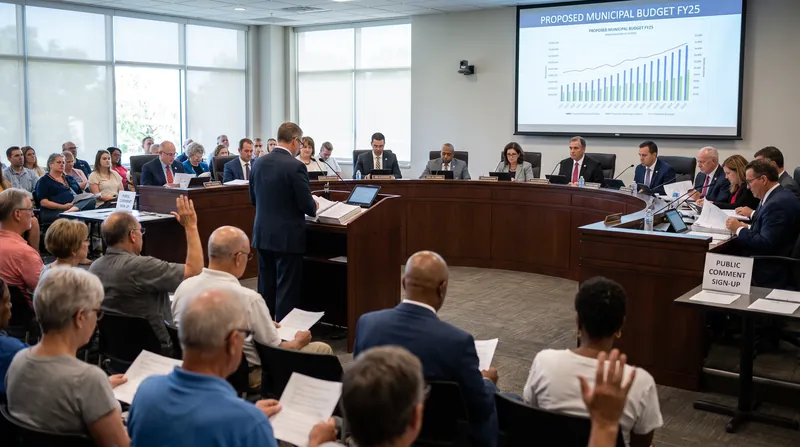
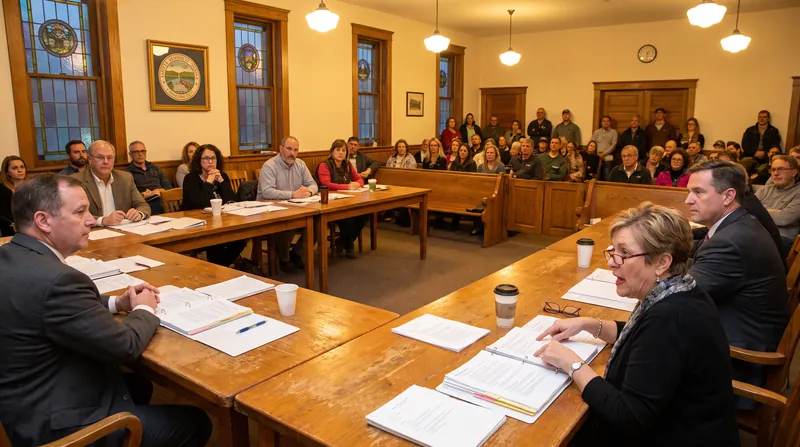
For most Americans, the local town hall meeting is a broken mechanism. Instead of a collaborative forum for community problem-solving, public comment periods are frequently dominated by a vocal, highly motivated minority. Civic researchers often refer to this group as the "usual suspects"—residents with the time, resources, and ideological drive to attend hours-long municipal hearings on a Tuesday night. For the broader public, this dynamic creates a profound sense of alienation from local government, leaving many feeling that their voices are structurally locked out of the decisions that shape their neighborhoods, their schools, and their tax rates.[1][3]
A comprehensive national survey conducted by the National Civic League and ActiVote quantifies this disconnect. The data reveals that 65% of Americans believe community decisions are entirely dominated by this small group of usual suspects. Furthermore, fewer than one in ten residents say they receive public information about local initiatives on time. This combination of delayed communication and exclusionary meeting formats has resulted in a civic environment where only 7% of respondents report feeling a strong sense of belonging in their local communities, highlighting a systemic failure in how municipalities engage their populations.[1]
However, the survey also highlights a clear public appetite for alternative democratic structures. When presented with different models of civic engagement, 61% of respondents expressed support for "citizen assemblies"—a deliberative model that bypasses the open-mic format in favor of structured, representative participation. This model outpolled traditional neighborhood councils, suggesting that Americans are increasingly open to innovative frameworks that actively counteract the loudest-voice-wins dynamic of contemporary local politics and return decision-making power to a genuine cross-section of the community.[1][2]
The core mechanism of a citizen assembly relies on a process called "sortition," which functions similarly to jury duty. Rather than relying on self-selected attendees who show up to yell at a microphone, organizers use a civic lottery to draft a group of residents that accurately mirrors the demographic makeup of the community. This rigorous selection process accounts for variables such as age, gender, income, education, and political affiliation. By randomly selecting participants, the assembly breaks the link with vested interests and ensures that marginalized or quietly busy residents are finally brought to the table.[4][5]
Once selected, the assembly does not simply vote on a pre-written proposal. Instead, members enter a structured, intensive learning phase. Over several weeks or months, the delegates are paid for their time and provided with necessary support, such as childcare and meals, to eliminate the financial barriers to participation. During this period, they hear detailed presentations from subject-matter experts, academic researchers, and advocacy groups representing various sides of the issue. Professional facilitators guide the discussions, ensuring that no single individual dominates the conversation and that all perspectives are weighed evenly.[4][6]
Once selected, the assembly does not simply vote on a pre-written proposal.
This deliberative environment fundamentally changes how citizens interact with policy. Research from institutions like Yale University indicates that when everyday people are placed in a collaborative, information-rich setting, they take the responsibility seriously and are often willing to change their preconceived opinions. Because the participants are not running for re-election or fundraising off their stances, they can weigh complex trade-offs—such as the economic costs of climate mitigation or the zoning impacts of affordable housing—without the pressure of partisan posturing or the fear of primary challengers.[2][5]
While the concept is relatively novel in the United States, it has an established track record internationally. In Europe, citizen assemblies have been deployed to break political deadlocks on highly contentious issues. In Gdansk, Poland, city officials convened an assembly following severe flooding; the randomly selected citizens successfully negotiated a comprehensive flood mitigation strategy that was widely accepted by the public. Similar national assemblies in Ireland and France have tackled constitutional reforms and end-of-life care, demonstrating that ordinary citizens can navigate deeply divisive moral and logistical questions when given the proper framework.[2][3][4]
Adoption in the United States has been slower, though experimental models are beginning to emerge. Washington State recently hosted one of the country's first statewide assemblies, convening 77 demographically representative residents to deliberate on equitable climate policies. At the local level, municipalities are exploring mini-publics to advise on budgeting and infrastructure. However, these initiatives face significant structural hurdles. Organizing a rigorous civic lottery, compensating participants, and hiring neutral facilitators requires substantial funding and administrative capacity that many local governments currently lack, making it a difficult sell for cash-strapped city councils.[6][7]
The most significant barrier to widespread adoption, however, is political will. For a citizen assembly to be effective, elected officials must commit to taking the group's recommendations seriously—either by directly implementing them or putting them to a public referendum. Skeptics of the model argue that bypassing elected representatives undermines traditional democratic accountability, and some question whether laypeople can truly grasp the technical nuances of municipal finance or environmental engineering without being overly swayed by the unelected experts and facilitators who design the curriculum.[4][5]
Despite these challenges, the growing interest in sortition reflects a deep frustration with the status quo. The National Civic League data underscores that Americans are not apathetic about local governance; rather, they are exhausted by a system that rewards outrage over deliberation. By institutionalizing a space where everyday residents are given the time, resources, and mandate to solve problems, citizen assemblies offer a concrete mechanism for rebuilding trust in democratic institutions and ensuring that the future of a community is decided by all of its residents, not just the usual suspects.[1][2]
Definitions
- Citizen Assembly
- A body of randomly selected citizens convened to deliberate on a specific policy issue and produce recommendations.
- Sortition
- The use of a random lottery to select decision-makers, ensuring the group accurately reflects the broader population.
- Mini-public
- A small group of people designed to be a demographic microcosm of the larger society, often used in deliberative democracy.
- Deliberative Democracy
- A framework where structured discussion and consensus-building are central to decision-making, rather than just voting.
Sources
Source coverage
7 outlets
3 viewpoints surfaced







- [1]National Civic LeagueDemocratic Innovators
National Survey on Civic Engagement and Citizen Assemblies
Read on National Civic League → - [2]Yale Institution for Social and Policy StudiesDemocratic Innovators
Democratic Innovations: Building Trust Through Citizens' Assemblies
Read on Yale Institution for Social and Policy Studies → - [3]Public AgendaDemocratic Innovators
Healthier Democracies: Lessons from Citizens' Assemblies
Read on Public Agenda → - [4]WikipediaTraditional Institutionalists
Citizens' assembly
Read on Wikipedia → - [5]The Philadelphia CitizenTraditional Institutionalists
Getting Citizen Assemblies to Work
Read on The Philadelphia Citizen → - [6]AtmosCivic Equity Advocates
The Washington Climate Assembly Experiment
Read on Atmos → - [7]Factlen Editorial TeamDemocratic Innovators
Synthesis by Factlen editorial team
Read on Factlen Editorial Team →
Comments

More in Community
See all →Urban Poverty
The Five Deprivations That Define a Slum Household in Global Monitoring
8 sources

Municipal Finance
The Three Revenue Pillars That Dictate Municipal Independence
9 sources
Governance Structures
The Distribution of Authority to the Lowest Competent Level of Governance
4 sources
Social Dynamics
The 25% Critical Mass That Causes a Minority Opinion to Overturn a Social Norm
7 sources
Every angle. Every day.
Get Community stories with full source coverage and perspective breakdowns delivered to your inbox.