
Demystifying the Mega-IPO: How Everyday Investors Can Navigate the SpaceX Public Debut
SpaceX is launching the largest initial public offering in history with an unprecedented 30% allocation for retail investors, testing both market mechanics and portfolio discipline.
By Factlen Editorial Team
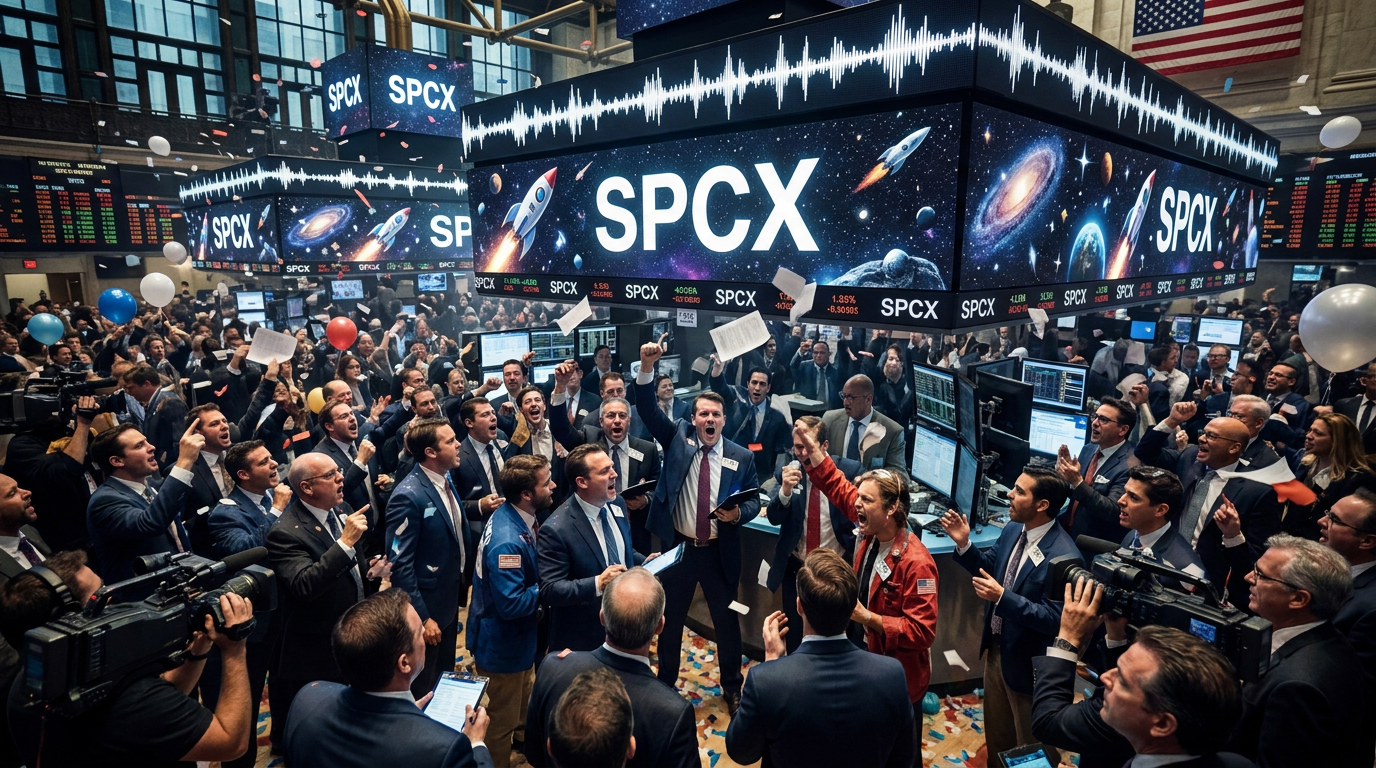
- Retail Access Advocates
- Argue that democratizing IPOs allows everyday investors to build wealth alongside institutions.
- Fundamental Analysts
- Focus on traditional valuation metrics, warning that the current price bakes in speculative, unproven technologies.
- Market Structure Experts
- Emphasize the mechanical forces of index inclusion and passive fund flows over fundamental valuation.
- Risk Management Advisors
- Warn against the dangers of hype-driven investing, particularly for those nearing retirement.
What's not represented
- · Institutional Underwriters
- · Space Industry Competitors
Why this matters
The SpaceX IPO is rewriting the rules of Wall Street by offering everyday investors unprecedented access to a mega-cap debut. Understanding the mechanics of this listing is crucial for retail investors deciding whether to participate in the hype or protect their portfolios from early volatility.
Key points
- SpaceX is raising $75 billion at a $1.77 trillion valuation, making it the largest IPO in history.
- In an unprecedented move, 30% of the public float has been reserved specifically for retail investors.
- At $135 per share, the company is valued at 92 times its trailing sales, sparking debate over its fundamental worth.
- Major index providers are fast-tracking SpaceX's inclusion, which will force passive funds to buy the stock.
- Financial advisors warn retail investors to manage their risk and avoid over-allocating retirement funds to the volatile stock.
The equity markets are witnessing a watershed moment as SpaceX officially transitions from a closely held private enterprise to a publicly traded behemoth. Pricing its shares at $135, the space exploration and satellite communications company is raising a staggering $75 billion. This debut implies a day-one valuation of approximately $1.77 trillion, instantly catapulting SpaceX into the upper echelon of the world's most valuable corporations.[2][7]
To understand the sheer scale of this offering, it helps to look at historical precedents. The $75 billion raise is nearly three times larger than the previous global record—Saudi Aramco’s $29.4 billion public debut in 2019. By absorbing such a massive amount of capital in a single event, the listing is testing the mechanical limits of the U.S. stock market and reshaping how generational technology companies approach the public sphere.[2][4]
But the most unprecedented aspect of the SpaceX debut is not its size; it is who gets to buy in. The company has earmarked 30% of its public float specifically for retail investors. This represents roughly three times the typical retail allocation for a mega-cap public offering, signaling a deliberate strategy to democratize access and harness the enthusiasm of everyday supporters.[6]
Historically, the mechanics of going public have heavily favored institutional players. The U.S. Securities and Exchange Commission notes that underwriters typically distribute the vast majority of initial shares to mutual funds, hedge funds, and high-net-worth clients. Everyday investors are usually locked out of the initial pricing, forced to purchase shares on the open market only after early trading has driven the price up.[5]

By reserving a massive tranche for the public, SpaceX is attempting to rewrite that playbook. Retail access is being routed through participating brokerages, allowing individuals to request shares at the $135 strike price. However, with institutional and retail demand reportedly exceeding $250 billion—more than three times the available supply—most individual investors will likely receive only a fraction of their requested allocation.[2][6]
For those who do secure shares, the immediate question becomes whether the $1.77 trillion price tag is justified. At $135 per share, the market is valuing SpaceX at roughly 92 times its trailing sales. This is a remarkably steep multiple for a company that posted a $4.28 billion net loss in the first quarter of 2026, requiring investors to underwrite a future of flawless execution across multiple bleeding-edge industries.[2][6][7]
The bullish justification rests heavily on Starlink, the company's satellite internet constellation. Operating over 9,000 satellites, Starlink provides high-speed connectivity to more than 12 million customers globally. It is the undisputed financial engine of the company, generating $11.4 billion of SpaceX's $18.7 billion in total revenue in 2025 and proving that space-based infrastructure can yield reliable, recurring cash flow.[7]
The bullish justification rests heavily on Starlink, the company's satellite internet constellation.
Yet, Starlink alone does not bridge the gap to a nearly $2 trillion valuation. To justify the premium, investors are betting on the company's artificial intelligence ambitions. SpaceX is aggressively building AI infrastructure, spending an eye-watering $7.7 billion on capital expenditures in the first quarter of 2026 alone. The ultimate goal is to deploy orbital AI data centers by 2028, tapping into an addressable market that the company's prospectus estimates at $26.5 trillion.[7]
Financial analysts remain deeply skeptical of pricing such speculative ventures into the stock today. Analysts at Morningstar have calculated a fundamental fair value estimate of just $63 per share, arguing that there is a severe disconnect between the underlying financials and the market's euphoric expectations. They caution that the $135 offering price requires investors to pay a $72 "option premium" for the mere possibility that these unproven technologies will succeed.[2][3]

Even in what Morningstar describes as a "moonshot" scenario—where SpaceX successfully commercializes orbital data centers and achieves rapid, weekly reusability of its Starship rockets—the firm estimates the value at $154 per share. Because they assign only a 7% probability to this flawless outcome, fundamental analysts are urging caution, suggesting that the current valuation leaves virtually no margin of safety for operational setbacks.[3]
However, in modern equity markets, fundamental valuation is only half the story. The other half is market structure, and SpaceX's sheer size guarantees it will trigger massive mechanical buying. Under Nasdaq's "Fast Entry" rules, top-tier companies can be added to major indices in as little as 15 trading days, bypassing the traditional seasoning periods.[4]
This accelerated inclusion will force the hand of the passive investing industry. Approximately $1.4 trillion in capital tracks the Nasdaq-100 index alone, spread across exchange-traded funds, mutual funds, and structured products. When SpaceX is added to these benchmarks, passive portfolio managers will have no choice but to automatically purchase the stock to match its index weighting, regardless of whether they believe the $135 price is fundamentally sound.[4]
Market structure experts at CME Group warn that this dynamic will create an intense supply-demand imbalance. With passive funds required to absorb a massive percentage of the public float, the early price discovery process for SpaceX shares may be driven entirely by structural liquidity demands rather than rational assessments of the company's earnings or cash flow.[4]

This combination of structural buying pressure and retail enthusiasm creates a highly volatile environment. Financial advisors are increasingly concerned about the "fear of missing out" driving irrational behavior, particularly among older investors. While a speculative bet might be appropriate for a young portfolio, advisors warn that over-allocating retirement funds to a single, highly volatile stock can be disastrous if the post-IPO momentum falters.[1]
The volatility will likely be amplified by the broader financial ecosystem springing up around the listing. The exchange-traded fund industry is already preparing to launch leveraged products tied specifically to SpaceX's daily performance. These instruments, designed to double or triple the stock's daily returns, will introduce even more speculative trading volume into the market, ensuring that the stock's early days will be characterized by violent price swings.[8]
Ultimately, the SpaceX listing is a dual-edged sword for the everyday investor. On one hand, the 30% retail allocation is a historic victory for market democratization, proving that the public can be invited to the table for the most significant wealth-creation events of the decade. It challenges the long-standing Wall Street monopoly on mega-cap debuts and sets a new standard for future tech listings.[6]
On the other hand, this unprecedented access comes with unprecedented complexity. Retail investors are being handed the keys to a $1.77 trillion vehicle that is priced for perfection, heavily reliant on unproven space technologies, and subject to the mechanical distortions of passive index flows. Navigating this landscape will require individuals to look past the historic hype and apply rigorous, disciplined portfolio management to their allocations.[3][4][6]
How we got here
2002
Elon Musk founds Space Exploration Technologies Corp. (SpaceX).
December 2025
A private tender offer values the company, setting the stage for a public debut.
May 2026
SpaceX files its S-1 prospectus, revealing plans for a record-breaking $75 billion raise.
June 11, 2026
The IPO prices after the market close at $135 per share.
June 12, 2026
SpaceX shares begin trading on the Nasdaq under the ticker SPCX.
Viewpoints in depth
Retail Access Advocates
Democratizing the wealth creation of mega-cap companies.
For decades, the most lucrative gains in private companies were captured by institutional investors and venture capitalists before the public ever had a chance to buy in. By reserving 30% of the float for everyday investors, this camp argues that the IPO structure is finally shifting to allow retail participants to share in the day-one momentum of a generational technology company.
Fundamental Analysts
Warning of a disconnect between price and underlying financials.
Analysts focused on traditional metrics point out that paying 92 times trailing sales requires near-perfect execution of highly speculative projects. They argue that the $135 price bakes in the success of unproven technologies, such as orbital AI data centers, leaving little margin of safety for investors if those ambitious timelines slip.
Market Structure Experts
Focusing on the mechanical forces of passive capital.
This perspective highlights that in modern markets, fundamental valuation often takes a back seat to structural flows. Because SpaceX is so large, its accelerated inclusion into major indices will force trillions of dollars in passive funds to automatically purchase the stock, creating a supply-demand imbalance that could drive the price independently of the company's actual earnings.
What we don't know
- Exactly what percentage of requested shares retail investors will actually receive after the brokerages prorate the massive demand.
- Whether SpaceX can successfully commercialize orbital AI data centers by its 2028 target.
- How the stock will react once the initial wave of mandatory passive index buying subsides.
Key terms
- Initial Public Offering (IPO)
- The first time a private company offers its shares to the general public to raise capital.
- Public Float
- The portion of a company's shares that are available for trading by the general public, excluding closely held shares by insiders.
- Total Addressable Market (TAM)
- The total revenue opportunity available for a product or service if it achieves 100% market share.
- Passive Index Fund
- A mutual fund or ETF designed to replicate the performance of a specific market index by holding all the stocks in that index.
- Option Premium
- In this context, the extra price investors pay above a company's current fundamental value for the chance to profit from its future, speculative projects.
Frequently asked
Can I buy SpaceX shares at the IPO price?
Retail investors can request shares through participating brokerages, but because demand vastly exceeds supply, most will receive only a fraction of their requested allocation.
Why is the valuation considered controversial?
At $1.77 trillion, the company is valued at roughly 92 times its trailing sales, meaning investors are paying a premium for future, unproven projects like orbital AI data centers.
How will index funds affect the stock price?
Because of its massive size, SpaceX will quickly be added to major indices like the Nasdaq-100, forcing passive index funds to buy the stock regardless of its fundamental price.
Sources
Source coverage
8 outlets
4 viewpoints surfaced







[1]MarketWatchRisk Management Advisors
SpaceX IPO hype is massive — and the FOMO can ruin your retirement
Read on MarketWatch →[2]The GuardianFundamental Analysts
Elon Musk's SpaceX is set to launch the biggest stock market float in history amid warnings that it may be overvalued
Read on The Guardian →[3]MorningstarFundamental Analysts
Why Is Morningstar So Bearish on SpaceX's IPO?
Read on Morningstar →[4]CME GroupMarket Structure Experts
The SpaceX IPO: A historic watershed moment
Read on CME Group →[5]U.S. Securities and Exchange Commission
Initial Public Offerings: Why Individuals Have Difficulty Getting Shares
Read on U.S. Securities and Exchange Commission →[6]Factlen Editorial TeamRetail Access Advocates
Synthesis by Factlen editorial team
Read on Factlen Editorial Team →[7]The Motley FoolRisk Management Advisors
SpaceX Is About to Be Worth More Than $1.7 Trillion. Here's Whether That Valuation Makes Sense.
Read on The Motley Fool →Upcoming SpaceX IPO spawns leveraged ETFs for bullish and bearish bets on its stock
Read on MarketWatch →

More in finance
See all 61 stories →Space Economy
Inside the SpaceX IPO: How the Market's Biggest Debut Will Actually Work
6 sources
Digital Finance
How Fully Backed Stablecoins Are Quietly Revolutionizing the $800 Billion Remittance Market
8 sources

Assumable Mortgages
The 3% Mortgage Hack: How Assumable Loans Are Unlocking the 2026 Housing Market
6 sources

Mainstream Adoption
Crypto Reaches Mainstream Milestone as 1 in 4 Americans Now Hold Digital Assets
7 sources

Every angle. Every day.
Get finance stories with full source coverage and perspective breakdowns delivered to your inbox.