
Complex Life on Earth May Survive 500 Million Years Longer Than Previously Expected
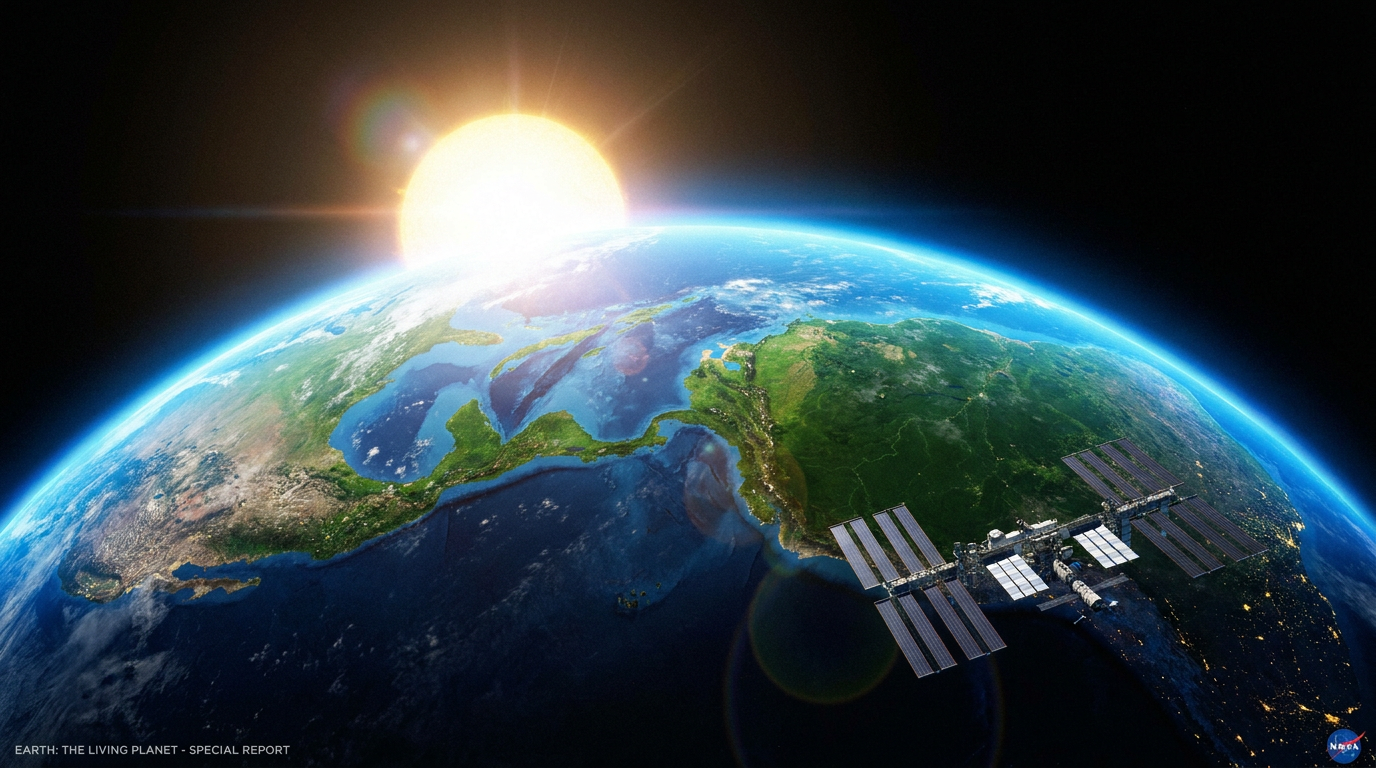
A revised climate and geological model suggests Earth's plants will not starve from a lack of carbon dioxide as the Sun brightens. Instead, the biosphere's habitable window has been extended to nearly 1.8 billion years, boosting the mathematical odds of finding intelligent life elsewhere in the universe.
By Factlen Editorial Team
- Earth System Modelers
- Focuses on the precise mechanics of the carbonate-silicate cycle, weathering rates, and the geological feedback loops that regulate planetary temperatures.
- Astrobiologists
- Examines how an extended biosphere lifespan increases the mathematical probability of intelligent life evolving on exoplanets.
- Deep-Time Forecasters
- Focuses on the ultimate timeline and thermal fate of the planet as the Sun continues its inevitable expansion.
What's not represented
- · Exoplanet observational astronomers
Why this matters
By proving that Earth's natural climate thermostat is more resilient than previously thought, this discovery not only delays our local doomsday but dramatically shifts the mathematical odds of finding intelligent life elsewhere in the cosmos.
Key points
- Previous models predicted Earth's plants would starve from a lack of CO2 in roughly one billion years.
- New research shows that the geological drawdown of CO2 will slow down, preventing carbon starvation.
- Complex life is now expected to survive for up to 1.86 billion years, until extreme heat boils the oceans.
- The 500-million-year extension suggests intelligent life may be mathematically more common in the universe.
The ultimate fate of Earth has long been a settled, if grim, consensus in planetary science. As the Sun ages, it burns brighter, and for decades, researchers believed this intensifying solar radiation would trigger a "carbon catastrophe" that would suffocate Earth's biosphere in roughly one billion years.[5][6]
But a new geological and climate model has rewritten the planet's obituary. According to research published in The Planetary Science Journal, complex life on Earth may actually survive for up to 1.86 billion years—granting the biosphere an unexpected 500 to 800 million-year extension.[1][4]
The findings fundamentally alter our understanding of planetary habitability. By proving that Earth's natural thermostat is far more resilient than previously thought, the study not only delays our local doomsday but dramatically shifts the mathematical odds of finding intelligent life elsewhere in the universe.[1][2]
To understand this stay of execution, one must understand the mechanism that was originally supposed to kill us: the carbonate-silicate cycle. This slow, geological process acts as Earth's long-term climate thermostat, regulating the amount of carbon dioxide in the atmosphere over millions of years.[3][4]

As the Sun ages, it fuses hydrogen into helium, becoming denser and burning hotter. Its luminosity increases by roughly 10 percent every billion years. As the Sun brightens, Earth's surface temperature naturally rises.[2][3]
This warming accelerates a process called silicate weathering. Rainwater, which contains dissolved carbon dioxide in the form of weak carbonic acid, breaks down silicate rocks on land. The carbon is washed into the oceans and eventually locked away in limestone on the seafloor, drawing CO2 out of the air.[2][6]
In 1992, planetary scientists Ken Caldeira and James Kasting published a landmark paper predicting how this cycle would end. They calculated that as the Sun brightened, hyper-accelerated weathering would aggressively strip CO2 from the atmosphere to compensate for the rising heat.[5][6]
In 1992, planetary scientists Ken Caldeira and James Kasting published a landmark paper predicting how this cycle would end.
Their model predicted that within 500 million to one billion years, atmospheric CO2 would plummet below 150 parts per million. At that threshold, C3 plants—which make up the vast majority of Earth's vegetation, including trees and most agricultural crops—would lose the ability to photosynthesize and starve.[5][6]
Shortly after, C4 plants, such as tropical grasses and corn, which can survive down to 10 parts per million of CO2, would also perish. Without flora to produce oxygen and anchor the food web, animal life would swiftly follow, leaving a barren rock populated only by single-celled microbes.[4][6]

The new research, led by R.J. Graham at the University of Chicago alongside Itay Halevy and Dorian Abbot, challenges a core assumption of that 1992 model. They re-examined how temperature and carbon levels actually affect the weathering of rocks.[3][4]
Using updated geological data, Graham's team found that silicate weathering is only weakly dependent on temperature, but strongly dependent on the amount of CO2 already in the air. This crucial distinction changes the entire mathematical trajectory of the planet's atmosphere.[3][4]
This dynamic creates a negative feedback loop that saves the plants. As CO2 levels drop, the weathering process itself slows down, preventing a catastrophic plunge. The drawdown of carbon temporarily reverses, stabilizing the atmosphere just enough to avert mass CO2 starvation.[3][4]
The interplay between climate, plant productivity, and weathering causes the future luminosity-driven CO2 decrease to slow, the authors note in their paper. This dynamic extends the survival of vascular land plants to between 1.6 and 1.86 billion years from now.[4]
The biosphere will still eventually die, but the kill mechanism has changed. Rather than suffocating from a lack of carbon, life will ultimately be boiled away. Around the 1.8 billion-year mark, the sheer heat of the brightening Sun will trigger a "moist greenhouse transition," evaporating the oceans and halting photosynthesis through extreme thermal stress.[4]
Beyond Earth, this 500-million-year extension has profound implications for astrobiology and the search for extraterrestrial intelligence. The timeline of a planet's habitability is the most critical variable in determining whether complex life has time to evolve.[1][2]

Evolutionary biologists often use the "hard steps" model to explain why intelligent life is rare. This theory posits that certain evolutionary leaps—like the genesis of complex cells, multicellularity, or human-level intelligence—are statistically improbable and require vast oceans of time to occur.[2][4]
If Earth's habitable window is nearly two billion years longer than we thought, it implies that the timeline required to clear these hard steps is more forgiving. As the researchers note, this suggests that the emergence of intelligent life might be a less difficult, and consequently more common, process across the cosmos than previously assumed.[2][4]
How we got here
4.5 billion years ago
Earth forms, and the Sun begins fusing hydrogen into helium, slowly brightening over time.
1992
Scientists Ken Caldeira and James Kasting publish a model predicting the biosphere will die from CO2 starvation in one billion years.
2024
A revised model by University of Chicago researchers reveals that CO2 drawdown will slow, extending the biosphere's life.
1.8 billion years from now
The brightening Sun triggers a moist greenhouse transition, evaporating the oceans and ending complex life.
Viewpoints in depth
Earth System Modelers
Focuses on the mechanics of the carbonate-silicate cycle and rock weathering.
This camp emphasizes that Earth's climate thermostat is far more dynamic than early 1990s models suggested. By demonstrating that silicate weathering is strongly dependent on existing CO2 levels rather than just temperature, modelers have uncovered a negative feedback loop that acts as a planetary safety net. When CO2 drops too low, weathering slows down, preventing the catastrophic carbon starvation that was once thought inevitable.
Astrobiologists
Focuses on the implications for finding intelligent life on other planets.
For astrobiologists, the exact date of Earth's demise is less important than what it represents for the cosmos. The 'hard steps' model of evolution suggests that leaps like multicellularity or intelligence require immense, stable oceans of time. If Earth-like planets can maintain a functioning biosphere for 500 million years longer than previously calculated, the statistical probability of alien civilizations successfully navigating those evolutionary bottlenecks increases significantly.
What we don't know
- How cloud feedback loops will behave in a significantly hotter, brighter future atmosphere.
- Whether the water cycle will change in ways that alter the newly calculated weathering rates.
- The exact statistical probability of the 'hard steps' required for intelligent life to evolve.
Key terms
- Carbonate-silicate cycle
- A geological process that regulates Earth's climate over millions of years by moving carbon between the atmosphere, rocks, and the ocean.
- Silicate weathering
- The breakdown of rocks on Earth's surface by slightly acidic rainwater, which draws carbon dioxide out of the atmosphere.
- Moist greenhouse transition
- A severe climate state where a planet becomes so hot that its oceans begin to evaporate into space, ultimately sterilizing the surface.
- Hard steps model
- An evolutionary theory suggesting that the development of intelligent life requires overcoming a series of highly improbable biological leaps.
Frequently asked
Why is the Sun getting brighter?
As the Sun ages, it fuses hydrogen into helium in its core. This increases the core's density, allowing it to burn hotter and more efficiently, which increases its overall luminosity by about 10 percent every billion years.
What is the carbonate-silicate cycle?
It is Earth's long-term climate thermostat. Rainwater absorbs CO2 and weathers rocks on land; the carbon washes into the ocean and forms limestone, and is eventually released back into the atmosphere by volcanoes.
Why did older models predict plants would die sooner?
Previous models assumed that a hotter Sun would cause rock weathering to accelerate uncontrollably, stripping all CO2 from the atmosphere and starving plants within a billion years.
How will life on Earth ultimately end?
According to the new model, life will end in about 1.8 billion years due to extreme heat. The brightening Sun will trigger a 'moist greenhouse transition,' evaporating the oceans and halting photosynthesis.
Sources
Source coverage
6 outlets
3 viewpoints surfaced






[1]New ScientistDeep-Time Forecasters
Complex life on Earth may last 500 million years longer than expected
Read on New Scientist →[2]ScienceAlertAstrobiologists
Earth's Life Could Outlast Previous Estimates by a Billion Years
Read on ScienceAlert →[3]Universe TodayAstrobiologists
Substantial Extension of the Lifetime of the Terrestrial Biosphere
Read on Universe Today →[4]The Planetary Science JournalEarth System Modelers
Substantial Extension of the Lifetime of the Terrestrial Biosphere
Read on The Planetary Science Journal →[5]NatureEarth System Modelers
The life span of the biosphere revisited
Read on Nature →[6]ForbesDeep-Time Forecasters
Complex Life On Earth Has Only 500 Million Years Left, Says Scientist
Read on Forbes →
Every angle. Every day.
Get science stories with full source coverage and perspective breakdowns delivered to your inbox.