
Buying New Construction vs. Existing Homes in 2026
With the price per square foot reaching near-parity and builders offering aggressive incentives, the financial math between buying a new or existing home has fundamentally shifted in 2026.
By Factlen Editorial Team
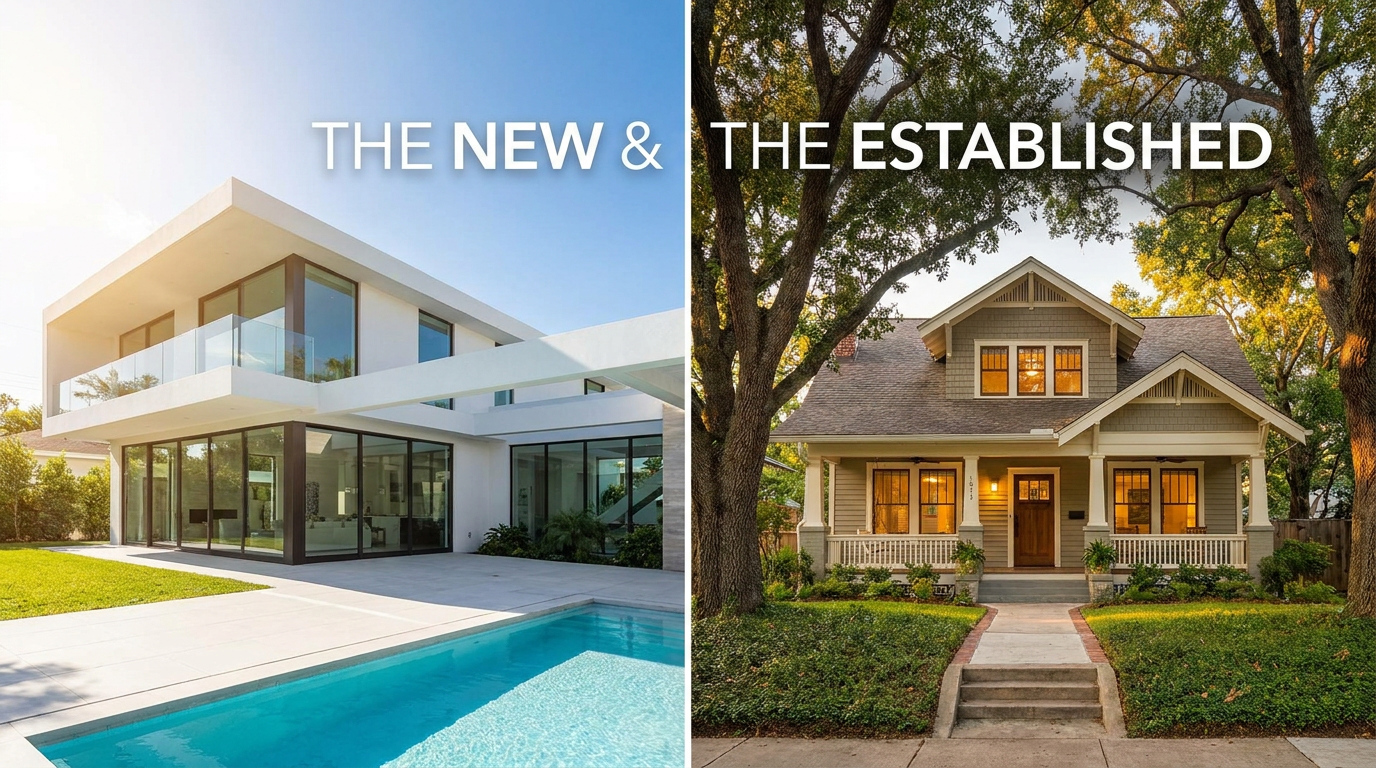
- New Construction Advocates
- Argue that modern building standards and builder incentives make new homes the smarter financial choice.
- Total-Cost Analysts
- Evaluate the market strictly through the lens of price-per-square-foot and long-term holding costs.
- Existing Home Proponents
- Focus on location, immediate availability, and the lower barrier to entry of the resale market.
What's not represented
- · Environmental Sustainability Advocates
- · Custom Home Builders
Why this matters
For decades, buyers assumed brand-new homes carried a massive luxury premium while older homes were the default budget option. In 2026, that math has flipped: near-identical per-square-foot pricing and massive energy savings mean buyers who automatically filter out new construction might be missing the most affordable path to homeownership.
Key points
- The national median price for a new home is roughly 15 percent higher than an existing home, but the price per square foot is nearly identical.
- Buyers of new construction can save an estimated $25,335 over ten years on energy and maintenance compared to a twenty-year-old home.
- Urban new construction carries a massive 78.4 percent price premium, while suburban new builds carry only a 7 percent premium.
- Builders are aggressively using mortgage rate buydowns to make new homes cheaper on a monthly basis than lower-priced existing homes.
The 2026 housing market has upended traditional assumptions about buying a home. Historically, buyers accepted that brand-new construction required a steep financial premium, while existing homes offered a more affordable entry point for the budget-conscious. Today, that dynamic has fractured entirely. With shifting supply chains, aggressive builder incentives, and an aging existing housing stock, the decision between buying new and buying old is no longer a simple question of upfront budget. Instead, it requires a complex evaluation of long-term holding costs, energy efficiency, and geographic compromises that dictate the true cost of homeownership.[3][4]
The argument for existing homes traditionally centers on the upfront sticker price. Looking strictly at the national median, existing homes still appear to offer a noticeable discount. In the first quarter of 2026, the median listing price for a new-construction home sat at roughly $449,000, compared to $390,000 for an existing home. For buyers constrained by strict loan approval limits or tight down-payment reserves, this 15 percent national premium can make existing homes seem like the only viable path. However, relying solely on the median price obscures a critical metric that levels the playing field: the actual cost of the space you acquire.[2]
The evidence reveals a market that has reached near-parity on a per-square-foot basis. Because new homes are generally built larger than older housing stock, the price per square foot tells a very different story than the median price. In early 2026, new homes commanded $217 per square foot, barely edging out existing homes at $216. This represents a massive historical shift; just a few years ago, new construction carried a heavy per-square-foot premium. Builders have actively managed their pricing to meet weaker demand, effectively erasing the traditional luxury markup associated with a brand-new build and offering buyers significantly more physical space for their money.[2]

Beyond the base price, the argument for existing homes is heavily supported by immediate availability and location variety. Existing homes offer a faster path to closing, typically allowing buyers to move in within thirty to forty-five days of an accepted offer. Furthermore, buyers purchasing older homes gain access to established communities, mature tree canopies, and central urban locations. These are neighborhood characteristics that builders simply cannot replicate overnight, offering a sense of character, walkability, and community history that many buyers deeply value over the sterile perfection of a brand-new subdivision.[3][5]
The evidence supporting the existing home route becomes overwhelming when buyers insist on living in dense city centers. Data from early 2026 reveals that urban new construction is both scarce and exorbitantly expensive. Buyers targeting new builds in urban ZIP codes face a staggering 78.4 percent price premium over existing urban homes. In contrast, the new-construction premium in suburban ZIP codes is a mere 7 percent. For city dwellers, the financial penalty for demanding a never-lived-in home is often insurmountable, making existing homes the undisputed winner in urban markets where land is at an absolute premium.[2]

The evidence supporting the existing home route becomes overwhelming when buyers insist on living in dense city centers.
The argument against existing homes, however, focuses on the hidden financial hazards of deferred maintenance and outdated infrastructure. While the upfront price and urban location might be appealing, buyers often inherit aging roofs, inefficient heating systems, and drafty windows that require immediate capital. The case for new construction is anchored in the total cost of ownership. Modern building codes and advanced materials mean that homes built today perform drastically better than those constructed even a decade ago, shielding buyers from the sudden, catastrophic repair bills that often plague older properties and derail household budgets.[1][6]
The evidence on long-term savings heavily favors new construction. Research tracking the total cost of ownership reveals that a buyer of a newly built home can expect to save over $25,000 in the first ten years compared to purchasing a twenty-year-old home. These savings are driven by a combination of drastically lower utility bills—thanks to high-performance insulation and Energy Star-rated HVAC systems—and the absence of major system replacement costs. When these monthly operational savings are factored into the budget, the initial sticker shock of a new build quickly dissipates, revealing a highly competitive long-term investment.[1]

The argument for new construction is further strengthened by the financial leverage of builder incentives. To keep inventory moving and offset the sting of elevated interest rates, builders in 2026 have aggressively utilized their corporate balance sheets to offer financing deals that individual sellers simply cannot match. Rather than dropping the recorded base price, which would harm the comparable sales values of their previous builds, builders are offering massive concessions in the form of mortgage rate buydowns, closing cost credits, and complimentary design upgrades that directly benefit the buyer's wallet.[5][6]
The evidence shows that these builder concessions can fundamentally alter the monthly payment math, often making a more expensive new home cheaper to carry on a monthly basis than a lower-priced existing home. A permanent rate buydown offered by a builder can save a buyer hundreds of dollars a month for the entire life of the loan. In many suburban markets, builders are offering incentive packages worth tens of thousands of dollars, effectively neutralizing the 7 percent suburban price premium and making new construction the more economical choice on a cash-flow basis.[6]
Ultimately, the new construction path fits well when a buyer has a flexible move-in timeline and prioritizes predictable monthly expenses over immediate location. It is the optimal choice for buyers who want the peace of mind that comes with multi-year structural warranties and the modern layouts required for remote work. Financially, it fits exceptionally well for buyers targeting suburban or developing areas where builder inventory is high, land is cheaper, and aggressive rate-buydown incentives are readily available to significantly lower the monthly mortgage payment and offset the initial purchase premium.[4][6]
Conversely, the new construction route does not fit well when buyers are on a strict relocation schedule and need to occupy a home within a month. It is also a poor fit for buyers who demand the architectural character of historic properties or insist on living in dense urban centers, where new builds carry a massive, near-80 percent price premium. For those who value mature neighborhoods, shorter commutes to downtown cores, and are comfortable maintaining an older property, the existing home market remains the most practical and financially viable option.[2][3]
How we got here
2013
New homes cost roughly 36 percent more than existing homes, establishing a massive premium for new construction.
2020–2022
The pandemic drives a surge in demand for new homes as buyers seek modern layouts and existing inventory plummets.
2023
The price gap between new and existing homes shrinks to just 9 percent as existing homeowners refuse to sell and give up low mortgage rates.
Early 2026
The price per square foot between new and existing homes reaches near-parity, fundamentally changing the financial calculus for buyers.
Viewpoints in depth
New Construction Advocates
Argue that modern building standards and builder incentives make new homes the smarter financial choice.
This camp emphasizes that the upfront purchase price is only a fraction of the homeownership story. By factoring in the massive energy savings from modern insulation, the lack of immediate repair bills, and the aggressive mortgage rate buydowns offered by corporate builders, they argue that new construction is actually cheaper on a month-to-month cash-flow basis. They view older homes as financial liabilities hiding behind a lower initial sticker price.
Existing Home Proponents
Focus on location, immediate availability, and the lower barrier to entry of the resale market.
Proponents of the resale market highlight that existing homes offer unparalleled access to established neighborhoods, mature landscaping, and shorter urban commutes. They argue that the 15 percent national price premium for new construction prices out many first-time buyers who are constrained by strict loan limits. Furthermore, they point out that existing homes allow buyers to move in within weeks, avoiding the unpredictable delays and supply chain issues that often plague new construction timelines.
Total-Cost Analysts
Evaluate the market strictly through the lens of price-per-square-foot and long-term holding costs.
This analytical camp strips away the emotional appeal of both brand-new finishes and historic charm, focusing entirely on the math. They point out that in 2026, the price per square foot between new and existing homes has reached near-parity at roughly $216 to $217. They advise buyers to base their decisions on geographic data, noting that while suburban new construction is a statistical bargain, demanding a new build in an urban core carries an irrational 78 percent financial penalty.
What we don't know
- Whether builder incentives will remain as aggressive if the Federal Reserve significantly cuts baseline interest rates later in 2026.
- How long the price-per-square-foot parity will last if supply chain disruptions for raw materials like lumber and copper accelerate.
Key terms
- Price per square foot
- A real estate metric that divides the total price of a home by its livable floor area, allowing for an apples-to-apples comparison of value between different sized properties.
- Mortgage rate buydown
- A financing incentive where a builder or seller pays an upfront fee to lower the buyer's interest rate, reducing their monthly mortgage payment.
- Total cost of ownership
- A financial calculation that includes not just the purchase price, but ongoing expenses like utilities, maintenance, and system replacements over time.
- Urban infill
- New construction built on vacant or underused lots within an already established, densely populated urban area.
Frequently asked
Is new construction always more expensive than an existing home?
While the median overall price is typically higher, the price per square foot in 2026 is nearly identical. In some suburban markets, builder incentives actually make new homes cheaper on a monthly basis.
How much can I save on energy with a new home?
Data shows that buyers can save upwards of $25,000 over ten years on combined energy and maintenance costs compared to a twenty-year-old home.
Do builders negotiate on price like regular sellers?
Builders rarely negotiate the base purchase price to protect neighborhood comparable sales, but they frequently negotiate by offering mortgage rate buydowns, design upgrades, and closing cost credits.
Why is new construction so expensive in cities?
Land scarcity and development regulations in urban cores drive up costs, resulting in a nearly 80 percent premium for urban new builds compared to existing urban homes.
Sources
Source coverage
6 outlets
3 viewpoints surfaced





[1]Realtor.comTotal-Cost Analysts
Total Cost of Ownership: Where Lower Operating Costs Offset the New-Construction Price Premium
Read on Realtor.com →[2]HousingWireTotal-Cost Analysts
Builders discount more but keep prices flat while resale values slip
Read on HousingWire →[3]ZillowExisting Home Proponents
New Construction vs Existing Homes: The Pros and Cons of Both
Read on Zillow →[4]National Association of Home BuildersNew Construction Advocates
Preference for New Homes Keeps Rising
Read on National Association of Home Builders →[5]AmeriSaveNew Construction Advocates
Buying a House in 2026: 7 Essential Cost Comparisons
Read on AmeriSave →[6]Fox Real EstateTotal-Cost Analysts
New Construction vs Existing Homes in 2026: Which One Actually Saves You More Money Long Term?
Read on Fox Real Estate →
Every angle. Every day.
Get real estate stories with full source coverage and perspective breakdowns delivered to your inbox.