
Block Applies for National Trust Bank Charter to Bring Crypto Custody Under Federal Oversight
Jack Dorsey’s payments company has filed with the OCC to establish Builders Bank & Trust, an uninsured national bank focused exclusively on digital asset custody. The move signals a push to consolidate Block's bitcoin and stablecoin operations under a single federal regulatory framework rather than a patchwork of state licenses.

Share this story
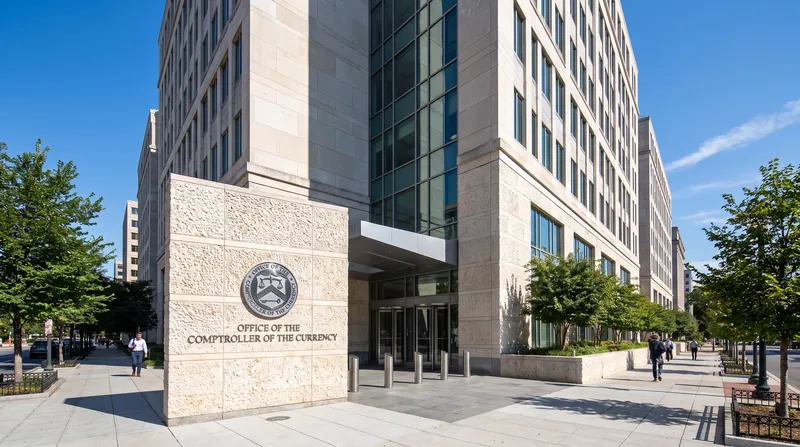
On September 8, 2026, Block, Inc. formally submitted an application to the Office of the Comptroller of the Currency to charter a new financial institution: Builders Bank & Trust, N.A. The proposed entity is structured as an uninsured national trust bank, designed specifically to bring the company's digital asset custody operations under direct federal supervision. If approved, the bank will operate with $0 in Federal Deposit Insurance Corporation backing, as it will not accept retail deposits or issue commercial loans.[1]
Instead, Builders Bank will be 100% focused on providing institutional-grade fiduciary custody and safekeeping for digital assets, explicitly naming bitcoin and stablecoins in its filing. The move represents a structural shift for the payments company led by Jack Dorsey, transitioning its existing crypto operations from a fragmented state-by-state regulatory model into a unified national framework.[1][3]
The application arrives as financial technology companies increasingly seek to own their regulatory relationships directly rather than relying on third-party sponsor banks. On the exact same day Block announced its OCC filing, digital banking platform Chime revealed a $590 million agreement to acquire its longtime partner, Stride Bank. For Block, securing a federal trust charter would provide the preemption necessary to scale its custody business nationally without navigating 50 separate state licensing regimes.[2][3]
"Block already self-custodies bitcoin in most cases, so the charter is likely primarily about federal preemption supporting better scale with growth at the federal regulatory level versus a state-level patchwork," analysts at KeyBanc Capital Markets noted following the filing. The analysts added that Block's digital asset focus remains heavily weighted toward bitcoin, with stablecoins adopted primarily in response to customer demand.[2]
The proposed trust bank would operate separately from Block's existing banking subsidiary, Square Financial Services. That entity, based in Salt Lake City, received an industrial loan company charter from Utah regulators in 2020 and handles the company's traditional merchant lending and payment processing services. By establishing Builders Bank as a distinct, non-deposit-taking trust, Block aims to isolate its digital asset custody functions from its broader consumer and commercial finance operations.[2][3]
To lead the new venture, Block has named Lee Woolley as the prospective president and chief executive officer of Builders Bank. Woolley currently serves as Block's digital asset strategy lead and brings more than 20 years of traditional banking experience to the role. His previous positions include serving as president and CEO of the Treasury Department Federal Credit Union, alongside senior leadership roles at Northern Trust and BNY Mellon.[1]
"Building on Block's experience in the digital asset space, our history with Square Financial Services, and the deep banking expertise of the team we've assembled, we believe Builders Bank is well positioned to support Block's broader vision of economic empowerment," Woolley stated in the company's announcement.[1]
Block is joining a growing queue of cryptocurrency and financial technology firms pursuing national trust charters from the OCC. The regulatory pathway was initially pioneered in 2021 when Anchorage Digital received the first conditional approval for a federal crypto bank charter. Since then, firms including Circle, BitGo, and Paxos have navigated similar OCC applications to legitimize their custody and stablecoin operations under federal oversight.[3][4]
The application now enters a standard OCC review process, which includes a mandatory 30-day public comment period. Regulators will evaluate Builders Bank's proposed capital adequacy, risk management protocols, internal controls, and governance structure. Block has emphasized that the filing is merely step 1, and Builders Bank will not commence any operations until it receives all required regulatory clearances.[1][4]
Viewpoints in depth
Fintech Innovators
Advocate for unified federal charters to scale digital asset operations efficiently.
For companies like Block, navigating 50 distinct state money transmitter licenses is a massive operational bottleneck. Proponents of the OCC trust charter argue that a single federal supervisory framework allows digital asset custodians to scale nationally while adhering to a consistent set of institutional-grade compliance and security standards.
Federal Regulators
Support bringing crypto custody into the federal perimeter while isolating it from insured deposits.
Federal banking regulators have generally favored the uninsured trust bank model for digital assets because it ring-fences volatile crypto operations away from the traditional banking system. By denying these entities the ability to take retail deposits or issue loans, the OCC ensures that any potential failure in the crypto custody space does not drain the FDIC insurance fund or trigger broader systemic contagion.
Market Analysts
View the charter push primarily as an operational scaling tactic rather than a product expansion.
Financial analysts emphasize that Block already self-custodies bitcoin for its users. From a market perspective, the OCC application is less about launching entirely new consumer products and more about securing the federal preemption necessary to streamline backend operations and reduce long-term compliance costs as the business grows.
Key points
- Block has applied to the OCC to charter Builders Bank & Trust, an uninsured national trust bank.
- The proposed bank will focus exclusively on providing custody and fiduciary services for bitcoin and stablecoins.
- Builders Bank will not accept retail deposits, issue loans, or carry FDIC insurance.
- The charter would allow Block to consolidate its crypto operations under a single federal framework, bypassing 50-state licensing.
- Fintech Innovators
- Advocate for unified federal charters to scale digital asset operations efficiently.
- Federal Regulators
- Support bringing crypto custody into the federal perimeter while isolating it from insured deposits.
- Market Analysts
- View the charter push primarily as an operational scaling tactic rather than a product expansion.
Perspectives this story doesn't cover
- State Banking Supervisors
- Retail Crypto Investors
Sources
Source coverage
4 outlets
3 viewpoints surfaced




- [1]Block, Inc.Fintech Innovators
Block Applies to Establish Builders Bank, a National Trust Bank
Read on Block, Inc. → - [2]American BankerMarket Analysts
Block seeks national trust charter to offer crypto custody
Read on American Banker → - [3]The BlockFintech Innovators
Why Jack Dorsey's Block Is Seeking an OCC Charter to Bypass 50-State Licensing
Read on The Block → - [4]Factlen Editorial TeamFederal Regulators
Synthesis by Factlen editorial team
Read on Factlen Editorial Team →
More in Finance
See all →Crypto Regulation
ESCB Urges EU to Scrap MiCA Stablecoin Deposit Rule Over Banking System Risks
6 sources

Fintech Regulation
BNPL Giant Sezzle Pivots to National Bank Charter to Escape Patchwork of State Regulations
6 sources
Central Bank Accounting
Fiat Solvency Without Capital: Why Central Banks Cannot Go Bankrupt Operating Under Negative Equity
5 sources
Cross-Border Payments
Why SWIFT Moves No Money: The Mechanics of Nostro and Vostro Ledgers in Global Finance
3 sources

Comments
Every angle. Every day.
Get Finance stories with full source coverage and perspective breakdowns, free every day.