
Beyond the Script: How Generative AI is Bringing Video Game Characters to Life
Driven by large language models and real-time animation tools, non-playable characters are evolving from rigid, scripted puppets into dynamic agents capable of unscripted conversation and persistent memory.
By Factlen Editorial Team
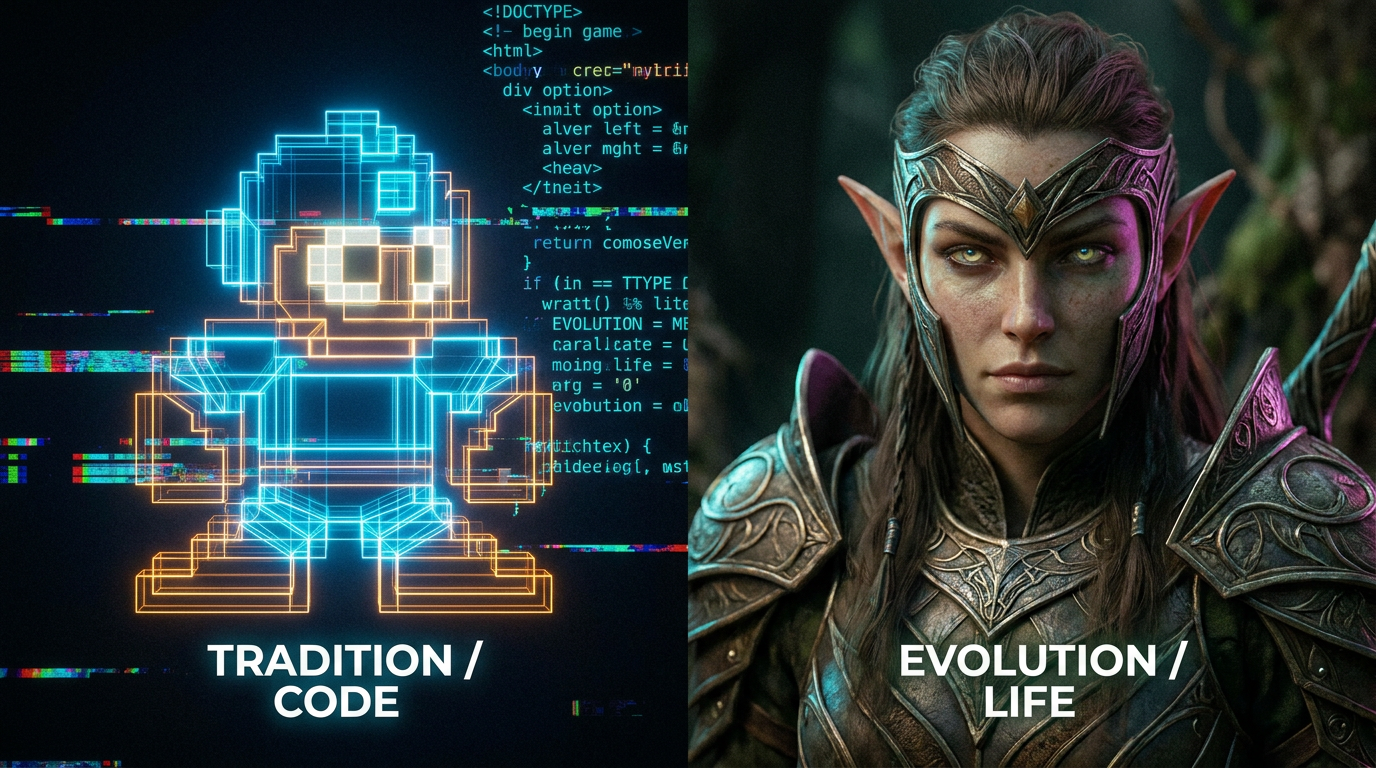
- Emergent Storytellers
- Advocates for AI-driven, infinite replayability and living worlds.
- Authorial Traditionalists
- Advocates for hand-crafted, emotionally resonant, scripted narratives.
- Production Pragmatists
- Producers focused on the unit economics, inference costs, and latency challenges.
What's not represented
- · Voice actors concerned about AI replacing their labor and the ethics of voice cloning
- · Players with low-end hardware who may be excluded from local-compute AI features
Why this matters
For decades, video game worlds have felt like elaborate theme parks populated by animatronic puppets. The integration of generative AI transforms these static environments into living, breathing ecosystems, offering players infinite replayability and deeply personalized storytelling that adapts to their unique choices.
Key points
- Generative AI is replacing static dialogue trees with dynamic, unscripted character interactions.
- AI NPCs use vector databases to remember past player interactions across multiple play sessions.
- Writers now craft behavioral prompts and guardrails rather than writing every line of dialogue.
- Cloud inference costs remain a major economic hurdle for widespread adoption in single-player games.
- Hardware manufacturers are integrating NPUs to run AI models locally, reducing latency and server costs.
For decades, the non-playable character (NPC) has been the ultimate illusion in video games. They populate bustling fantasy taverns and neon-lit cyberpunk streets, but their intelligence is a facade built on rigid scripts and dialogue trees. Once a player exhausts an NPC's pre-written lines, the character is reduced to repeating the same phrase endlessly, shattering the immersion.[1]
But in 2026, we are witnessing a fundamental architectural shift in how virtual worlds are built. Driven by the maturation of large language models (LLMs) and real-time generative animation, studios are abandoning static scripts in favor of dynamic, AI-driven character brains. According to industry data, 62% of new role-playing and adventure games in development this year feature AI-powered NPCs, a massive leap from just 8% in 2024.[3][5]
The mechanism behind this transformation is a complex, multi-layered technology stack that operates in milliseconds. When a player speaks into their microphone, automatic speech recognition translates the audio to text. This text is fed into a custom LLM acting as the character's brain, which generates a contextually appropriate response.[4]
That text response is then pushed through a text-to-speech engine to synthesize the character's voice, while tools like Nvidia's Audio2Face dynamically generate matching facial animations and lip-syncing in real time. Platforms like Inworld AI and Convai provide the underlying infrastructure, allowing developers to plug these "living" characters directly into engines like Unreal and Unity.[3][4]

Crucially, this does not eliminate the role of the human game writer; it simply changes the medium. Instead of writing every possible branch of a conversation, narrative designers now craft intricate prompts that define an NPC's personality, backstory, emotional triggers, and knowledge base.[3]
These parameters act as strict guardrails. They ensure that a medieval blacksmith doesn't hallucinate a conversation about modern sports, keeping the generative output strictly within the game's lore and tone. The writer defines the soul, and the AI improvises the performance based on the player's unique input.[3]
The most profound upgrade to the NPC experience is the introduction of persistent memory. Traditional game characters suffer from perpetual amnesia, reacting only to binary database flags like whether a specific quest is complete.[2]
Modern AI NPCs utilize vector databases to simulate both short-term and long-term memory. Short-term memory tracks the immediate flow of a conversation, ensuring the character doesn't repeat themselves or lose the thread of the chat.[2]
Long-term memory, however, allows an NPC to recall a player's actions from weeks prior. A shopkeeper might remember that the player haggled aggressively during their last visit, or a guard might hold a grudge because the player previously allied with a rival faction. This semantic retrieval makes the world feel genuinely reactive.[2]
Long-term memory, however, allows an NPC to recall a player's actions from weeks prior.
This technology is also giving rise to what developers are calling "agentic games." Rather than waiting for the player to initiate an interaction, these AI agents operate with their own internal motivations, schedules, and goals.[7]
In early prototypes like Parallel Studios' survival simulation Colony, AI agents can actually refuse a player's commands if the order conflicts with the NPC's own survival instincts or personality. This forces players to negotiate, bribe, or persuade characters, turning dialogue into a dynamic gameplay mechanic rather than a cinematic cutscene.[7]

Despite the creative breakthroughs, the widespread adoption of generative AI in gaming faces a brutal economic reality: the cost of inference. In a traditional game, rendering a line of dialogue costs the studio nothing once the game is shipped.[6]
With AI NPCs, every time a player chats with a character, the game must ping a cloud-based LLM, incurring a fractional compute cost. For games designed to be played for hundreds of hours by millions of players, these API calls can quickly destroy a studio's profit margins.[6]
Developers are forced to ask whether the added immersion of an unscripted chat is worth the ongoing server costs. If the AI doesn't directly increase player retention or monetization, the unit economics simply do not work for traditional single-player titles.[6]

Latency presents another significant hurdle. Human conversation relies on rapid back-and-forth pacing. If an AI NPC takes three seconds to process a player's voice, generate a response, and animate the facial rigging, the interaction feels sluggish and robotic, breaking the very immersion the technology is meant to build.[8]
To solve both cost and latency, the hardware industry is racing to move AI processing from the cloud to the local machine. The integration of Neural Processing Units (NPUs) into modern gaming PCs and consoles allows smaller, highly optimized models to run directly on the player's hardware.[8]
There is also a philosophical debate within the industry regarding authorial intent. Traditionalists argue that the emotional peaks of gaming—like the carefully orchestrated narratives of critically acclaimed blockbusters—rely on bespoke, hand-crafted dialogue that an improvisational AI cannot replicate.[8]

Conversely, immersion advocates believe that the future of interactive entertainment lies in emergent storytelling, where the player and the game world co-author a completely unique narrative that no other player will experience.[8]
Ultimately, we expect the industry to settle on a hybrid approach. Major plot points and cinematic moments will likely remain hand-scripted by human writers to guarantee emotional impact, while the broader world—the townsfolk, the merchants, the wandering travelers—will be handed over to generative AI.[8]
As these systems mature, the promise of the living video game world is finally materializing. Players are no longer just consumers of a static script; they are active participants in a responsive ecosystem that listens, remembers, and plays back.[8]
How we got here
2023
Nvidia unveils the Avatar Cloud Engine (ACE) at Computex, showcasing real-time AI NPC interactions.
2024
Early AI NPC mods flood older games like Skyrim, demonstrating potential but highlighting latency issues.
2025
Studios begin integrating vector databases, granting NPCs persistent long-term memory across play sessions.
2026
Agentic games emerge, featuring AI characters capable of refusing player commands based on their own goals.
Viewpoints in depth
Emergent Storytellers
Advocates for AI-driven, infinite replayability and living worlds.
This camp, largely composed of technologists and forward-thinking game designers, argues that the future of gaming lies in systems that react unpredictably to the player. They view traditional dialogue trees as an outdated bottleneck. By handing the reins over to generative AI, they believe games can offer infinite replayability, where every player's journey and relationships within the game world are entirely unique.
Authorial Traditionalists
Advocates for hand-crafted, emotionally resonant, scripted narratives.
Narrative designers and traditional studio heads caution against over-relying on AI for storytelling. They argue that the emotional resonance of critically acclaimed games stems from deliberate, human-authored pacing, subtext, and performance. In their view, an improvisational AI might generate endless content, but it often lacks the thematic depth and emotional punch of a carefully crafted script.
Production Pragmatists
Producers focused on the unit economics, inference costs, and latency challenges.
For studio executives and producers, the debate is less about art and more about math. They point out that while AI NPCs make for great tech demos, the recurring cloud inference costs associated with millions of players chatting with an LLM can quickly bankrupt a studio. This group insists that until on-device processing becomes the standard, AI NPCs must be used sparingly to protect profit margins.
What we don't know
- Whether players will ultimately prefer the unpredictability of AI over the tight pacing of hand-crafted narratives.
- How quickly local NPUs will become powerful enough to run complex character brains without relying on the cloud.
Key terms
- Non-Playable Character (NPC)
- A video game character controlled by the computer rather than the player.
- Large Language Model (LLM)
- An AI system trained on vast amounts of text, capable of understanding and generating human-like language.
- Vector Database
- A type of database used by AI to store and quickly retrieve semantic memories and context, acting as an NPC's long-term memory.
- Inference Cost
- The compute expense incurred every time an AI model is asked to process data and generate a response.
- Agentic Game
- A game design philosophy where AI characters have their own autonomous goals, schedules, and motivations, rather than just waiting for player interaction.
Frequently asked
Will AI NPCs replace human game writers?
No. Writers are essential for crafting the complex prompts, lore, and behavioral guardrails that give AI characters their distinct personalities.
Do games with AI NPCs require a constant internet connection?
Currently, most rely on cloud-based APIs, requiring an internet connection. However, the industry is moving toward running smaller AI models locally on the player's hardware.
Can players trick AI NPCs into breaking the game's lore?
Developers use strict parameters and custom models to prevent 'hallucinations,' ensuring characters stay in-universe and don't discuss real-world topics.
Why don't all games use AI NPCs yet?
The primary barriers are the recurring cloud computing costs (inference) and the latency required to generate real-time voice and animation.
Sources
Source coverage
8 outlets
3 viewpoints surfaced








[1]GamesD AppEmergent Storytellers
AI NPCs: Creating Smarter and More Immersive Game Worlds
Read on GamesD App →[2]Aivexify
How AI NPCs Work
Read on Aivexify →[3]NaavikProduction Pragmatists
How AI NPCs Work and Their Impact on Gaming
Read on Naavik →[4]WccftechEmergent Storytellers
NVIDIA ACE & Inworld AI Are Bringing Lifelike NPCs To Next-Gen Games
Read on Wccftech →[5]AI Buzz Blog
AI in Game Development in 2026: The State of the Industry
Read on AI Buzz Blog →[6]Frisson LabsProduction Pragmatists
Where are all the AI NPCs?
Read on Frisson Labs →[7]GameList+
Agentic Games: AI Characters That Refuse Commands
Read on GameList+ →[8]Factlen Editorial TeamAuthorial Traditionalists
Synthesis by Factlen editorial team
Read on Factlen Editorial Team →

More in technology
See all 83 stories →Infrastructure Defense
How Autonomous AI Agents Are Becoming the Primary Defense for EV Charging Networks
7 sources

AI Metacognition
Google Researchers Propose 'Faithful Uncertainty' to Solve AI Hallucinations
6 sources

Space Economy
SpaceX Completes Historic $75 Billion IPO: How the Space Economy Just Changed
8 sources

AI Reliability
How Google’s 'Faithful Uncertainty' Research Aims to Fix AI Hallucinations
6 sources

Every angle. Every day.
Get technology stories with full source coverage and perspective breakdowns delivered to your inbox.