
Beyond Planting: How Acoustic Enrichment and Micro-Fragmentation Are Rebuilding Coral Reefs
Marine biologists are deploying a new suite of high-tech interventions, from underwater soundscapes to rapid-growth cloning, to actively engineer the recovery of the world's coral reefs.
By Factlen Editorial Team
- Marine Biologists and Technologists
- Advocates for active, technology-driven interventions to accelerate reef recovery and build resilience.
- Climate Policy Advocates
- Emphasizes that technological fixes must be paired with massive global funding and strict emissions reductions.
- Coastal Communities and Eco-Tourism
- Focuses on the immediate economic and protective benefits of restored reefs for local livelihoods.
What's not represented
- · Commercial fishing industries affected by new marine protected areas
- · Fossil fuel industries responsible for the carbon emissions driving ocean warming
Why this matters
Coral reefs support a quarter of all marine life and the livelihoods of over a billion people. These new technologies offer a scalable blueprint to rebuild these foundational ecosystems before they are lost to climate change.
Key points
- Micro-fragmentation allows slow-growing massive corals to grow up to 50 times faster by triggering a rapid healing response.
- Acoustic enrichment uses underwater speakers to play healthy reef sounds, increasing coral larval settlement by up to seven times.
- Scientists are transplanting "super corals" from extreme environments to breed heat-resilient reefs capable of surviving warming oceans.
- The UN-backed Coral Reef Breakthrough aims to mobilize $12 billion to protect and restore 125,000 square kilometers of reef by 2030.
- Experts warn that these technologies buy crucial time but cannot replace the urgent need to reduce global carbon emissions.
For decades, the narrative surrounding the world’s coral reefs has been one of inevitable decline. Rising ocean temperatures, ocean acidification, and local pollution have triggered mass bleaching events, threatening ecosystems that support a quarter of all marine life. But beneath the surface, a quiet revolution in marine biology is shifting the paradigm from passive conservation to active, high-tech ecosystem engineering.[6]
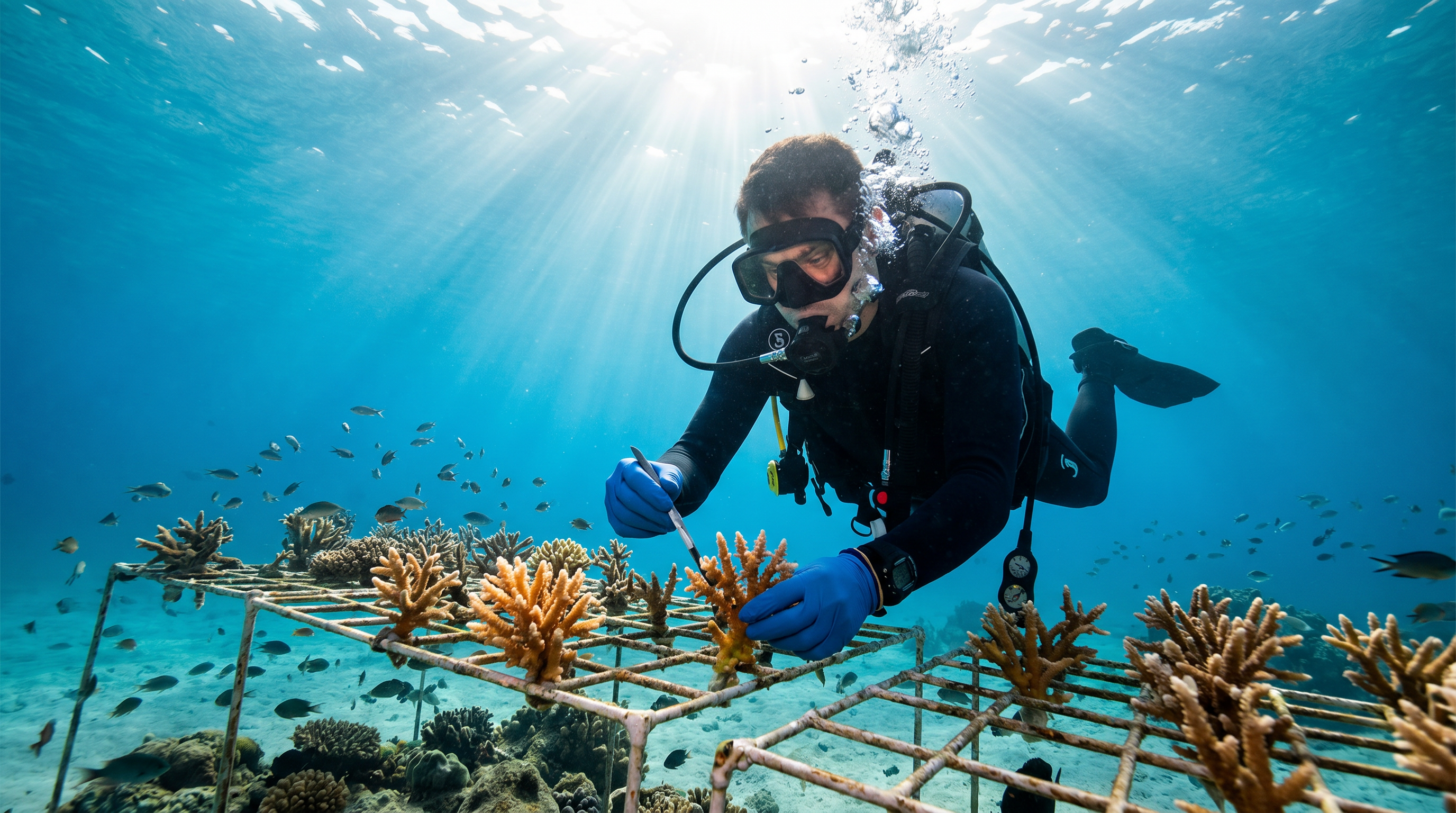
Traditional reef restoration relied heavily on "coral gardening"—manually breaking off pieces of fast-growing branching corals, growing them in underwater nurseries, and replanting them. While effective on a small scale, the process is labor-intensive and struggles to keep pace with the rate of global reef degradation. Today, scientists are deploying a new suite of interventions that manipulate coral biology and behavior to accelerate recovery by orders of magnitude.[6]
At the forefront of this shift is a technique known as micro-fragmentation. Pioneered to address the notoriously slow growth rates of "massive" coral species—such as brain, boulder, and star corals—the process involves using specialized diamond-blade band saws to cut adult corals into tiny fragments, often no larger than a single square centimeter or containing just one to five polyps.[3]
To a layperson, slicing a living animal into microscopic pieces might seem counterintuitive to conservation. However, this deliberate trauma triggers an extraordinary biological response. When sectioned so severely, the coral prioritizes tissue repair over normal metabolic functions, leading to rapid cell division and regeneration.[3]

The results are staggering. Marine biologists have documented that micro-fragmented corals grow at 25 to 50 times their natural rate. Because corals are clonal animals, when these rapidly expanding fragments are placed near each other on a degraded reef, they recognize their identical genetics and fuse back together, forming a large, sexually mature colony in a fraction of the time it would take in nature.[3]
This breakthrough has fundamentally changed what is possible in reef restoration. Previously, massive corals were largely excluded from restoration projects because a boulder coral might take decades to grow to the size of a basketball. Now, these resilient, reef-building species can be cultivated in months, allowing conservationists to rebuild the structural foundation of reefs rather than just the fragile branching canopy.[3][6]

But growing coral is only half the battle; getting new generations of coral to naturally settle and thrive on a degraded reef is equally critical. This is where the emerging science of "acoustic enrichment" comes into play.[6]
A healthy coral reef is a remarkably noisy place. It crackles with the continuous popping of snapping shrimp and hums with the grunts, clicks, and purrs of feeding and mating fish. For decades, scientists assumed coral larvae—tiny, free-swimming organisms known as planulae—drifted aimlessly on ocean currents until they bumped into a suitable surface.[1]
Recent research has proven otherwise. Coral larvae are covered in microscopic hairs called cilia, which they use to sense their environment and actively swim toward the sounds of a vibrant ecosystem. A degraded, bleached reef, devoid of fish and shrimp, is eerily silent, offering no acoustic cues to attract passing larvae.[1][4]
Coral larvae are covered in microscopic hairs called cilia, which they use to sense their environment and actively swim toward the sounds of a vibrant ecosystem.
To bridge this gap, researchers from the Woods Hole Oceanographic Institution (WHOI) and other marine labs have begun deploying underwater speaker systems, known as Reef Acoustic Playback Systems (RAPS), into dead reef zones. By broadcasting high-fidelity recordings of healthy reefs, they artificially recreate the acoustic signature of a thriving ecosystem.[1]

The data from these acoustic enrichment trials is highly promising. In field studies, coral larvae settled at significantly higher rates in acoustically enriched areas compared to silent control sites. Some species demonstrated settlement rates up to seven times higher within the first 36 hours of exposure to the broadcasted soundscapes.[1][4]
Furthermore, the speakers do not just attract coral. The broadcasted sounds also draw in juvenile fish across multiple trophic levels, including herbivores that graze on algae. By keeping algae in check, these fish create clean benthic substrate, which is essential for coral larvae to successfully attach and grow, creating a positive feedback loop of ecosystem recovery.[4][6]
Even with accelerated growth and enhanced settlement, restored reefs face the looming threat of future marine heatwaves. To ensure that newly planted corals survive a warming ocean, researchers are turning to "super corals"—strains that have naturally adapted to survive in extreme environments.[2]
In a landmark 2025 study, scientists from the University of Technology Sydney (UTS) focused on corals living in shallow mangrove lagoons on the Great Barrier Reef. These lagoons experience harsh, fluctuating temperatures, low oxygen, and high salinity—conditions that would quickly kill a typical reef coral.[2]
The researchers transplanted these resilient specimens to cooler, more stable reef environments to see if they would lose their hardiness. After a year of monitoring, gene expression analysis revealed that the transplanted corals retained their elevated heat tolerance, actively maintaining biological pathways associated with DNA repair and metabolic homeostasis.[2]
Similar discoveries of heat-resistant corals have been made in the semi-enclosed lagoons of French Polynesia’s Tatakoto atoll. By identifying and selectively breeding these naturally resilient strains, scientists are practicing "assisted evolution," ensuring that the reefs being rebuilt today are equipped with the genetic tools to survive the oceans of tomorrow.[2][6]
Scaling these localized breakthroughs into a global solution requires unprecedented coordination and funding. To that end, the International Coral Reef Initiative (ICRI), backed by the UN and the Global Fund for Coral Reefs, recently launched the Coral Reef Breakthrough.[5]
This global mandate aims to secure the future of at least 125,000 square kilometers of shallow-water tropical coral reefs by 2030. Achieving this target requires mobilizing at least $12 billion in public and private investment to halt local drivers of loss, double the area of protected reefs, and accelerate the deployment of climate-smart restoration technologies.[5]

Despite the optimism surrounding these innovations, researchers are quick to acknowledge what we still do not know. The long-term ecological impacts of artificially manipulating reef soundscapes remain under study, and it is unclear if micro-fragmented massive corals will exhibit the same reproductive success as their naturally grown counterparts over multi-decade timelines.[6]
Most importantly, marine biologists stress that technology cannot outpace unchecked climate change. Acoustic enrichment, micro-fragmentation, and super corals are powerful tools that can buy crucial time and hold the line against ecosystem collapse. Ultimately, however, the survival of the world's coral reefs depends on the global reduction of carbon emissions to stabilize ocean temperatures.[6]
How we got here
2013
Early coral gardening pilot projects begin demonstrating the viability of underwater nurseries.
2020
Micro-fragmentation gains widespread traction as a method to rapidly grow massive, reef-building coral species.
2023
The Coral Reef Breakthrough is launched, aiming to mobilize $12 billion for global reef conservation by 2030.
Oct 2024
Woods Hole Oceanographic Institution publishes breakthrough field data showing acoustic enrichment increases coral settlement by up to seven times.
Sept 2025
University of Technology Sydney researchers demonstrate that 'super corals' retain their heat tolerance even when transplanted to new environments.
Viewpoints in depth
Marine Biologists and Technologists
Advocates for active, technology-driven interventions to accelerate reef recovery and build resilience.
For decades, marine biology focused on observing coral decline and advocating for passive protection. Today, researchers argue that passive conservation is no longer sufficient. By utilizing micro-fragmentation, acoustic enrichment, and assisted evolution, scientists believe they can actively engineer resilient ecosystems that outpace natural degradation. They point to field data showing exponential growth rates and vastly improved larval settlement as evidence that human intervention can successfully rebuild the structural foundations of the ocean.
Climate Policy Advocates
Emphasizes that technological fixes must be paired with massive global funding and strict emissions reductions.
While celebrating the scientific breakthroughs in coral restoration, climate advocates warn against viewing technology as a panacea. They argue that planting heat-resilient corals will ultimately fail if ocean temperatures continue to rise unchecked. Organizations backing the Coral Reef Breakthrough stress that the $12 billion needed for restoration must be coupled with aggressive, legally binding reductions in global carbon emissions, as well as strict regulations on local coastal pollution and overfishing.
Coastal Communities and Eco-Tourism
Focuses on the immediate economic and protective benefits of restored reefs for local livelihoods.
For the billion people living near coral reefs, restoration is not just an ecological imperative but an economic one. Local communities rely on healthy reefs to buffer coastlines from storm surges and to sustain local fisheries. Furthermore, active restoration projects have become a new driver of eco-tourism, where visitors pay to participate in coral planting and monitoring, creating a sustainable economic model that directly funds ongoing conservation efforts.
What we don't know
- Whether micro-fragmented massive corals will exhibit the same long-term reproductive success as naturally grown colonies.
- The potential unintended ecological consequences of artificially manipulating reef soundscapes over large areas.
- If the genetic resilience of 'super corals' will be enough to withstand the most extreme marine heatwaves projected for the late 21st century.
Key terms
- Micro-fragmentation
- The process of cutting coral into tiny pieces to stimulate rapid tissue regeneration and accelerated growth.
- Acoustic enrichment
- The use of underwater speakers to broadcast the sounds of a healthy ecosystem, attracting marine life to degraded areas.
- Planulae
- Free-swimming coral larvae that drift in ocean currents before settling on the seafloor to grow into adult corals.
- Benthic substrate
- The ecological zone at the lowest level of a body of water, including the sediment surface where corals attach and grow.
- Assisted evolution
- Human intervention to accelerate the natural evolutionary processes of a species, such as selectively breeding heat-tolerant corals.
Frequently asked
What is micro-fragmentation?
A technique where slow-growing massive corals are cut into tiny pieces, triggering a rapid healing response that accelerates their growth by up to 50 times.
How does acoustic enrichment work?
Underwater speakers play the sounds of a healthy, noisy reef—like snapping shrimp and fish grunts—which attracts free-swimming coral larvae to settle on degraded reefs.
What are "super corals"?
Corals that have naturally adapted to survive in extreme environments with high temperatures and low oxygen, making them valuable for breeding heat-resilient reefs.
Can technology alone save the reefs?
No. While these interventions buy crucial time and accelerate local recovery, scientists emphasize that global carbon emissions must be reduced to stop ocean warming.
Sources
Source coverage
6 outlets
3 viewpoints surfaced






[1]Woods Hole Oceanographic InstitutionMarine Biologists and Technologists
Using successful techniques from an earlier study, acoustic enrichment continues to show promise
Read on Woods Hole Oceanographic Institution →[2]University of Technology SydneyMarine Biologists and Technologists
Super corals offer hope for vulnerable reefs
Read on University of Technology Sydney →[3]Coral VitaMarine Biologists and Technologists
Coral Fragmentation: A Vital Technique for Reef Restoration
Read on Coral Vita →[4]Royal Society PublishingMarine Biologists and Technologists
Acoustic enrichment of a degraded coral reef increases larval settlement
Read on Royal Society Publishing →[5]International Coral Reef InitiativeClimate Policy Advocates
Coral Reef Breakthrough launches to prevent extinction of one of the world's most threatened ecosystems
Read on International Coral Reef Initiative →[6]Factlen Editorial TeamClimate Policy Advocates
Synthesis by Factlen editorial team
Read on Factlen Editorial Team →
Every angle. Every day.
Get environment stories with full source coverage and perspective breakdowns delivered to your inbox.