
AI Models Decode Sperm Whale 'Alphabet,' Revealing Vowel-Like Structures in Animal Communication
Using advanced machine learning, researchers have discovered that sperm whale vocalizations contain phonetic structures remarkably similar to human vowels and diphthongs.
By Factlen Editorial Team
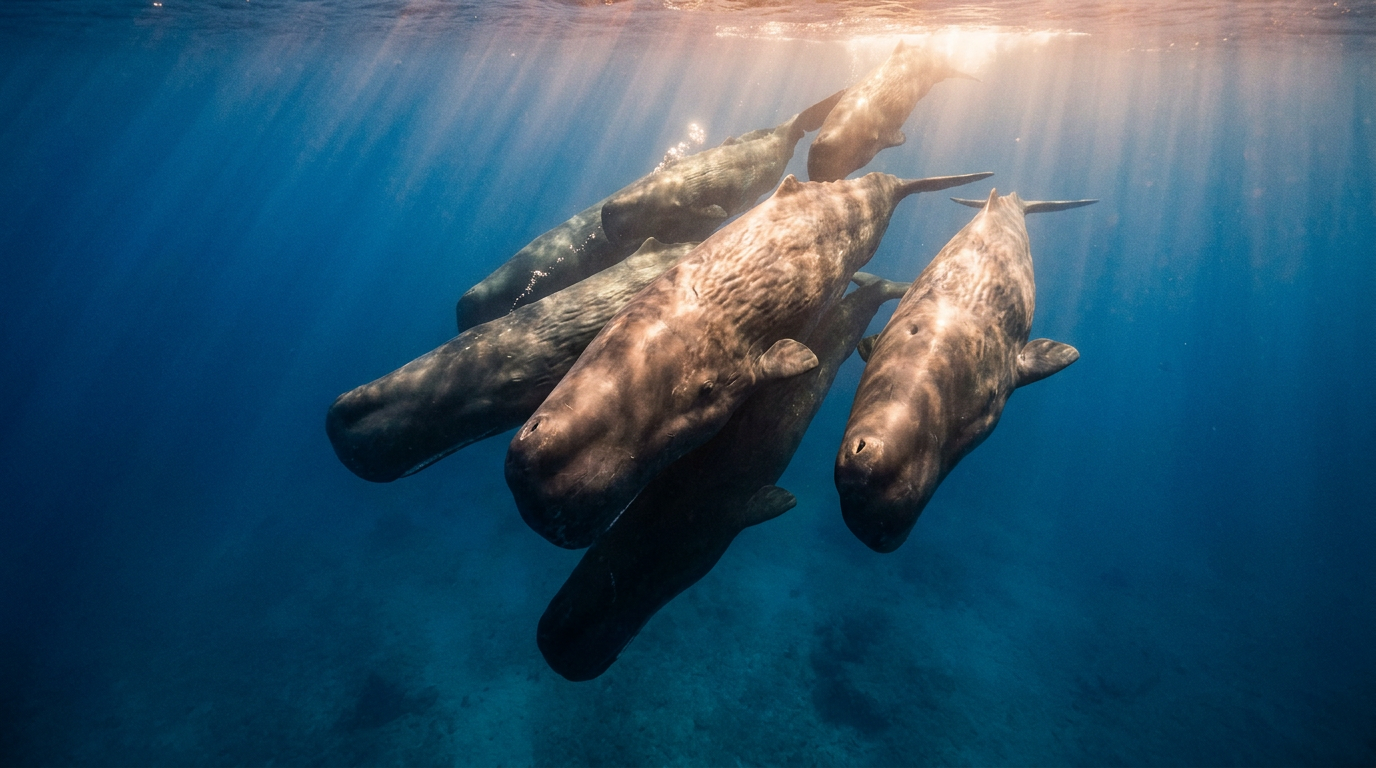
- Marine Biologists & Linguists
- Focusing on the structural complexity of the communication and its evolutionary significance.
- Conservation & Ethics Advocates
- Prioritizing the moral implications of interspecies communication and legal protections.
- Technology & AI Researchers
- Highlighting the machine learning models and data processing capabilities enabling the breakthrough.
What's not represented
- · Indigenous coastal communities
- · Commercial maritime industries
Why this matters
By proving that complex, rule-based language is not uniquely human, this breakthrough fundamentally shifts our understanding of animal intelligence. It paves the way for true interspecies communication, which could revolutionize marine conservation and redefine the legal and moral standing of animals.
Key points
- Researchers used Generative Adversarial Networks (GANs) to analyze thousands of hours of sperm whale clicks.
- The AI identified phonetic structures in the codas that closely mirror human vowels and diphthongs.
- Sperm whales actively control these sounds and exchange them in structured, dialogue-like sequences.
- The discovery challenges the assumption that complex, rule-based language is a uniquely human trait.
- Project CETI aims to decode 20 distinct vocalized expressions within the next five years.
For decades, the rhythmic clicks of sperm whales echoing through the deep ocean were thought to be a rudimentary form of Morse code. Now, an unprecedented convergence of marine biology and artificial intelligence has revealed a far more profound reality. Researchers have discovered that sperm whale communication contains a complex phonetic alphabet, complete with structures that closely mirror human vowels and diphthongs. The breakthrough, spearheaded by the Cetacean Translation Initiative (Project CETI) and researchers at UC Berkeley, marks a historic milestone in the quest to understand non-human intelligence.[1][2][3][4]
The discovery hinges on the application of Generative Adversarial Networks (GANs), a class of machine learning models adept at identifying hidden patterns within massive datasets. By feeding thousands of hours of underwater recordings into these models, researchers bypassed the limitations of human auditory processing. The AI systems, operating similarly to how they learn human languages, began to isolate distinct spectral properties within the whales' rapid-fire clicks, known as codas.[2][7][8]
What the models uncovered fundamentally alters the scientific understanding of marine linguistics. The acoustic properties of the codas feature distinct variations in length, timing, and frequency that align with human phonetic structures. Specifically, the research team identified consistent patterns resembling the human ɑ-vowel and i-vowel, alongside complex diphthongs. UC Berkeley linguistics professor Gašper Beguš noted that these sounds are produced intentionally and exchanged in what appears to be structured dialogue among the whales.[1][2][5]

The structural parallels to human language are particularly striking given the evolutionary distance between the species. Humans and sperm whales last shared a common ancestor more than 90 million years ago, suggesting that the need for complex, structured communication evolved independently in the ocean's depths. The findings were recently published in leading scientific journals, detailing how these highly social mammals utilize their vocal tracts to generate controlled, differentiated sounds.[1][6]
The structural parallels to human language are particularly striking given the evolutionary distance between the species.
To contextualize these vocalizations, Project CETI deployed an array of advanced technologies off the coast of Dominica, where a resident population of sperm whales has been studied for decades. The team utilized soft robotics, aquatic drones, and a custom computer vision software package called 'Whale Tales' to map the audio data directly to physical behaviors. This multimodal approach allows scientists to observe exactly what the whales are doing—diving, socializing, or nursing—while specific codas are exchanged.[3][7][8]
The power of this combined audio-visual tracking was recently demonstrated when the team captured a collaborative sperm whale birth. Drone footage, segmented and analyzed by the AI, revealed a highly coordinated social event where non-kin members of the pod supported the pregnant female. During these key events, the researchers documented distinct shifts in coda vocal styles, providing crucial clues about how the whales convey urgency, cooperation, and social bonding.[3][6]

While identifying the phonetic building blocks is a monumental step, true translation remains on the horizon. Project CETI has set an ambitious goal to comprehend 20 distinct vocalized expressions within the next five years. The current phase is akin to understanding the alphabet and basic phonetics of a foreign language without yet knowing the vocabulary or grammar. However, researchers are confident that as the AI models ingest more contextual data, the semantic meaning of the codas will begin to emerge.[1][7]
As the prospect of interspecies communication moves from science fiction to tangible reality, it brings profound ethical and legal implications. If sperm whales possess a language rich enough to share inner worlds and cultural knowledge across generations, the moral framework surrounding their treatment must inevitably shift. Project CETI has already partnered with legal scholars to explore how these discoveries could inform new international protections for marine life, ensuring that the technology is used to foster empathy rather than exploitation.[2][4][5]

Ultimately, the integration of artificial intelligence into marine biology is doing more than just decoding ocean acoustics; it is decentering the human experience. By proving that complex, rule-based communication is not a uniquely human trait, the research challenges long-held assumptions about intelligence and consciousness. As the models continue to learn, the ocean is transforming from a silent abyss into a vibrant, conversational world, waiting to be understood.[2][4][5][8]
How we got here
1950s
Scientists first confirm that sperm whales actively vocalize in the deep ocean.
2019
Project CETI is conceptualized to apply modern machine learning to animal communication.
2024
Researchers begin deploying advanced soft robotics and drone arrays off the coast of Dominica.
April 2026
Publication of findings revealing vowel-like spectral patterns in sperm whale codas.
Viewpoints in depth
Marine Biologists & Linguists
Focusing on the structural complexity of the communication and its evolutionary significance.
For researchers in biology and linguistics, the discovery bridges a massive gap between human and animal cognition. By proving that sperm whales utilize controlled spectral properties like vowels and diphthongs, scientists argue that complex language is a convergent evolutionary trait rather than a human anomaly. They emphasize that the next hurdle is mapping these structural phonetic units to specific, observable behaviors to build a functional dictionary of the whale's inner world.
Conservation & Ethics Advocates
Prioritizing the moral implications of interspecies communication and legal protections.
Ethicists and conservationists view the breakthrough as a powerful tool for animal rights. If whales possess a structured language capable of transmitting culture across generations, advocates argue they deserve elevated legal standing. However, they also warn of the risks: the same technology that allows humans to listen could theoretically be used to broadcast deceptive signals, making strict ethical guardrails and non-invasive research methods paramount.
Technology & AI Researchers
Highlighting the machine learning models and data processing capabilities enabling the breakthrough.
From a technological standpoint, the success of Project CETI is a testament to the power of Generative Adversarial Networks (GANs) and multimodal AI. Technologists point out that human ears and traditional acoustic software were fundamentally unequipped to parse the micro-variations in whale clicks. By treating the ocean as a massive, unstructured dataset, AI researchers are proving that foundation models can decode complex systems far beyond human text and speech.
What we don't know
- The semantic meaning of the specific vowels and diphthongs remains untranslated.
- It is unclear how regional dialects among different whale pods affect their phonetic structures.
- Scientists do not yet know if the whales' grammar allows for abstract concepts or only immediate environmental communication.
Key terms
- Coda
- A patterned series of short acoustic clicks used by sperm whales to communicate.
- Generative Adversarial Network (GAN)
- A type of machine learning model where two neural networks compete to generate and identify patterns, often used to process complex audio or visual data.
- Diphthong
- A sound formed by the combination of two vowels in a single syllable, now identified in whale communication.
- Phonology
- The system of relationships among speech sounds that constitute the fundamental components of a language.
Frequently asked
Can we talk to whales now?
Not yet. Scientists have identified the phonetic building blocks of their communication, but translating the actual meaning of these sounds will take more time and data.
Why are researchers studying sperm whales?
Sperm whales have highly complex, multi-generational social structures and rely heavily on acoustic communication in the deep ocean, making them ideal subjects for linguistic analysis.
How does AI help decode animal languages?
Machine learning models can process massive datasets of underwater recordings, identifying subtle acoustic patterns and variations that human ears cannot easily distinguish.
Sources
Source coverage
8 outlets
3 viewpoints surfaced








[1]The GuardianTechnology & AI Researchers
Analysis shows whales' coda vocalizations are 'highly complex' and remarkably similar to our own
Read on The Guardian →[2]UC BerkeleyMarine Biologists & Linguists
The way sperm whales communicate may be more similar to human language than previously thought
Read on UC Berkeley →[3]Project CETIMarine Biologists & Linguists
A Sperm Whale Is Born: Decoding Communication
Read on Project CETI →[4]BioneersConservation & Ethics Advocates
The Ethical Implications of Talking to Whales
Read on Bioneers →[5]The Explorers ClubConservation & Ethics Advocates
Decoding the Communication of Sperm Whales
Read on The Explorers Club →[6]Scientific ReportsMarine Biologists & Linguists
Shifts in Coda Vocal Styles During Key Events
Read on Scientific Reports →[7]WiredTechnology & AI Researchers
How AI is Cracking the Code of Whale Speech
Read on Wired →[8]National GeographicTechnology & AI Researchers
Inside the AI project translating the language of sperm whales
Read on National Geographic →



Every angle. Every day.
Get ai stories with full source coverage and perspective breakdowns delivered to your inbox.