
A New Tantalum Alloy Survives 2,400°C Heat, Shattering a Major Barrier in Materials Science
Researchers have engineered a boron-stabilized tantalum alloy that maintains immense structural strength at 2,400°C without sacrificing room-temperature flexibility. The breakthrough could remove critical thermal bottlenecks in hypersonic flight and nuclear fusion.

In short
- A newly engineered tantalum alloy maintains 100 MPa of tensile strength at 2,400 °C, a record for ductile metals.
- The material uses nanometer-scale oxide particles and trace boron to prevent structural deformation under extreme heat.
- Unlike many high-temperature ceramics, the alloy remains ductile at room temperature, allowing it to be easily machined.
The fundamental limit of modern engineering is rarely software or fuel; it is almost always melting points. When humanity tries to push aerospace vehicles faster through the atmosphere or contain miniature stars inside fusion reactors, the physical materials holding the machines together simply melt, warp, or shatter.
Now, a major thermal threshold has been crossed. According to a new paper published in the journal Nature, researchers have successfully engineered a metal alloy capable of bearing immense physical loads at 2,400 degrees Celsius (4,352 degrees Fahrenheit)—a temperature that turns standard aerospace metals into liquid.[1]
The material, described as a "boron-stabilized oxide-strengthened tantalum alloy," achieves a tensile strength of 100 megapascals (MPa) at 2,400 °C. Just as importantly, it remains highly ductile at room temperature, meaning it can be bent, machined, and shaped in a factory without snapping like a ceramic.[1][2]
To understand the magnitude of this claim, one must look at the current state of the art in high-temperature engineering. The workhorse materials of extreme environments are nickel-based superalloys, which line the inside of modern jet engines. But even the most advanced nickel superalloys begin to lose their structural integrity and soften around 1,100 °C to 1,300 °C.[4]
When engineers need to go hotter, they turn to refractory metals like tungsten, molybdenum, or pure tantalum. Tantalum boasts a staggering melting point of 3,017 °C. However, pure refractory metals suffer from a fatal flaw: at ultra-high temperatures, their internal grain structures slip, causing them to slowly deform under stress—a process known in metallurgy as "creep."[3][4]
Furthermore, when engineers try to harden these metals to prevent creep, they typically raise the material's ductile-to-brittle transition temperature. The result is a part that might survive a 2,000 °C blast of heat but will shatter like glass if dropped on the factory floor at room temperature.[3][5]
The Nature study outlines a dual-mechanism approach to solving this paradox. First, the researchers utilized "oxide dispersion strengthening" (ODS). By seeding the tantalum matrix with nanometer-scale oxide particles, they created microscopic roadblocks. When the metal gets hot and its atomic layers try to slide past one another, the oxide particles pin them in place, halting the creep.[1][4]
The second, more novel intervention was the addition of trace amounts of boron. In body-centered cubic metals like tantalum, grain boundaries are notorious weak points where fractures initiate. The researchers demonstrated that boron atoms migrate to these boundaries, acting as a chemical glue that stabilizes the structure even as the temperature approaches the metal's melting point.[1][5]
The resulting evidence is striking. In laboratory testing, the alloy withstood 100 MPa of tension at 2,400 °C. For context, 100 MPa is roughly equivalent to the crushing pressure at the bottom of the Mariana Trench. Maintaining that strength at a temperature hotter than the surface of some red dwarf stars is unprecedented for a ductile metal.[1][2]
The aerospace industry has been searching for exactly this kind of material. Hypersonic vehicles, which travel at more than five times the speed of sound, generate intense atmospheric friction. The leading edges and engine inlets of these craft routinely experience temperatures exceeding 2,000 °C, forcing designers to rely on brittle carbon-carbon composites or complex active cooling systems that add massive weight.
A ductile metal that can survive these conditions could fundamentally alter hypersonic design, allowing for thinner, uncooled aerodynamic surfaces and more efficient scramjet engines that do not melt themselves from the inside out.
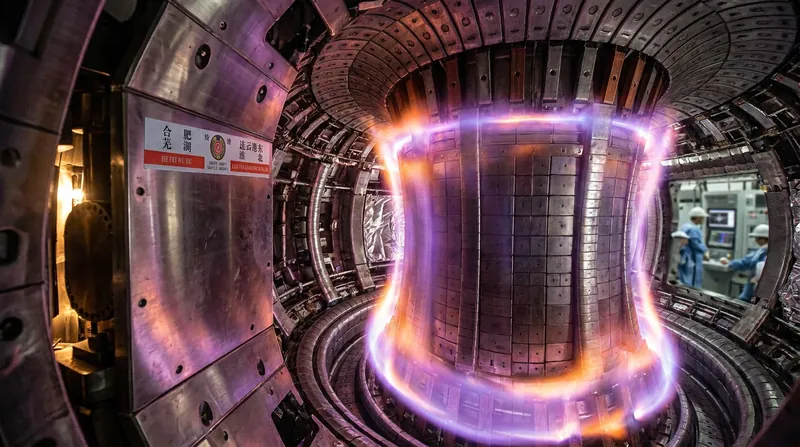
Beyond the atmosphere, the alloy presents a compelling case for nuclear fusion. Inside a tokamak reactor, magnetic fields confine a plasma that burns at millions of degrees. However, the "divertor"—the physical exhaust system at the bottom of the reactor—must withstand direct bombardment from escaping plasma particles and extreme heat loads.[6]
Currently, fusion reactors rely heavily on tungsten for these plasma-facing components. But tungsten is notoriously brittle, difficult to machine, and prone to cracking under thermal shock. A tantalum-based alternative that can be easily shaped at room temperature but survives 2,400 °C could accelerate the commercial viability of fusion power by reducing the failure rate of these critical parts.[6]
Despite the breakthrough, the evidence pack carries significant caveats regarding scalability and operating environments. The most glaring limitation is oxidation. Like most refractory metals, tantalum reacts catastrophically with oxygen at high temperatures.[3]
If this alloy is exposed to atmospheric air at 2,400 °C, it will rapidly oxidize and disintegrate. Therefore, for air-breathing hypersonic applications, the alloy will still require an advanced environmental barrier coating. Its bare, uncoated use is largely restricted to the vacuum of space or the oxygen-free environment of a fusion reactor.[2]
Cost and weight present further hurdles. Tantalum is a dense, heavy element—weighing more than twice as much as steel—and it is relatively scarce. Mass-producing aerospace components from a tantalum-heavy alloy will be prohibitively expensive for anything outside of specialized defense, space exploration, or advanced energy applications.[2][3]
Jargon, explained
- Tensile Strength
- The maximum amount of stretching or pulling stress a material can withstand before failing or breaking.
- Ductility
- A solid material's ability to deform under tensile stress without fracturing; essentially, how bendable or machinable it is.
- Creep
- The slow, progressive deformation of a solid material under mechanical stress, which accelerates dramatically at high temperatures.
- Refractory Metals
- A class of metals—including tantalum, tungsten, and molybdenum—that are extraordinarily resistant to heat and wear.
- Oxide Dispersion Strengthening (ODS)
- A metallurgical technique where tiny oxide particles are mixed into a metal to block the movement of its atomic layers, increasing high-temperature strength.
- Body-Centered Cubic (BCC)
- A specific arrangement of atoms found in certain metals, including tantalum, which influences how the metal bends and breaks.
Common questions
What makes this alloy different from existing high-temperature metals?
It maintains 100 MPa of strength at 2,400 °C while remaining ductile and bendable at room temperature, whereas most metals either melt or become as brittle as glass under those conditions.
How does the alloy achieve this extreme heat resistance?
It uses a combination of nanometer-scale oxide particles to prevent the metal's internal structure from sliding, and trace amounts of boron to glue the grain boundaries together.
Will this material be used to build commercial airplanes?
No. Tantalum is extremely heavy and expensive. Its use will be limited to highly specialized applications like hypersonic missiles, rocket nozzles, and nuclear fusion reactors.
Does the alloy have any weaknesses?
Yes. Like pure tantalum, it oxidizes rapidly if exposed to oxygen at extreme temperatures, meaning it requires a protective coating if used in the atmosphere.
Competing readings
Materials Scientists
The alloy represents a fundamental breakthrough in physical metallurgy.
For materials scientists, the true achievement is breaking the inverse relationship between high-temperature strength and low-temperature ductility. Historically, hardening a metal to survive 2,000 °C meant accepting that it would become as brittle as glass at room temperature. By proving that boron stabilization and oxide dispersion can solve this paradox in a body-centered cubic metal, researchers have opened a new playbook for alloy design.
Aerospace Engineers
The material offers a passive structural solution to the extreme thermal barriers of hypersonic flight.
Aerospace engineers view the 2,400 °C threshold as a holy grail. Vehicles traveling at Mach 5 or faster generate so much atmospheric friction that standard materials melt, forcing designers to use heavy, complex active cooling systems. A ductile metal that can simply absorb that heat without deforming allows for thinner aerodynamic surfaces, lighter vehicles, and more efficient scramjet engines.
Industrial Analysts
The alloy's commercial viability is constrained by weight, cost, and oxidation.
While the laboratory results are flawless, industrial analysts point to the harsh realities of manufacturing. Tantalum is a dense, heavy element, making the alloy too heavy for widespread aviation use. Furthermore, because tantalum oxidizes catastrophically in air at high temperatures, the alloy requires advanced protective coatings for atmospheric flight, limiting its immediate use to the vacuum of space or the controlled environments of fusion reactors.
- Materials Scientists
- Focus on the fundamental metallurgical achievement of breaking the inverse relationship between high-temperature strength and low-temperature ductility.
- Aerospace Engineers
- View the alloy as a critical enabler for hypersonic flight, offering a passive structural solution to extreme atmospheric friction.
- Nuclear Fusion Researchers
- Value the material as a durable, machinable alternative to brittle tungsten for plasma-facing components in commercial reactors.
- Industrial Analysts
- Emphasize the practical limitations of the alloy, specifically its high density, high cost, and vulnerability to oxidation in atmospheric conditions.
Perspectives this story doesn't cover
- Environmental groups concerned about the impacts of increased tantalum mining
Sources
Source coverage
6 outlets
4 viewpoints surfaced





- [1]NatureMaterials Scientists
Ductile alloys offering 100 MPa tensile strength at 2,400 °C
Read on Nature → - [2]Factlen Editorial TeamIndustrial Analysts
Synthesis by Factlen editorial team
Read on Factlen Editorial Team → - [3]NASA Technical Reports ServerAerospace Engineers
High-Temperature Properties of Tantalum-Based Refractory Alloys
Read on NASA Technical Reports Server → - [4]Materials Science and Engineering: AMaterials Scientists
Creep mechanisms and microstructural stability in oxide-dispersion-strengthened superalloys
Read on Materials Science and Engineering: A → - [5]arXivMaterials Scientists
Thermodynamic modeling of boron stabilization in body-centered cubic refractory metals
Read on arXiv → - [6]Journal of Nuclear MaterialsNuclear Fusion Researchers
Plasma-facing materials for next-generation fusion reactors: The role of ultra-high temperature alloys
Read on Journal of Nuclear Materials →
More in Science
See all →Astrochemistry
ALMA Finds Complex Organic Molecules Surviving Inside Supernova Remnant, Rewriting Star Formation Theory
3 sources

Quantum Physics
First Direct Observation of the Migdal Effect Confirms 1939 Quantum Prediction
2 sources
Primordial Black Holes
LIGO Signal From Subsolar-Mass Black Hole May Be First Direct Evidence of Primordial Black Holes
5 sources

Regenerative Medicine
Stanford Researchers Regrow Joint Cartilage by Blocking Aging Enzyme
3 sources
Comments
Every angle. Every day.
Get Science stories with full source coverage and perspective breakdowns, free every day.