
2026 Sport Climbing Injury Report: Chaehyun Seo's Miraculous Return and Jakob Schubert's Lingering Finger Rehab
South Korea's Chaehyun Seo completes a stunning return from a skull fracture, while Austrian veteran Jakob Schubert withdraws from the Innsbruck World Cup to rehab a complex finger injury.
By Meera Iyer

Share this story
The 2026 World Climbing Series has pushed the boundaries of human movement, but the pursuit of gravity-defying ascents exacts a heavy toll. As the season progresses, the medical tents have become just as vital as the isolation zones. For the sport's elite, navigating the razor-thin line between peak performance and catastrophic injury is a constant calculation. This year, the circuit has witnessed both the terrifying reality of acute trauma and the grinding frustration of chronic ligament wear.[4][5]
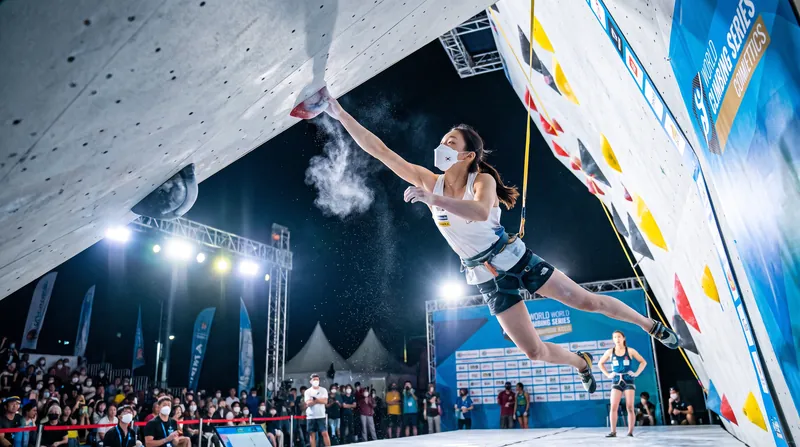
No story embodies the sheer resilience of the climbing community quite like that of South Korea's Chaehyun Seo. On March 5, the lead climbing specialist suffered a horrifying accident while training, taking a massive ground fall that resulted in a fractured skull and a severe concussion. In a sport where a minor pulley tweak can end a season, a head injury of that magnitude threatened to derail her entire career.[1]
The immediate aftermath was defined by strict rest and lingering symptoms. Seo endured severe headaches for a week, stepping away from the wall entirely to allow her brain to heal. Beyond the physical recovery, the psychological trauma of a major fall often leaves lasting scars, making the prospect of tying back into a rope a daunting mental hurdle.[1]
Yet, in a testament to her extraordinary grit, Seo did not just return to the wall—she dominated it. A mere two weeks after fracturing her skull, she entered the South Korean National Championships. Step by step, she overcame the trauma of the fall, testing her limits in a competitive environment where hesitation can cost a podium spot.[1]
The result was nothing short of miraculous. Seo captured double gold, sweeping both the Lead and Boulder disciplines against a stacked domestic field. "This double means a lot more than before," Seo shared with her supporters, expressing profound gratitude for simply being able to participate without further injury. Her focus has now shifted back to the World Series, where she remains one of the most formidable threats to the podium.[1]
While Seo's acute trauma required immediate emergency intervention, the vast majority of climbing injuries are born from chronic overuse. The modern competition style—defined by dynamic leaps, volume-heavy coordination moves, and microscopic crimps—places immense physiological stress on the hands and fingers.[4][5]
For Austrian veteran and two-time Olympic medalist Jakob Schubert, the 2026 season has been defined by a frustrating battle against his own anatomy. In January, Schubert sustained a complex ligament injury in his right index finger. Unlike a clean bone break, ligament damage in the hands is notoriously difficult to heal, often lingering as a dull ache that flares up under maximum load.[2]
Schubert spent the first half of the year attempting to climb through the pain. His sheer talent allowed him to secure his 13th national lead title at the Austrian Championships, but the effort exposed the limits of his compromised finger. "Up to a certain level, I can still climb," Schubert explained, noting that the closer he pushed to his absolute limit, the more the injury held him back.[2]
The breaking point arrived in late June, just days before the World Climbing Series event in Innsbruck. Competing in front of a home crowd is a highlight of the season for the Austrian star, but after promising training sessions gave way to repeated setbacks, Schubert made the agonizing decision to withdraw. "At the moment, I'm simply not able to climb the way I want to," he admitted. "It just doesn't feel right—not like myself."[2]
Schubert's withdrawal highlights a shift in how veteran climbers manage their bodies. Rather than risking permanent damage for a single event, he is prioritizing long-term recovery. After exhausting standard treatments like shockwave therapy and platelet-rich plasma (PRP) injections, Schubert has partnered with a German specialist to map out a new, highly specific therapeutic approach.[2]
The prevalence of upper extremity injuries is a well-documented phenomenon in sports medicine. Orthopaedic data indicates that between 42 and 71 percent of all climbing injuries affect the hands, fingers, and arms. Finger pulley ruptures and flexor tendon strains are particularly common, driven by the immense forces required to hold onto millimeter-wide edges.[4][5]
Fortunately, the circuit is also rich with successful rehabilitation stories. USA Climbing's Melina Costanza arrived at the season opener in Keqiao, China, carrying the weight of a lengthy recovery from a 2025 knee injury. Lower extremity injuries, while less common than finger tweaks, often require extensive surgical repair and months of physical therapy to rebuild explosive jumping power.[3][4]
Fortunately, the circuit is also rich with successful rehabilitation stories.
Costanza's return to the Boulder circuit was a triumph of patience. Competing in her first full slate of Boulder World Cups since 2022, she navigated the physical slabs and powerful overhangs with renewed confidence. "I'm gonna knock on wood, but they feel good right now," Costanza remarked regarding her knees, celebrating a return to full health and the joy of competing on the international stage.[3]
The governing bodies of the sport are increasingly recognizing the need to protect athletes from themselves. The International Federation of Sport Climbing (now operating as World Climbing) has empowered Medical Delegates to make final, binding decisions on whether an injured climber can safely continue to compete, ensuring that the pressure of the podium never overrides medical necessity.[6]
As the 2026 season marches toward the European Championships and the Nations Grand Finale, the injury report serves as a stark reminder of the sport's physical demands. Yet, it is also a chronicle of human endurance. Whether it is Chaehyun Seo shaking off a fractured skull or Jakob Schubert meticulously rebuilding a single finger ligament, the drive to return to the wall remains the most powerful force in the sport.
Key points
- South Korea's Chaehyun Seo returned from a March 2026 skull fracture to win double gold at the National Championships just two weeks later.
- Austrian veteran Jakob Schubert withdrew from the Innsbruck World Cup to pursue specialized treatment for a lingering index finger ligament injury.
- USA's Melina Costanza successfully returned to the World Climbing Series boulder circuit after a lengthy knee rehabilitation.
- Orthopaedic data shows that up to 71 percent of all climbing injuries affect the upper extremities, driven by the sport's dynamic movements.
How we got here
Jan 2026
Jakob Schubert sustains a complex ligament injury in his right index finger.
Mar 5, 2026
Chaehyun Seo suffers a fractured skull and severe concussion during a training fall.
Mar 22, 2026
Seo completes a miraculous return, winning double gold at the South Korean National Championships.
May 2026
Melina Costanza returns to the World Climbing Series in Keqiao after a lengthy knee rehab.
Jun 25, 2026
Schubert formally withdraws from the Innsbruck World Cup to pursue a new treatment method in Germany.
- Competing Athletes
- Focused on returning to the wall as quickly as possible while managing pain and trauma.
- Sports Medicine Specialists
- Focused on long-term joint health, proper diagnosis of microtraumas, and conservative rehabilitation.
- Governing Bodies
- Focused on implementing safety protocols and empowering medical delegates to protect athletes.
Perspectives this story doesn't cover
- Physical Therapists
- Routesetters
Sources
Source coverage
6 outlets
3 viewpoints surfaced






- [1]Gripped MagazineCompeting Athletes
Chaehyun Seo Fractures Skull, Wins National Championships Two Weeks Later
- [2]World Climbing SeriesCompeting Athletes
Schubert forced to skip home World Cup: “Not an easy decision”
- [3]World ClimbingCompeting Athletes
KEQIAO 2026: WHAT THE ATHLETES SAID
- [4]AAOSSports Medicine Specialists
Upper extremity injuries increase as rock climbing ascends
- [5]BMJ Open Sport & Exercise MedicineSports Medicine Specialists
Epidemiology of rock climbing injuries
- [6]IFSCGoverning Bodies
World Climbing Event Regulations 2026
More in Sports
See all →Standings
Veddriq Leonardo's Emotional Chamonix Victory Ignites the 2026 Men's Speed Title Race
6 sources
Standings
Rosa Rekar and Lucka Rakovec Join Janja Garnbret to Cement Slovenia's Dominance in the 2026 Women's Lead Standings
3 sources
Standings
Alberto Ginés López Commands 2026 Men's Lead Standings Following Historic Chamonix Victory
6 sources
Standings
Chaehyun Seo and Annie Sanders Headline a Historically Tight 2026 Women's Lead Title Race
5 sources
Comments
Every angle. Every day.
Get Sports stories with full source coverage and perspective breakdowns, free every day.