
2026 Rivian R2 vs. Tesla Model Y: The Ultimate Electric SUV Trade-Off Analysis
The highly anticipated Rivian R2 arrives to challenge the reigning Tesla Model Y, forcing buyers to choose between boxy off-road utility and sleek aerodynamic efficiency.
By Factlen Editorial Team
- Utility & Adventure Advocates
- Prioritize maximum space, traditional SUV aesthetics, and off-road capability.
- Efficiency & Value Pragmatists
- Focus on aerodynamic efficiency, lower starting prices, and proven on-road dynamics.
- Neutral Market Analysts
- Evaluate the vehicles purely on spec-sheet comparisons, pricing strategies, and market impact.
What's not represented
- · Traditional dealership networks facing direct-to-consumer sales models
- · Buyers requiring three-row seating configurations
Why this matters
The midsize electric SUV segment is the most critical battleground in the automotive industry today. Choosing between the Rivian R2 and the Tesla Model Y dictates not just a family's daily commuting comfort, but whether they prioritize aerodynamic efficiency or rugged, go-anywhere utility for the next decade.
Key points
- The Rivian R2 offers 19% more cargo space and a boxy, traditional SUV design.
- The Tesla Model Y maintains a significant starting price advantage at $41,630.
- Rivian's 9.6 inches of ground clearance makes it genuinely capable off-road.
- Tesla's aerodynamic shape provides superior highway efficiency and range-per-dollar.
- Both vehicles now utilize the NACS port, granting equal access to the Supercharger network.
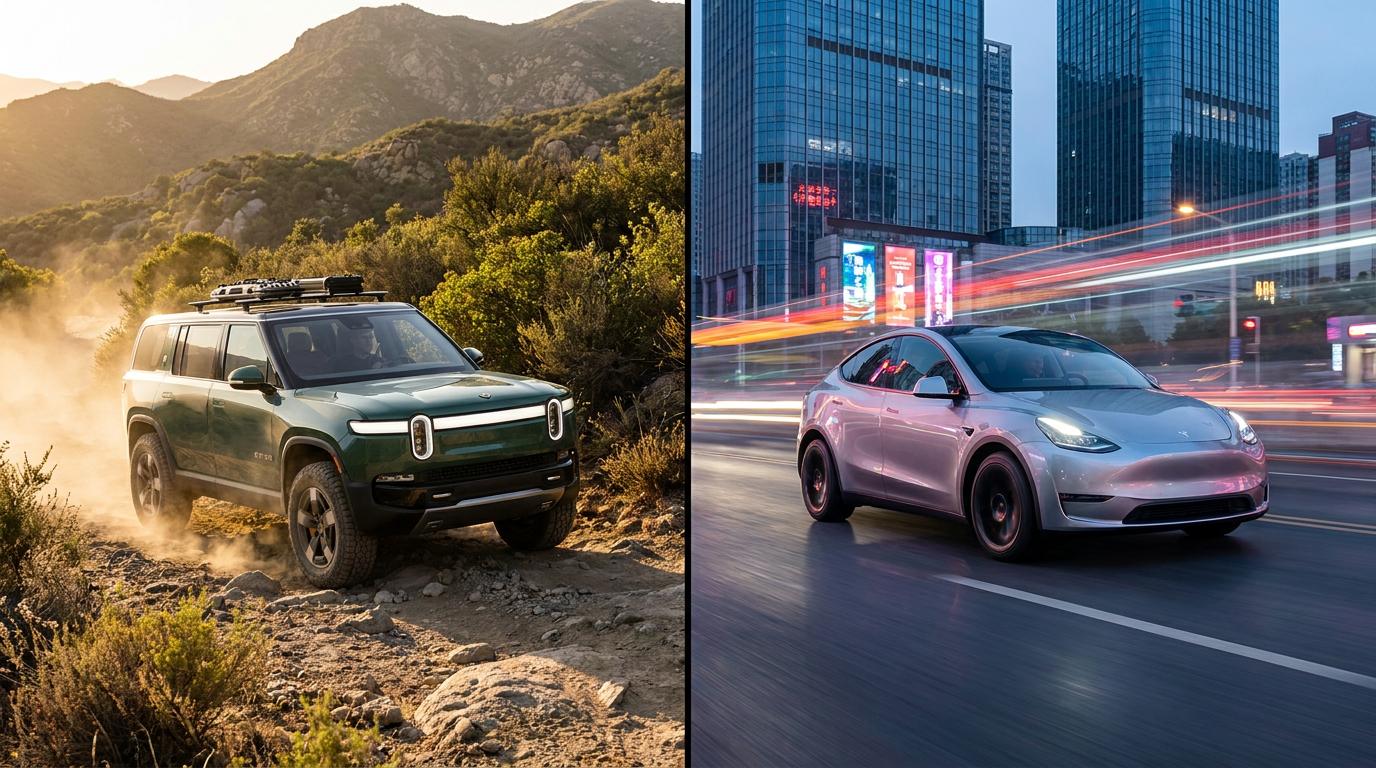
The 2026 electric vehicle market has finally delivered the heavyweight matchup consumers have been waiting for: the newly launched Rivian R2 versus the recently refreshed 2026 Tesla Model Y. For years, the Model Y has dominated the global sales charts, offering a compelling blend of range, software, and charging infrastructure. However, Rivian’s highly anticipated R2 arrives as a direct challenger, aiming to capture buyers who want a more rugged, traditional SUV form factor without sacrificing electric performance. This comparison represents a fundamental divergence in automotive design philosophy, pitting aerodynamic efficiency against boxy utility in the fiercely competitive midsize crossover segment.[1][3]
When conducting a side-by-side trade-off analysis, the primary argument for the Rivian R2 centers on its exceptional space utilization and rugged capability. The evidence is found directly in its physical dimensions and cargo capacity. Despite being slightly shorter in overall length at 185.9 inches compared to the Model Y, the R2’s taller, boxier greenhouse translates into a massive interior that reviewers have likened to the Sistine Chapel for headroom. With the seats folded flat, the R2 offers 90.1 cubic feet of total storage—including a spacious front trunk—which represents a 19 percent increase over the Model Y’s 76 cubic feet.[1][4]
Further evidence for the Rivian R2 lies in its genuine off-road hardware. While many electric crossovers are simply tall hatchbacks, the R2 is engineered for the trail. It boasts 9.6 inches of ground clearance, which is a full 60 percent more than the Model Y, alongside a 25-degree approach angle and a 26-degree departure angle. Equipped with traditional coil springs, semi-active shock dampers, and physical sway bars, the R2 maintains composure on rocky fire roads and shallow water crossings while remaining exceptionally smooth and relaxing on the highway.[1][5][6]

However, the argument against the Rivian R2 involves its higher initial cost and slightly slower peak charging speeds. The evidence shows that while Rivian promises a $45,000 base model in the future, the 2026 launch lineup is spearheaded by the Performance trim, which commands a premium price of $57,990. Additionally, the R2’s peak DC fast-charging rate is capped at 210 kilowatts. While it can still charge from 10 to 80 percent in about 30 minutes, it lags behind the 250-kilowatt peak rates of the Model Y and the even faster architectures found in some international competitors.[1][5]
Conversely, the primary argument for the 2026 Tesla Model Y is built on unmatched value, aerodynamic efficiency, and sporty on-road dynamics. The evidence is clear in its pricing structure and performance metrics. Following its 2026 styling refresh, the Model Y introduces a new entry-level base trim that starts around $41,630, significantly undercutting the Rivian R2's launch price. The Model Y’s sleek, sloped roofline prioritizes aerodynamic slipperiness, allowing the Long Range All-Wheel Drive version to squeeze out impressive real-world range figures that can approach 391 miles under ideal conditions, making it one of the most efficient vehicles on the road.[3][7]
Conversely, the primary argument for the 2026 Tesla Model Y is built on unmatched value, aerodynamic efficiency, and sporty on-road dynamics.
Additional evidence for the Model Y highlights its engaging driving experience and refined suspension. The 2026 update addressed previous criticisms of a stiff ride by lavishing attention on general rigidity, damping, and noise reduction. The result is a quieter, more forgiving cabin that still retains a low-key sporting feel. With a lower center of gravity and more direct steering than the R2, the Model Y feels sharper and more precise on twisty back roads, behaving more like a sports sedan than a traditional family hauler.[2][7]

The argument against the Tesla Model Y focuses on its extreme interior minimalism and its strict confinement to paved roads. The evidence lies in its 6.0-inch ground clearance, which makes it entirely unsuitable for anything beyond a flat gravel driveway. Furthermore, the Model Y’s cabin relies almost exclusively on a central 15.3-inch touchscreen for every function, from adjusting the mirrors to changing the wiper speed. While the 2026 refresh added richer materials and ambient lighting, the lack of physical buttons remains a frustrating learning curve for drivers who prefer tactile controls, and the exterior design has been described by some critics as possessing a placid androgyny that blends into the crowd.[1][2]
When it comes to charging infrastructure, the historical advantage held by Tesla has effectively been neutralized in this matchup. The evidence for this shift is the Rivian R2’s inclusion of a native North American Charging Standard (NACS) port right from the factory. This means Rivian owners have seamless, adapter-free access to Tesla’s expansive and highly reliable Supercharger network. Consequently, buyers no longer have to choose the Model Y simply to guarantee a stress-free road trip; both vehicles offer the same top-tier charging convenience across the country.[5]

In terms of raw acceleration, both vehicles offer staggering performance that belies their family-hauler status. The evidence shows the Rivian R2 Performance trim, with its dual-motor setup generating 656 horsepower and 609 pound-feet of torque, can sprint from zero to 60 miles per hour in just 3.6 seconds. The Tesla Model Y Performance is similarly explosive, offering upgraded suspension and a widened track to handle its immense power. Yet, despite this sports-car quickness, both manufacturers have tuned the throttle response to be progressive and smooth in standard driving modes, ensuring that the vehicles remain docile during daily school runs.[2][5]
Ultimately, choosing between these two capable electric SUVs requires honest reflection on how the vehicle will actually be used. The Rivian R2 fits well when a buyer prioritizes maximum interior cargo space, desires a commanding, upright seating position, and genuinely plans to venture off-road for weekend camping or trail driving. It is the ideal choice for those who want the rugged aesthetic of a traditional SUV paired with modern electric performance. However, the R2 does not fit when a buyer is strictly bound by a $45,000 budget today, or when their daily commute involves tight, high-speed cornering where a lower, sportier vehicle would excel.[1][4]

On the other hand, the 2026 Tesla Model Y fits well when a buyer wants the absolute best range-for-dollar value on the market, prefers a sleek, aerodynamic aesthetic, and enjoys a firmer, more car-like handling experience on paved roads. It remains the undisputed champion of frictionless daily commuting and software integration. However, the Model Y does not fit when a buyer needs to haul bulky, boxy items that conflict with the sloped rear roofline, when they regularly navigate deeply rutted dirt roads, or when they simply cannot tolerate navigating a touchscreen menu to adjust their steering wheel.[2][3]
How we got here
2020
Tesla begins deliveries of the Model Y, which quickly becomes the best-selling electric vehicle globally.
Late 2021
Rivian launches its flagship R1T pickup and R1S SUV, establishing its reputation for rugged, premium electric adventure vehicles.
March 2024
Rivian officially unveils the midsize R2 platform, promising a more accessible price point and mass-market appeal.
Late 2025
Tesla rolls out a major styling and suspension refresh for the Model Y, improving ride comfort and updating the interior.
Mid 2026
The first Rivian R2 Launch Edition models begin arriving to customers, setting up a direct market clash with the Model Y.
Viewpoints in depth
Utility & Adventure Advocates
Prioritize maximum space, traditional SUV aesthetics, and off-road capability.
This camp argues that an SUV should fundamentally be a utility vehicle. They point to the Rivian R2's boxy design, massive 90.1 cubic feet of cargo space, and 9.6 inches of ground clearance as evidence that it is a true sport utility vehicle, not just a lifted hatchback. For these buyers, the aerodynamic penalty is a worthwhile trade-off for the ability to fold the seats flat for car-camping or to confidently navigate deeply rutted fire roads without fear of battery damage.
Efficiency & Value Pragmatists
Focus on aerodynamic efficiency, lower starting prices, and proven on-road dynamics.
This perspective champions the Tesla Model Y for its relentless focus on efficiency and cost-effectiveness. They argue that since 99 percent of drivers rarely leave paved roads, the aerodynamic, teardrop shape of the Model Y is the objectively superior engineering choice, resulting in better range per kilowatt-hour. Furthermore, they highlight the Model Y's significantly lower base price of $41,630, arguing that it democratizes long-range electric driving in a way the premium-priced Rivian R2 Launch Edition currently does not.
What we don't know
- Whether Rivian can scale R2 production quickly enough to meet massive consumer demand without delays.
- How the long-term reliability of Rivian's new dual-pinion steering and suspension components will compare to Tesla's mature platform.
Key terms
- NACS (North American Charging Standard)
- The charging plug design originally developed by Tesla, which has now been adopted by most major automakers, including Rivian, to allow seamless use of the Supercharger network.
- Ground Clearance
- The distance between the lowest point of the vehicle's undercarriage and the ground, crucial for driving over rocks and uneven terrain without causing damage.
- MPGe (Miles Per Gallon Equivalent)
- A metric used by the EPA to compare the energy efficiency of electric vehicles to traditional gas-powered cars.
- Torque Vectoring
- A technology that allows the vehicle's computer to control the amount of power sent to each individual wheel, improving grip and stability on slippery or uneven surfaces.
Frequently asked
Does the Rivian R2 use the Tesla Supercharger network?
Yes. The 2026 Rivian R2 comes equipped with a native North American Charging Standard (NACS) port, allowing it to plug directly into Tesla Superchargers without needing an adapter.
Which vehicle has more cargo space?
The Rivian R2 offers significantly more cargo capacity. With the seats folded down and including the front trunk, the R2 provides 90.1 cubic feet of space, compared to the Model Y's 76 cubic feet.
Is the Tesla Model Y cheaper than the Rivian R2?
Currently, yes. The 2026 Tesla Model Y starts around $41,630 for the base trim. While Rivian plans to release a $45,000 base R2 in the future, the 2026 Launch Edition starts at $57,990.
Can the Tesla Model Y go off-road?
The Model Y is not designed for serious off-roading. It has a relatively low ground clearance of 6.0 inches and a firmer suspension tuned for on-road handling, making it suitable only for flat dirt or gravel roads.
Sources
Source coverage
7 outlets
3 viewpoints surfaced







[1]ElectrekUtility & Adventure Advocates
Rivian R2 vs Tesla Model Y spotted side-by-side: Detailed size comparison
Read on Electrek →[2]Top GearEfficiency & Value Pragmatists
Rivian R2 (US) Review 2026
Read on Top Gear →[3]Car and DriverEfficiency & Value Pragmatists
2026 Tesla Model Y Review, Pricing, and Specs
Read on Car and Driver →[4]The AutopianUtility & Adventure Advocates
The Most Detailed Review Of The Rivian R2 You Will Ever Read
Read on The Autopian →[5]EdmundsNeutral Market Analysts
2027 Rivian R2 Prices, Reviews, and Pictures
Read on Edmunds →[6]Men's JournalUtility & Adventure Advocates
The Rivian R2 Is the Best New Car I've Driven in Years
Read on Men's Journal →[7]CarwowNeutral Market Analysts
Rivian R2 vs Tesla Model Y: which electric SUV does Mat Watson prefer?
Read on Carwow →
Every angle. Every day.
Get automotive stories with full source coverage and perspective breakdowns delivered to your inbox.